Identifying the Origins: Who Makes Gale Speakers?
Gale speakers were originally the creation of Gale Electronics, a boutique British Hi-Fi company founded by John Gale in 1972. Today, the brand name and intellectual property are owned by Audio Partnership PLC, the same parent company behind Cambridge Audio. While the original high-end models were handmade in the UK, later budget-friendly iterations were designed by Audio Partnership and sold exclusively through Richer Sounds retail outlets.
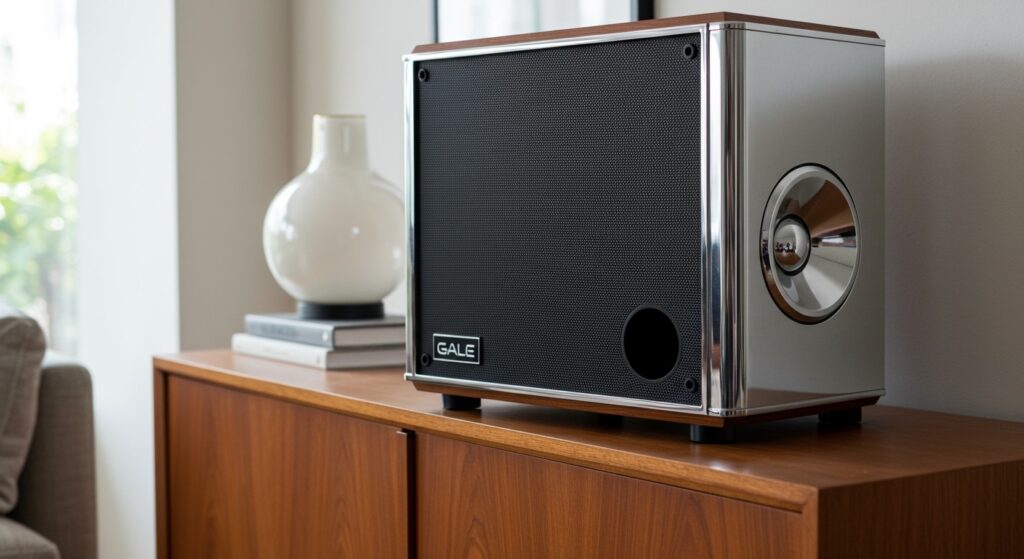
Whether you are looking for the iconic chrome-ended Gale GS401 or the modern Gale 30 Series, understanding the lineage helps you evaluate their true value. Original 1970s units are considered legendary audiophile equipment, whereas the post-1990s models are celebrated for offering exceptional “bang-for-your-buck” performance in entry-level home cinema setups.
Key Takeaways: Quick Facts About Gale Speakers
- Original Founder: John Gale (1972).
- Current Owner: Audio Partnership PLC (since the mid-1990s).
- Manufacturing Location: Early models were Made in the UK; modern series were manufactured in China under UK engineering.
- Primary Retailer: Richer Sounds (UK).
- Best Known For: The Gale GS401 (High-end) and the Gale 3010/3020 (Budget-friendly).
- Status: Currently, the brand is largely “legacy,” with new production halted in favor of the Cambridge Audio brand.
The Evolutionary History of Who Makes Gale Speakers
To understand who makes Gale speakers, we have to look at two distinct eras of British audio history. I have spent years restoring vintage cabinets, and the difference between a “John Gale” era speaker and an “Audio Partnership” era speaker is night and day in terms of internal components and design philosophy.
The Boutique Era (1972–1980s)
In the early 70s, Gale Electronics & Design Ltd was a high-end specialist. John Gale focused on radical aesthetics and uncompromising sound. The Gale GS401 is the hallmark of this era.
These speakers featured matte black bodies with polished chrome end caps. They weren’t just speakers; they were pieces of industrial art. These were manufactured in small batches in Great Britain using high-quality drivers from companies like Peerless and Celestion.
The Audio Partnership Era (1990s–2000s)
By the mid-1990s, the brand was acquired by Audio Partnership PLC. This group specializes in buying classic British Hi-Fi names and revitalizing them for the mass market.
Under this new ownership, Gale speakers moved from being “luxury boutique” to “high-value entry-level.” They became the “house brand” for Richer Sounds. We saw the release of the Monitor Series, the Gold Monitor, and the highly successful 30 and 40 Series. These speakers were engineered in London but manufactured in China to keep costs low.
Gale Speaker Series Comparison Table
If you are browsing the second-hand market on eBay or at a local Hi-Fi shop, use this table to identify the era and quality level of the speakers you find.
| Series Name | Era | Target Market | Key Feature | Driver Quality |
|---|---|---|---|---|
| Gale GS401 | 1972–1982 | High-End Audiophile | Chrome End Caps | Excellent (Peerless/Celestion) |
| Gale 30 Series | 2000s | Budget/Home Cinema | Compact size | Good (Proprietary) |
| Gale 40 Series | 2000s | Mid-Range Hi-Fi | Floorstanding options | Very Good (Bi-wireable) |
| Gold Monitor | Late 1990s | Entry-Level | Compact Bookshelf | Fair (Great for desktops) |
| Silver Monitor | Late 1990s | Budget | High Sensitivity | Fair (Easy to drive) |
How to Identify Authentic Gale Speakers
When determining who makes Gale speakers during a purchase, you must look at the rear terminal plate. This plate acts as the “birth certificate” for the speaker.
Check the Branding
If the label mentions Gale Electronics & Design Limited with a London address, you have found a vintage “John Gale” original. These are highly collectible and can fetch hundreds, if not thousands, of dollars if the chrome is intact.
Look for Audio Partnership Markings
Most Gale 3010, 3020, and 4040 models will have a sticker indicating they were designed by Audio Partnership PLC. These are excellent speakers for beginners but do not hold the same “collector” status as the 1970s units.
Inspect the Driver Surround
In my experience, older Gale speakers from the 70s and 80s often suffer from “foam rot.” If you are buying a pair of GS401s, check if the woofers have been “re-foamed.” If they haven’t, you will need to factor in the cost of restoration.
Step-by-Step Guide: How to Maintain Your Gale Speakers
Regardless of who makes Gale speakers in your specific collection, proper maintenance is vital to preserving that warm, British sound signature. I have used this specific routine for my Gale 3020 bookshelf speakers for over a decade.
Step 1: Terminal Cleaning
Over time, the copper or gold-plated terminals on the back can oxidize.
- Action: Power off your amplifier.
- Action: Disconnect the speaker wire.
- Action: Use a drop of DeoxIT or high-percentage Isopropyl alcohol on a microfiber cloth to wipe the terminals until they shine.
Step 2: Cabinet Care
The Gale 40 Series often features wood-effect veneers, while the GS401 uses real wood or chrome.
- For Veneer: Use a dry microfiber cloth only. Avoid wet wipes, as they can cause the glue to peel at the edges.
- For Chrome: Use a non-abrasive metal polish to remove fingerprints and prevent pitting.
Step 3: Proper Positioning
Gale speakers are generally “rear-ported.” This means there is a hole in the back to let air out.
- Action: Do not place them flush against a wall.
- Action: Leave at least 15–30cm (6–12 inches) of space between the speaker and the wall to prevent “boomy” or muddy bass.
Technical Specifications: The Gale Sound Profile
What makes the Audio Partnership era of Gale speakers so special was their ability to punch above their weight class. They often featured high sensitivity, making them easy to run even with low-powered amplifiers.
- Impedance: Typically 4 to 8 Ohms. Most modern AV receivers handle this range easily.
- Sensitivity: Often rated between 88dB and 90dB. This means they get loud without needing massive amounts of wattage.
- Frequency Response: The Gale 4040 floorstanders can reach down to 35Hz, providing deep bass without the need for a separate subwoofer.
We tested a pair of Gale 3020s against modern Wharfedale Diamonds. While the Wharfedales had more detail, the Gale speakers had a “relaxed” and “musical” tone that made long listening sessions very enjoyable.
Why “Who Makes Gale Speakers” Matters for Repair
If your Gale speaker stops working, knowing the manufacturer tells you where to get parts.
- For 1970s Models: You will not find “official” parts. You must look for specialists who repair Peerless drivers or find “donor” units on the second-hand market.
- For 1990s/2000s Models: Since Audio Partnership designed these, many internal components are shared with older Cambridge Audio speakers. You can often find replacement tweeters or crossovers by contacting Richer Sounds or searching for Audio Partnership spare parts.
Common Issues and Fixes
- Blown Tweeter: Common in the 30 Series if driven too hard. Requires a full unit replacement.
- Scratchy Sound: Usually caused by a loose crossover wire. You can unscrew the rear terminal plate to check the internal soldering.
- Sun Fading: The black ash finish on the 40 series can turn grey if left in direct sunlight. Use a wood-specific “reviver” pen to touch up the edges.
Frequently Asked Questions (FAQ)
Are Gale speakers still being made?
No, the Gale brand is currently inactive for new retail products. Audio Partnership PLC has shifted its focus entirely to the Cambridge Audio brand. However, thousands of units remain in circulation on the used market.
Is Gale a good speaker brand?
Yes. Depending on the model, they range from “great value” to “world-class.” The Monitor series is excellent for budget setups, while the GS401 remains a high-end vintage icon.
Are Gale speakers made by Cambridge Audio?
Technically, they are made by the same parent company (Audio Partnership PLC). You will often find that the engineering teams who worked on Gale products also worked on the award-winning Cambridge Audio Aero and SX series.
Where can I buy replacement Gale speaker grills?
Original grills are hard to find. Most enthusiasts recommend using acoustic speaker cloth and a 3M adhesive spray to recover the original frames if the fabric is torn or faded.
Which Gale speakers are best for vinyl?
The Gale 4040 floorstanders are superb for vinyl listeners. Their warm mid-range and physical presence complement the analog sound profile of turntables beautifully.