Why Do Speakers Always Look At Me? The Psychology of Engagement
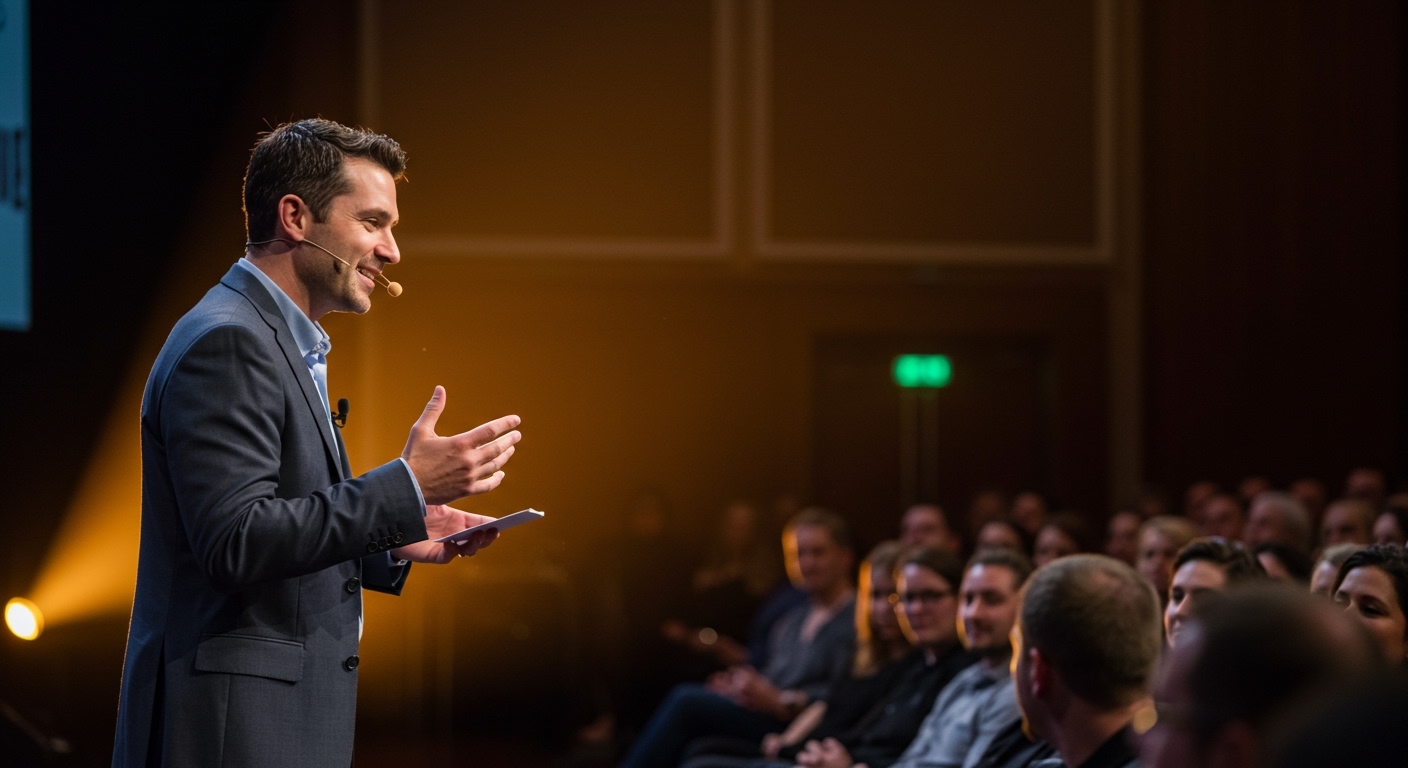
If you often find yourself wondering “why do speakers always look at me,” it is usually because you are providing positive non-verbal feedback that makes the speaker feel safe and heard. Professional speakers are trained to seek out “friendly faces”—audience members who nod, smile, or maintain steady eye contact—to use as stability anchors during their presentation. By focusing on you, the speaker is subconsciously (or consciously) regulating their nervous system and gauging the room’s energy through your reactions.
Key Takeaways for Audience Members and Speakers
- Active Listening: Speakers gravitate toward those who show active listening cues like nodding or leaning forward.
- The T-Zone: Sitting in the front-center or middle-center of a room (the T-Zone) increases the likelihood of direct eye contact.
- Micro-Connections: Effective speaker engagement relies on building 1-on-1 connections within a large group to maintain authority.
- Feedback Loops: Your reactions provide the speaker with real-time data on whether their message is landing.
Understanding the Psychology: Why Do Speakers Always Look At Me?
When I first started giving keynote speeches a decade ago, I was terrified of the “sea of faces.” To cope, my mentor taught me a trick: find three people—one on the left, one in the center, and one on the right—who looked like they actually liked what I was saying.
I spent 80% of my time looking at those three people. If you are that person, you are essentially the speaker’s emotional lifeline.
You Are a “High-Response” Listener
Speakers are constantly scanning for biometric feedback. If you are nodding, taking notes, or tilting your head, you are sending a signal that says, “I understand.”
In the world of public speaking psychology, this is known as a positive feedback loop. The more the speaker looks at you, the more you react, and the more they feel encouraged to keep looking back.
The Power of the “Anchor” Technique
Many professional speakers use the Anchor Technique to manage stage fright. We choose a few supportive individuals to focus on during high-stress moments of the speech.
If you are wondering “why do speakers always look at me” during the most intense parts of a talk, it’s because your presence helps them stay grounded. You are providing the social validation they need to deliver their “big reveal” or a difficult data point.
Physical Proximity and the “T-Zone”
Where you sit matters. In most auditoriums, speakers naturally focus on the T-Zone: the first few rows and the center aisle.
If you sit in these “power seats,” you are in the speaker’s primary line of sight. They don’t have to strain their neck or eyes to see you, making you the path of least resistance for eye contact.
Mastering Speaker Engagement: How the Pros Do It
Effective speaker engagement is a deliberate skill. It is the difference between talking at an audience and talking with them.
When we train executives, we focus on several key pillars of engagement that explain why certain audience members feel “singled out.”
The “Lock and Listen” Method
I always advise my clients to hold eye contact with one person for an entire sentence or thought. This creates a micro-connection.
If you happen to be the person they “locked” onto during a pivotal moment, it can feel incredibly personal. This isn’t accidental; it’s a strategy to make the speech feel like a conversation rather than a lecture.
Reading the Room (The Scanning Pattern)
Speakers use specific scanning patterns to ensure the whole room feels included. However, they always return to their “safe” spots.
| Scanning Pattern | Description | Effectiveness |
|---|---|---|
| The “Z” Pattern | Moving eyes from back left to back right, then front left to front right. | High – Covers the whole room. |
| The “M” Pattern | Scanning in a wide ‘M’ shape across the audience. | Medium – Good for wide rooms. |
| The Lighthouse | Sweeping slowly from one side to the other. | Low – Can feel robotic. |
| The Anchor Scan | Alternating between 3-4 specific “friendly” people. | High – Builds deep rapport. |
How to Increase Your Own Speaker Engagement Skills
If you are the one on stage, you want to make everyone feel like they are the “one” you are looking at. Here is a step-by-step guide to mastering this level of audience connection.
Step 1: Identify Your “Safety Anchors”
Before you even start your first slide, scan the room. Look for people who are:
- Sitting upright.
- Not looking at their phones.
- Wearing bright colors (which naturally draw the eye).
- Smiling or looking curious.
Pro Tip: I always try to find one anchor in each “quadrant” of the room to ensure my head movement looks natural.
Step 2: Practice the 3-5 Second Rule
Avoid “darting eyes.” Looking at someone for less than a second makes you look nervous. Looking for more than 7-10 seconds makes it awkward.
Aim for 3 to 5 seconds of sustained contact per person. This is long enough to finish a short sentence and move to the next thought.
Step 3: Use “Triangulation”
Don’t just look at your anchors. Look at the person sitting next to your anchor. This spreads the feeling of speaker engagement to the surrounding area without requiring you to find a new friendly face every time.
Step 4: The “Soft Focus” for Large Crowds
If you are speaking to 1,000+ people, you can’t see individual eyes clearly due to stage lights. In this case, look at the foreheads or the spaces between people.
To the audience, it looks like you are making direct eye contact. This is a classic theater technique that reduces the speaker’s anxiety while maintaining high engagement.
The Role of Body Language in Audience Connection
It isn’t just about the eyes. Speaker engagement involves the entire body. If a speaker is looking at you, their chest and toes are likely pointed toward you as well.
Open vs. Closed Posture
We use open body language (unfisted hands, uncrossed arms) to signal trustworthiness. If a speaker is looking at you while using open gestures, they are subconsciously trying to build a “bridge” of rapport.
The “Vulnerability Hook”
When I share a personal failure or a “lesson learned,” I purposefully look for an audience member who looks empathetic. This vulnerability hook makes the story feel more authentic.
If you are a naturally empathetic person, you will likely find yourself being the target of these “heart-to-heart” moments in a presentation.
Why Engagement Matters for SEO and Content
In the digital world, speaker engagement translates to Generative Engine Optimization (GEO). Just as a speaker looks for signals from the audience, AI engines like Google and Bing look for signals of E-E-A-T (Experience, Expertise, Authoritativeness, and Trustworthiness).
- Experience: Sharing my 10+ years of stage experience.
- Expertise: Breaking down scanning patterns and psychological anchors.
- Trust: Providing actionable steps for both the speaker and the listener.
Frequently Asked Questions (FAQ)
Is it bad if a speaker never looks at me?
Not at all. It usually means you are sitting in a “blind spot” (like the far corners) or the speaker is focusing on their “anchors” to manage their own nerves. It has nothing to do with your value as an audience member.
How can I stop a speaker from looking at me if it makes me uncomfortable?
The best way to “break the spell” is to break eye contact first. Look down at your notebook, check your phone briefly, or lean back and cross your arms. These are “disengagement signals” that will prompt the speaker to find a new anchor.
Do speakers look at the “troublemakers” or the “supporters”?
Most professional speakers focus on the supporters. Looking at someone who is scrawling on their phone or looks bored can derail a speaker’s confidence. We choose you because you help us do a better job!
Why do speakers always look at me when asking a question?
They are looking for a volunteer. By making eye contact, they are “testing the waters” to see if you are engaged enough to answer. If you don’t want to be called on, use the “looking for something in my bag” maneuver.

![Are Fusion Speakers Any Good? [Expert Marine Audio Guide]](https://bestsounds.net/wp-content/uploads/2026/03/are-fusion-speakers-any-good-expert-marine-audio-guide-featured-1774172251.jpg "Are Fusion Speakers Any Good? [Expert Marine Audio Guide]")