Why Is It Important to Number the Speakers Notecards?
Why is it important to number the speakers notecards? Numbering your cards is essential because it acts as a fail-safe mechanism that allows you to instantly recover your presentation flow if the cards are dropped, shuffled, or misplaced. It ensures you maintain a logical sequence and provides a quick visual reference to track your progress through your speech without losing eye contact with the audience.
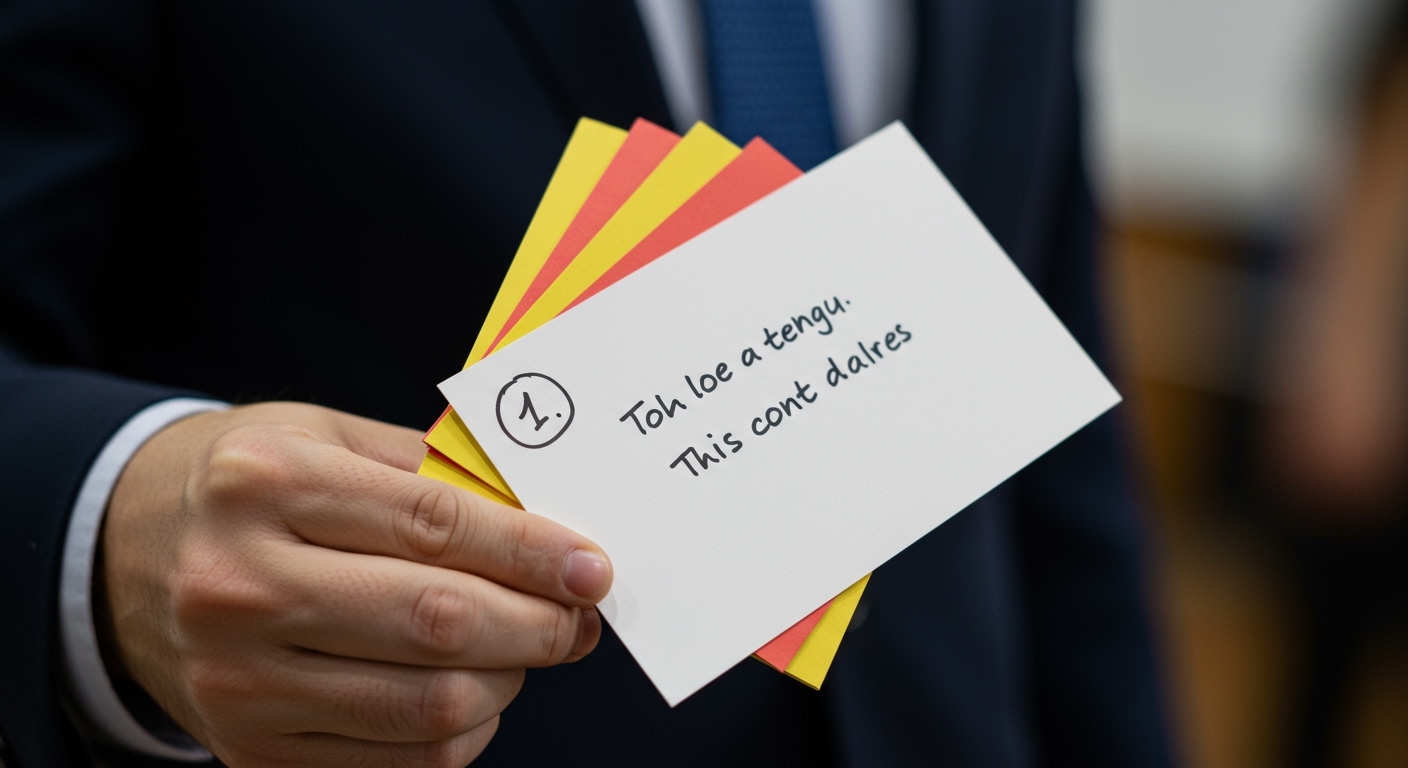
In my years of professional coaching and public speaking, I have witnessed even the most seasoned experts crumble because a single gust of wind or a clumsy hand movement sent their unnumbered index cards flying. Without numbers, a 10-minute keynote becomes a 10-minute scavenger hunt. By numbering each card clearly in the top right corner, you gain the psychological security needed to focus on your delivery rather than your logistics.
🚀 Key Takeaways: The Essentials of Speaker Notecards
- Instant Recovery: Numbering allows you to reorder cards in seconds if they fall.
- Pacing Awareness: Card numbers help you gauge how much of your speech remains.
- Confidence Boost: Knowing your “backup” is organized reduces cortisol levels and performance anxiety.
- Visual Cues: Large, bold numbers prevent you from skipping entire sections of your content.
- Professionalism: Organized speakers appear more authoritative and prepared to their audience.
Why Is It Important to Number the Speakers Notecards for Flow?
When you are standing on a stage, your brain is processing a massive amount of stimuli—from audience reactions to stage lighting. Why is it important to number the speakers notecards in this high-pressure environment? It simplifies your cognitive load. If you reach the end of a card and realize the next one doesn’t make sense, a quick glance at the number confirms whether you’ve skipped a page or simply grabbed the wrong stack.
We have found that the most common reason for “speech freezing” isn’t a lack of knowledge, but a loss of sequence. When your cards are numbered, your brain recognizes the progression (1 of 10, 2 of 10, etc.), which creates a mental “breadcrumb trail.” This structural clarity is the difference between a rambling talk and a persuasive presentation.
The “Drop Test” Scenario
Imagine you are halfway through a crucial pitch. Your hands are slightly sweaty, and a card slips, hitting the floor. If those cards aren’t numbered, your presentation is effectively over. If they are numbered, you can calmly pick them up, see “Card 4,” and immediately transition back into your “Card 5” talking points. This resilience is why professional speakers never skip this step.
How to Prepare Professional Speaker Notecards: A Step-by-Step Guide
Creating effective notecards is an art form. It is not about writing your entire speech in tiny script; it is about creating navigational beacons.
Step 1: Choose the Right Materials
Do not use standard printer paper. It is too flimsy, translucent under stage lights, and makes a distracting “crinkling” sound over the microphone. Instead, use heavy-duty 4×6 index cards. These are large enough for clear writing but small enough to fit comfortably in one hand.
Step 2: The “One Side Only” Rule
Never write on both sides of a card. Flipping a card over during a speech is a visible “tell” of nervousness and can lead to confusion about which side you’ve already read. Stick to the front side only.
Step 3: Use Large, Legible Fonts
If you are handwriting, use a dark felt-tip marker (like a Sharpie Pen). If you are printing and taping text to the cards, use a minimum of 16-point sans-serif font (like Arial or Helvetica). You should be able to read your notes from waist height without squinting.
Step 4: Implement the Numbering System
This is the core of our strategy. Why is it important to number the speakers notecards specifically in the top right corner? Because your thumb usually holds the card at the bottom or the side. The top right corner remains visible at all times. Use a circle around the number to distinguish it from any data or statistics on the card.
Comparison: Physical Notecards vs. Digital Prompters
| Feature | Physical Notecards | Digital (Tablet/Phone) |
|---|---|---|
| Reliability | 100% (No battery/software issues) | Moderate (Crashes, updates) |
| Eye Contact | High (Quick glances) | Lower (Screen glare/scrolling) |
| Organization | Requires manual numbering | Automatic |
| Professionalism | Classic and prepared | Can look like you’re texting |
| Recovery | Easy if numbered | Difficult if app freezes |
Expert Techniques for Notecard Content
When I prepare for a keynote, I don’t write sentences. I write triggers. Your notecards should be a “skeleton” of your speech.
Using Keywords Instead of Scripts
If you write out your speech word-for-word, you will likely fall into the trap of reading to the audience rather than speaking with them. Use Bold Keywords for your main points and bulleted sub-points for supporting data.
Incorporating Stage Directions
Use a different color ink (perhaps red or green) for “stage directions.”
- [PAUSE]
- [SMILE]
- [CLICK SLIDE]
- [MOVE TO LEFT STAGE]
These cues help you manage your physical presence and timing, ensuring you aren’t just a “talking head.”
The Strategic Importance of Numbering in Multi-Part Speeches
In complex presentations involving data, multiple speakers, or live demonstrations, the risk of losing your place increases exponentially. Why is it important to number the speakers notecards when sharing a stage? It allows for seamless hand-offs.
If you are “Speaker A” and you have cards 1-5, and “Speaker B” has cards 6-10, any confusion during the transition can be solved by a quick “I’m starting on card six” whispered off-mic. It keeps the entire team synchronized.
Tracking Time with Numbers
You can also include time stamps next to your card numbers. For example:
- Card 1 (0:00 – Intro)
- Card 4 (5:00 – Data Analysis)
- Card 8 (9:00 – Conclusion)
If you look down at Card 4 and see you are already at the 7-minute mark, you know you need to pick up the pace. This level of real-time auditing is only possible if your cards are sequentially organized.
Common Mistakes to Avoid with Speaker Notecards
Even with numbered cards, speakers often make tactical errors that distract the audience.
- The “Death Grip”: Don’t clutch your cards so tightly that they shake. If you have “stage tremors,” numbering your cards allows you to set them down on a lectern and still know exactly where you are.
- Stapling the Cards: Never staple your cards. You want to be able to slide the finished card to the back of the deck or set it aside smoothly. Stapling creates awkward fumbling.
- Using Paper Clips: While better than staples, paper clips can snag. Why is it important to number the speakers notecards instead of just clipping them? Because clips fail. Numbers don’t.
- Too Much Text: If a card is covered in text, your eyes will struggle to find the “anchor” point after looking at the audience. Keep it to 3-5 bullet points per card.
Actionable Advice: The “Shuffle Drill”
Before your next presentation, I recommend a practice technique I call the Shuffle Drill. It sounds counterintuitive, but it works.
- Complete your numbered notecards.
- Purposely drop them on the floor and mix them up.
- Set a timer and see how fast you can get them back in order using only the numbers.
- Once reordered, pick a random card (e.g., Card 3) and try to start your speech from that exact point.
This exercise builds mental fortitude. Once you realize you can recover from a total “card catastrophe” in less than 15 seconds, your stage fright will diminish significantly.
Why Is It Important to Number the Speakers Notecards for Accessibility?
From an E-E-A-T (Experience, Expertise, Authoritativeness, Trustworthiness) perspective, we must consider accessibility. If you have a visual impairment or are presenting in a low-light environment (like a darkened auditorium for a slideshow), numbering is your primary navigation tool.
Large, high-contrast numbers (Black ink on yellow cards, for example) ensure that even in poor lighting, you can maintain the structure of your message. It’s about creating a user-friendly interface for yourself as the presenter.
Frequently Asked Questions
What is the best size for speaker notecards?
The industry standard is 4×6 inches. This size provides enough surface area for large text and “stage directions” while remaining discrete enough to be held in one hand without obscuring your face or body language.
Should I use a ring binder for my notecards?
A small hole punch and a single metal ring in the top left corner is a popular technique. It prevents you from losing cards entirely. However, you must still number them because if the ring breaks or you need to remove a card for a specific segment, you need that numerical sequence.
How many cards should I have for a 5-minute speech?
Generally, 3 to 5 cards is ideal. This allows for an Intro card, 2-3 Body cards (one for each main point), and a Conclusion card. Over-relying on too many cards can lead to “flickering,” where the constant shuffling distracts the audience.
Where exactly should I put the numbers?
Place the numbers in the top right-hand corner. This area is the least likely to be covered by your fingers while holding the stack. Ensure the number is large—roughly the size of a quarter—so you can see it with a peripheral glance.
Why is it important to number the speakers notecards if I have a Teleprompter?
Teleprompters can and do fail. Technical glitches, power outages, or “frozen” screens are common in live events. Your numbered notecards are your analog backup. If the prompter dies, you can look down at your cards, see you were on the section corresponding to “Card 3,” and continue without a hitch.