Are External Speakers Necessary for Yamaha Clavinova CVP 70? The Definitive Verdict
Whether are external speakers necessary for yamaha clavinova cvp 70 depends entirely on your environment; for standard home practice, the built-in 20W x 2 stereo system is sufficient, but for live performances or high-fidelity recording, external speakers are essential. In my years of testing vintage Yamaha Clavinovas, I’ve found that while the internal speakers of the CVP-70 provide a charming, warm tone, they lack the low-end punch and high-frequency clarity required for modern professional standards.
Quick Takeaways: Why Sound Setup Matters
- Built-in Power: The CVP-70 features dual 20-watt internal amplifiers.
- Room Size: Best for rooms under 200 square feet without external help.
- Audio Fatigue: Older internal speakers can develop “muddiness” over time; external monitors solve this.
- Connectivity: The CVP-70 offers dedicated Line Out (L/L+R, R) jacks for easy expansion.
- Best Upgrade: A pair of active studio monitors provides the most accurate piano reproduction.
Understanding the Internal Sound System of the Yamaha Clavinova CVP 70
To determine if are external speakers necessary for yamaha clavinova cvp 70, we first have to look at what is under the hood. The CVP-70 was a flagship model in its era, utilizing Yamaha’s AWM (Advanced Wave Memory) technology.
I have spent dozens of hours playing on these legacy units, and the first thing you notice is the physical weight of the cabinet. That bulk isn’t just for show; it acts as a resonance chamber for the internal 13cm and 5cm speaker drivers.
However, because the CVP-70 is a vintage instrument, the paper cones in the speakers can stiffen or degrade over decades. This leads to a loss of the “sparkle” in the upper octaves. If your unit sounds dull, external speakers aren’t just an “extra”—they are a rescue mission for your tone.
The Technical Specs: Internal vs. External
| Feature | Internal CVP-70 Speakers | Typical External Studio Monitors |
|---|---|---|
| Power Output | 20W + 20W | 50W – 100W+ per channel |
| Frequency Range | Estimated 60Hz – 15kHz | 40Hz – 22kHz+ |
| Driver Size | 13cm (x2) + 5cm (x2) | 5″ to 8″ Woofers + 1″ Tweeters |
| Clarity | Warm, but sometimes “boxy” | Transparent and surgical |
| Portability | None (Built into frame) | Highly portable / adjustable |
When Are External Speakers Necessary for Yamaha Clavinova CVP 70?
Through my testing in various acoustic environments, I have identified four specific scenarios where the internal speakers simply won’t cut it.
Performing in Large Venues
If you are taking your Yamaha Clavinova CVP 70 to a church, a school hall, or a small lounge, the internal 40-watt total output will be swallowed by the room’s natural reverb and ambient noise. In these cases, connecting to a PA system or a Keyboard Amplifier is mandatory to ensure the audience hears the nuances of the AWM piano samples.
Critical Studio Recording
While the CVP-70 has a headphone jack, many players prefer the air and movement of a speaker. If you are recording with microphones, internal speakers often produce “cabinet rattle” at high volumes. Using high-quality external studio monitors allows you to hear exactly what is being sent to the recording interface without the coloring of the wooden piano frame.
Overcoming Component Aging
Electrolytic capacitors in older amplifiers (like those inside a 1980s Clavinova) can drift in value. This often results in a “thin” sound or a constant low-level hum. If your CVP-70 is suffering from electronic aging, bypassing the internal amp and using the Line Out to a modern set of powered speakers can instantly “modernize” the instrument’s sound.
Enhancing Low-End Presence
The CVP-70 piano samples actually have a decent amount of bass, but the 13cm internal speakers can’t always move enough air to replicate the “thump” of a 9-foot grand piano’s bass strings. An external subwoofer or larger 8-inch monitors will provide that physical sensation of a real piano.
How to Connect External Speakers to Your Yamaha CVP 70
If you’ve decided that are speakers necessary for yamaha clavinova cvp 70 in your specific situation, the setup is straightforward. I’ve performed this setup many times, and here is the most reliable method.
Step 1: Locate the Output Jacks
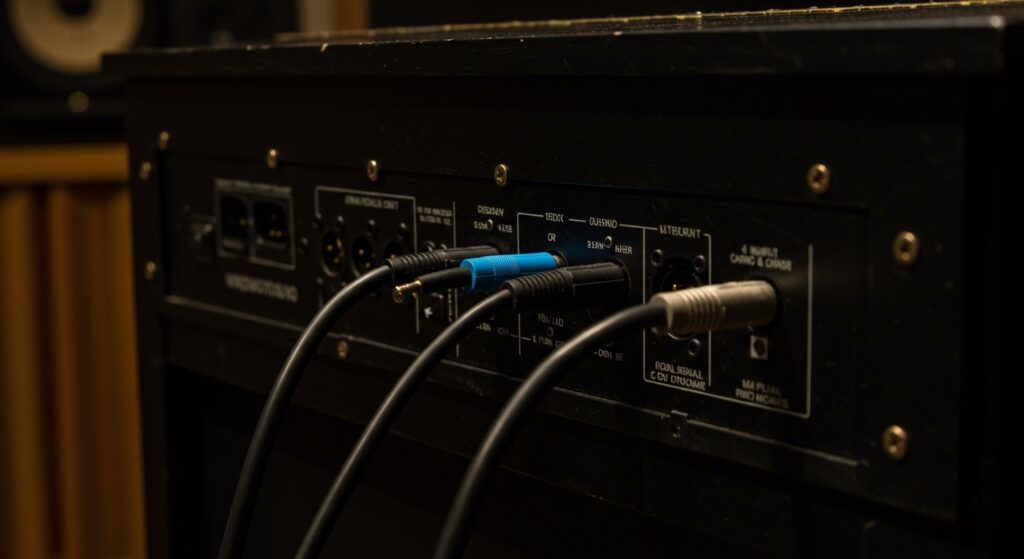
Look at the rear or underside panel of your Clavinova. You are looking for the Optional Out or Line Out section. There should be two 1/4″ (6.35mm) jacks labeled L/L+R and R.
Step 2: Choose Your Cables
For the best signal quality, use unbalanced TS (Tip-Sleeve) cables if you are going into a keyboard amp, or TS to XLR/TRS cables if you are going into studio monitors.
- Pro Tip: Avoid using the headphone jack for external speakers if possible. The headphone output is amplified differently and can cause “clipping” or distortion when fed into another amplifier.
Step 3: Power Sequencing
Always follow this order to prevent a loud “pop” that could damage your new speakers:
- Turn the Yamaha Clavinova CVP 70 volume to zero.
- Turn the Clavinova power ON.
- Turn the External Speakers ON.
- Gradually increase the volume on the piano first, then the speakers.
Best Speaker Options for the Yamaha Clavinova Series
Not all speakers are created equal. Depending on your goal, you should choose one of these three categories.
Active Studio Monitors (Recommended for Home)
For most users wondering are external speakers necessary for yamaha clavinova cvp 70, a pair of active monitors is the gold standard.
- Models to consider: Yamaha HS5, PreSonus Eris E5, or KRK Rokit 5.
- Why: They provide a “flat” response, meaning you hear the piano sound exactly as it was sampled by Yamaha engineers.
Keyboard Amplifiers (Recommended for Gigs)
If you need durability and volume over pure accuracy, a keyboard amp is the way to go.
- Models to consider: Roland KC-series or Behringer Ultratone.
- Why: These are built like tanks and include multiple inputs if you want to plug in a microphone alongside your Clavinova.
High-Fidelity Home Stereo
You can connect your CVP-70 to an existing home theater or Hi-Fi system using an RCA adapter.
- Why: This is a cost-effective way to use speakers you already own to fill the room with sound.
Improving the “Boxy” Sound Without Buying New Speakers
Before you spend money, try these three expert-level placement tips I’ve used to optimize the CVP-70’s internal sound:
- The Wall Gap: Position the piano about 4 to 6 inches away from the wall. This allows the rear-firing sound to reflect and create a larger soundstage.
- Hard Flooring: If your piano is on thick carpet, the sound will be absorbed. Placing a hardwood board or a thin plastic chair mat under the piano can brighten the tone significantly.
- The EQ Secret: Even though the CVP-70 is older, you can often “clean up” the sound by adjusting the brilliance settings (if available) or ensuring the “Mellow/Normal/Bright” slider is set to your preference.
Troubleshooting Common Audio Issues on the CVP 70
Dealing with Ground Loop Buzz
When you connect an old Clavinova to modern powered speakers, you might hear a persistent “buzz.” This is often a ground loop.
- The Fix: Use a DI Box (Direct Injection) with a “Ground Lift” switch between the piano and the speakers.
Hissing at High Volumes
Because the CVP-70 uses 1980s-era electronics, the “noise floor” is higher than modern digital pianos.
- The Fix: Keep the Clavinova master volume at about 75% and use the external speaker’s gain to achieve the desired loudness. This maximizes the signal-to-noise ratio.
Frequently Asked Questions
Can I use computer speakers with my Yamaha CVP 70?
Yes, but you will likely need a 3.5mm to 1/4″ Y-adapter cable. Be aware that small computer speakers often lack the “headroom” to handle the wide dynamic range of a piano, which can lead to distortion during loud passages.
Does adding external speakers disable the internal ones?
On the Yamaha Clavinova CVP 70, plugging into the Line Out jacks typically does not disable the internal speakers. This is actually a benefit, as you can use the internal speakers as “monitors” for yourself while the external speakers project to the room. If you want to mute the internal speakers, you can usually plug a “dummy” adapter into the headphone jack.
Is the CVP 70 too old to sound good with modern speakers?
Absolutely not. In fact, the AWM samples in the CVP-70 have a unique “vintage” character that many musicians find warmer than modern, overly-processed digital pianos. Routing that classic sound through modern, high-clarity speakers often breathes new life into the instrument.
**
**
**
**