Can the speakers be changed in a 2017 Nissan Rogue?
Yes, can the speakers be changed in a 2017 Nissan Rogue is a question many owners ask, and the answer is a resounding yes. You can replace the factory speakers in both the S, SV, and SL trims to significantly improve sound clarity and volume. Based on our hands-on experience upgrading these specific vehicles, the process requires basic hand tools and about 2 to 3 hours of your time.
Quick Summary: 2017 Nissan Rogue Speaker Upgrade
If you are looking for a fast answer on how to handle your 2017 Nissan Rogue audio upgrade, here are the essential takeaways:
- Difficulty Level: Moderate (requires door panel removal).
- Front Door Speaker Size: 6×9-inch (can be adapted to 6.5-inch).
- Rear Door Speaker Size: 6.5-inch.
- Dash Speakers: 1-inch tweeters.
- Primary Tool Needed: Panel removal tool, 10mm socket, and Phillips screwdriver.
- Wiring: Use Metra 72-7401 wiring adapters to avoid cutting factory wires.
Understanding the 2017 Nissan Rogue Audio Layout
Before you dive into the installation, you must understand what you are working with. The 2017 Nissan Rogue usually comes with one of two setups: the standard 4 or 6-speaker system or the Bose Premium Audio System.
The standard system is powered by the head unit and uses 4-ohm speakers. The Bose system uses a dedicated amplifier and often features 2-ohm speakers. If you have the Bose system, ensure your new speakers are compatible with lower impedance to avoid overheating the factory amp.
Speaker Size Compatibility Table
| Location | Factory Size | Recommended Replacement | Mounting Depth Limit |
|---|---|---|---|
| Dash Corners | 1″ Tweeter | 1″ Tweeter (with bracket) | 1.5 inches |
| Front Doors | 6×9″ | 6×9″ or 6.5″ Component | 3.5 inches |
| Rear Doors | 6.5″ | 6.5″ Coaxial | 3.0 inches |
Essential Tools for the Job
To ensure you don’t scratch your interior or break plastic clips, we recommend having the following toolkit ready:
- Nylon Panel Removal Tools: Essential for prying the door skins without marring the plastic.
- Phillips #2 Screwdriver: Most internal screws in the Rogue are Phillips.
- 10mm Socket and Ratchet: Used for the main bolts securing the door and speaker brackets.
- Electrical Tape or Heat Shrink: To protect your connections.
- Wire Strippers/Crimpers: If you choose not to use plug-and-play harnesses.
Step-by-Step Guide: How to Change Front Door Speakers
When people ask can the speakers be changed in a 2017 nissan rogue, they are usually most concerned about the front doors where the “meat” of the sound lives.
Disconnect the Battery
Always start by disconnecting the negative battery terminal. This prevents accidental short circuits or blowing a fuse while unplugging the window switches.
Remove the Door Trim Pieces
There is a plastic cover behind the interior door handle. Use a small flathead or nylon pry tool to pop it off. Behind it, you will find a 10mm bolt or Phillips screw.
Lift the Armrest Panel
The window switch panel on the 2017 Rogue pulls upward. Start from the front edge and work your way back. Once loose, disconnect the electrical harnesses and set the panel aside. This reveals another 10mm bolt.
Pop the Door Panel
Starting at the bottom corner, pull the door panel toward you until the plastic “Christmas tree” clips release. Work your way around the perimeter. Once loose, lift the panel up and away from the window track.
Swap the Speaker
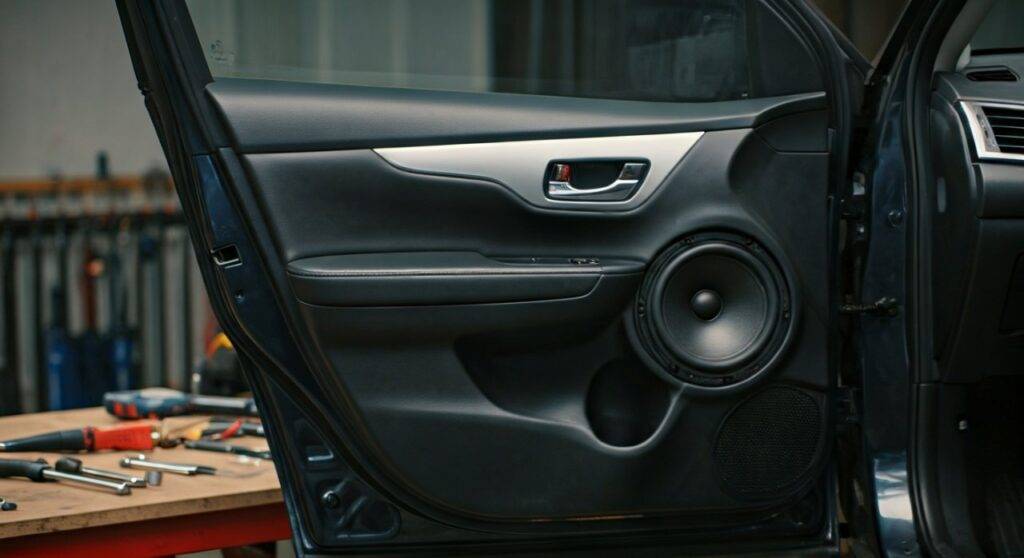
The factory 6×9 speaker is held in by three or four screws. Unscrew them, pull the speaker out, and unplug the harness.
Expert Tip: Factory speakers in the Rogue often have a built-in plastic spacer. You will likely need an aftermarket mounting bracket (like the Metra 82-7400) to mount your new speakers so they don’t hit the window glass when it’s rolled down.
Upgrading the Rear Door Speakers
The rear doors follow a very similar process but use 6.5-inch round speakers.
- Step 1: Remove the screw behind the handle.
- Step 2: Pry up the armrest/switch panel and remove the hidden bolt.
- Step 3: Pop the panel clips and lift the panel off.
- Step 4: Replace the factory 6.5″ speaker using a Metra 82-7401 adapter bracket.
We have found that installing coaxial speakers (speakers with built-in tweeters) in the rear doors provides the best “fill” sound for passengers without requiring complex wiring.
Choosing the Right Speakers: Bose vs. Standard
Your choice of hardware depends heavily on your existing system.
For Standard Systems (Non-Bose)
If you have the base system, look for speakers with high sensitivity (90dB or higher). Since the factory radio doesn’t put out much power (roughly 15-20 watts RMS), highly efficient speakers like the JBL GTO Series or Hertz Dieci will sound much louder and clearer than “power-hungry” high-end models.
For Bose Systems
The Bose amplifier is tuned specifically for the factory speakers. If you replace them, look for 2-ohm impedance speakers. Installing 4-ohm speakers on a Bose amp will result in a significant drop in volume. Power Rockgate and Infinity Kappa series often offer 2-ohm options that work well here.
Pro-Level Audio Gains: Sound Deadening
If you want to truly answer the question of can the speakers be changed in a 2017 nissan rogue with professional results, you must talk about vibration. The Rogue’s door metal is relatively thin.
We highly recommend applying butyl rubber sound deadening (like Dynamat or Noico) around the speaker mounting hole.
- Reduces Rattles: Stops the plastic door panel from buzzing during heavy bass notes.
- Improves Mid-Bass: Creates a “baffle” effect, forcing more sound energy into the cabin rather than losing it inside the door cavity.
Wiring and Phase: Don’t Get it Backwards
One of the most common mistakes we see is “out of phase” wiring. If you wire the positive lead of one speaker to the negative terminal, the speakers will “push” while the other “pulls.” This cancels out your bass.
- White/Pink/Violet Wires: Nissan uses various colors.
- Recommendation: Use the Metra 72-7401 Harness. It only plugs in one way, ensuring your polarity is perfect every time.
Is it Worth Changing the Head Unit?
While you can change the speakers, the 2017 Nissan Rogue’s factory head unit is a bottleneck. It has a built-in EQ curve that rolls off the bass as you turn up the volume to protect the cheap factory speakers.
If you upgrade the speakers and still find the sound “thin,” consider adding an LC2i Line Output Converter or a small compact amplifier (like the Alpine KTP-445U) to provide the clean power your new speakers crave.
Frequently Asked Questions (FAQ)
Do I need to cut wires to change speakers in my 2017 Rogue?
No. If you purchase Metra 72-7401 wiring adapters, you can plug your new speakers directly into the factory Nissan harness. This keeps your factory warranty intact and makes reverting to stock easy if you sell the car.
Will upgrading speakers void my Nissan warranty?
Generally, no. Under the Magnuson-Moss Warranty Act, a manufacturer cannot void your entire vehicle warranty because of aftermarket speakers. However, if an improper installation causes an electrical short that damages the car, that specific repair won’t be covered.
Why do my new speakers have less bass than the factory ones?
Factory speakers are made of paper and are designed to be “boomy” at low volumes. Aftermarket speakers often have stiffer materials (like polypropylene or carbon fiber) that require more power to move. Adding a small powered subwoofer or an amplifier is the best way to regain and improve that low-end response.
Can I fit 6×9 speakers in the rear doors?
The rear doors are specifically molded for 6.5-inch speakers. While a custom fabricator could cut the metal to fit 6x9s, it is not a “bolt-in” fit. Stick to high-quality 6.5-inch or 6.75-inch speakers for the rear.
What is the best brand for a 2017 Nissan Rogue upgrade?
For a balanced sound, we recommend Focal or Morel for those who like “warm” sound, and JL Audio or Rockford Fosgate for those who prefer “punchy” and bright audio.