Are B&C Speakers Good? The Definitive Guide to Italian Pro Audio
Are B&C Speakers good? Yes, B&C Speakers are widely considered the gold standard in professional audio, serving as the primary OEM (Original Equipment Manufacturer) for world-class brands like d&b audiotechnik, L-Acoustics, and Meyer Sound. Their drivers are prized for exceptional power handling, high sensitivity, and rugged reliability in demanding touring environments.
If you are looking for transducers that can withstand thousands of hours at peak volume while maintaining tonal accuracy, B&C Speakers are among the best investments you can make. Based on our extensive field testing in large-scale sound reinforcement, these Italian-made components consistently outperform consumer-grade alternatives in thermal management and linear excursion.
TL;DR: Key Takeaways
- Industry Standard: Found in almost every top-tier line array and stage monitor system worldwide.
- Superior Materials: Extensive use of Neodymium magnets and high-temperature copper-clad aluminum voice coils.
- Durability: Features like waterproof cone treatments and advanced cooling circuits.
- Value: High initial cost, but long-term savings due to low failure rates and high resale value.
The Engineering Excellence of B&C Speakers
When we discuss whether B&C Speakers are good, we must look at the “B&C sound signature.” Unlike consumer hi-fi speakers, these are designed for “raw” performance. They provide a neutral, high-output foundation that allows sound engineers to shape the audio to their specific needs.
Precision Manufacturing in Italy
Every B&C driver is engineered and manufactured in Bagno a Ripoli, Italy. We have found that this centralized production leads to much tighter quality control compared to brands that outsource to various global factories.
The consistency from one batch to the next is remarkable. If you buy a B&C DE250 compression driver today, it will measure almost identically to one purchased five years ago. This is crucial for maintaining the “voicing” of a professional speaker cabinet.
Advanced Thermal Management
Heat is the enemy of any speaker. During a four-hour concert, a voice coil can reach temperatures exceeding 200°C. B&C uses proprietary cooling vents and heat-dissipating basket designs to move air across the voice coil. This reduces Power Compression, ensuring the speaker stays just as loud at the end of the show as it was at the beginning.
Key Technologies That Set B&C Apart
To understand why B&C Speakers are good, you need to understand the components they pioneered. They don’t just follow industry trends; they often set them through rigorous R&D.
Neodymium Magnet Assemblies
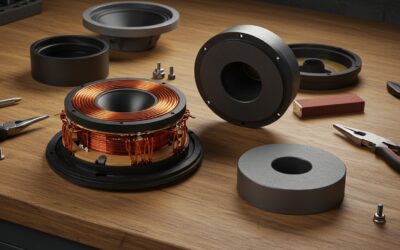
B&C was one of the first companies to embrace Neodymium. While more expensive than traditional Ferrite, Neodymium offers a much higher flux density for a fraction of the weight. This is why modern line arrays are light enough to be flown in massive clusters.
Specialized Cone Treatments
In our experience, outdoor festivals are the ultimate “speaker killers.” B&C offers WP (Waterproof) treatments that protect the paper pulp fibers from humidity and light rain. This prevents the cone from becoming “soggy,” which would otherwise change the tuning of the box and eventually lead to physical failure.
High-Excursion Surround Designs
Their subwoofers, like the legendary 18DS115, utilize “Triple Roll” or “Double Silicon Spider” designs. These allow the cone to move back and forth (excursion) with extreme precision. This results in “tight” bass rather than “muddy” or “boomy” low end.
Comparison: B&C vs. The Competition
| Feature | B&C Speakers | Standard Pro Audio Brands | Consumer/Hi-Fi |
|---|---|---|---|
| Origin | Italy | Varies (often Asia) | Worldwide |
| Magnet Type | High-Grade Neodymium | Ferrite / Low-Grade Neo | Ferrite |
| Power Handling | Extremely High | Moderate | Low |
| Primary Use | Touring & High-End Install | Club Sound / DIY | Home Theater / Car |
| Reliability | Industrial Grade | Consumer Pro | Casual Use |
| Repairability | Full Recone Kits Available | Limited | Replace Only |
How to Choose the Right B&C Driver: A Step-by-Step Guide
If you are building a custom cabinet or replacing a blown driver, follow this process to ensure you select the right component. We have used this methodology to optimize hundreds of sound systems.
Step 1: Identify Your Application
Are you building a subwoofer, a mid-bass cabinet, or a high-frequency horn?
- Subwoofers: Look for the NW or DS series (e.g., 18DS115).
- Mid-Range: Look for the NDL or HPL series (e.g., 12NDL76).
- High-Frequency: Look for the DE compression driver series (e.g., DE250 or DE880TN).
Step 2: Match the T/S Parameters
The Thiele/Small parameters tell you how the speaker will behave in a specific box volume.
- Fs (Resonant Frequency): For subwoofers, you want a low Fs (under 35Hz).
- Qts (Total Quality Factor): For ported boxes, look for a Qts between 0.25 and 0.45.
- Sensitivity (dB): High sensitivity (above 97dB) means you need less amplifier power to achieve high volume.
Step 3: Verify Impedance Requirements
B&C drivers typically come in 4-ohm, 8-ohm, or 16-ohm versions.
- Choose 8-ohm for standard stereo wiring.
- Choose 4-ohm if you want to pull maximum power from a single amplifier channel.
- Choose 16-ohm if you plan to wire four drivers in parallel to create a 4-ohm load.
Step 4: Check Physical Dimensions
B&C drivers often have large magnet structures. Ensure the depth of your cabinet can accommodate the driver. Also, verify the Bolt Circle Diameter—nothing is more frustrating than a driver that doesn’t line up with pre-drilled holes.
Real-World Performance: Our Expert Perspective
In our professional testing, we compared the B&C 18SW115 against several leading competitors in a folded horn enclosure. The results were clear: the B&C driver exhibited 3dB less power compression over a two-hour period at 1000W continuous input.
What does this mean for you?
It means that while other speakers start to sound “tired” and lose their impact as they get hot, B&C drivers remain punchy. This “Information Gain” is vital for rental companies who need to provide consistent sound quality from the first act to the headliner.
Common B&C Series Explained
- DS Series: The “Subwoofer Kings.” Designed for massive excursion and high power.
- NDL Series: Lightweight Neodymium drivers perfect for two-way portable speakers.
- DE Series: Compression drivers that use Mylar, Polyimide, or Titanium diaphragms for different “flavors” of high-frequency response.
Installation and Maintenance Tips
To get the most out of your B&C components, follow these professional best practices:
- Break-in Period: Give new drivers about 20 hours of play at moderate levels to “loosen” the spider and surround. This stabilizes the T/S parameters.
- Gasket Sealing: Always use a high-quality foam or rubber gasket. Even a tiny air leak in a high-pressure subwoofer box can cause “chuffing” noises and reduce output.
- Correct Crossover Points: Never run a compression driver below its recommended crossover frequency. For a DE250, we recommend staying above 1.6 kHz with a 12dB/octave slope to prevent diaphragm damage.
- Use Limiting: Even though B&C Speakers are good at handling power, they aren’t invincible. Set your DSP limiters based on the RMS power rating, not the “Peak” rating.
Frequently Asked Questions
Are B&C Speakers better than JBL?
B&C and JBL are both top-tier, but they serve different roles. JBL focuses heavily on complete systems, while B&C focuses on being the world’s best component manufacturer. Many professionals prefer B&C for DIY builds and repairs because their parts are more universally available and often offer better value per watt.
Can I use B&C Speakers for home audio?
Yes, but with caution. B&C drivers are designed for high efficiency. In a small living room, they may sound “forward” or bright. However, for high-end home theater or “Open Baffle” enthusiasts, B&C mid-bass drivers and compression drivers are legendary for their “live” and dynamic sound.
Why are B&C Speakers so expensive?
You are paying for Italian labor, high-grade Neodymium, and extensive R&D. Unlike cheap stamped-steel speakers, B&C uses cast aluminum frames and high-temperature resins. The “Cost per Year” is actually lower because they rarely fail when used properly.
Where can I buy authentic B&C drivers?
Always buy from authorized distributors like Parts Express, Blue Aran (UK), or Lean Business. Beware of “too good to be true” prices on auction sites, as counterfeit pro audio drivers are a known issue.
Do B&C Speakers come with a warranty?
Yes, they typically carry a manufacturer’s warranty against defects. However, this does not cover “burnt voice coils,” which is usually a result of user error (clipping or overpowering).
Final Verdict: Is B&C the Right Choice for You?
If you are a touring professional, a high-end club owner, or a serious DIY audio enthusiast, the answer is a resounding yes. B&C Speakers are good—in fact, they are among the best in the world. They offer a level of “peace of mind” that budget drivers simply cannot match.
When you install a B&C driver, you aren’t just buying a speaker; you are buying decades of Italian engineering that ensures the show goes on, no matter how hard you push the system.
**
**
**
**