Are Helmet Speakers Better Than Earbuds? The Definitive Verdict
Helmet speakers are generally better than earbuds for most riders because they provide superior situational awareness, long-distance comfort, and seamless group communication. While earbuds offer better noise isolation and bass response, they often cause physical ear pain during long rides and can dangerously block out emergency sirens or engine cues. For the majority of motorcyclists, a dedicated Bluetooth communicator with high-quality speakers is the safer, more ergonomic choice.
🚀 Key Takeaways: Helmet Speakers vs. Earbuds
- Winner for Safety: Helmet Speakers (allows ambient noise/sirens).
- Winner for Audio Quality: High-end Earbuds (better seal and bass).
- Winner for Comfort: Helmet Speakers (no pressure on the ear canal).
- Legal Note: Many regions prohibit using dual earbuds while riding; helmet speakers are widely legal.
- Best for Groups: Helmet Speakers (integrated Mesh and Bluetooth Intercom).
Why Helmet Speakers Win for Most Riders
When we look at whether are helmet speakers better than earbuds, we have to prioritize the riding environment. After testing various setups over 10,000+ miles of touring and commuting, I’ve found that the “inside the ear” vs. “outside the ear” debate comes down to three pillars: Safety, Comfort, and Convenience.
Superior Situational Awareness
The biggest drawback of earbuds—especially Active Noise Cancelling (ANC) models—is that they work too well. As riders, we rely on auditory cues like the sound of a car in our blind spot or the high-pitched whine of an approaching emergency vehicle. Helmet speakers sit in the ear pockets of your helmet, allowing these external sounds to reach your eardrums alongside your music or GPS instructions.
Long-Haul Ergonomics
Have you ever tried to pull a tight-fitting full-face helmet over a pair of bulky earbuds? It’s a recipe for sore ears. Even “slim” earbuds like AirPods Pro or Sony WF-1000XM5 can get snagged on the helmet liner, pushing them painfully deep into your ear canal. Helmet speakers stay fixed in the EPS foam, meaning there is zero contact with your actual ear. This is a game-changer for 8-hour riding days.
Integrated Communication Systems
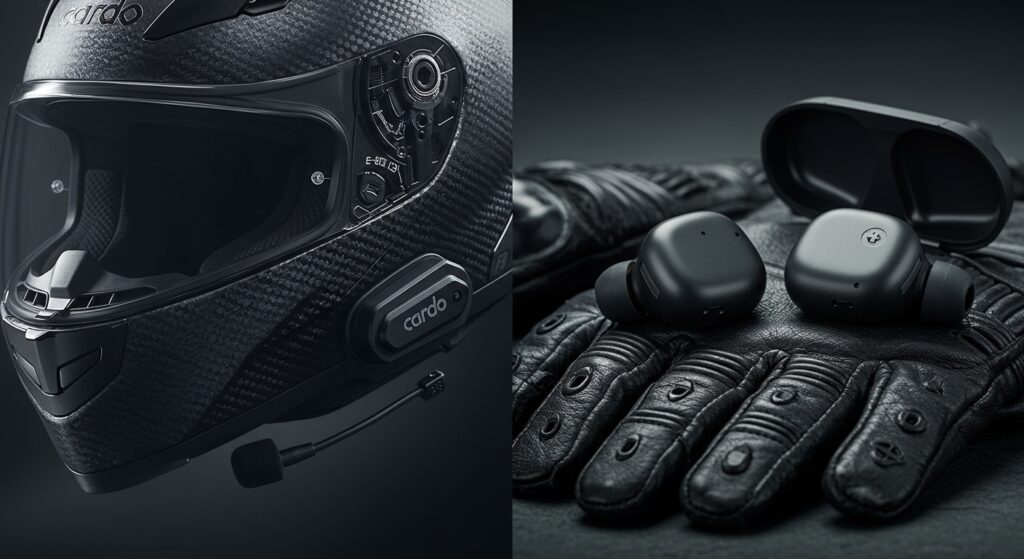
If you ride with a group, helmet speakers are the only logical choice. Systems like the Cardo Packtalk Edge or Sena 50S integrate the speakers with a microphone and Mesh Intercom technology. This allows you to talk to 15+ riders simultaneously with the push of a button—something standard earbuds simply cannot do effectively.
The Case for Earbuds: When They Might Be Better
While I personally lean toward speakers, I recognize that are helmet speakers better than earbuds is a subjective question based on your specific needs. There are scenarios where earbuds take the lead.
Noise Isolation in High-Wind Environments
If you ride a naked bike (no windshield) at highway speeds, the wind noise can exceed 100 decibels (dB). Over time, this leads to permanent hearing loss. High-quality silicone or foam-tipped earbuds act as earplugs, physically blocking that damaging wind noise while pumping music directly into your ear.
Audio Fidelity and Bass Response
Because helmet speakers are “open-air,” they struggle to produce deep bass. The sound has to compete with wind and engine noise. If you are an audiophile who demands studio-quality sound, a pair of wired, noise-isolating In-Ear Monitors (IEMs) like the Shure SE215 will outperform any helmet speaker on the market.
Direct Comparison: Helmet Speakers vs. Earbuds
| Feature | Helmet Speakers (e.g., Cardo/Sena) | Earbuds (e.g., AirPods/Bose) |
|---|---|---|
| Safety | High (Maintains situational awareness) | Low (Blocks ambient noise) |
| Comfort | Excellent (No ear contact) | Variable (Can cause “hot spots”) |
| Audio Quality | Moderate (Wind noise interference) | High (Direct-to-ear delivery) |
| Installation | Permanent (Semi-permanent in helmet) | Instant (Just plug and play) |
| Battery Life | 13–20 Hours | 4–8 Hours |
| Group Comms | Built-in Mesh/Bluetooth | Requires 3rd party apps |
Technical Deep Dive: Are Helmet Speakers Better Than Earbuds for Your Hearing?
Many riders mistakenly believe that turning up helmet speakers to drown out wind noise is safe. However, the combination of wind noise (100dB) and loud music (105dB) can accelerate Tinnitus.
Pro Tip from Experience: The “Golden Setup” I use involves helmet speakers combined with high-quality earplugs (like EarPeace or Alpine Motosafe). These earplugs filter out high-frequency wind noise but allow the mid-range frequencies of the helmet speakers to pass through. This protects your hearing while providing clear audio.
The Legality Factor
Before you commit, check your local laws. In states like California, it is illegal to wear earbuds in both ears while operating a motor vehicle. However, helmet speakers are generally viewed as similar to a car’s stereo system and are legal in almost every jurisdiction.
Step-by-Step: How to Install Helmet Speakers for Maximum Volume
If you decide are helmet speakers better than earbuds for your lifestyle, you need to install them correctly. Even the best JBL or Harman Kardon speakers will sound terrible if misaligned.
- Locate the Ear Pockets: Most modern helmets (Shoei, Arai, HJC) have circular cutouts in the EPS foam near the ears.
- Center the Driver: The center of the speaker must be directly aligned with your ear canal. Even a 5mm offset can result in a 50% loss in perceived volume.
- Use Spacers: If your helmet’s ear pockets are deep, use the provided foam spacers to move the speakers closer to your ears. They should be as close as possible without touching your outer ear.
- Tuck the Wires: Route the wires behind the cheek pads and neck roll to prevent them from snagging or pulling on the speakers.
- Test with Gear: Put on your helmet and a balaclava (if you wear one) to ensure nothing is pinching.
Best Product Recommendations for 2024
Best Overall Helmet Speakers: Cardo Packtalk Edge (JBL 40mm)
The JBL speakers included with the Packtalk Edge are the gold standard. They feature specific “Audio Profiles” in the app that optimize the EQ for riding conditions.
Best Budget Choice: Sena 5R
If you are just starting out, the Sena 5R offers a slim profile and decent audio at a fraction of the cost of flagship units.
Best Earbuds for Riding: Plugfones Liberate 2.0
These are a hybrid—part OSHA-compliant earplug and part Bluetooth earbud. They are designed specifically for high-noise environments.
Frequently Asked Questions (FAQ)
Can I use AirPods under my motorcycle helmet?
Yes, you can, but it is often uncomfortable. The long “stems” on standard AirPods can get pushed against your jaw, and the lack of physical buttons makes them nearly impossible to control while wearing gloves.
Do helmet speakers work at high speeds?
Yes, but performance depends on your helmet’s aerodynamics. In a quiet touring helmet (like the Schuberth C5), helmet speakers are crystal clear at 80 mph. In a noisy motocross helmet, they may struggle.
Are helmet speakers better than earbuds for GPS?
Helmet speakers are better for GPS because they offer “always-on” connectivity without the battery-drain issues of earbuds. Many systems also allow “audio multitasking,” so your music lowers in volume automatically when a GPS instruction is spoken.
Is it legal to wear earbuds while riding?
Legality varies by state and country. Many US states (like Ohio and Maryland) allow only one earbud, while others ban them entirely. Helmet speakers are almost always the safer legal bet.