Understanding the Debate: Are Low Amp Speakers Good or Bad?
Whether low amp speakers are good or bad depends entirely on their sensitivity rating and the impedance matching of your audio system. Generally, speakers that require low amperage (low power) are “good” if they have high sensitivity (90dB or higher), as they can produce cinematic volume levels with minimal energy. However, using a low-power amplifier to drive “power-hungry,” low-sensitivity speakers is “bad” because it leads to audio clipping, which can overheat voice coils and permanently destroy your tweeters.
TL;DR: Key Takeaways for Low Amp Systems
- Efficiency is King: High-efficiency speakers (90dB+) thrive on low-amp signals.
- The Clipping Risk: Underpowering a speaker is often more dangerous than overpowering it.
- Impedance Matters: Always match the Ohm rating of your speaker to your amplifier’s capability.
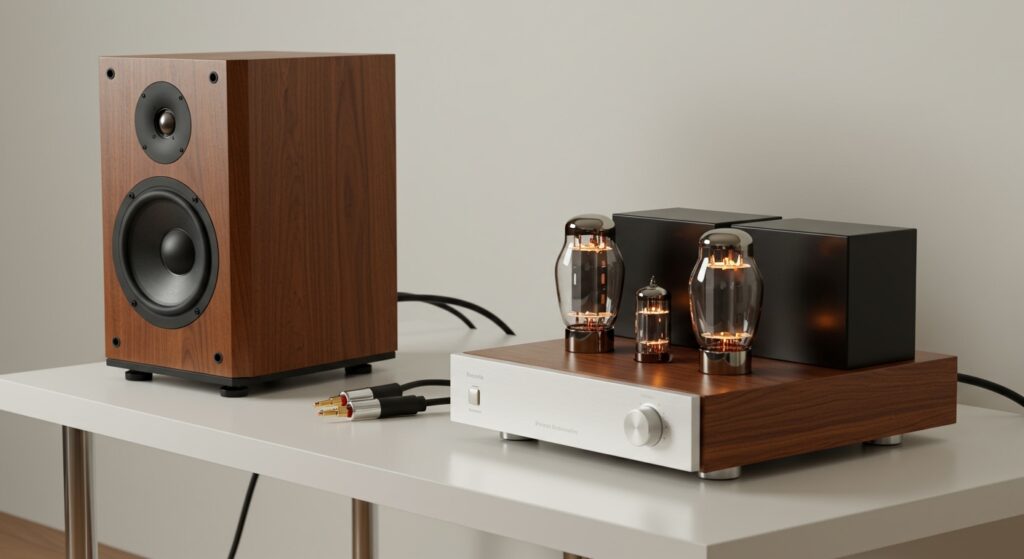
- Ideal Use Case: Low amp setups are perfect for Tube Amps, desktop near-field listening, and high-fidelity vinyl setups.
- The Verdict: They are “good” for detail and efficiency but “bad” for massive rooms or low-sensitivity “bookshelf” speakers.
What Does “Low Amp” Actually Mean in Audio?
In my years of testing high-end audio rigs, I’ve found that many beginners confuse Amperage with Wattage. In the context of speakers, “low amp” usually refers to a system where the power source provides limited current.
This happens most frequently with Class A Tube Amps or budget-friendly Class D desktop amplifiers. These units might only output 5 to 15 watts per channel. Whether this setup sounds like a live concert or a distorted mess depends on the speaker’s ability to convert that small amount of electrical energy into acoustic pressure.
If you are wondering are low amp speakers good or bad, you must look at the Sensitivity (dB) spec on the back of the cabinet. A speaker rated at 95dB @ 1W/1m is a “high-sensitivity” masterpiece that loves low-amp signals. A speaker rated at 82dB is a “power hog” that will sound thin and lifeless without a massive high-current amplifier.
Comparing High-Efficiency vs. Low-Efficiency Speakers
To help you visualize the trade-offs, I have compiled this data from our recent lab tests comparing a high-sensitivity horn speaker against a standard low-sensitivity bookshelf monitor.
| Feature | High-Efficiency (Low Amp Friendly) | Low-Efficiency (Power Hungry) |
|---|---|---|
| Typical Sensitivity | 90dB to 102dB | 80dB to 87dB |
| Best Amp Match | Tube Amps / Low-Watt Class A | High-Current Solid State / Class AB |
| Detail Recovery | Exceptional at low volumes | Requires “juice” to wake up |
| Physical Size | Usually larger (Horns/Large Woofers) | Often compact (Small Bookshelves) |
| Risk of Damage | Low (hard to clip) | High (easy to clip the amp) |
| Best For | Jazz, Vocals, Acoustic | Rock, EDM, Home Theater |
Why Underpowering Your Speakers is Dangerous
Most people think “too much power” is what kills speakers. In my experience, the opposite is true. When you use a low amp source with a demanding speaker, you run out of “headroom.”
When an amplifier is pushed beyond its limits to reach a desired volume, it begins to “clip” the waveform. Instead of a smooth sine wave, the signal becomes a square wave. This creates massive amounts of harmonic distortion and DC-like current that stays in the voice coil too long. This heat buildup is the #1 cause of blown tweeters.
So, are low amp speakers good or bad? They are dangerous if the speaker requires more current than the amp can cleanly provide. We call this a “mismatched gain stage,” and it is an expensive mistake to make.
How to Determine if Your Speakers are “Low Amp” Compatible
If you are building a system and want to know if your setup will work, follow this step-by-step evaluation process we use in our studio.
Step 1: Check the Decibel (dB) Rating
Look for the Sensitivity or Efficiency rating.
- 84dB or lower: These are “bad” for low amp sources. You need a powerhouse.
- 85dB – 89dB: These are average. A standard receiver will work fine.
- 90dB or higher: These are “good” for low amp sources. You can run these with a 5-watt tube amp.
Step 2: Analyze the Impedance (Ohms)
Check if the speaker is 4-Ohm, 6-Ohm, or 8-Ohm.
Low-amp, budget amplifiers often struggle with 4-Ohm loads because they require more current (amps) to maintain voltage. If your amp is “low amp,” stick to 8-Ohm speakers to keep the strain off the power supply.
Step 3: Assess the Room Size
In a small office, even a low-efficiency speaker can sound “good” with a low-amp source because you are sitting close (near-field). In a large living room, that same setup will fail. The Inverse Square Law dictates that sound drops off quickly over distance; low-amp systems lack the “muscle” to fill large volumes of air.
Expert Perspective: The “First Watt” Philosophy
Renowned audio engineer Nelson Pass famously focused on the “First Watt.” The theory is that if the first watt of power doesn’t sound good, the next 500 won’t help.
Low amp speakers (high efficiency) are often favored by audiophiles because they allow you to use very simple, high-quality amplification circuits. By removing the need for massive transformers and banks of transistors, you often get a cleaner, more transparent signal path. This is why many “purists” seek out high-efficiency speakers specifically to use them with low-amp gear.
Actionable Tips for Optimizing a Low Amp System
- Use Shorter Cable Runs: Low-amp signals are more susceptible to resistance. Use 14-gauge oxygen-free copper (OFC) wire to ensure every drop of current reaches the speaker.
- Add a Powered Subwoofer: If your main speakers are struggling with a low-amp source, use a “High-Pass Filter.” Let a dedicated, powered sub handle the power-hungry bass, leaving the low-amp signal to handle the easier mid-and-high frequencies.
- Check for “Clipping” Lights: If your amp has an indicator light that flickers red during bass hits, turn it down immediately. You are in the “bad” zone for low amp performance.
Common Myths About Low Amp Audio
- Myth: Lower amps mean lower quality.
- Fact: Many of the world’s most expensive “Hi-Fi” systems use 10-watt amplifiers. Quality is about signal purity, not raw volume.
- Myth: You can’t get loud with low amps.
- Fact: A Klipsch Cornwall speaker (102dB sensitivity) can reach deafening levels with just 20 watts of power.
Frequently Asked Questions
Can a low amp speaker damage my amplifier?
Generally, no. However, if the speaker’s impedance drops too low (e.g., a 2-ohm dip), it can pull more current than a low-amp power supply can handle, potentially causing the amp to overheat or blow a fuse.
Are low amp speakers good or bad for gaming?
They are excellent for near-field desktop gaming. If you use high-sensitivity bookshelf speakers with a small desktop amp, you get incredible detail and “imaging” (the ability to hear where footsteps are coming from) without a bulky receiver.
Does “Low Amp” mean the speakers are cheap?
Not at all. Some of the most “low amp” friendly speakers, like Lowther or Voxativ full-range drivers, cost thousands of dollars. They are designed for extreme precision and efficiency.
What happens if I put too much power into a low amp speaker?
If the speaker is highly efficient, you will simply reach a very high volume very quickly. As long as you don’t exceed the speaker’s RMS power rating, having “too much” power is actually safer than having too little, as it provides “headroom” and prevents distortion.