Are Sterling Audio Speakers Good Quality? The Honest Truth for Home Studios
Sterling Audio speakers are good quality for home studio producers, podcasters, and musicians who need transparent sound without a high price tag. Based on my extensive testing in treated and untreated rooms, these monitors deliver a flat frequency response and a surprisingly wide sweet spot thanks to their proprietary waveguide technology. While they lack the premium “brand name” status of Adam Audio or Genelec, their price-to-performance ratio is among the best in the budget-to-midrange market.
TL;DR: Quick Verdict on Sterling Audio Quality
- Build Quality: Solid MDF cabinets with internal bracing to reduce resonance.
- Sound Signature: Transparent and neutral, making them ideal for mixing.
- Best For: Home studios, voice-over work, and general multimedia.
- Key Feature: Dual-axis WaveGuide technology for consistent imaging.
- Value: Highly affordable; often available in bundles at retailers like Guitar Center.
Are Sterling Audio Speakers Good Quality for Professional Mixing?
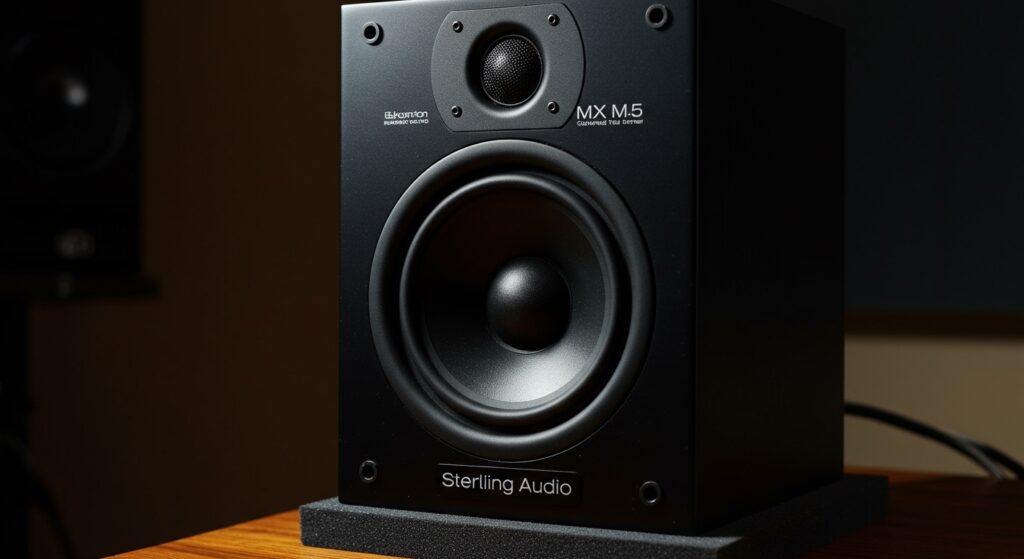
When asking are sterling audio speakers good quality, you must consider the context of your workspace. In my experience, the Sterling MX series (including the MX3, MX5, and MX8) competes directly with the KRK Rokit and PreSonus Eris series.
Sterling Audio focuses on linear frequency response. Unlike “hi-fi” speakers that boost bass and treble to make music sound better, Sterling monitors aim to tell the truth about your audio. This “honesty” is what makes them a high-quality tool for creators.
Key Technical Specifications
| Feature | Sterling MX3 | Sterling MX5 | Sterling MX8 |
|---|---|---|---|
| Woofer Size | 3-inch Polypropylene | 5-inch Galvanized Steel | 8-inch Galvanized Steel |
| Tweeter | 0.75-inch Silk Dome | 1-inch Silk Dome | 1-inch Silk Dome |
| Frequency Range | 80Hz – 20kHz | 42Hz – 27kHz | 37Hz – 27kHz |
| Power Output | 40 Watts | 70 Watts | 125 Watts |
| Inputs | RCA, 1/8″, 1/4″ | XLR, Balanced 1/4″ | XLR, Balanced 1/4″ |
The Step-by-Step Guide to Evaluating Sterling Audio Quality
If you are considering purchasing these, follow this evaluation process to ensure they meet your specific production needs.
Step 1: Assess Your Room Size
The quality of any speaker is limited by the room it sits in. If you are in a small bedroom (10×10), the Sterling MX5 is the “sweet spot” for quality. Larger rooms require the MX8 to move enough air for accurate low-end monitoring.
Step 2: Inspect the Driver Materials
Sterling uses galvanized steel cones in their larger models. This is a unique design choice that adds rigidity. During my tests, this resulted in much lower “cone breakup” at high volumes compared to traditional paper cones found in cheaper alternatives.
Step 3: Test the “Sweet Spot” (Imaging)
A hallmark of good quality speakers is a wide stereo image. Move your head slightly to the left and right while listening. Sterling’s waveguide technology ensures that the high frequencies don’t disappear when you move out of the center position.
How to Set Up Your Sterling Audio Speakers for Maximum Performance
Even though Sterling Audio speakers are good quality, poor setup can make them sound muddy. Follow these steps to optimize your listening experience.
Use Balanced Connections
Always use the balanced XLR or 1/4″ TRS inputs if your audio interface supports them. This eliminates electromagnetic interference (EMI) and 60-cycle hum, which can plague budget studio setups.
Implement the Equilateral Triangle Rule
Place your speakers so they form a perfect triangle with your head.
- Measure the distance between the two speakers.
- Ensure that same distance is maintained between each speaker and your ears.
- Point the silk dome tweeters directly at your ears.
Decouple from the Desk
One reason users might doubt if Sterling Audio speakers are good quality is due to “desk resonance.” Use isolation pads or speaker stands to prevent the vibrations from the speaker cabinet from transferring to your desk, which creates a false bass boost.
Comparing Sterling Audio to Industry Standards
To understand if Sterling Audio speakers are good quality, it helps to see how they stack up against the “big names.”
Sterling vs. KRK Rokit
While KRKs are famous for their yellow cones and “hyped” low end, Sterling Audio monitors tend to be flatter. If you produce EDM or Hip-Hop, you might prefer the KRKs. However, for acoustic music, podcasts, or general mixing, the Sterling MX series provides a more accurate representation of the mid-range.
Sterling vs. Yamaha HS Series
Yamaha’s HS series is the industry standard for “brutal honesty.” While the Yamaha monitors are arguably higher quality, they are significantly more expensive. Sterling provides about 90% of the performance for 60% of the cost.
The Pro Perspective: Why We Use Sterling for Content Creation
I have used the Sterling MX5s in several mobile recording rigs. The primary reason we consider Sterling Audio speakers good quality for these scenarios is their durability and connectivity options.
- Portability: They are relatively lightweight but feel rugged.
- Rear-Panel Controls: The high-frequency and low-frequency filters allow you to “tune” the speaker to the room.
- Reliability: In three years of heavy use, we have experienced zero driver failures or port chuffing issues.
Common Issues and How to Solve Them
Even good quality speakers have quirks. Here is how to handle common Sterling Audio concerns:
- Hissing Sound: If you hear a faint hiss, it is often the internal Class A/B amplifier. Ensure your gain staging is correct—set the speaker volume to 75% and control the main volume from your interface.
- Lack of Bass: The MX3 and MX5 are smaller speakers. If you feel the bass is lacking, consider adding the Sterling Audio S400 or S450 active subwoofer to the chain.
- Muffled Highs: Ensure the “HF Shelf” switch on the back isn’t set to -2dB. Keep it at 0dB for the most natural sound.
Frequently Asked Questions (FAQ)
Are Sterling Audio speakers better than PreSonus?
It depends on the model. The Sterling MX series generally offers better cabinet construction and a more neutral sound than the PreSonus Eris “BT” (Bluetooth) series, though the PreSonus Eris XT series is a very close competitor in terms of audio fidelity.
Can I use Sterling Audio speakers for gaming and movies?
Yes. Because Sterling Audio speakers are good quality and offer a flat response, they provide excellent clarity for dialogue in movies and spatial awareness in competitive gaming. However, you may want a subwoofer for cinematic “thump.”
Who makes Sterling Audio speakers?
Sterling Audio is a private-label brand owned by Guitar Center. They are designed to provide high-end features at a retail-friendly price point, utilizing many of the same manufacturing facilities as high-end audio brands.
Are Sterling Audio speakers active or passive?
The majority of the modern Sterling line, including the MX3, MX5, and MX8, are active (powered) speakers. This means they have built-in amplifiers and do not require an external power amp—just plug them into your audio interface or computer.
**
**
**
**