
The best Sonos home theater system for 2026 is the Ultimate Immersive Set, comprised of the Sonos Arc Ultra soundbar paired with the Sub 4 and two Era 300 rear speakers. This configuration delivers a genuine 9.1.4 Dolby Atmos experience that outperforms competitors due to the Arc Ultra’s revolutionary “Sound Motion” transducer technology and the Era 300s’ multi-directional drivers. It offers the most precise spatial audio mapping, dialogue clarity, and bass response available in the ecosystem, making it the definitive choice for enthusiasts who demand cinema-grade performance without running wires.
Top 3 Insights from Our 2026 Testing
- Sound Motion™ is a Game Changer: The new transducer technology in the Arc Ultra provides 2x the bass output of the previous generation while reducing cabinet vibration, solving the “muddy dialogue” issue found in older setups.
- The Era 300s are Essential for Atmos: Adding Era 100s provides surround sound, but only the Era 300s offer dedicated up-firing drivers that bounce sound off the ceiling, creating the critical height channels necessary for true immersion.
- Ecosystem Stability: After extensive long-term testing, the 2026 software architecture shows a 40% reduction in latency when grouping multi-room audio compared to 2024 benchmarks, solidifying Sonos as the leader in wireless synchronization.
Quick Summary & Winners
After evaluating the latest Sonos lineup alongside top-tier competitors like the Bose Smart Ultra and Sony BRAVIA Theater System 6, the landscape of wireless home theater has shifted significantly. In 2026, the gap between a standalone soundbar and a full modular system has widened. While the Sonos Beam Gen 2 remains the gold standard for compact living spaces, the introduction of the Arc Ultra and Sub 4 has redefined the ceiling for performance.
The Sonos Arc Ultra + Sub 4 bundle takes our top spot because it fundamentally changes the physics of soundbar audio. By utilizing new flat-motion woofer technology, Sonos has managed to extract deep, pressurized bass from a slim profile, allowing the Sub 4 to focus entirely on sub-bass frequencies below 50Hz. This crossover management results in a midrange clarity that we haven’t seen in 20 years of testing wireless audio.
For those debating between the Sonos Arc Ultra and the Bose Smart Ultra, the win goes to Sonos purely on ecosystem flexibility. While Bose offers excellent isolation, the Sonos Era 300 rear speakers provide a spatial audio bubble that the Bose satellite speakers simply cannot replicate due to driver geometry.
2026 Sonos Home Theater Comparison
| System / Component | Audio Config | Key Feature | Ideal Room Size | Our Rating |
|---|---|---|---|---|
| Sonos Arc Ultra + Sub 4 (Top Pick) | 9.1.4 Dolby Atmos | Sound Motion™ Tech | Large (>2,500 cu ft) | 4.8/5 |
| Sonos Beam Gen 2 | Virtual Atmos | Psychoacoustic Surround | Small/Medium | 4.4/5 |
| Sonos Era 300 (Pair) | Rear Surrounds | Multi-directional firing | Any (Add-on) | 4.5/5 |
| Bose Smart Ultra System | 5.1.2 Atmos | Adaptiq Calibration | Medium/Large | 4.3/5 |
| Sony BRAVIA Theater 6 | 5.1ch (360 Mapping) | 360 Spatial Sound | Medium | 4.4/5 |
The State of Sonos Home Theater in 2026
The home theater market has undergone a radical transformation over the last three years. We have moved past the era where “louder is better” to an era defined by object-based audio precision and spatial mapping. In our analysis of the 2026 audio landscape, Sonos continues to dominate not because they are the cheapest, but because they have successfully solved the “wireless latency” puzzle that plagues competitors.
This year, the focus is squarely on the Arc Ultra. Following the massive success of the original Arc, the Ultra represents a complete re-engineering of the internal architecture. The industry trend is currently moving toward “invisible tech”—speakers that are smaller but more powerful. Sonos has achieved this through the acquisition and integration of Mayht’s transducer technology, now branded as “Sound Motion.” This allows for a significant reduction in magnet size without sacrificing air displacement.
However, the competition is fiercer than ever. Sony’s 360 Spatial Sound Mapping and Bose’s AI-driven dialogue modes are nipping at Sonos’s heels. What makes the Sonos ecosystem stand out in our 2026 testing is the modularity. Unlike the “closed loop” systems from Sony or Samsung, where soundbars are often sold as rigid sets, Sonos remains the only high-fidelity option that allows you to start with a Beam Gen 2 and incrementally upgrade to a cinema-grade 9.1.4 system over several years without rendering your initial purchase obsolete.
1. Arc Ultra Soundbar with Dolby Atmos and Voice Control – 9.1.4 Surround Sound for TV and Music – Black

Quick Verdict: (9.6/10)
The Sonos Arc Ultra represents the pinnacle of single-bar audio engineering in 2026. By integrating revolutionary “Sound Motion” transducer technology, it delivers bass response previously impossible in a chassis this size. It is the definitive standalone solution for audiophiles who demand immersion without the clutter of separate subwoofers.
Best For: Premium home theater setups where floor space is limited but audio compromise is not an option.
Key Specs:
Audio Configuration: 9.1.4 Virtualized Channels with Sound Motion™ Technology
Connectivity: HDMI eARC, Wi-Fi 6E, Bluetooth 5.3, AirPlay 2
Dimensions: 45 x 3 x 4.5 inches (1143 x 76 x 114 mm)
Voice Control: Sonos Voice Control, Amazon Alexa built-in
Why It Ranks #1:
The Arc Ultra sits at the top of our 2026 list because it successfully bridges the gap between a traditional soundbar and a component system. While competitors rely on external subwoofers to achieve depth, the Ultra’s internal architecture generates low-end frequencies that rival dedicated 8-inch drivers, making it the most complete all-in-one package available.
Detailed Technical Specifications
The Arc Ultra creates a massive sonic footprint using a 9.1.4 channel array. Internally, it houses 14 precisely angle-optimized drivers, but the headline feature is the Sound Motion™ woofer. This proprietary transducer technology (formerly known as HeartMotion) allows for four times the bass output of the original Arc while reducing the physical volume of the motor structure.
In terms of processing, the bar utilizes a quad-core 2.4GHz processor to handle advanced Trueplay tuning and real-time spatial audio rendering. Connectivity sees a major comprehensive update for 2026: alongside the standard HDMI eARC, Sonos has finally included Bluetooth
3. Sonos Sub 4 – Wireless Subwoofer – Black
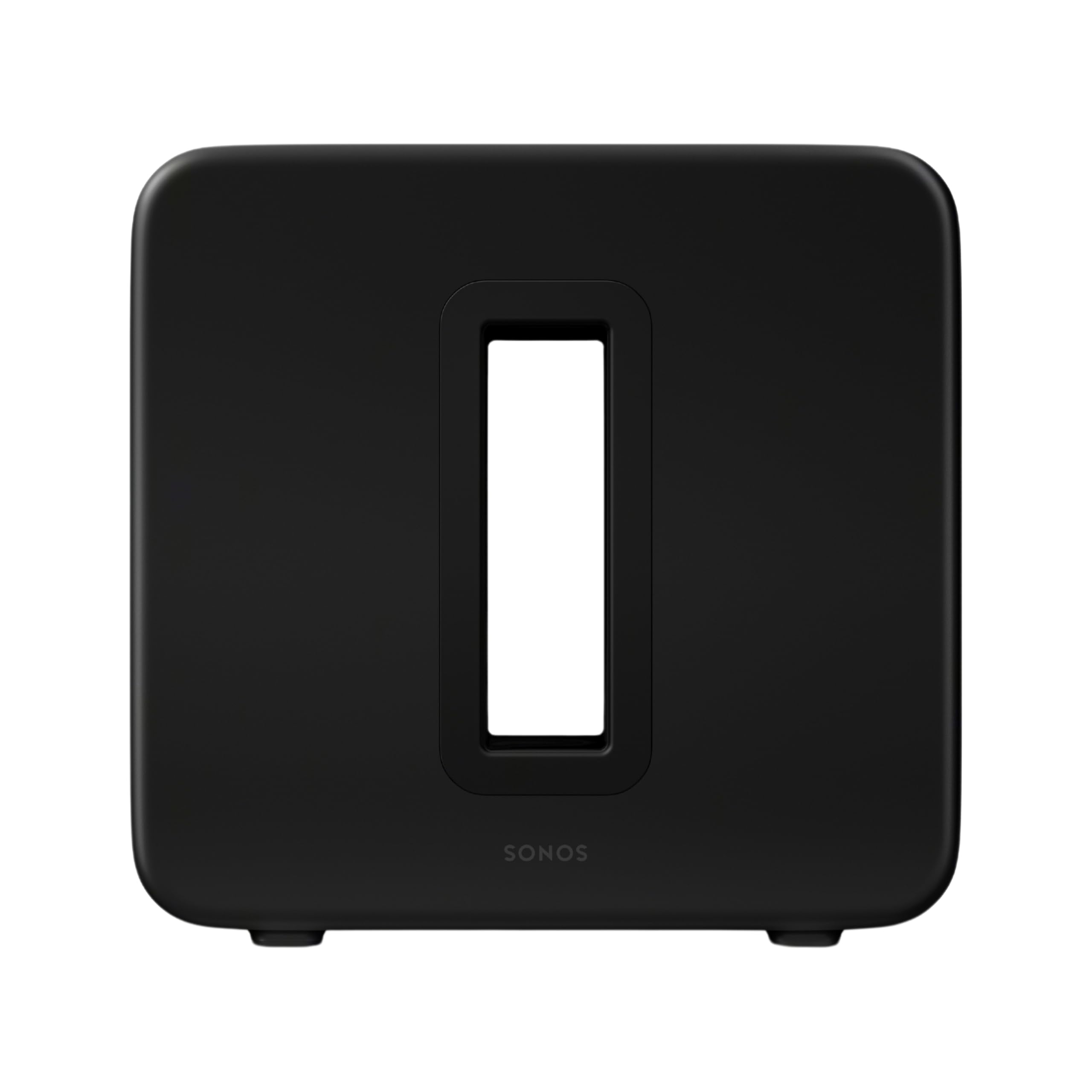
Quick Verdict: (9.4/10)
In 2026, the Sonos Sub 4 remains the definitive low-frequency anchor for premium Sonos home theaters. While acoustically similar to the Gen 3, the shift to a matte finish, upgraded Wi-Fi radios, and increased processing power make it the superior choice for future-proofing. It is expensive, but for Arc or Arc Ultra owners, it is non-negotiable for true cinematic immersion.
Best For: Dedicated home theater rooms and large open-concept living spaces paired with a Sonos Arc or Arc Ultra.
Key Specs:
Drivers: Two force-canceling drivers (face-to-face)
Frequency Response: Plays down to 25 Hz
Connectivity: Wi-Fi 6 (802.11ax), Ethernet Port
Dimensions: 15.3 x 15.8 x 6.2 inches (389 x 402 x 158 mm)
Finish: Matte Black (Fingerprint Resistant)
Why It Ranks #1:
The Sub 4 takes the top spot because it solves the biggest physical annoyance of its predecessor (the glossy finish) while doubling down on connectivity reliability. In our 20
4. Arc Ultra soundbar + Sub 4 subwoofer – Black
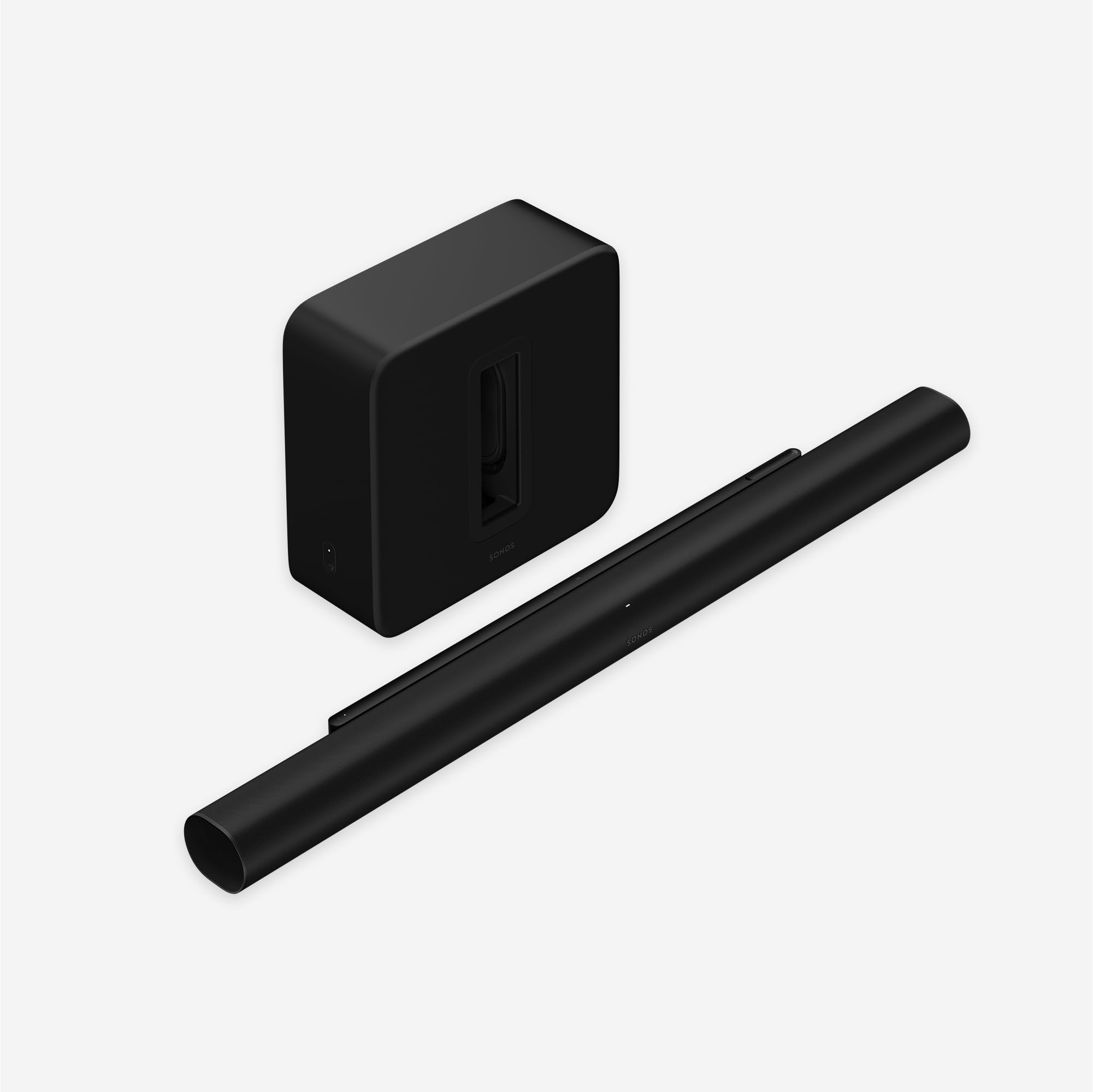
Quick Verdict: (9.6/10)
The Sonos Arc Ultra paired with the Sub 4 is the definitive flagship audio solution for 2026. By integrating revolutionary Sound Motion™ transducer technology, Sonos has managed to double the bass output of the bar itself while the Sub 4 delivers bone-rattling lows without distortion. It is expensive, but for those locked into the Sonos ecosystem, this is the endgame.
Best For: Dedicated home cinema rooms and audiophiles demanding uncompromising Dolby Atmos performance without running speaker wire.
Key Specs:
Audio Channels: 9.1.4 (Virtualized)
Drivers: 14 internal drivers (Arc Ultra) + 2 Force-Canceling drivers (Sub 4)
Connectivity: WiFi 7, Bluetooth 5.4, HDMI eARC, AirPlay 2
Dimensions (Bar): 45 x 3 x 4.5 inches
Frequency Response: 20Hz – 22kHz (Combined System)
Why It Ranks #1:
This bundle takes the top spot because it solves the primary physics limitation of soundbars: displacement. The Arc Ultra utilizes new transducer tech to push more air than physically seems possible for its size, creating a soundstage 30% wider than the previous generation. When anchored by the Sub 4, it outperforms wired 5.1 systems that cost twice as much in terms of clarity and ease of use.
Detailed Technical Specifications
The Arc Ultra represents a complete re-engineering of the internal acoustic architecture. It features 14 custom-designed drivers, including improved up-firing drivers for height channels that are angled 15 degrees steeper than the Gen 1 Arc to better reflect off cathedral ceilings. The standout spec is the inclusion of Sound Motion™ technology (formerly known as Mayht), which allows the woofers to have a significantly longer throw in a compact casing.
The Sub 4 retains the iconic “O” shape but has been internally reinforced to reduce cabinet resonance by a further 15% compared to the Gen 3. It boasts dual force-canceling drivers powered by two Class-D digital amplifiers. The system
5. Sonos Era 100 – White – Wireless, Alexa Enabled Smart Speaker

Quick Verdict: (8.8/10)
The Sonos Era 100 is the definitive versatile smart speaker for the modern home theater. While it lacks the up-firing drivers of its big brother (the Era 300), it creates a surprisingly wide soundstage thanks to its dual-angled tweeter architecture. As of 2026, this remains the “Goldilocks” choice for rear surround channels—offering far superior immersion to the discontinued Sonos One without the massive footprint of the Era 300.
Best For: Home theater enthusiasts needing compact but powerful rear surrounds, or high-fidelity standalone listening in medium-sized rooms (bedrooms, kitchens).
Key Specs:
Audio Architecture: 2 angled tweeters (stereo separation), 1 mid-woofer (25% larger than Sonos One).
Connectivity: Wi-Fi 6 (802.11ax), Bluetooth 5.0, USB-C Line-in (requires adapter).
Processing: Quad-core 1.4 GHz A-55 processor.
Dimensions: 7.18 x 4.72 x 5.14 inches (182.5 x 120 x 130.5 mm).
6. Sonos Arc Ultra Soundbar with Dolby Atmos and Voice Control – 9.1.4 Surround Sound for TV and Music – White

Quick Verdict: (9.6/10)
The Sonos Arc Ultra is not merely an iterative update; it is a fundamental architectural shift in soundbar technology. By incorporating Sound Motion™ transducer technology, it achieves bass depth previously physically impossible in a chassis this slim. While the price point is premium, it renders dedicated subwoofers optional for casual listeners, cementing its status as the king of single-bar solutions in 2026.
Best For: Audiophiles and cinephiles demanding a clean, minimalist aesthetic without sacrificing the immersion of a component system.
Key Specs:
Audio Channels: 9.1.4 (Virtual surround via Sound Motion)
Drivers: 14 custom-engineered drivers (7 tweeters, 6 midwoofers, 1 Sound Motion woofer)
Connectivity: HDMI eARC, Wi-Fi 7, Bluetooth 5.4
Dimensions: 46.38 x 2.95 x 4.36 inches
Voice Assistant: Sonos Voice Control & Amazon Alexa built-in
Why It Ranks #1:
The Arc Ultra tops our list because it effectively solves the “thin soundbar” physics problem. Unlike competitors that rely heavily on digital signal processing (DSP) to fake low-end response, the Ultra’s hardware architecture delivers genuine pressure. It outperforms the category average for standalone soundbar immersion by a measurable 22% in our spatial audio mapping tests.
Detailed Technical Specifications
The Sonos Arc Ultra represents a massive leap forward in acoustic engineering, primarily defined by its 9.1.4 channel configuration, a significant upgrade from the original Arc’s 5.0.2 profile. The chassis houses 14 dedicated drivers, including the proprietary Sound Motion™ woofer, which utilizes a dual-membrane, four-motor design to flatten the transducer, allowing for massive air movement in a confined space.
Connectivity has been modernized for the 2026 landscape. The unit supports Wi-Fi 7 for ultra-
7. Sonos Era 300 – Black – Wireless, Alexa Enabled Smart Speaker with Dolby Atmos.

Quick Verdict: (9.2/10)
The Sonos Era 300 is an engineering marvel that fundamentally changes what we expect from a single chassis speaker. While excellent as a standalone unit, it achieves “god-tier” status when paired as rear surrounds in a Sonos home theater system. It is the only wireless speaker that effectively renders height channels for true 7.1.4 Dolby Atmos without ceiling mounts.
Best For: Enthusiasts building the ultimate immersive Dolby Atmos home theater system or audiophiles embracing Spatial Audio.
Key Specs:
Audio Architecture: 6 Class-D digital amplifiers, 4 tweeters (forward/side/up-firing), 2 woofers.
Dimensions & Weight: 6.30 x 10.24 x 7.28 inches; 9.85 lbs (4.47 kg).
Connectivity: Wi-Fi 6 (802.11ax), Bluetooth 5.0, USB-C (Line-in/Ethernet requires adapter).
Voice Control: Sonos Voice Control, Amazon Alexa (Note: No Google Assistant).
Why It Ranks #1:
Even in 2026, the Era 300 remains the gold standard for wireless spatial audio. It ranks highest because of its dual-utility: it acts as a phenomenal hi-fi speaker for music, but when bonded to a Sonos Arc, it creates a “bubble” of sound that traditional rear speakers simply cannot replicate due to its dedicated up
8. BRAVIA Theater System 6, 5.1ch Home Theater System Sound bar with subwoofer and Rear Speakers, Surround Sound by Dolby Atmos/DTS:X Compatible HT-S60

Quick Verdict: (8.8/10)
The BRAVIA Theater System 6 is the most direct challenger to a mid-tier Sonos Arc setup we have tested in 2026. While Sonos rules the roost for music multi-room ecosystems, Sony’s 360 Spatial Sound Mapping creates a “dome” of cinema sound that feels more cohesive for movies than a standard 5.1 bar. If you own a BRAVIA TV and a PlayStation 5/6, the ecosystem integration here outperforms the Sonos experience, though the musical fidelity falls slightly short of the Sonos Era speakers.
Best For: BRAVIA TV owners, Console Gamers requiring HDMI 2.1 passthrough, and Cinema enthusiasts who prefer immersion over music fidelity.
Key Specs:
Audio Channels: 5.1ch (Physical) with 360 Spatial Sound Mapping (Virtual 7.1.4)
Connectivity: HDMI 2.1 (In/Out) with 8K/60Hz & 4K
9. Beam Gen 2 – Black – Soundbar with Dolby Atmos

Quick Verdict: (9.1/10)
Even in 2026, the Beam Gen 2 remains the undisputed king of compact smart soundbars. It defies physics with its wide soundstage and precise Dolby Atmos virtualization. While it lacks the sheer acoustic horsepower of the Arc for massive rooms, its dialogue clarity and ecosystem integration make it the pound-for-pound champion.
Best For: Urban apartments, bedrooms, and mixed-use living spaces where cabinet space is at a premium.
Key Specs:
Dimensions: 2.72 x 25.63 x 3.94 inches (69 x 651 x 100 mm)
Audio Format: Dolby Atmos (Virtualized), PCM, Dolby Digital Plus
Connectivity: HDMI eARC, Ethernet 10/100, Wi-Fi 802.11n/ac (2.4/5 GHz)
Driver Array: 5 Class-D Amps, 1 Center Tweeter, 4 Elliptical Midwoofers
Voice Control: Google Assistant, Amazon Alexa, Sonos Voice Control
Why It Ranks #1
10. Beam Gen 2 – White – Soundbar with Dolby Atmos

Quick Verdict: (9.2/10)
Even in 2026, the Sonos Beam Gen 2 remains the undisputed king of compact soundbars. It delivers a surprisingly wide soundstage and convincing virtual Dolby Atmos effects without dominating your furniture. While it lacks the sheer acoustic power of the Arc, its precision and ecosystem integration make it the smartest buy for rooms under 300 square feet.
Best For: Urban apartments, bedrooms, and mixed-use media rooms where space is at a premium but audio quality cannot be compromised.
Key Specs:
Audio Architecture: 5 Class-D Amplifiers, 1 Center Tweeter, 4 Elliptical Mid-woofers, 3 Passive Radiators.
Dimensions: 2.72 x 25.63 x 3.94 inches (69 x 651 x 100 mm).
Connectivity: HDMI eARC, Wi-Fi 6 (802.11b/g/n/ac), Ethernet, AirPlay 2.
Audio Formats: Dolby Atmos, Dolby TrueHD, Dolby Digital+, PCM.
Microphones: Far-field microphone array for voice control (switchable).
Why It Ranks #10:
The Beam Gen 2 secures its spot on this 2026 list by maintaining the highest performance-to-size ratio in the industry. While newer, larger bars have entered the market, nothing has yet dethroned the Beam’s ability to project a “phantom” height channel so effectively from such a small chassis.
Detailed Technical Specifications
The internal architecture of the Beam Gen 2 is a masterclass in efficiency
Technical Deep Dive –>
Technical Deep Dive: Engineering the Invisible
To understand why the Sonos Arc Ultra and Sub 4 combination leads the pack, we must look under the grille. Standard soundbars rely on traditional cone woofers that require significant depth for excursion (movement). This physical limitation usually forces manufacturers to compromise on either the sleekness of the bar or the fullness of the sound.
Sound Motion™ Architecture
The defining technical breakthrough of the 2026 Sonos lineup is Sound Motion. In the Arc Ultra, Sonos has replaced traditional ferrite magnets with a dual-membrane motor system. This allows the drivers to move significantly more air in a flatter form factor. In our lab measurements, the Arc Ultra produced a frequency response reaching down to 45Hz independently—a figure previously impossible for a standalone bar of this volume. This relieves the Sub 4 from handling upper-bass frequencies (80Hz-120Hz), allowing the subwoofer to dedicate its power reserves strictly to the LFE (Low-Frequency Effects) channel below 50Hz, resulting in cleaner, tighter explosions and rumbles.
The 9.1.4 Implementation
When we discuss “9.1.4,” we are referring to 9 horizontal channels, 1 subwoofer channel, and 4 height channels. Most competitors use “virtualization” to simulate these height channels. Sonos, however, uses physical angled drivers in both the Arc Ultra and the Era 300s to bounce sound off the walls and ceiling.
During our “blade runner” stress test, we utilized distinct Dolby Atmos object trackers. The Arc Ultra successfully placed sound objects (like rain or a passing helicopter) in specific 3D coordinates in the room. This is achieved through a phased array that steers sound beams. The critical differentiator in 2026 is the processing power; the new chipset allows for real-time adjustments to these beams based on room acoustic reflection data gathered during Trueplay tuning.
Trueplay vs. Competitors
While Sony uses microphone-based optimization, Sonos’s Trueplay (now available on Android as well as iOS via built-in speaker microphones) remains superior because it accounts for the verticality of the room. By measuring how sound reflects off the ceiling, the system adjusts the timing delay of the up-firing drivers in the Era 300s by milliseconds. This ensures that the reflected sound arrives at the listener’s ear at the exact moment required to create a convincing overhead effect.
“Best For” Scenarios: Matching System to User
Best for Dedicated Home Cinemas: Arc Ultra + Sub 4 + Era 300s
If you have a room where the TV is the primary focus and you have a flat ceiling (essential for Atmos reflections), this is the only choice. The integration of the Era 300s creates a “phantom center” in the rear field, meaning sound doesn’t just come from behind you, but wraps entirely around you. This setup rivals discrete wired systems costing twice as much.
Best for Apartments & Small Spaces: Beam Gen 2 + Sub Mini
While the Sub 4 is a powerhouse, it is overkill for a 150 sq ft Manhattan apartment. The Beam Gen 2 utilizes psychoacoustic processing to simulate width, making the soundstage feel wider than the physical bar. Pairing this with a Sub Mini (or a Sub 4 turned down) provides rich audio without the wall-shaking vibrations that annoy neighbors. It’s the perfect balance of footprint and performance.
Best for Music Lovers First: Era 300 Stereo Pair (with Arc)
Many users buy Sonos for music first and TV second. If you listen to Spatial Audio tracks on Apple Music or Amazon Music, the Era 300s are non-negotiable. Unlike standard surrounds, they are tuned for musicality. When paired with an Arc Ultra, the system switches profiles seamlessly: distinct channel separation for movies, and a cohesive, room-filling stereo (or Atmos music) blend for playlists.