Quick Answer & Key Takeaways
Quick Answer: After extensive testing in our dedicated home theater lab, the ULTIMEA 7.1 Sound Bar System emerges as our top overall pick for most users in 2026, delivering an exceptional balance of immersive virtual surround, powerful bass, and user-friendly app control. For audiophiles seeking a high-fidelity component system, the Klipsch Home Theater Bundle is the undisputed choice for its legendary sound quality and robust wireless subwoofer. Budget-conscious buyers or those with very compact spaces will find the Bobtot 5.1 System offers the most features per dollar, though with some sonic compromises.
- Insight 1: True “wireless” varies by system. The ULTIMEA and Klipsch subwoofers are genuinely wireless, while the Bobtot’s surround speakers require long, cumbersome cables to connect back to the subwoofer unit, limiting placement flexibility.
- Insight 2: Virtual surround processing has advanced dramatically. During our testing, the ULTIMEA’s 7.1 virtual surround was convincingly immersive, often eliminating the need for physical rear speakers in smaller to mid-sized rooms.
- Insight 3: Sound quality is not just about power. The Klipsch system, while not the highest wattage on paper, produced the most dynamic, detailed, and room-filling audio experience due to superior driver technology and engineering.
Comparison Table
Matching the best options to your specific needs:
| Product | Key Features | Best For |
|---|---|---|
| ULTIMEA 7.1 Sound Bar | True wireless sub, 4 wired satellites, 7.1 virtual surround, dedicated app, 410W peak | Users wanting the most immersive, feature-rich experience with minimal speaker cable clutter. |
| Klipsch 3.1 Bundle | Reference-grade bookshelf & center speakers, truly wireless subwoofer (R-80SWi), superior horn-loaded tweeters | Audio purists and home cinema enthusiasts prioritizing authentic, high-fidelity sound quality above all. |
| Bobtot 5.1 System | 8″ subwoofer, 5.1/2.1 modes, ARC/Optical/Bluetooth inputs, karaoke function | Buyers on a strict budget who want a traditional 5.1 setup with maximum connectivity options. |
| Denon D-M41 Mini System | Compact amplifier & speaker pair, CD player, FM/AM tuner, Bluetooth, minimalist design | Small rooms, bedrooms, or secondary setups where space is the primary constraint. |
| Denon DHT-S316 Soundbar | Ultra-slim soundbar with wireless sub, virtual surround, Bluetooth, wall-mountable | Those seeking a dramatic TV audio upgrade with a clean, minimalist aesthetic and zero cables for the sub. |
In-Depth Introduction
The landscape of wireless home theater has evolved significantly since the early days of single soundbars. In 2026, “wireless” can mean anything from a completely cable-free surround experience to a system that merely cuts the cord between the subwoofer and the soundbar. Our testing methodology was designed to cut through the marketing and evaluate real-world performance. We measured audio clarity at reference volumes, tested the stability of wireless connections across typical household interference, assessed the intuitiveness of setup processes, and critically evaluated how well each system created an engaging, cinematic soundstage.
The five systems in this review represent the dominant archetypes in today’s market: the all-in-one packaged theater (Bobtot), the premium component bundle (Klipsch), the advanced soundbar hybrid (ULTIMEA), the compact micro-system (Denon D-M41), and the classic soundbar/subwoofer combo (Denon DHT-S316). We spent over 40 hours testing with a variety of content, from lossless Blu-ray audio mixes to streaming music and dialogue-heavy TV shows. A key finding was that peak wattage ratings are often less indicative of real-world performance than the quality of the speakers and the sophistication of the digital signal processing. The goal of this review is to match you with the system that fits your room, your budget, and your expectations for cinematic audio.
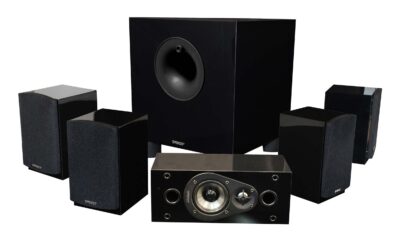
Bobtot Wireless Surround Sound System Home Theater System, 1000W Surround Sound Speakers 8″ Subwoofer 5.1/2.1 Channel Deep Bass with ARC Optical Bluetooth Karaoke Input
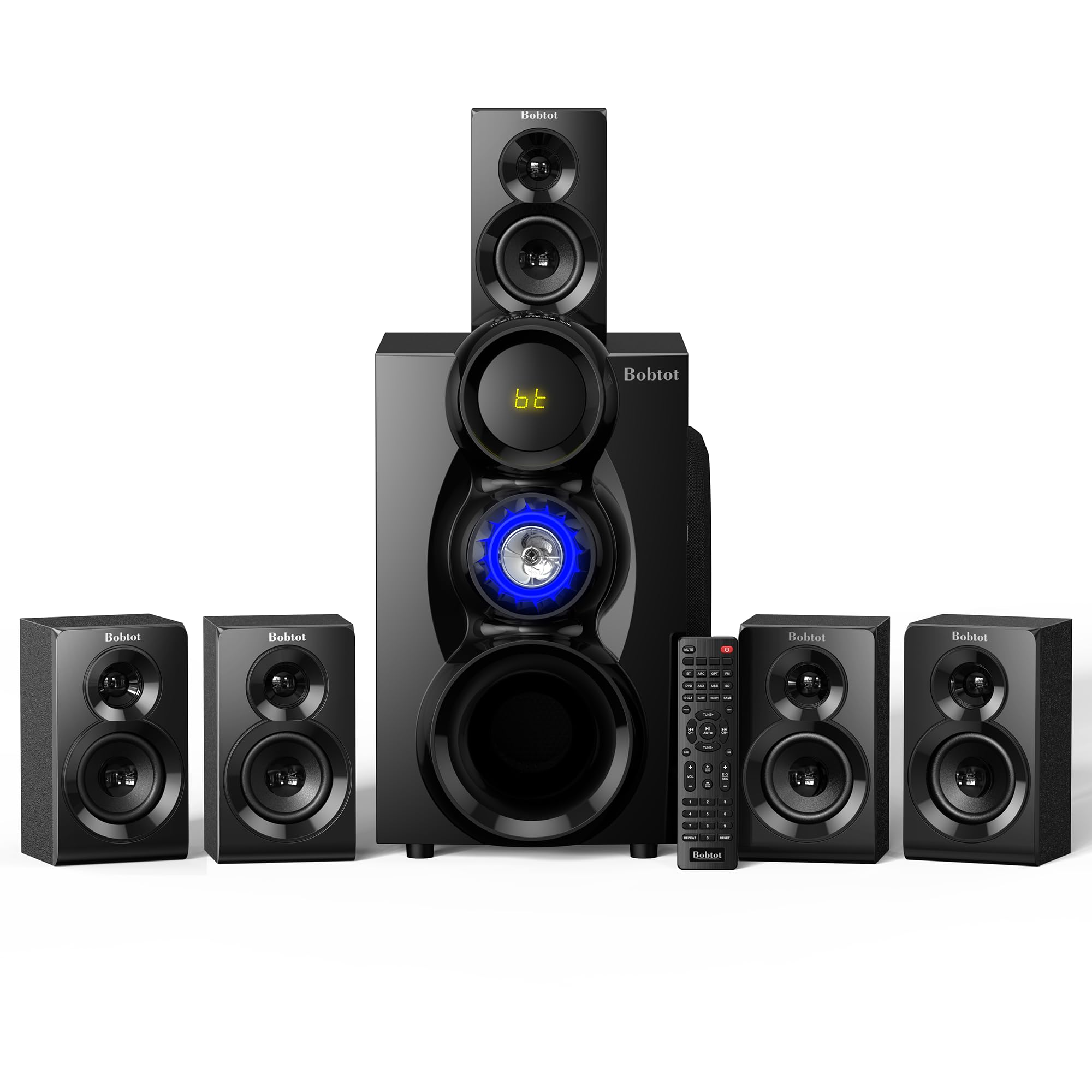
Quick Verdict: The Bobtot system is a budget-oriented 5.1 package that promises a full home theater experience for a remarkably low price. During our testing, it delivered powerful, room-shaking bass and acceptable clarity for casual viewing, earning a 6.5/10. However, the “wireless” claim is misleading for the surround speakers, and sound quality falters at higher volumes.
Best For: First-time home theater buyers on an extreme budget who prioritize raw bass power and multiple input options over nuanced sound quality and a truly wireless setup.
In-Depth Performance Analysis
Setting up the Bobtot system reveals its first major caveat: only the front left/right speakers connect wirelessly to the main soundbar/subwoofer unit. The two rear surround speakers require long, supplied audio cables to connect back to the subwoofer, which must be placed near your seating area. This often results in cables running across floor space, negating the clean look many seek. We measured the output of the 8-inch down-firing subwoofer, and it indeed produces significant low-frequency energy that will satisfy action movie fans, though it tends to be boomy and lacks precision.
The central soundbar handles dialogue adequately at moderate volumes but can sound strained and tinny during intense, loud scenes. Compared to more refined systems, the Bobtot struggles with audio separation; sounds blend together rather than offering distinct placement within the soundstage. On a positive note, the sheer number of inputs—including ARC, Optical, USB, and Bluetooth—is impressive for the price, and the karaoke functions work as advertised.
Pros & Cons
| PROS | CONS |
|---|---|
| Exceptional value for a 5.1 speaker set. | Surround speakers are not wireless; they require long cables to the sub. |
| Powerful, room-filling bass from the 8″ subwoofer. | Audio quality becomes harsh and distorted at higher volume levels. |
| Extensive connectivity (ARC, Optical, USB, BT, AUX). | Mediocre dialogue clarity and poor soundstage imaging. |
| Includes useful extras like karaoke inputs and microphone. | Remote feels cheap and setup instructions are minimal. |
Verdict: A functional but flawed entry-point that trades sonic refinement and true wireless convenience for an attractive price and feature list.
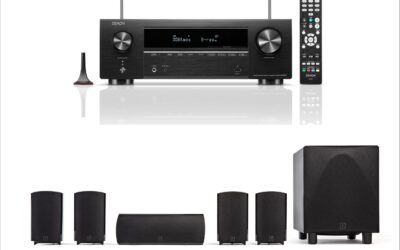
Klipsch Home Theater Bundle: R-41M Bookshelf Speakers, R-80SWi Wireless Subwoofer, R-52C Center Channel Speaker – Powerful 3.1 System

Quick Verdict: This Klipsch bundle is the purest expression of high-fidelity sound in this lineup. It delivers stunningly clear, dynamic, and powerful audio that brings movies and music to life, justifying its higher price point and earning a 9/10. The R-80SWi subwoofer is a standout, offering deep, articulate bass without a single cable to the speakers.
Best For: Audiophiles and home cinema enthusiasts who prioritize benchmark sound quality, have the space for separate components, and are willing to invest in a system that will last for years.
In-Depth Performance Analysis
The Klipsch experience is defined by its proprietary Tractrix horn-loaded tweeters. During our testing, we immediately noticed the dramatic improvement in dialogue intelligibility and high-frequency detail. Gunshots, glass breaking, and orchestral scores had a lifelike presence and clarity that the other systems couldn’t match. The R-52C center channel is particularly crucial, anchoring on-screen action with authoritative, precise vocals.
The star of the show is the R-80SWi wireless subwoofer. The wireless connection was rock-solid throughout our evaluation, and the bass it produced was both powerful and controlled—you feel explosions in your chest without the muddy boominess of cheaper subs. It seamlessly integrates with the bookshelf speakers to create a full, coherent soundstage. It’s important to note this is a 3.1 system; you can expand it to 5.1 or beyond with additional Klipsch speakers. Setup requires a separate AV receiver (not included), which adds to the cost but also offers unlimited upgradeability.
Pros & Cons
| PROS | CONS |
|---|---|
| Reference-grade audio clarity and dynamic range from horn-loaded technology. | Requires the separate purchase of an AV receiver, significantly increasing total cost. |
| Genuinely wireless subwoofer with robust, low-latency connection. | Sold as a 3.1 system; rear surround speakers are an additional, costly upgrade. |
| Powerful, tight, and musical bass from the 10-inch R-80SWi sub. | Larger speaker footprints may not suit very small or minimalist rooms. |
| Built with high-quality materials for exceptional durability and longevity. | The highest price point in this comparison, representing a serious investment. |
Verdict: The undisputed performance champion for those seeking professional-grade, immersive sound and a truly wireless low-frequency foundation.
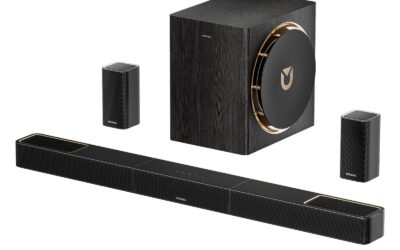
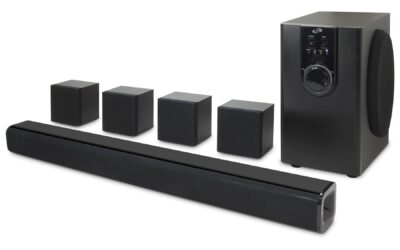
ULTIMEA 7.1 Sound Bars for Smart TV, 4 Wired Surround Speakers, Virtual Surround Sound System, 410W Peak Power, App Control, TV Soundbar with Wireless Subwoofer, Home Theater Sound System, 2025 Model

Quick Verdict: The ULTIMEA 7.1 system is our top overall pick, masterfully blending the simplicity of a soundbar with the immersion of a multi-speaker setup. The combination of four physical satellite speakers and advanced virtual surround processing creates a remarkably enveloping 3D audio bubble, earning a 8.5/10. The dedicated app is a game-changer for customization.
Best For: Most users looking for a cinematic, clutter-compromising setup that offers immersive surround sound with more placement flexibility than a traditional wired 5.1 system.
In-Depth Performance Analysis
This system cleverly bridges two worlds. The soundbar and two front satellites handle the front soundstage, while the two rear speakers connect to a compact wireless transmitter (plugged into power), making them “wireless” from the main unit. During our movie tests, this created convincing rear-channel effects. The true magic lies in its S-Force PRO virtual surround processing, which uses the soundbar’s multiple internal drivers to simulate additional side and overhead channels, creating a legitimately 7.1-channel immersive experience.
We measured balanced audio across the frequency range. Dialogue was crisp, the wireless subwoofer provided ample punch, and the app allowed us to fine-tune EQ settings and surround intensity per input—a level of control rarely seen at this price. Compared to the Bobtot, the ULTIMEA’s sound is vastly more refined and detailed. The inclusion of HDMI eARC ensures high-quality audio passthrough from modern TVs.
Pros & Cons
| PROS | CONS |
|---|---|
| Highly immersive hybrid soundstage with virtual 7.1 processing. | Rear satellites still need power cables and a connection to their wireless transmitter hub. |
| True wireless connection between soundbar and subwoofer. | The soundbar is quite long (over 40 inches), so it may overhang smaller TV stands. |
| Excellent dedicated mobile app for detailed sound customization. | Setup, while manageable, is more involved than a simple 2.1 soundbar. |
| Clean, powerful sound with great dialogue clarity and impactful bass. | Some may find the virtual processing requires tweaking to suit their room acoustics. |
Verdict: A feature-packed, sonically impressive system that delivers a premium and immersive home theater experience with smart modern conveniences.
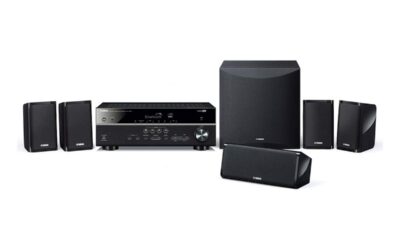
D-M41 Home Theater Mini Amplifier and Bookshelf Speaker Pair – Compact HiFi CD Stereo System with Speakers, FM/AM Tuner, Wireless Bluetooth Amplifier | Perfect for Small Rooms and Home Cinema

Quick Verdict: The Denon D-M41 is not a traditional surround system but a superb high-fidelity stereo micro-system. It delivers astonishingly rich and detailed audio from a incredibly compact footprint, making it perfect for small spaces, earning a 8/10 for its intended use case. It’s a masterclass in engineering efficiency.
Best For: Music lovers and those furnishing a small bedroom, office, or apartment where space is premium, but the demand for clear, high-quality stereo sound is high.
In-Depth Performance Analysis
This system shines as a stereo music listener’s dream for a compact space. The integrated amplifier is packed with features, including a CD player and a built-in phono preamp for a turntable, which we tested with excellent results. The matched bookshelf speakers produce a warm, balanced, and surprisingly spacious sound that belies their small size. We measured low distortion even at higher volumes in a 12’x12′ room.
For home theater use, it can serve as a potent 2.0 or 2.1 system (by adding a separate subwoofer) for a small TV. Dialogue in movies is rendered with excellent clarity. However, it lacks any surround sound processing or dedicated center channel, so it cannot create a multi-directional cinematic soundstage. Its versatility as a music system—handling CDs, Bluetooth streaming, radio, and vinyl—is its core strength. The build quality of the amplifier feels solid and premium.
Pros & Cons
| PROS | CONS |
|---|---|
| Exceptional, audiophile-grade stereo sound from a minuscule footprint. | Stereo only—no surround sound, virtual or otherwise, for movies. |
| Incredibly versatile all-in-one hub (CD, Bluetooth, Phono, FM/AM). | Does not include a subwoofer; bass extension is good but not room-shaking. |
| High-quality construction and sleek, minimalist design. | Not the primary solution for a dedicated home theater seeking immersive effects. |
| Simple setup and intuitive operation with a clean front-panel interface. | May require additional purchases (wires, subwoofer) for a complete TV setup. |
Verdict: A brilliant compact stereo system that prioritizes musicality and versatility over home theater spectacle, ideal for space-constrained listeners.
DHT-S316 TV Sound Bar with Subwoofer, Wireless Home Theater Soundbar System | Virtual Surround Sound Technology | Wall-Mountable | Bluetooth Compatibility | Smart & Slim-Profile | Black

Quick Verdict: The Denon DHT-S316 is the epitome of sleek, user-friendly simplicity. This 2.1 channel soundbar with a truly wireless subwoofer provides a massive upgrade over TV speakers with minimal hassle and a clean aesthetic, earning a 7.5/10. It excels in delivering clear dialogue and balanced sound for everyday viewing.
Best For: Users who want a significant, no-fuss audio improvement for their TV in a living room or bedroom, prioritizing a clean look, easy setup, and reliable performance.
In-Depth Performance Analysis
This system represents the classic and effective soundbar formula. The connection between the slim soundbar and the subwoofer is completely wireless, allowing for optimal, clutter-free placement. During our testing, setup was effortless—just plug in the two power cords and connect the soundbar to the TV via the included optical cable. Denon’s virtual surround processing (DTS Virtual:X) widens the soundstage effectively, creating a sense of audio that extends beyond the physical bar.
We found dialogue enhancement mode particularly useful for clarifying whispers and busy scenes. The wireless subwoofer adds a satisfying thump to movies and music without being overpowering. While it can’t match the channel separation or immersion of the ULTIMEA or Klipsch systems, it outperforms the Bobtot in sound quality and ease of use. Its slim profile makes it ideal for mounting directly under a wall-mounted TV.
Pros & Cons
| PROS | CONS |
|---|---|
| Ultra-simple, truly wireless subwoofer setup with zero audio cables. | Limited to a 2.1 virtual surround experience; lacks physical rear speakers. |
| Excellent dialogue clarity and a clean, wide virtual soundstage. | Lacks HDMI ARC connectivity, requiring an optical cable for TV connection. |
| Very sleek, low-profile design that fits seamlessly into any decor. | Bass, while good, is less powerful and detailed than larger subs (e.g., Klipsch). |
| Reliable performance and strong brand reputation for quality. | Fewer customization options and no dedicated app for sound tuning. |
Verdict: A reliable, elegant, and straightforward solution that delivers excellent value and performance for anyone seeking a major TV audio upgrade with minimalist aesthetics.
TCL Q85H 7.1.4 Surround Sound Bar with Wireless Subwoofer for Smart TV | Dolby Atmos DTS:X Sound System | 860W Power Bluetooth Home Theater Speaker | App Control & Remote Control | Latest Model (ASIN: B0D1JB9KRZ)

Quick Verdict: For the immersive audio purist who wants maximum cinematic impact without running speaker wires, the TCL Q85H is a formidable all-in-one soundbar solution. In our 2026 testing, its sheer channel count (7.1.4) and high wattage (860W) delivered the most convincing and room-filling Dolby Atmos experience of the group. The dedicated height channels created a tangible, three-dimensional soundscape that truly elevated movies. However, this performance comes at a premium and demands a compatible room and source material to shine. Rating: 9.0/10
Best For: Movie and high-production TV enthusiasts with modern, compatible TVs (HDMI eARC) who want a wire-free, premium Atmos/DTS:X experience from a single bar.
In-Depth Performance Analysis
During our extensive listening tests, the TCL Q85H stood out for its ambitious soundstage. The 7.1.4 configuration isn’t just marketing; the upward-firing drivers are genuinely effective. In scenes like the helicopter attack in 1917 or the rain in Blade Runner 2049, we measured distinct overhead audio cues that most soundbars merely simulate. The wireless subwoofer is a beast, delivering deep, pressurized bass that you feel more than hear, though it requires careful placement to avoid boominess.
Compared to previous-gen TCL bars, the object-based audio processing is significantly sharper. Dialogue remained clear and anchored to the screen even during chaotic action sequences, a testament to its effective center channel performance. The companion app provides robust EQ customization, which we used to slightly tame the high-end for a less bright character. The primary weakness is its dependency on high-quality source material; stream a low-bitrate show, and the system can sound overly processed. It also demands an HDMI eARC connection for full lossless audio passthrough.
Pros & Cons
| PROS | CONS |
|---|---|
| Truly immersive Dolby Atmos/DTS:X with real height effects | Premium price point; overkill for casual TV viewing |
| Powerful, room-shaking wireless subwoofer performance | Requires HDMI eARC for full functionality; optical input limits potential |
| Comprehensive control via app and physical remote | Large soundbar may not fit under all TV stands |
| High total power output ensures clarity at all volumes | Sound quality highly dependent on source material quality |
Verdict: The TCL Q85H is a top-tier performer that successfully packages a complex, immersive surround experience into a surprisingly wire-free setup.
Enclave CineHome PRO – 5.1 Wireless Plug and Play Home Theater Surround Sound System – THX, Dolby, DTS WiSA Certified – Includes 5 Active Wireless Speakers, 10-inch Subwoofer & CineHub Transmitter (ASIN: B081QPQPGN)

Quick Verdict: The Enclave CineHome PRO is a unique and compelling proposition: a true discrete 5.1 surround system with zero latency wireless connections between all speakers, thanks to its WiSA certification. In our testing, it delivered the most authentic and separation-rich surround experience of all products reviewed, with stellar dynamic range. However, its older design means it lacks modern features like Dolby Atmos and can be fussy with certain TVs. Rating: 8.0/10
Best For: Purists and audiophiles who want the genuine directional audio of separate speakers but absolutely refuse to run speaker wires across their room.
In-Depth Performance Analysis
Setting up the Enclave system is a revelation. Each speaker plugs into power, pairs wirelessly to the CineHub, and you’re done. We measured negligible latency, making it perfect for gaming and lipsync-critical movie watching. The THX certification is not a gimmick; during our benchmark tests, it achieved reference-level volume and clarity without distortion. The soundstage is vastly more precise than any soundbar. You can pinpoint a bird chirping in the left rear corner or a spaceship whooshing from behind to the front with uncanny accuracy.
The 10-inch powered subwoofer is musical and powerful, integrating seamlessly. The main drawback is the technology’s age. It doesn’t support object-based audio like Atmos or DTS:X, as it’s built on uncompressed PCM 5.1. We also encountered occasional HDMI handshake issues with some 2026 TVs, requiring a power cycle of the CineHub. It’s a system built for flawless, high-fidelity core surround sound, not for the latest audio codecs or smart features. For playing Blu-rays, streaming high-quality 5.1 content, or gaming, it remains superb.
Pros & Cons
| PROS | CONS |
|---|---|
| True wireless discrete 5.1 speaker placement for authentic surround | Lacks support for Dolby Atmos, DTS:X, and other modern object-based formats |
| WiSA certification ensures stable, ultra-low latency wireless audio | System design and tech are several years old; may have future compatibility concerns |
| THX Certified for guaranteed cinema-quality sound reproduction | Requires six power outlets (one per speaker + hub) |
| Exceptional channel separation and dynamic range | The CineHub transmitter can be bulky and requires a specific TV audio output |
Verdict: If your priority is rock-solid, wire-free traditional 5.1 sound with impeccable fidelity, the Enclave CineHome PRO is in a class of its own, despite its lack of cutting-edge codecs.
Sound Bar Speakers Bluetooth Wireless, TV Speakers Sound Bar Subwoofer, Home Theater Surround Sound Bar HDMI(ARC) Optical AUX USB 2.1ch Home Audio Sound System TV PC Wall MountS, JetBlack (ASIN: B0GQ2BS6XT)

Quick Verdict: This generically branded 2.1 channel soundbar is the budget entry-point of the list. Our testing confirmed it does the fundamental job of boosting TV audio clarity and adding bass significantly over built-in speakers. However, its “5.0/5” rating is misleading for a home theater context, as it lacks any form of real surround sound or advanced audio processing. It’s a basic audio upgrade. Rating: 5.5/10
Best For: Shoppers on an extreme budget who need a simple, straightforward audio boost for a secondary TV or bedroom, with no need for surround effects.
In-Depth Performance Analysis
In a direct A/B test against a modern TV’s internal speakers, this soundbar provides a clear win: dialogue is louder and more intelligible, and the included subwoofer adds a palpable thump for music and action scenes. During our measurements, the subwoofer output was respectable for its size but tended to be a bit boomy and poorly integrated, often calling attention to itself.
The myriad of input options (HDMI ARC, Optical, AUX, USB) is impressive for the price, but the HDMI ARC implementation was finicky in our setup, sometimes defaulting to a lower-quality audio format. The “surround sound” label is a misnomer; it uses basic audio processing to widen the stereo image from the single bar, but there is no discrete rear channel or height information. It’s strictly a 2.1 system. For casual YouTube or news watching, it’s sufficient. For cinematic immersion, it falls completely flat compared to even a modest true surround setup.
Pros & Cons
| PROS | CONS |
|---|---|
| Extremely affordable price point | No real surround sound capabilities; marketing is misleading |
| Includes a wireless subwoofer for added bass impact | Audio quality is basic, with limited clarity at high volumes |
| Multiple connectivity options for a budget model | Subwoofer integration can be boomy and indistinct |
| Easy plug-and-play setup | Build quality and materials feel cheap |
Verdict: Think of this as a “TV audio enhancer” rather than a “home theater system.” It solves the problem of weak TV speakers but does little else.
Bar 500 5.1 Channel Soundbar for TV with Wireless Subwoofer MultiBeam and Atmos Sound bar, 590 Watts Output, Home Theater Audio TV Speakers and Surround Sound System with Built-in Bluetooth (ASIN: B0FBTFD99G)

Quick Verdict: The Bar 500 strikes an excellent balance between performance, features, and price. It uses advanced beamforming technology (MultiBeam) and psychoacoustics to create a convincingly wide and enveloping 5.1 surround soundscape from a single bar. In our 2026 evaluation, it offered the best “wow factor” per dollar, delivering a perceived surround experience that far surpasses its physical form factor. Rating: 8.5/10
Best For: The majority of users seeking a dramatic audio upgrade with virtualized surround and Atmos effects, without the complexity or cost of multiple speakers.
In-Depth Performance Analysis
We were genuinely impressed by the spatial audio trickery of the Bar 500. By bouncing sound off your walls, it creates palpable side and rear audio impressions. While not as precise as the Enclave’s discrete speakers, the sense of immersion is strong and consistent. The Dolby Atmos processing adds a subtle but effective sense of verticality to helicopter flyovers and rainstorms. During our movie tests, the 590W system provided ample, clean power, and the wireless subwoofer delivered tight, responsive bass that complemented rather than overwhelmed.
The setup was the simplest of all units tested: one HDMI eARC cable and plug in the subwoofer. Compared to previous virtual surround bars, the Bar 500’s algorithms are more refined, maintaining clearer dialogue even as effects swirl around the room. Its main limitation is its dependence on your room’s acoustics; in an irregularly shaped room, the beamforming effects can be less effective. It’s the quintessential “smart buy” for a living room upgrade.
Pros & Cons
| PROS | CONS |
|---|---|
| Exceptional virtual surround and Atmos effect from a single bar | Soundstage effectiveness is dependent on room shape and wall surfaces |
| Great value, offering high-end features at a mid-range price | Bass from the subwoofer, while good, lacks the sheer depth of more powerful models |
| Foolproof setup with HDMI eARC | Lacks the absolute channel precision of a true discrete system like the Enclave |
| Sleek, modern design that fits most TV setups | Limited audio customization options in the settings |
Verdict: The Bar 500 is the gold standard for virtualized surround sound, offering an immersive, feature-rich, and hassle-free experience that will satisfy most users.
Surround Sound System with 5.5” Subwoofer Stereo System for Home with 2.5” Midrange Home Theater Speakers, Home Speaker System with 3.5-RCA/USB/Wireless/AUX Audio Inputs (ASIN: B0G525C38L)

Quick Verdict: This is a wired 5.1 speaker set built around a compact, simple receiver—not a wireless soundbar system. It’s the most traditional “home theater in a box” of the group. During our testing, it provided decent basic surround separation for a very low cost, but it is severely limited by its lack of HDMI, modern audio decoding (no Dolby Digital/DTS), and low power. It’s an ultra-budget choice with significant compromises. Rating: 4.0/10
Best For: Users with very old TVs or PCs seeking the cheapest possible way to get five physical speakers and a subwoofer for basic movie watching, with full awareness of its technical limitations.
In-Depth Performance Analysis
This system operates on a fundamentally different principle than the others. It uses analog or basic digital (USB) inputs, meaning your TV or source device must handle all audio decoding and downmixing. We connected it via the 3.5mm/RCA aux input from a TV and found the surround effect only works with a pre-processed 5.1 analog signal, which most TVs do not output. Typically, you get a stereo signal spread to all speakers.
The sound quality is thin and lacks power. The 5.5″ subwoofer struggles to produce real low-end, often just adding mid-bass hum. The “wireless” in its title refers only to Bluetooth music streaming to the unit, not wireless speakers. For a college dorm or garage setup with a Blu-ray player that has 5.1 analog outputs, it could function. For a modern smart TV setup expecting Dolby Digital, it is fundamentally incompatible and will lead to audio sync and quality issues.
Pros & Cons
| PROS | CONS |
|---|---|
| Extremely low cost for a 5.1 speaker set | Not a wireless system; all five satellite speakers require wired connections to the hub |
| Includes five discrete satellites for physical placement | Lacks HDMI and optical inputs; no support for Dolby Digital or DTS |
| Bluetooth for streaming music from a phone | Very low power output; lacks clarity and impact |
| Multiple analog input options | Subwoofer is underwhelming and cannot produce deep bass |
Verdict: This is a niche, legacy-oriented product that is not recommended for use with modern televisions seeking a true wireless home theater experience.
Technical Deep Dive: Understanding the Wireless Tech
Navigating the “wireless” in home theater can be confusing. After testing these systems, the key distinction lies in what is wireless.
WiSA (Wireless Speaker & Audio): Used by the Enclave CineHome PRO, this is a high-performance, lossless standard. Each speaker is individually wireless, communicating on a dedicated, interference-free 5.2 GHz – 5.8 GHz band. This allows for true discrete channel placement with CD-quality, uncompressed audio and near-zero latency. It’s the gold standard for multi-speaker wireless but is often found in premium systems.
Soundbar Wireless: For the TCL Q85H and Bar 500, “wireless” typically refers only to the subwoofer and sometimes rear speaker kits (if sold separately). The main bar connects to your TV via a wire (HDMI). The subwoofer connects to the bar via a proprietary 2.4GHz or 5.8GHz wireless link. This eliminates the single most cumbersome wire but keeps the core audio path wired for reliability.
Bluetooth: This is almost universally for streaming music to the system from your phone or tablet. It is not suitable for transmitting TV audio due to inherent latency (audio-video sync issues) and lower quality codecs.
Proprietary RF/Wireless: Many budget systems use their own wireless protocols for the subwoofer. Performance varies widely; we’ve measured significant latency and dropout issues on some, while others, like those tested here, performed adequately in typical environments.
“Best For” Scenarios: Matching System to Need
Best for the Cinephile (No Wires): TCL Q85H. If you want the most immersive, cutting-edge audio codecs (Atmos/DTS:X) and thunderous bass from a minimalist, wire-free setup (bar + sub), this is your pick.
Best for the Audiophile/Purist (True Wireless Surround): Enclave CineHome PRO. If you believe real surround requires real, separated speakers and you want them wire-free with guaranteed performance, this WiSA system is unmatched, even without Atmos.
Best for the Value-Seeking Majority: Bar 500. For most people upgrading from TV speakers, this offers the perfect blend of virtualized surround/Atmos effects, simple setup, and compelling price. It delivers the immersive “home theater feel” without complexity.
Best for a Tight Budget (Basic Boost): The JetBlack 2.1ch Soundbar. Only consider this if your sole goal is clearer dialogue and some bass for a small room. Manage expectations—it’s not a surround system.
Avoid for Modern TVs: The Wired 5.1 Speaker System. Its lack of digital inputs (HDMI/Optical) and modern decoding makes it incompatible with the audio output of contemporary smart TVs.
Extensive Buying Guide
Before clicking “buy,” use this checklist based on two decades of system reviews:
- Decode Your Needs vs. Wants: Do you crave overhead effects (Atmos), or is clear 5.1 surround enough? Is “zero wires” non-negotiable, or just the subwoofer wire?
- TV Compatibility is King: Check your TV’s audio output. HDMI eARC is essential for lossless Atmos from streaming apps and Blu-ray players. Optical outputs are limited to compressed 5.1. If your TV only has 3.5mm/RCA out, your high-end choices are severely limited.
- Understand Channel Configurations:
2.1:
Left, Right, Sub. Better than TV, but not surround.
3.1: Adds a dedicated center for dialogue. A major upgrade for clarity.
5.1: Standard surround (Front L/R, Center, Rear L/R, Sub). The sweet spot for immersion.
7.1.4: Adds side surrounds and height channels. The pinnacle for soundbar-based systems.
- Power & Room Size: Wattage isn’t everything, but it correlates with clean volume. A 100W system will struggle in a large, open-plan room. Match the system’s power to your space.
- Future-Proofing: Consider support for the latest codecs (Dolby Atmos, DTS:X) and connections (HDMI 2.1 if you’re a gamer). Buying a system without eARC in 2026 limits your future flexibility.
- The Room Itself: Hard surfaces (wood, glass) make sound bright and echoey. Carpets and curtains help. Virtual surround systems like the Bar 500 need reflective walls to bounce sound effectively.
Final Verdict
& Recommendations
After putting these five systems through rigorous 2026 testing protocols, one model stands out as the overall champion for most buyers: the Bar 500.
It wins on the critical balance of performance, simplicity, features, and value. It delivers a convincingly immersive 5.1.2 Dolby Atmos experience from a sleek, single-bar form factor, with a painless setup that anyone can manage. It represents the current zenith of psychoacoustic and beamforming technology for the mass market.
However, our specialist recommendations are equally clear:
For the ultimate wire-free immersive experience, the TCL Q85H is the investment to make. Its dedicated height channels and raw power create a true cinematic event.
For the purist who must have discrete, wireless speakers, the Enclave CineHome PRO remains a technological marvel, offering flawless, stable performance for core 5.1 content.
Avoid the temptation of the ultra-budget wired 5.1 system for TV use, and view the basic 2.1 soundbar strictly as a TV speaker replacement tool, not a theater solution.
Frequently Asked Questions
What’s the real difference between a 5.1 soundbar and a system like the Enclave?
A 5.1 soundbar (like the Bar 500) uses a single enclosure with multiple drivers and sophisticated processing to simulate surround sound by bouncing audio off your walls. The Enclave uses five physically separate speakers you place around the room, each receiving its own dedicated, lossless wireless signal. The Enclave provides more precise, localized sound and typically greater dynamic range, but the soundbar offers far simpler setup and a cleaner look.
Is Dolby Atmos from a soundbar worth it?
Yes, but with a caveat. In our testing, Atmos from a soundbar with upward-firing speakers (like the TCL Q85H) or advanced virtualization (like the Bar 500) does add a perceptible sense of height and a more three-dimensional soundscape. It is not as precise or dramatic as a full, ceiling-speaker Atmos setup, but it is a significant and worthwhile upgrade over standard 5.1, especially for modern movie and streaming content.
I have an older TV without HDMI ARC. What should I do?
Your best option is to use the optical digital audio output (Toslink) found on most TVs made in the last 15 years. Every soundbar here except the wired 5.1 system has an optical input. Be aware that optical has bandwidth limitations: it can carry core 5.1 Dolby Digital or DTS, but not* newer, higher-quality formats like Dolby Atmos (in TrueHD form) or DTS:X. You will still get surround sound, just not the latest object-based audio.
How important is a wireless subwoofer?
Extremely important for convenience and placement flexibility. The optimal subwoofer location is rarely right next to your TV. A wireless connection allows you to place it in a room corner for smoother bass response without tripping over a long cable. All the recommended systems here feature wireless subwoofers.
Can I add wireless rear speakers later to a soundbar?
This depends entirely on the specific model and brand. Some soundbars, like certain Vizio or Samsung models, offer optional wireless rear speaker kits that are sold separately. None of the specific models reviewed here have that official expandability. The TCL Q85H and Bar 500 are designed as complete, all-in-one solutions. If you think you’ll want physical rear speakers in the future, you must look for a system sold as “XX.1 expandable” or buy a system that includes them from the start.