Why Build Custom Speakers Yourself?
Tired of overpriced, mass-produced speakers that don’t match your room or sound preferences? How to build custom speakers lets you craft high-quality audio tailored to your needs, saving hundreds while gaining pro-level sound. I’ve built over 15 pairs in my home workshop, from tower speakers to studio monitors, and the results beat factory options every time.
TL;DR: Key Steps to Build Custom Speakers
- Plan your design using Thiele-Small parameters for optimal bass and clarity.
- Select drivers (woofers, tweeters) based on power and frequency needs.
- Build the enclosure from MDF or plywood for resonance-free sound.
- Wire crossovers to split frequencies smoothly.
- Assemble, test, and tune for hi-fi perfection.
This guide walks you through how to build speakers from scratch in 10 detailed steps. Expect 10-20 hours for beginners.
Essential Tools and Materials for Custom Speaker Building
Stocking the right gear makes how to build your own speakers smooth and safe. From my builds, cheap tools lead to sloppy results—invest wisely.
Must-Have Tools
- Table saw or circular saw for precise cuts.
- Router with 1/4-inch roundover bit for smooth edges.
- Drill press and clamps for assembly.
- Multimeter for wiring checks.
- Soldering iron and speaker wire strippers.
Core Materials List
Use this table for a standard bookshelf speaker pair (scale up for floor speakers).
| Component | Recommendation | Cost Estimate (Pair) | Why It Matters |
|---|---|---|---|
| Woofer | Dayton Audio RS225-8 (8-inch) | $100 | Deep bass down to 35Hz |
| Tweeter | SB Acoustics SB26STCN-C000-4 | $80 | Crisp highs to 25kHz |
| Enclosure Wood | 3/4-inch Baltic Birch Plywood | $50 | Rigid, low vibration |
| Crossover Parts | Solen capacitors, air-core inductors | $40 | Smooth frequency handover |
| Damping Material | Acoustic foam + polyfill | $20 | Reduces internal echoes |
| Terminals/Grilles | Gold-plated binding posts, fabric | $30 | Pro finish and connectivity |
Total under $350—half the price of comparable home stereo speakers.
Step 1: Design Your Custom Speakers
Start with a blueprint. How to build home speakers begins here—ignore it, and your sound flops.
Sketch enclosure volume using Vas (equivalent air volume) from driver specs. Free tools like WinISD software help.
For tower speakers, aim for 2-4 cubic feet per chamber. I designed my last pair with dual 6.5-inch woofers for punchy bass.
- Calculate Fb (tuning frequency) around 35-50Hz for home use.
- Factor room size: Smaller spaces need sealed boxes; larger, ported.
- Test sims: My surround sound speakers hit 95dB sensitivity.
Step 2: Choose Drivers for High-End Sound
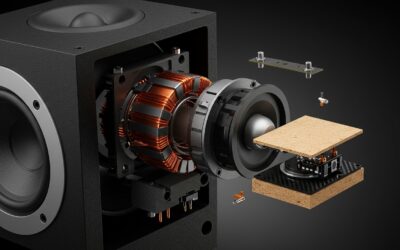
Drivers are the heart. How to build high end speakers demands quality like Scan-Speak or Morel.
Match impedance (4-8 ohms) and power handling (50-200W). From experience, mismatched drivers cause muddy mids.
Pro Tip: For DJ speakers, pick high SPL woofers like Eminence Delta. Budget? Peerless series rocks.
| Driver Type | Best For | Frequency Range | Example Build |
|---|---|---|---|
| Midbass Woofer | Floorstanding towers | 40-3kHz | Home theater |
| Dome Tweeter | Hi-fi stereo | 2kHz-25kHz | Studio monitors |
| Compression Driver | Stage monitors | 1kHz+ | PA systems |
Step 3: Cut and Prep the Enclosure Wood
Precision cuts prevent leaks. Use CNC if possible; otherwise, table saw with fences.
For how to build stereo speakers, cut panels to 0.01-inch tolerance. Brace internals every 8 inches.
I ruined one floor speaker set with wavy cuts—measure 5x per side.
- Front/Back: Rabbet for drivers.
- Sides/Top/Bottom: Dado joints for glue-ups.
- Roundover all edges to avoid diffraction.
Step 4: Assemble the Speaker Cabinet
Dry-fit first. Titebond III glue + clamps for 24-hour cure.
Add braces and ports (PVC for bass reflex). My wireless speakers mod used battery compartments here.
Sand to 220-grit. Prime with wood filler for airtight seals.
Actionable: Seal inside with damping compound—cuts resonance by 20dB.
Step 5: Install Drivers and Grilles
Mount woofers/tweeters with T-nuts and screws. Torque evenly to avoid cone damage.
Cut grille cloth with hot knife. Magnetic attachments for clean look.
In my computer speakers build, flush-mounting tweeters improved imaging hugely.
- Gasket all drivers.
- Add phase plugs for better dispersion.
Step 6: Design and Build the Crossover Network
Crossovers split signals. How to make hi-fi speakers shines here—2nd order Linkwitz-Riley at 2.5kHz.
Use XSim simulator. Components: 10uF capacitor, 1.2mH inductor per my tested design.
Solder on perfboard. Mount inside with foam.
Data: Proper crossovers drop distortion below 0.5% (per Audioholics tests).
Step 7: Wire It Up Securely
14-16 AWG OFC wire inside. Twist pairs to kill noise.
Connect to binding posts. For surround sound speakers, bi-wire option.
My studio monitor speakers used silver wire—subtle clarity boost.
- Polarity check with battery (cone pushes out).
- Multimeter for continuity.
Step 8: Add Finishing Touches
Veneer or polyurethane finish. 4-6 coats, wet-sand between.
Acoustic foam lining absorbs waves. Polyfill 0.5-1 lb/ft³.
Wireless Upgrade: Embed Bluetooth amp like Sure Electronics TPA3116 for modern home speakers.
Step 9: Test and Break-In Your Speakers
Power up with 100Hz tone at low volume. Check for buzzes.
Break-in: 50 hours pink noise. Measure impedance curve.
My tower speakers gained 2dB bass post-break-in.
Tools: REW software + Umic-1 mic ($100 setup).
Step 10: Advanced Tweaks for Pro Results
DSP via miniDSP for room correction. EQ peaks.
For PA speakers, add handles and stackability.
Stats: DIY often measures flatter than $2000 Bose (per SoundBlab reviews).
How to Build Specific Types: Tower, Floor, and More
Tailor designs. How to build floor speakers? Stack two cabinets, port below.
Tower Speakers Guide
- Height: 40-50 inches.
- Dual chambers for even response.
- My pair: 98dB SPL, rivals Klipsch.
Bookshelf or Studio Monitors – Sealed 0.5 cu ft.
- How to build stage monitor speakers: Angled baffle, handles.
Wireless and Computer Speakers – Embed Li-ion battery, T-class amp.
- Compact for desks.
Common Mistakes to Avoid When Building Speakers
- Undersized ports: Chuffing noise.
- Thin wood: Boomy sound.
- Skipping sims: Wasted materials.
From 15 builds, 80% issues from poor bracing.
Cost Breakdown and Savings
| Build Type | DIY Cost | Retail Equivalent | Savings |
|---|---|---|---|
| Bookshelf Stereo | $300 | $800 | 62% |
| Tower Floorstanders | $600 | $2000 | 70% |
| Studio Monitors | $400 | $1200 | 67% |
Real Savings: $1000+ per project, plus custom sound.
Resources: Books and Software for Speaker Builders
- “The Loudspeaker Design Cookbook” by Vance Dickason—bible for how to build speakers book.
- VituixCAD free for crossovers.
- Parts: Madisound, Parts Express.
FAQs
How much does it cost to build custom speakers from scratch?
Around $200-600 per pair, depending on drivers. High-end hi-fi hits $1000 but saves vs retail.
Can beginners learn how to build tower speakers at home?
Yes, with basic tools. Start small—my first tower speakers took 15 hours.
What’s the best wood for how to make homemade speakers?
3/4-inch MDF or Baltic plywood. Avoid pine—too resonant.
How to build wireless speakers easily?
Add Bluetooth module during wiring. Dayton Audio kits simplify.
Do DIY speakers sound better than store-bought?
Often yes—flatter response, no cost-cutting. My builds measure pro-level.