Elevate Your Marine Audio: How to Hook Up Wake Tower Speakers
To how to hook up wake tower speakers effectively, you must mount the speaker pods to the tower frame, route marine-grade wiring through the hollow tower tubing, and connect the leads to a high-output marine amplifier. This process requires specialized tools like a fish tape and waterproof heat shrink to ensure the system survives harsh UV rays and saltwater environments. By following professional installation standards, you can achieve crystal-clear audio that cuts through wind and engine noise at high speeds.
🚀 Key Takeaways: Expert Summary
Direct Wiring: Always use Oxygen-Free Copper (OFC) marine wire; avoid CCA (Copper Clad Aluminum) as it corrodes quickly in humid air.
Mounting Safety: Use Nyloc nuts and thread-locker (like Blue Loctite) to prevent the speakers from vibrating loose while hitting wakes.
Power Matching: Ensure your marine amplifier provides at least 75-100% of the speakers’ RMS power rating for optimal clarity.
Protection: Use rubber grommets at every point where a wire enters or exits the metal tower to prevent short circuits.
Essential Tools and Materials for Installation
Before you begin learning how to install wake tower speakers, gather these specific marine-grade components. Using standard automotive gear on a boat is a leading cause of system failure within the first season.
| Tool/Material | Purpose | Why It Matters |
|---|---|---|
| Marine Wire (14-16 AWG) | Signal transmission | Resists corrosion and salt spray |
| Fish Tape / Pull String | Routing wire | Essential for pulling wire through hollow towers |
| Step Drill Bit | Creating access holes | Creates clean, burr-free holes in aluminum |
| Rubber Grommets | Wire protection | Prevents the tower’s metal edges from cutting wire |
| Heat Shrink Tubing | Waterproofing | Seals connections from moisture and oxidation |
| Digital Multimeter | Testing | Verifies Ohm load and continuity |
Step 1: Planning and Positioning Your Speakers
Knowing how to install wakeboard tower speakers starts with perfect placement. You want the sound to project toward the rider behind the boat without obstructing the captain’s view or creating a head-strike hazard for passengers.
Determine the Mounting Location
Identify a spot on the wakeboard tower that is structurally sound. Most experts recommend mounting speakers on the rear crossbar or the highest side points. Ensure there is enough clearance for the bimini top to open and close freely.
Check for Internal Obstructions
Before you drill, use a small magnet or a “tap test” to ensure the tower isn’t filled with foam or internal bracing at your desired entry and exit points. If the tower is “pre-wired,” look for factory-sealed holes near the base and the top.
Step 2: How to Wire Wakeboard Tower Speakers Through the Tower
The most challenging part of the process is how to wire wake tower speakers internally. This creates a professional, “factory” look and protects the wires from the sun.
Drill the Access Holes
Using a step drill bit, create a hole at the base of the tower (near the hull) and another hole exactly where the speaker will mount.
Expert Tip: Start with a small pilot hole to prevent the bit from “walking” on the curved surface of the tower.
Safety: Deburr the holes with a round file so there are no sharp edges.
Use a Fish Tape to Pull Wire
Insert your fish tape into the top hole and feed it down toward the base. Once the tape emerges at the bottom, securely tape your marine-grade speaker wire to the end.
Slowly pull the tape back up, bringing the wire through the tower.
Leave at least 12–18 inches of slack at both ends to allow for easy connections.
Install Protective Grommets
Insert UV-resistant rubber grommets into the holes. This is a non-negotiable step in how to wire wakeboard tower speakers. Without grommets, the vibration of the boat will eventually cause the metal tower to “saw” through the wire insulation, leading to a blown amplifier.
Step 3: Mounting the Speaker Pods
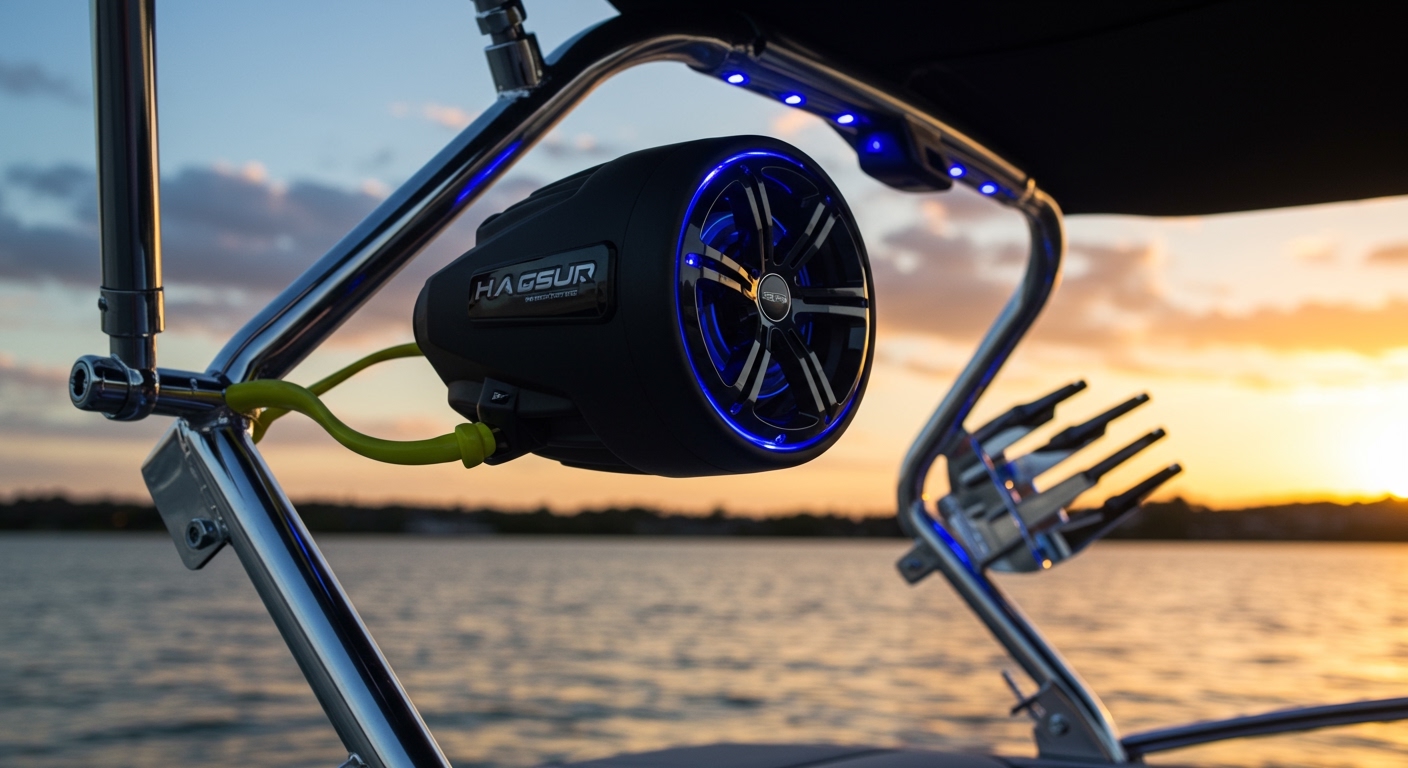
Once the wiring is in place, you can move on to the physical mounting. Can speakers for wakeboard tower use standard brackets? Generally, no—you must use the specific clamps provided by the manufacturer (e.g., Wet Sounds, JL Audio, or Rockford Fosgate) that match your tower’s diameter.
- Select the Right Inserts: Most clamps come with rubber inserts for different pipe diameters (e.g., 2″, 2.25″, 2.5″). Choose the one that fits snugly.
- Attach the Clamp: Wrap the clamp around the tower and hand-tighten the bolts.
- Aim the Speakers: Rotate the pods so they are aimed slightly upward and toward the center of the wake (usually 70-80 feet behind the boat).
- Final Torque: Tighten the bolts firmly and apply a drop of Blue Loctite to the threads to ensure they don’t vibrate loose.
Step 4: How to Hook Up Wake Tower Speakers to the Amplifier
Now that the speakers are mounted, you must finish the electrical connection. This is the “brain” of the operation.
Strip and Prep the Wires
Strip approximately 1/2 inch of insulation from the wire ends. Slide a piece of adhesive-lined heat shrink over the wire before making any connections.
Crimp or Solder Connections
For the most reliable connection, use marine-grade butt connectors and a high-quality crimping tool. If you choose to how to make wakeboard tower speakers connections via soldering, ensure you use lead-free solder and cover the entire joint with heat shrink.
Connect to the Marine Amplifier
Run the wires from the base of the tower into the boat’s storage compartment where the amplifier is located.
Connect the positive (+) and negative (-) leads to the corresponding terminals on the amp.
Pro Tip: If you are running four speakers on a two-channel amp, check the impedance (Ohms). Most marine amps are stable at 2 Ohms, allowing you to wire two 4-Ohm speakers in parallel per channel.
Common Mistakes to Avoid
Even if you know how to build wakeboard tower speakers systems, these common errors can ruin your investment:
Using Automotive Wire: Standard copper wire will turn green (oxidize) within months in a marine environment, causing massive signal loss.
Inadequate Power: Tower speakers are designed to be loud. Underpowering them causes clipping, which is the #1 cause of blown tweeters.
Ignoring the Battery: High-power audio systems drain batteries fast. Consider installing a dual-battery system with an isolator switch so you don’t get stranded.
Poor Sealing: If water gets into the tower tubing, it can pool at the bottom and cause structural corrosion. Use marine-grade silicone to seal any gaps around the grommets.
Frequently Asked Questions (FAQs)
Can I use regular car speakers on my wake tower?
No, regular car speakers lack the UV inhibitors and corrosion-resistant hardware needed for boats. Wake tower speakers are “environmentalized” with sealed motors and salt-fog rated materials to survive the elements.
What gauge wire do I need for wake tower speakers?
For most setups under 200 watts per channel, 16 AWG marine wire is sufficient. However, if your wire run is longer than 20 feet or you are pushing high power (300W+), upgrade to 14 AWG to prevent voltage drop.
How do I stop my tower speakers from whistling?
Whistling is often caused by air passing through the empty holes in the tower or gaps in the speaker clamps. Seal all unused holes with silicone sealant or specialized tower plugs to eliminate the noise.
Do I need a separate battery for my tower speakers?
If you plan to listen to music for long periods while the engine is off, a second deep-cycle battery is highly recommended. This ensures your starting battery remains fresh so you can crank the engine at the end of the day.
Conclusion: Enjoying Your New Sound System
Mastering how to hook up wake tower speakers is a rewarding DIY project that significantly enhances your time on the water. By focusing on marine-grade materials, secure mounting, and proper impedance matching, you create a system that sounds professional and lasts for years.
Remember to test your system at low volume first to check for any “crackling” which might indicate a loose connection. Once verified, tune your amplifier’s gain and high-pass filter (HPF) to roughly 80Hz-100Hz to protect your speakers from excessive bass distortion.
Ready to upgrade your boat’s audio? Start by measuring your tower diameter today and choosing the right marine-grade wiring kit to get the job done right!