How to Remove Ceiling Mounted Speakers: The Professional Guide
To remove ceiling mounted speakers, you must first pry off the protective grille, loosen the mounting screws (dog-legs) until the clamps retract, and carefully disconnect the speaker wiring. This process requires precision to avoid damaging the surrounding drywall or losing the cables inside the ceiling cavity.
Whether you are upgrading your audio system or learning how to remove ceiling speakers for painting, following a systematic approach ensures a clean removal without costly ceiling repairs.
Key Takeaways: Expert Summary
Difficulty: Easy to Moderate (DIY-friendly).
Time Required: 15–30 minutes per speaker.
Critical Tool: A grille removal tool or a bent paperclip to prevent scratching the frame.
Safety First: Always power down the amplifier or receiver before touching any internal wiring.
Pro Tip: Use painter’s tape to secure the speaker wires to the ceiling so they don’t disappear into the attic space.
Essential Tools and Materials
Before you begin, gather these specific tools. Using the correct equipment prevents the most common mistake: stripped screws and cracked gypsum board.
| Tool | Purpose | Recommended Type |
|---|---|---|
| Grille Hook | Pulls the metal mesh away from the frame | Small Allen wrench or bent paperclip |
| Phillips Screwdriver | Loosens the mounting “dog-leg” clamps | Manual #2 Phillips (Avoid high-torque drills) |
| Voltage Tester | Confirms no active current is running | Non-contact voltage pen |
| Painter’s Tape | Secures wires and protects the ceiling | Low-tack blue tape |
| Dust Mask/Goggles | Protects against falling insulation/debris | N95 or standard safety glasses |
Step 1: Power Down and Safety Preparation
Safety is the foundation of any home electronic project. Even though speaker wires carry low voltage, a short circuit can damage your audio receiver or amplifier.
Disconnect the Power
Turn off your audio system completely. For added safety, unplug the amplifier from the wall outlet. This prevents accidental signals from reaching the speaker while you are handling the bare copper leads.
Prepare the Workspace
Removing speakers often releases “attic dust” and fiberglass insulation. Lay a drop cloth directly beneath the speaker. If you are learning how to remove speakers from ceiling in a finished room, this step saves hours of cleaning later.
Step 2: Removing the Speaker Grille
The grille is the perforated metal or plastic cover that hides the internal components. This is often the most frustrating part of learning how to remove flush mount ceiling speakers.
How to Remove Round Ceiling Speakers’ Grilles
Most round ceiling speakers use a friction-fit or magnetic grille. Do not use a flat-head screwdriver, as this will dent the plastic flange or gouge the drywall.
- Insert the Hook: Take a small Grille Hook or a paperclip bent into a “U” shape.
- Find the Edge: Insert the hook into one of the small holes near the edge of the mesh.
- Pull Gently: Apply steady, even pressure toward yourself.
- Work the Perimeter: Move the hook around the circle, pulling slightly at different points until the grille pops out.
How to Remove Sonance Ceiling Speakers
If you are dealing with high-end models like Sonance, many use powerful magnets. For these, you can often use a suction cup tool or gently press on one side of the grille to see if the opposite side pivots outward.
Step 3: Loosening the Mounting Clamps (Dog-Legs)
Once the grille is off, you will see several Phillips head screws recessed into the speaker’s outer frame. These screws are connected to plastic “dog-legs” or clamps behind the drywall.
Identify the Screws
Look for the screws located on the outer perimeter of the speaker baffle. Do not confuse these with the smaller screws holding the tweeter or woofer in place.
The Reverse Rotation Method
Turn the screws counter-clockwise. As you turn, the plastic clamp behind the ceiling will rotate inward and move upward (away from the drywall).
Expert Insight: Stop turning once you feel the screw become “loose” or “floppy.” If you unscrew it entirely, the plastic clamp may fall off into the ceiling, making it difficult to reinstall the speaker later.
Step 4: Extracting the Speaker from the Ceiling
With the clamps retracted, the speaker should be free to move. However, years of heat or paint may have caused the gasket to stick to the drywall.
- Break the Seal: If the speaker is stuck, run a thin putty knife around the edge of the frame. This is a vital step when learning how to remove ceiling speakers for painting to prevent tearing the paper layer of the drywall.
- Lower Slowly: Support the weight of the speaker with one hand while using the other to guide it out of the hole.
- Watch the Crossover: Be careful not to snag the crossover network (the circuit board) on the edge of the cutout.
Step 5: Disconnecting the Wiring
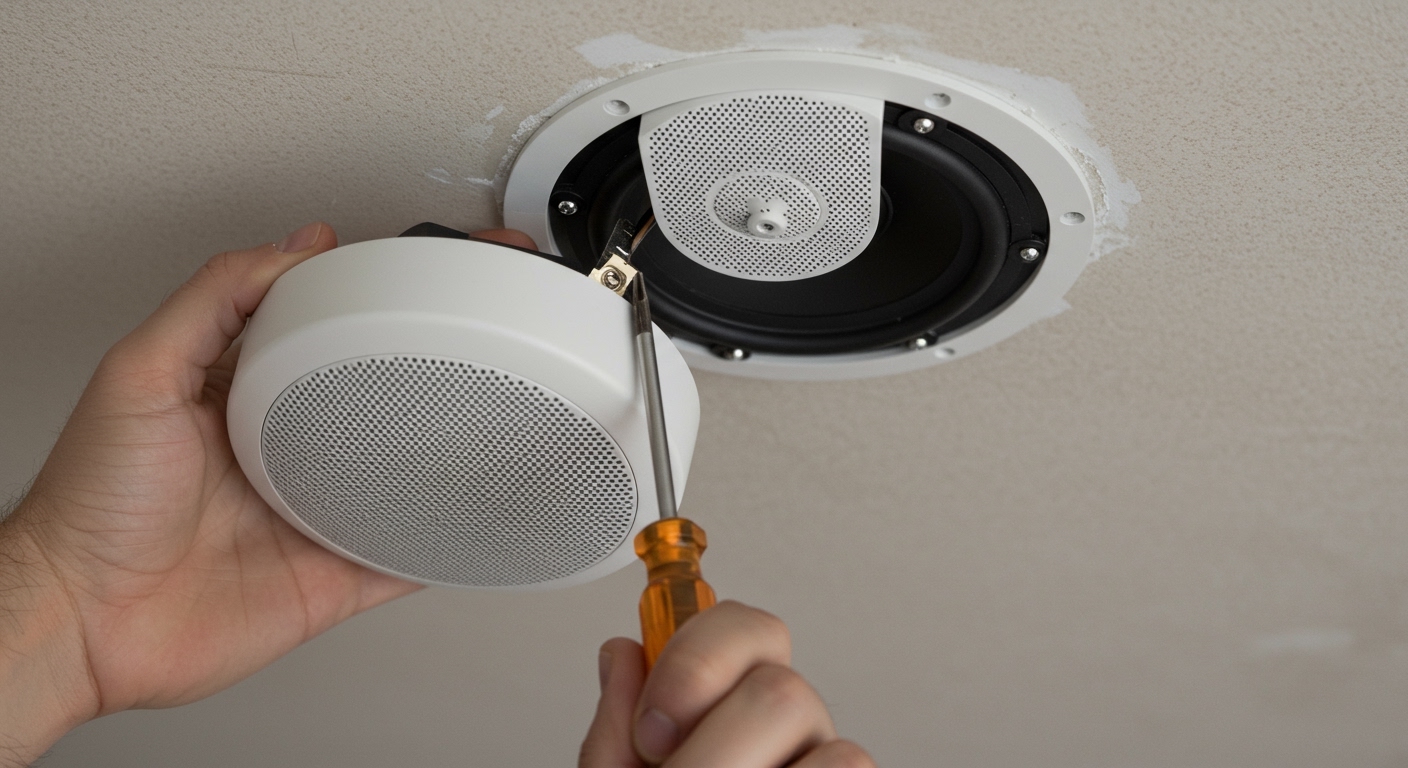
Now that the speaker is hanging, you will see two wires (usually Red/Positive and Black/Negative) connected to the terminals.
Press and Release
Most recessed ceiling speakers use spring-loaded terminals. Press down on the colored tab and pull the wire out.
Label Your Wires
If you plan on how to replace ceiling speakers with a new model, wrap a piece of painter’s tape around the wires. Mark them “Front Left,” “Kitchen 1,” etc. This ensures your phasing remains correct during the new installation.
Secure the Cables
CRITICAL: Do not let the wires fall back into the hole. Tape the wires to the outside of the ceiling or tie them to a small piece of wood (like a paint stirrer) to keep them accessible.
Specialized Removal Scenarios
How to Remove Recessed Ceiling Speakers with Spring Clips
Some older or commercial-grade speakers do not use screws. Instead, they use heavy-duty metal springs. To remove these, you must pull the speaker down slightly and reach inside to pinch the springs toward the speaker body. Watch your fingers, as these springs can snap back with significant force.
Removing Speakers for Painting
If your goal is painting, you don’t always need to disconnect the wires.
- Loosen the dog-legs.
- Let the speaker hang slightly (2-3 inches).
- Wrap the entire speaker in a plastic bag.
- Tape the bag to the speaker frame.
- This allows you to paint the ceiling and the “edge” of the hole without getting paint on the speaker cone.
Common Mistakes to Avoid
Using a Power Drill: High-speed drills can easily strip the plastic threads of the mounting clamps. Always use a manual screwdriver for the final loosening.
Forcing the Grille: If the grille is painted over, use a utility knife to lightly score the paint line between the grille and the frame first.
Ignoring Insulation: In some homes, loose-fill insulation will pour out of the hole. Have a vacuum ready.
- Cutting Wires Too Short: If you must cut the wires, leave at least 6-10 inches of slack for future maintenance.
Frequently Asked Questions
(FAQs)
Can I remove ceiling speakers without damaging the paint?
Yes, by using a utility knife to score the perimeter of the speaker frame before removal. This breaks the paint “bridge” and prevents the ceiling paint from peeling away in large flakes when the speaker is lowered.
How do I fill the hole after removing ceiling speakers?
If you aren’t replacing the speaker, you will need a drywall patch kit. You can also use “blind covers” or “hole covers,” which are flat plastic plates designed to hide the 6-inch or 8-inch holes left by round ceiling speakers.
What if the screws just spin and won’t loosen?
This usually means the plastic dog-leg is broken or stripped. You may need to gently pry the speaker frame downward while turning the screw to provide the friction necessary for the clamp to catch and rotate.
Is it safe to leave the wires in the ceiling?
If the other end of the wire is disconnected from the amplifier, it is perfectly safe. However, you should cap the ends with wire nuts or electrical tape and tuck them away to prevent them from becoming a nuisance for future homeowners.
Conclusion: Ready for an Upgrade
Learning how to remove ceiling mounted speakers is a fundamental skill for any home cinema enthusiast. By carefully removing the grille, loosening the dog-leg clamps, and securing your wiring, you protect both your equipment and your home’s aesthetics.
If you are transitioning to a new system, remember to check the cutout diameter of your new units. Most Sonance or Polk speakers follow standard sizing, but verifying the hole size now will save you from “drywall surgery” later.
Are you ready to install your new system? Check out our guide on how to replace ceiling speakers for the best wiring and positioning tips!