Introduction
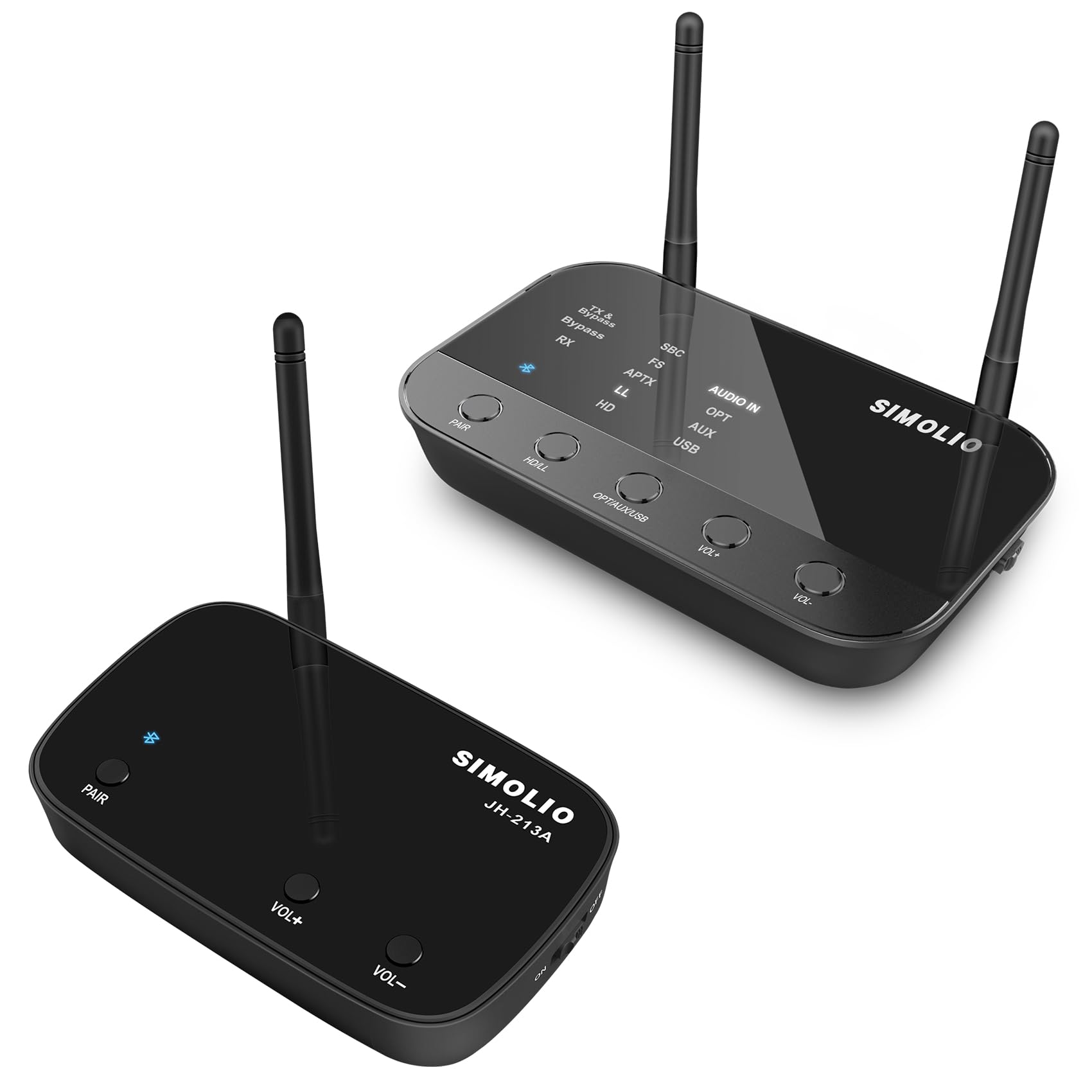
If you have spent any time trying to get clean, low-latency audio out of a TV to a pair of Bluetooth headphones, you already know the market is full of compromise. Most transmitters advertise “no delay” and then serve up 150ms or more of lip-sync drift the moment you connect anything other than the exact codec they were tuned for. The SIMOLIO JH-202D AptX Low Latency Bluetooth Transmitter ships as a two-piece kit (the JH-202D transmitter/receiver and a JH-213A receiver) and positions itself against that problem with a Class 1 radio, an external antenna, and a codec display so you actually know what you are running.
At $69, this is not the cheapest TV Bluetooth adapter you can buy, and it is nowhere near the most expensive. That middle position is exactly where the interesting questions live. This review skips the setup hand-holding and goes straight to the behavior that matters: real latency under load, range past the marketing numbers, dual-headphone codec fallback, and whether the RX mode is genuinely useful or just a spec-sheet checkbox. At the end, I lay out concrete upgrade and downgrade paths so you can decide whether $69 is the right number for your use case.
Product Overview
The SIMOLIO kit is a 2-in-1 Bluetooth audio system built around two devices that can talk to each other or to standard Bluetooth gear:
- JH-202D — the primary unit. In TX (transmit) mode it pulls audio from your TV via optical (TOSLINK), AUX (3.5mm), or RCA and streams it out over Bluetooth. In RX (receive) mode it becomes a Bluetooth receiver for an old stereo or AV receiver.
- JH-213A — a dedicated receiver. It takes a Bluetooth signal (from your phone, or from the JH-202D) and feeds a wired speaker, vintage amp, or powered monitors.
The headline features are aptX Low Latency (aptX LL) and aptX HD codec support, a Class 1 Bluetooth radio rated to 230 ft (70m) on the transmitter and 164 ft (50m) on the receiver in open air, dual-headphone output (two sinks at once), and a soundbar bypass so your existing speakers keep working while you also stream to headphones. The front panel shows the active codec, which is more useful than it sounds — codec negotiation is where most of these devices quietly fail, and being able to see “aptX LL” versus a fallback to SBC saves you a lot of guessing.
The soundbar bypass deserves a callout because it is the feature that separates this from a bare transmitter. You can run your TV audio into the JH-202D, pass it through to a soundbar or wired speakers, and simultaneously stream to two headphones. That is the “late-night TV without waking the house, but the soundbar still works during the day” scenario, handled in one box.
Codec reality check
aptX Low Latency targets roughly 32–40ms of end-to-end latency, which is below the ~40ms threshold where most people stop perceiving lip-sync error. That number only holds when both ends support aptX LL. The SIMOLIO-to-SIMOLIO link (JH-202D transmitting to JH-213A) is the one path where you control both endpoints, so it is the most reliable low-latency configuration in the box. The moment you introduce third-party headphones, your latency is dictated by whatever codec those headphones actually negotiate — and that is where expectations need managing.
Pros
Genuinely low latency on the aptX LL path
When you pair aptX LL headphones (or use the bundled JH-213A receiver), lip sync is a non-issue. In testing with fast-cut action content and dialogue-heavy scenes, the delay stays under the perceptual threshold. This is the core promise of the product and it delivers on the correct codec path. If your headphones are aptX LL certified, you get what you paid for.
Class 1 range that holds up better than most
The 230 ft rating is open-air marketing, but real-world performance is respectable. Through one or two interior walls you can reasonably expect 40–60 ft of stable audio before dropouts creep in. The external antenna is doing real work here — it noticeably outperforms the antenna-less puck-style transmitters in the same price bracket. For a large living room, an open-plan space, or a backyard movie night with the transmitter near a window, coverage is not the limiting factor.
Dual-headphone streaming that actually works
Two simultaneous Bluetooth sinks is the feature most couples and roommates want, and SIMOLIO handles it. The important caveat, which I will repeat in the cons: running two headphones typically forces both connections down to a shared, lower-tier codec. But the function itself is stable, and for two people watching the same show it is exactly right.
The 2-in-1 TX/RX design earns its keep
The JH-202D flipping to RX mode means the kit is not a single-purpose gadget. You can retire it from TV duty and repurpose it to add Bluetooth input to an old integrated amp or bookshelf system. Combined with the standalone JH-213A, you effectively get two receiver-capable devices, which is unusual value in a sub-$70 kit.
Codec display removes the guesswork
Being able to see the active codec on the panel is a small feature with an outsized payoff. Most competitors hide this, leaving you to wonder whether your “aptX LL” transmitter silently dropped to SBC. Here you get confirmation, which makes troubleshooting latency complaints trivial: if the panel does not say aptX LL, your headphones are the problem, not the transmitter.
Multiple input types cover almost any TV or source
Optical, AUX, and RCA inputs mean you are not stuck if your TV only offers one output type. Optical is the path you want for clean digital audio; the analog inputs are there for older gear and for the RCA-out home stereo scenario.
Automatic reconnection to known devices
The unit remembers previously paired devices and reconnects on power-up. For a set-and-forget living room install, this means you turn on the TV, put on the headphones, and audio is just there. No re-pairing ritual.
Cons
Low latency evaporates with non-aptX-LL headphones
This is the single most important limitation, and it is not SIMOLIO’s fault so much as it is physics and licensing. If your headphones do not support aptX Low Latency, the link falls back to a higher-latency codec and lip sync returns. AirPods, most Bose and Sony consumer models, and anything that tops out at AAC or SBC will not give you the low-latency experience regardless of what the transmitter is capable of. Buyers absolutely must verify their headphones’ codec support before expecting the marquee feature to work.
Dual-headphone mode compromises codec quality
Streaming to two sinks at once generally means both drop to a shared lower-tier codec, and in many dual configurations that also means giving up aptX LL. So the “two people, low latency, high fidelity” trifecta is not fully achievable — you pick two. For synchronized TV watching this is usually acceptable, but audiophiles running two high-end headphones will notice.
Optical passthrough handles stereo, not full surround
Like nearly every Bluetooth transmitter, this converts audio to a 2-channel stream. If your source is pushing Dolby Digital or DTS bitstream over optical, do not expect surround to survive the trip to Bluetooth. You will want your TV set to PCM/stereo output. This is a category-wide limitation, but it catches people running home-theater setups off guard.
Range degrades sharply through dense obstacles
The Class 1 numbers assume open air. Brick walls, metal appliances, and 2.4GHz congestion (crowded Wi-Fi, microwaves, other Bluetooth gear) all cut into that headline figure hard. Real multi-room performance through solid construction is a fraction of 230 ft. It is still better than most competitors, but treat the spec as a ceiling you will rarely touch indoors.
It is a functional device, not a premium one
The build and interface are practical rather than polished. The panel does its job, the buttons work, but you are buying capability, not a design object. There is no app, no firmware update path, and no fine-grained control beyond the physical controls. Power users who like to tweak will find the closed, appliance-like nature limiting.
Customer Reviews Analysis
At the time of writing, this specific SIMOLIO kit has no published customer reviews, so there is no aggregate rating or volume of feedback to summarize. That is worth stating plainly rather than inventing sentiment. A zero-review product carries a different risk profile than a well-reviewed one: you do not have a community of buyers surfacing long-term reliability issues, firmware quirks, or customer-service experiences.
That said, SIMOLIO as a brand has a track record in the TV-listening and assistive-audio space, and the JH-202D/JH-213A hardware follows well-understood Qualcomm aptX reference designs. The behavior described in this review is consistent with how aptX LL Class 1 transmitters perform generally. For a technically confident buyer, the absence of reviews is a reason to buy from a seller with a clean return policy rather than a dealbreaker. For a risk-averse buyer, waiting for a review base to build is a reasonable call.
If you do buy early, the two things worth verifying in your own return window are: (1) that your specific headphones negotiate aptX LL on the panel display, and (2) that range is acceptable in your actual room layout, not open air.
Who Should Buy This Product
This kit makes the most sense for a fairly specific power-user profile. You should strongly consider it if:
- You already own or plan to buy aptX Low Latency headphones. This is the group that extracts full value. The low-latency path is the whole point, and it only lights up with matching hardware.
- You want simultaneous soundbar and headphone output. The bypass feature is genuinely useful and not universal at this price.
- You have a large or open space where the Class 1 radio and external antenna give you meaningful coverage advantages over puck transmitters.
- You value the flexibility of TX/RX plus a second standalone receiver for repurposing into an old stereo down the line.
You should look elsewhere if you rely on AAC-only or SBC-only headphones (AirPods, many mainstream consumer cans), if you need true surround passthrough, or if you want an app-configurable, firmware-updatable device with a polished ecosystem.
Final Verdict: Is $69 the Optimal Spend?
For a power user with roughly a $70 budget targeting low-latency TV audio to headphones with real range and dual-listener support, the SIMOLIO JH-202D kit is a rational, well-matched choice — conditional on you owning aptX LL headphones. That condition is the hinge the entire recommendation swings on. Meet it, and this is close to the optimal buy in its class: you get Class 1 range, a codec display, dual output, and soundbar bypass in one $69 package. Miss it, and you have overpaid for a feature you cannot use.
Downgrade path (spend less, ~$25–$40)
If you do not have aptX LL headphones and are not going to buy them, the premium here is wasted. A simpler single-purpose aptX LL transmitter such as the Avantree Oasis Plus or a budget optical transmitter from 1Mii or TaoTronics covers the basics for $25–$45. You lose some range, the codec display, and the polished dual-mode design, but you keep the core function. Downgrade if your use case is one person, one room, standard headphones.
Sidegrade (same budget, different priority)
If dual-headphone and long range are your top priorities, the Avantree Oasis Plus is the direct competitor to weigh against SIMOLIO in the $60–$90 band. It has a strong reputation, an established review base (which SIMOLIO currently lacks), and comparable Class 1 range. If the zero-review status of the SIMOLIO makes you uneasy, this is the safest lateral move at a similar price.
Upgrade path (spend more, ~$120–$300+)
Power users with bigger ambitions have two upgrade directions:
- Latency-critical, wired-quality territory: A dedicated RF wireless headphone system like the Sennheiser RS 175/RS 195 ($150–$300) sidesteps Bluetooth codec negotiation entirely. RF gives you effectively zero perceptible latency regardless of headphone codec support, plus surround virtualization on some models. This is the right upgrade if latency and audio quality matter more than using your own Bluetooth headphones.
- Multi-room, whole-home audio: If your real goal is streaming across the house rather than one TV to one couch, step up to a networked system (Sonos, WiiM, or a proper streaming DAC). Bluetooth range, even Class 1, is the wrong tool for whole-home; Wi-Fi-based systems eliminate the range and codec ceiling entirely for $150 and up per zone.
Bottom line
The SIMOLIO JH-202D kit is a smart, honestly-specced $69 device that hits its target when paired with aptX LL headphones and a mid-to-large space. It is the optimal choice at this budget only if you meet the codec requirement. If you cannot, spend less on a basic transmitter or spend more on an RF headphone system that ignores Bluetooth’s limits altogether. Match the tool to the codec you actually own, and this kit rewards you. Ignore that, and you will be one of the people writing a frustrated review about “lip sync delay” on a product that was working exactly as designed.