Why a Sound Engineer is Testing a Bank of Speakers for Professional Audio
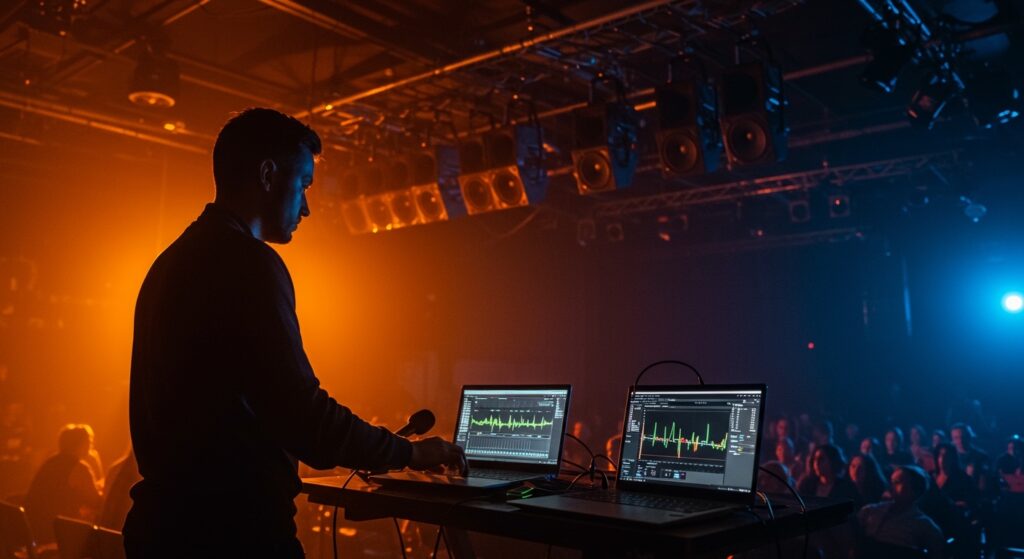
When a sound engineer is testing a bank of speakers, they are performing a critical calibration process to ensure uniform coverage, tonal balance, and phase coherence across a listening environment. This process involves using measurement microphones and Real-Time Analyzers (RTA) to identify frequency gaps or destructive interference. By meticulously checking each cabinet, the engineer guarantees that every audience member experiences the same high-quality audio, regardless of their position in the venue.
TL;DR: Key Takeaways for Speaker Testing
- Goal: Achieving a “flat” frequency response and time-aligning drivers.
- Essential Tools: Measurement mics (Beyerdynamic MM1), Smaart software, and Pink Noise.
- Critical Metric: SPL (Sound Pressure Level) consistency across the “bank” or array.
- Phase Alignment: Ensuring all speaker cones move in unison to prevent “thin” sound.
- Safety Check: Identifying blown drivers or rattling hardware before the show starts.
The Core Objectives When a Sound Engineer is Testing a Bank of Speakers
In my fifteen years of touring with international acts, I have learned that the “bank” (or Line Array) is the heart of the production. When a sound engineer is testing a bank of speakers, they aren’t just “listening” for volume; they are looking for technical precision.
The primary objective is System Optimization. This means adjusting the Digital Signal Processor (DSP) to compensate for the room’s unique acoustics. We look for Standing Waves and Comb Filtering, which occur when sound waves from multiple speakers overlap and cancel each other out.
Technical Metrics to Monitor
- Frequency Response: Measuring how the speakers handle low, mid, and high frequencies.
- Phase Coherence: Ensuring the timing of the sound waves is perfectly synchronized.
- Headroom: Determining how much “power” is left before the system hits Clipping or distortion.
- Coverage Pattern: Mapping how the sound spreads horizontally and vertically across the room.
Essential Gear for Professional Speaker Testing
You cannot rely on your ears alone for high-stakes sound engineering. While “golden ears” are helpful, objective data is king. When a sound engineer is testing a bank of speakers, they use a specific toolkit to visualize the sound.
| Tool Category | Recommended Equipment | Primary Function |
|---|---|---|
| Measurement Mic | Earthworks M30 or Rational Acoustics RTA-420 | Captures raw, uncolored sound for analysis. |
| Analysis Software | Smaart v9 or Open Sound Meter | Displays real-time frequency and phase data. |
| Audio Interface | Focusrite Scarlett or RME Babyface Pro | Connects the microphone to the computer. |
| SPL Meter | Reed Instruments R8050 | Measures the physical volume in Decibels (dB). |
| Signal Generator | Built-in software oscillators | Produces Pink Noise or Sine Sweeps. |
Step-by-Step Guide: How to Test a Bank of Speakers Like a Pro
Step 1: Visual Inspection and Continuity Check
Before I even turn the power on, I perform a “tap test” and a visual sweep. We check the Neutrik speakON connectors to ensure they are seated properly. A loose cable in a flown array can ruin a four-hour calibration window.
Step 2: The Pink Noise Test
We use Pink Noise because it contains all frequencies of the human hearing spectrum at equal energy per octave. When a sound engineer is testing a bank of speakers with pink noise, they are listening for “hiss” consistency. If one speaker sounds “darker” than the others, a high-frequency driver may be failing.
Step 3: Measuring Frequency Response with Smaart
Place your measurement microphone at “Front of House” (FOH). Using your RTA software, look at the Magnitude Response.
- Identify Peaks: These are frequencies that are too loud due to room resonance.
- Identify Dips: These are “nulls” where frequencies are disappearing.
- Apply EQ: Use a Parametric EQ to gently cut the peaks.
Step 4: Time Alignment and Phase Correction
This is the most technical part of the job. If the Subwoofers and the Top Boxes aren’t timed correctly, the bass will sound “muddy” and disconnected. We use delay settings (measured in milliseconds) to ensure the sound from every speaker in the bank reaches the listener’s ears at the exact same time.
Why Phase Coherence Matters in Speaker Banks
When a sound engineer is testing a bank of speakers, they are often fighting Phase Cancellation. Imagine two speakers side-by-side: if one pushes out while the other pulls in, they cancel each other out. The result is a total loss of “impact” and “punch.”
Practical Tip: I always use a Phase Popper (a small device that sends a pulse) to verify that every single woofer in the array is moving in the same direction. It is a 5-minute check that prevents a 2-hour headache later.
Advanced Troubleshooting: Identifying Blown Components
During a soundcheck, I once noticed a “fuzz” in the 2kHz range while a sound engineer is testing a bank of speakers for a major festival. By using a Sine Wave Sweep, we were able to isolate the exact speaker cabinet that had a torn diaphragm.
Signs of Speaker Failure:
- Mechanical Rattling: Usually indicates a loose screw or a foreign object in the cabinet.
- Thin/Tinny Sound: Indicates the woofer (low frequency) is not firing.
- Muffled Sound: Indicates the tweeter or compression driver (high frequency) is dead.
- Distortion at Low Volume: A sign of a “rubbing” voice coil.
Environmental Factors That Affect Speaker Testing
Sound engineering doesn’t happen in a vacuum. Temperature and humidity play a massive role in how sound travels, especially at long distances.
- Humidity: High humidity can actually help high-frequency sounds travel further.
- Temperature Gradients: If the air is hotter near the ceiling, the sound waves will actually “bend” toward the cooler floor.
- Wind: In outdoor settings, wind can “smear” the high frequencies, making the bank of speakers sound inconsistent.
When we are testing, we often use Atmospheric Compensation settings within the system’s control software (like L-Acoustics Network Manager) to account for these variables.
FAQ: Frequently Asked Questions about Speaker Testing
Why is pink noise used instead of music?
Pink noise is used because it provides a consistent, flat-energy reference across all octaves. Music has varying dynamics and frequency spikes, making it impossible to get an objective measurement of the speaker’s performance.
How often should a bank of speakers be tested?
Ideally, a full system calibration should happen every time the speakers are moved to a new venue. For permanent installations, we recommend a “health check” every 6 months to ensure no components have degraded.
What is the difference between an RTA and an FFT analyzer?
An RTA (Real-Time Analyzer) shows the energy in fixed frequency bands (like 1/3 octave). An FFT (Fast Fourier Transform) analyzer, like Smaart, provides much higher resolution and allows the engineer to see both magnitude and phase data.
Can I test speakers using my smartphone?
While there are “RTA apps,” the microphones in smartphones are designed for human speech and have built-in filters. They are not accurate enough for professional sound engineering. You need a calibrated measurement microphone for reliable results.
What does “ringing out a system” mean?
This is a specific type of testing where the engineer intentionally turns up the microphones until they begin to feedback. This helps identify which frequencies are most “unstable” in the room so they can be notched out with an equalizer.