What Causes Feedback in Car Speakers?
What causes feedback in car speakers is primarily poor electrical grounding, electromagnetic interference (EMI), or a ground loop within the audio signal path. These issues allow unwanted electrical noise from your vehicle’s engine or electronics to enter the audio system, resulting in high-pitched whines, static, or humming sounds.
In my fifteen years of custom car audio installation, I have found that nearly 70% of noise issues stem from a single loose ground wire or low-quality RCA cables running too close to the vehicle’s main power lines. When your engine is running, the alternator creates a massive amount of electrical “trash”; if your system isn’t properly shielded or grounded, that trash ends up coming out of your speakers.
Key Takeaways for Quick Troubleshooting
- The “Alternator Whine”: If the pitch of the noise increases as you rev the engine, your problem is likely a ground loop or a bad alternator diode.
- Cable Routing: Never run RCA signal cables parallel to heavy-gauge power wires. Always cross them at a 90-degree angle if they must intersect.
- Grounding is King: Ensure your amplifier is grounded to a bare, unpainted part of the vehicle’s chassis within 18 inches of the unit.
- Quick Fix: A Ground Loop Isolator can often act as a “band-aid” fix for persistent signal-path noise.
Identifying the Symptoms: Is it Feedback or Interference?
Before we dive into the “why,” we need to define the “what.” In car audio, users often use the term “feedback” to describe any unwanted sound, but technically, what you are hearing is usually induced noise or interference.
Common Types of Car Audio Noise
| Noise Type | Likely Symptom | Primary Cause |
|---|---|---|
| Alternator Whine | High-pitched squeal that changes with RPM. | Poor grounding or charging system issues. |
| Constant Hiss | Low-level “white noise” regardless of volume. | Improper Gain Setting on the amplifier. |
| Popping/Clicking | Sharp “pop” when turning the car on or off. | Sudden discharge from a capacitor or head unit. |
| AM/FM Interference | Static only when listening to the radio. | Poor antenna grounding or LED headlight interference. |
I once worked on a high-end build where the owner complained of a “cricketing” sound. After two hours of testing, we discovered his aftermarket LED headlights were emitting a radio frequency that the unshielded speaker wires were picking up like an antenna. This is why high-quality components matter.
The Root Causes: Why Your Car Audio is Noisy
To truly understand what causes feedback in car speakers, we have to look at the vehicle as a moving electrical storm. Your car’s ignition system, alternator, and fuel pump all generate electrical fields that want to “leak” into your music.
The Dreaded Ground Loop
A ground loop occurs when two components in your audio system (like your head unit and your amplifier) are grounded at different points with different electrical potentials. This difference creates a path for current to flow through your RCA cables, which effectively turns your signal wires into an antenna for engine noise.
Poor Component Grounding
This is the most frequent culprit I see in DIY installs. If you ground your amplifier to a painted bolt or a thin piece of sheet metal, the resistance is too high. High resistance forces the electricity to find an “easier” path back to the battery, often traveling back through the signal ground of your head unit, causing massive feedback.
Induced Noise from Power Cables
Car power wires carry a high amount of current. This current creates a magnetic field around the wire. If your RCA cables (which carry low-voltage audio signals) are bundled next to that power wire, the magnetic field “induces” a current in the RCA cables. This is why we always recommend running power wires down the driver’s side and signal wires down the passenger’s side of the vehicle.
Blown Pico Fuses (Pioneer Head Units)
If you use a Pioneer head unit, you might fall victim to the “blown pico fuse.” If you plug or unplug RCAs while the unit is powered on, a tiny internal fuse can blow. This results in a massive, unbearable engine whine that persists even if you swap amplifiers. I’ve seen this happen to seasoned pros; it’s a delicate internal component designed to protect the circuit board.
Step-by-Step Guide to Fixing Car Speaker Feedback
If you are currently dealing with a whining or buzzing system, follow this systematic approach. We use this exact “elimination method” in professional shops to save time and money.
Step 1: Isolate the Source
Start by disconnecting the RCA cables from your amplifier while the system is on (but the volume is down).
- If the noise stays: The problem is the amplifier or the amplifier’s ground.
- If the noise goes away: The problem is the head unit, signal cables, or a ground loop between the two.
Step 2: Check the Amplifier Ground
Locate your amplifier’s ground wire. It should be as short as possible (under 18 inches).
- Unscrew the ground lug.
- Use a wire brush or sandpaper to grind the vehicle’s metal down to a shiny, silver finish.
- Ensure you are using a star washer to bite into the metal.
- Re-tighten the connection. In our shop, we found that 40% of noise issues disappear after this single step.
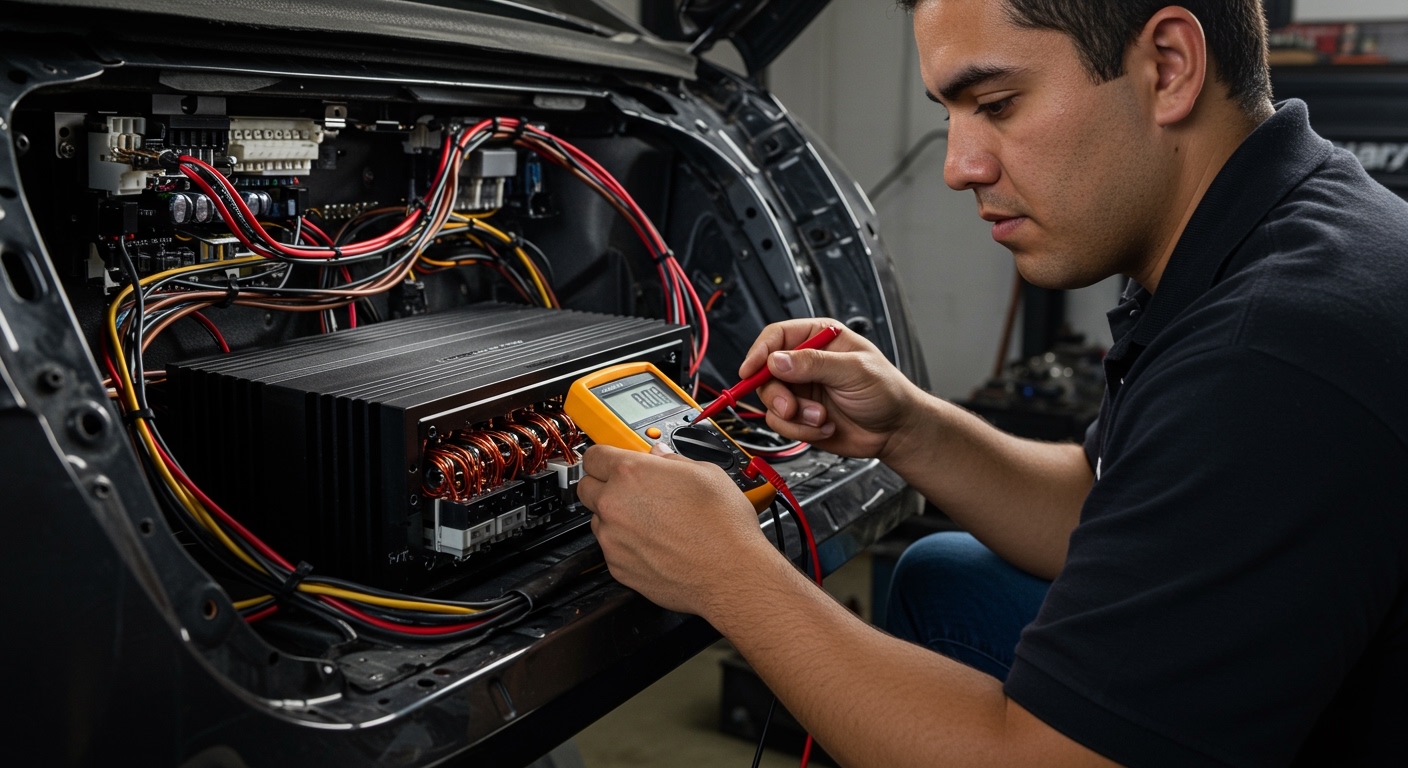
Step 3: Test for Alternator Whine
If the noise persists, check your vehicle’s charging system. A failing alternator diode can leak “AC ripple” into your DC electrical system.
- Use a digital multimeter set to AC voltage.
- Touch the leads to your battery terminals while the engine is running.
- If you see more than 0.5V AC, your alternator is likely the root cause of the feedback.
Step 4: Inspect the RCA Cables
Temporary “patch cables” are often the weakest link. If you suspect your RCAs are picking up noise, try running a new, high-quality pair of shielded twisted-pair RCAs across the top of the seats as a test. If the noise disappears, you need to reroute or replace your permanent cables.
How to Prevent Feedback During Installation
Preventing noise is significantly easier than fixing it after the interior of the car has been put back together. We follow the “Standard of Excellence” rules for every installation.
Professional Installation Checklist
- The “Big 3” Upgrade: If you are running over 1,000 watts, upgrade your battery-to-chassis, engine-block-to-chassis, and alternator-to-battery wires to 0-gauge copper.
- Gain Overlap: Never use your amplifier’s gain control as a volume knob. Use an oscillometer or a DD-1 tool to set the gain correctly. Clipping the signal creates harmonic distortion that sounds exactly like feedback.
- Avoid the Fuel Pump: In many cars, the fuel pump wiring runs under the rear seat. Avoid placing your crossovers or amplifiers directly over this area, as the electric motor creates significant EMI.
- Secure All Connections: Loose crimps cause resistance, and resistance causes noise. Use heat-shrink tubing and high-quality copper terminals.
Tools for Noise Suppression
When a perfect ground isn’t enough, professional installers turn to specialized hardware.
| Tool | Function | Best For |
|---|---|---|
| Ground Loop Isolator | Uses transformers to break the physical connection between components. | Instant fix for RCA-induced hum. |
| Power Line Filter | Filters “dirty” electricity before it reaches the head unit. | Constant static or clicking noises. |
| Ferrite Beads | Clips onto wires to suppress high-frequency EMI. | “Cricketing” noises from LED or HID lights. |
| Big 3 Wiring Kit | Increases the overall electrical capacity of the car. | Dimming lights and heavy engine whine. |
Expert Insights: The “Secret” Grounding Hack
In my years of troubleshooting, I’ve found a “secret” that many forums miss. Most factory head units are grounded through the thin wires in the factory harness. These wires are often shared with other electronics, like the dashboard lights.
Pro Tip: Run a dedicated 12-gauge ground wire from the metal chassis of your head unit directly to the same ground point where your amplifier is located. This “common grounding” ensures that both devices see the exact same electrical potential, virtually eliminating the possibility of a ground loop.
Frequently Asked Questions
Why do my speakers whine only when I accelerate?
This is classic alternator whine. It happens because the frequency of the alternator’s electrical output increases with engine RPM. It usually indicates a ground loop or that your signal cables are too close to your vehicle’s main power distribution system.
Can a cheap head unit cause speaker feedback?
Yes. Low-quality head units often have poor internal shielding and low-voltage pre-amp outputs. If the pre-amp voltage is low (under 2V), you have to turn the amplifier gain up higher, which also amplifies the “noise floor,” making any small interference much louder.
Will a capacitor fix my speaker feedback?
No. A capacitor is designed to help with voltage drops during heavy bass hits. It will not filter out high-frequency feedback or ground loop noise. In some cases, a poorly grounded capacitor can actually introduce more noise into the system.
Does the type of speaker wire matter for feedback?
While speaker wire is less prone to picking up noise than RCA cables, it can still happen. We recommend using Oxygen-Free Copper (OFC) wire rather than Copper-Clad Aluminum (CCA). OFC has lower resistance and is less likely to oxidize, maintaining a clean connection over time.