Determining What Size Are Car Door Speakers for Your Vehicle
Upgrading your factory audio starts with one frustrating question: what size are car door speakers in my specific vehicle? Most modern vehicles use standard sizes like 6.5-inch, 6×9-inch, or 5.25-inch drivers, but mounting depth and bracket shapes vary wildly between brands. To find what size door speakers you need, you must look at your car’s year, make, and model or physically measure the existing speaker’s diameter and screw-hole patterns.
💡 Expert Summary: Key Takeaways
Common Standards: Most cars utilize 6.5″ circular or 6×9″ oval speakers for front doors.
Fitment Tools: Use online databases like Crutchfield or Metra Online to confirm what size car speakers fit your specific VIN.
Check Depth: Beyond diameter, mounting depth is critical to ensure the window glass doesn’t hit the speaker magnet when rolled down.
Adapters are Key: Many vehicles (like the Chevy Silverado or Toyota Camry) require plastic adapter brackets to fit aftermarket speakers into non-standard factory holes.
Understanding Common Car Speaker Sizes
Before you buy, you need to understand the landscape of what size door speakers are currently on the market. Manufacturers design doors with specific acoustic cavities, and while some are flexible, others are very restrictive.
Standard Speaker Dimensions
| Speaker Size | Common Location | Typical Vehicle Types |
|---|---|---|
| 6.5 Inches | Front/Rear Doors | Most Sedans, SUVs, and Hatchbacks |
| 6×9 Inches | Front Doors / Rear Decks | Trucks (Silverado, F-150), Muscle Cars |
| 5.25 Inches | Rear Doors / Kick Panels | Older vehicles, Jeeps, Compact cars |
| 4×6 / 5×7 Inches | Dash / Narrow Doors | Ford, Mazda, and older GM trucks |
| 3.5 Inches | Dash / Upper Door | High-end systems with 3-way setups |
Why Size Matters for Sound Quality
Choosing what size speakers fit my car door isn’t just about the physical hole. A 6×9-inch speaker has more surface area, providing better mid-bass response, while a 6.5-inch speaker often offers more precise mid-range clarity. If your car currently has a smaller size, you may need to perform minor modifications or use a mounting spacer to upgrade to a larger driver.
Step 1: Research Your Vehicle’s Specific Fitment
The easiest way to answer what size are my door speakers is to use digital databases. You don’t always need to tear your door apart just to see the specs.
Use Online Fitment Guides
Professional installers rely on massive databases to determine what size are the front door speakers. Websites like Crutchfield, Sonic Electronix, and Scosche allow you to enter your vehicle’s year, make, model, and trim level. These tools will tell you the exact diameter and the maximum mounting depth allowed before you interfere with the window regulator.
Check the Silverado and Truck Exceptions
If you are asking what size are silverado door speakers, the answer depends heavily on the generation. For example:
2014-2018 Silverado: Usually features 6×9-inch speakers in the front doors.
Older Silverado Models: Often used 6.5-inch or even 4×6-inch depending on the cab configuration.
Pro Tip: Always check if your truck has the Bose Premium Sound package, as these often use different impedances (Ohms) and unique sizes compared to base models.
Step 2: Manually Measure Your Existing Speakers
If you have a custom build or an imported vehicle, online guides might be wrong. In this case, you must manually verify what size speakers are in my car door.
Tools Needed for Measurement
| Tool | Purpose |
|---|---|
| Trim Removal Tool | To pop plastic door clips without breaking them |
| Phillips Head Screwdriver | To remove the main door panel screws |
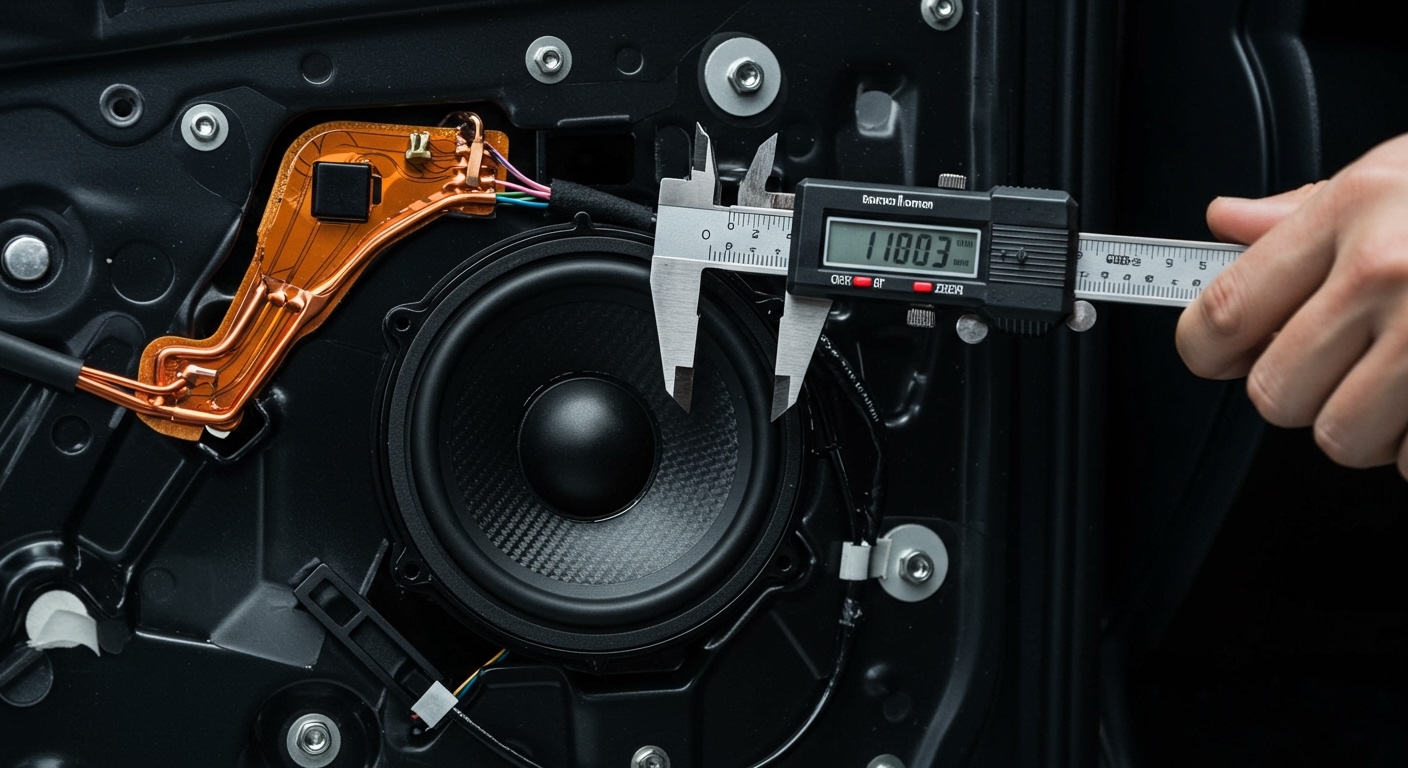
| Measuring Tape / Caliper | To measure diameter and depth |
| Flashlight | To see inside the door cavity |
How to Measure Correct-Size Speakers
- Remove the Door Panel: Use your trim tool to pry the panel away from the frame.
- Measure the Diameter: Measure across the center of the speaker from one edge of the mounting flange to the other.
- Check Bolt Pattern: Note if there are three or four screws. Some 6.5-inch speakers use a triangular pattern that requires a specific adapter plate.
- Measure Mounting Depth: This is the most skipped step. Measure from the mounting surface back to the nearest obstruction (usually the window track).
Step 3: Choose Between Coaxial and Component Speakers
Once you know what size door speakers do i need, you must choose the type of speaker. This choice affects both the installation difficulty and the final soundstage.
Coaxial Speakers (Full-Range)
These are “all-in-one” units where the tweeter is mounted on a pole in the center of the woofer. They are the easiest to install because they fit directly into the factory hole and use the factory wiring. Most people looking for what size are car door speakers end up buying coaxials for a quick, effective upgrade.
Component Speakers (Separates)
Component systems separate the woofer and the tweeter. The woofer goes in the door, while the tweeter is mounted higher up on the dash or “A-pillar.”
Pros: Better imaging and higher sound quality.
Cons: Requires more complex wiring and finding a place to mount the crossover network.
Step 4: Prepare the Mounting Surface
Knowing what size car speakers you need is only half the battle. You also need to ensure the mounting surface is “acoustically dead” to prevent rattles.
Use Sound Deadening Material
Products like Dynamat or HushMat are essential. Apply these butyl-rubber sheets to the metal inner door skin. This stops the metal from vibrating, which significantly increases the “punch” of your mid-bass.
Installing Speaker Baffles
Foam speaker baffles can protect your new investment from moisture dripping down inside the door. However, experts recommend cutting the bottom out of the baffle. A fully sealed foam baffle can make a high-quality speaker sound “thin” or “boxy.”
Step 5: Wiring and Final Installation
After confirming what size speakers fit my car door, you must connect them to the vehicle’s electrical system.
Avoid Cutting Factory Wires
Do not snip your car’s original wiring harness. Instead, buy a vehicle-specific wiring adapter. These plug into the car’s factory plug on one end and have slide-on terminals for the new speaker on the other. This maintains the resale value of your car and prevents polarity issues (wiring the positive and negative backward).
Testing Before Reassembly
Before snapping the door panel back on:
- Turn on the head unit.
- Fade the music entirely to the speaker you just installed.
- Check for phase: If the bass sounds weaker than the old speaker, you may have the positive and negative wires swapped.
- Roll the window down: Ensure the glass does not strike the back of the speaker.
Expert Advice & Common Pitfalls
Through years of professional audio installation, we have identified the most common mistakes users make when determining what size are car door speakers.
The “Oversized 6.5” Trap: Some brands (like Focal or JL Audio) make “oversized” 6.5-inch speakers (often called 6.75-inch). These may require you to trim the metal of your door.
Ignoring Impedance: Most car head units are designed for 4-ohm speakers. If you install 2-ohm speakers (common in Infinity or JBL lines), you might overheat your factory radio.
Bracket Thickness: If your new speaker is too deep, you can use a plastic spacer ring to bring it forward. However, ensure the speaker doesn’t then hit the back of the door panel’s plastic grille.
Frequently Asked Questions
(FAQs)
What size are car door speakers in most sedans?
Most modern sedans use 6.5-inch circular speakers. This has become the industry standard because it balances space efficiency with decent frequency response. However, always check for a bracket adapter, as the actual hole in the metal is often larger than the speaker itself.
Can I put 6.5 speakers in a 6×9 hole?
Yes, this is a very common upgrade. You can purchase a 6×9 to 6.5 adapter plate. Many audiophiles prefer this because 6.5-inch speakers generally have better structural integrity and less “cone flex” than oval 6×9 speakers, leading to clearer sound.
How do I know what size are my door speakers without taking the door apart?
The most reliable way is to use a VIN-based fitment tool online. You can also look through the speaker grille with a high-powered flashlight; often, the shape (round vs. oval) will give you a definitive clue about what size door speakers are installed.
Are front and rear door speakers always the same size?
Not necessarily. Many vehicles use 6×9-inch speakers in the front for bass and smaller 5.25-inch or 6.5-inch speakers in the rear for “fill” sound. Always verify both locations separately before ordering.
What size are silverado door speakers for a 2020 model?
For the 2019-2024 Chevrolet Silverado, the front door speakers are typically 6×9-inch, while the rear doors usually house 6.5-inch speakers. If you have the premium system, there are also dash-mounted tweeters.
Conclusion
Determining what size are car door speakers is the most critical step in your DIY audio journey. Whether you are driving a rugged Silverado or a compact commuter, matching the diameter, mounting depth, and bolt pattern ensures a seamless installation.
Remember to prioritize mounting depth and use wiring harnesses to avoid damaging your vehicle’s electrical system. By following this guide, you can confidently select the right hardware to transform your driving experience from a dull commute to a high-fidelity concert on wheels.