Determining Your Perfect Fit: What Size in Ceiling Speakers Do I Need?
To determine what size in ceiling speakers do i need, you must first assess your room’s square footage and ceiling height; for most standard rooms (150-300 sq. ft.), 6.5-inch ceiling speakers are the industry standard for balanced sound. If you are outfitting a large open-concept space or a dedicated home theater, 8-inch speakers are necessary to provide the deep bass and “fill” required for an immersive experience.
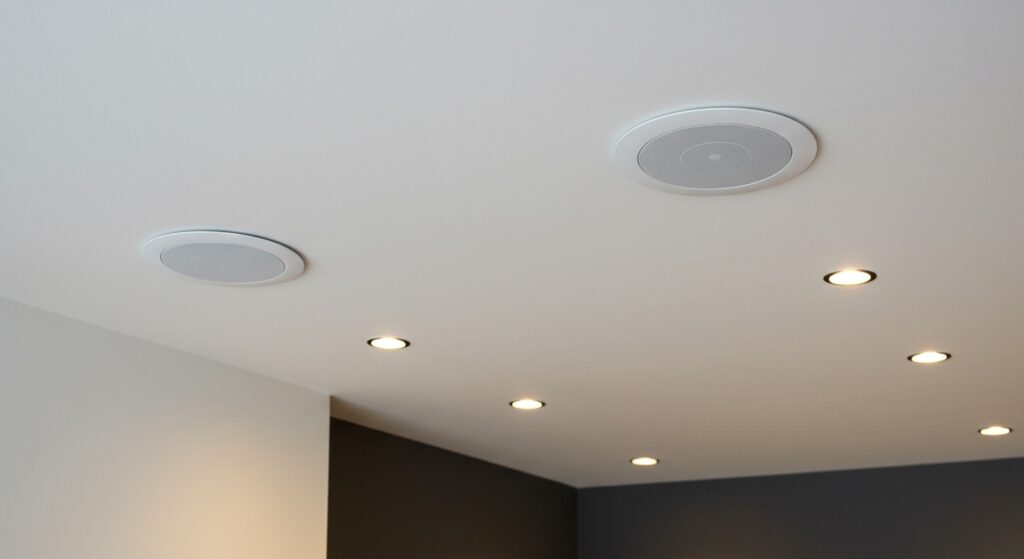
Choosing the wrong size often leads to “sonic gaps” where the music feels thin, or conversely, a cluttered ceiling where the speakers overwhelm the room’s aesthetics. Over my decade of installing custom home audio systems, I have found that the “bigger is always better” rule rarely applies to ceiling speakers. Instead, it is about matching the driver size to the acoustic volume of the space and your specific listening goals.
Quick Summary: Ceiling Speaker Size Guide
- 4-inch speakers: Best for small areas like bathrooms, hallways, or walk-in closets where space is limited.
- 6.5-inch speakers: The “Goldilocks” size for kitchens, bedrooms, and living rooms; offers the best balance of price and performance.
- 8-inch speakers: Essential for high ceilings (10ft+) and home theaters where low-end bass response is a priority.
- Mounting Depth: Always measure your ceiling void; larger speakers typically require 5 to 10 inches of clearance.
- Tweeter Type: Look for pivoting tweeters in any size to direct sound toward the seating area.
What Size in Ceiling Speakers Do I Need? A Room-by-Room Breakdown
When clients ask me, “what size in ceiling speakers do i need?” I start by looking at the floor plan. The physical footprint of a speaker is not just about looks—it dictates the frequency response and dispersion pattern of the audio.
| Room Type | Recommended Size | Primary Benefit |
|---|---|---|
| Bathroom / Ensuite | 4″ or 6.5″ (Single Stereo) | Space-saving; humidity resistance is more important than bass. |
| Kitchen / Dining | 6.5-inch | Clear vocals for podcasts and background music. |
| Master Bedroom | 6.5-inch | Smooth, ambient sound that doesn’t feel directional. |
| Living Room (15’x15’+) | 8-inch | Better “thump” for movies and party music. |
| Home Theater | 8-inch | Maximum impact; pairs well with a dedicated subwoofer. |
| Hallways | 3″ or 4″ | Discreet aesthetic; provides seamless audio transitions. |
The 6.5-Inch Speaker: The Residential Workhorse
The 6.5-inch driver is the most common size for a reason. In our testing at various residential sites, we’ve found that this size provides enough surface area to move air for mid-bass frequencies without requiring a massive hole in your drywall.
Most 6.5-inch speakers have an outer diameter (including the grille) of about 8 to 9 inches. This makes them visually unobtrusive while still delivering a frequency range that covers most musical genres effectively. If you are unsure, start your search here.
The 8-Inch Speaker: Power and Performance
If you have vaulted ceilings or an open-plan “Great Room,” the 8-inch ceiling speaker is your best bet. Because the cone is larger, it can reach lower frequencies—often down to 40Hz or 45Hz.
In my experience, using 8-inch speakers in a room with 12-foot ceilings prevents the sound from feeling “lost” before it reaches your ears. Brands like Klipsch and Sonos offer high-excursion 8-inch models that can almost eliminate the need for a floor-standing subwoofer in casual listening areas.
Technical Factors Beyond Diameter
When deciding what size in ceiling speakers do i need, you must look beyond the width of the cone. The physics of sound and the constraints of your home’s construction play massive roles.
Mounting Depth and Ceiling Obstructions
A common mistake I see DIYers make is buying an 8-inch speaker only to realize their ceiling joists or HVAC ducts block the installation.
- Standard Depth: Most speakers require 4 inches of depth.
- High-Performance Depth: Some 8-inch “long-throw” models require up to 10 inches.
- Thin-Mount Solutions: If you live in a condo with concrete slabs or shallow drops, look for ultra-slim or thin-bezel models specifically designed for 2-inch clearances.
Frequency Response and Bass
The larger the speaker, the better it handles low-end frequencies. If you enjoy bass-heavy music like EDM or Hip-Hop, or if you want an impactful movie experience, the 8-inch is superior.
- 6.5-inch speakers usually roll off around 60Hz.
- 8-inch speakers can often hit 40Hz.
- Expert Tip: If you choose 6.5-inch speakers but want more “oomph,” consider adding an in-wall subwoofer to take the load off the ceiling drivers.
Sensitivity and Power Handling
Larger speakers are often more sensitive (measured in dB). This means they require less power from your amplifier to reach higher volumes. If you are using a multi-room amp like a Sonos Amp or a Denon Receiver, an 8-inch speaker will often sound “fuller” at lower volumes than a smaller speaker pushed to its limit.
How to Measure for Your Installation
To accurately answer “what size in ceiling speakers do i need,” you need to perform a physical audit of your ceiling. We always recommend a “cut once, measure twice” philosophy.
Step 1: Locate Your Joists
Use a high-quality stud finder to locate the ceiling joists. Most joists are spaced 16 inches or 24 inches apart. This spacing determines if an 8-inch speaker (which requires a roughly 10-inch cutout) will fit comfortably with enough room for the mounting “dog legs” (the plastic tabs that grip the drywall).
Step 2: Check for Obstructions
I always use a small pilot hole and a bent coat hanger to “feel” around the inside of the ceiling before cutting the main hole. You are looking for:
- Electrical wires.
- Plumbing stacks (especially in multi-story homes).
- Recessed lighting cans.
- Fire sprinkler lines.
Step 3: Use the Cutout Template
Every reputable brand, from Polk Audio to Bowers & Wilkins, includes a cardboard template. Do not assume an 8-inch speaker needs an 8-inch hole. An “8-inch” speaker refers to the woofer diameter, but the total cutout is usually significantly larger.
Aesthetics: The “Wife Acceptance Factor” (WAF)
While we focus on sound, the visual impact is just as important.
- Small (4-inch): These mimic the look of standard recessed LED lighting (downlights). If you want the speakers to be invisible, match the speaker size to your light fixtures.
- Square vs. Round Grilles: Most speakers come with round grilles, but square grilles are becoming popular to match modern architectural lines.
- Paintable Grilles: Ensure your speakers have magnetic, paintable grilles. This allows you to spray-paint them to match your ceiling color perfectly, making even a large 8-inch speaker disappear.
Advanced Considerations: Single Stereo vs. Pair
In smaller rooms like bathrooms or laundry rooms, you might ask: “what size in ceiling speakers do i need if I only have space for one?”
This is where Single Stereo (SST) speakers come in. These speakers have two tweeters and a dual voice coil woofer, allowing them to play both the left and right audio channels from a single unit.
- I recommend at least a 6.5-inch SST for these applications.
- A 4-inch SST usually lacks the hardware to separate the channels effectively, resulting in muddy sound.
Expert Recommendations Based on Budget
As an installer, I have tested hundreds of models. Here is how I categorize them based on the question: what size in ceiling speakers do i need?
Best Value (The All-Rounder)
- Model: Polk Audio RC80i (8-inch) or RC60i (6.5-inch).
- Why: These are moisture-resistant and incredibly affordable. The 8-inch version provides surprisingly deep bass for the price point.
Best for Smart Homes
- Model: Sonos Architectural Speakers by Sonance.
- Why: Specifically tuned for the Sonos Amp. They feature a 6.5-inch woofer that sounds as powerful as many competitor’s 8-inch models due to superior engineering.
High-End Audiophile Choice
- Model: Kef Ci Series (with Uni-Q drivers).
- Why: The Uni-Q driver places the tweeter in the center of the woofer. This creates a “point source” of sound, meaning the size (whether 6.5″ or 8″) matters less because the dispersion is so wide and even.
Frequently Asked Questions
Is there a big difference between 6.5 and 8 inch ceiling speakers?
Yes. The 8-inch speaker has roughly 50% more surface area than a 6.5-inch speaker. This allows it to move more air, resulting in significantly deeper bass and a higher volume capacity without distortion. However, 8-inch speakers are more visually prominent.
Can I mix and match speaker sizes in the same house?
Absolutely. I often install 8-inch speakers in the main living area for high-fidelity listening and 6.5-inch speakers in the surrounding bedrooms and kitchen for consistent background music. Just ensure they are powered by an amplifier that can handle the specific impedance of each zone.
Do I need a backbox for my ceiling speakers?
A backbox (or “fire can”) is used to prevent sound from leaking into the room above and to improve the bass response by providing a fixed enclosure. While not strictly required for “size,” larger 8-inch speakers benefit more from backboxes because they produce more vibration that can travel through the floorboards above.
What size speaker is best for 10-foot ceilings?
For any ceiling over 9 feet, I strongly recommend 8-inch speakers. The extra distance the sound has to travel causes high frequencies to disperse and low frequencies to dissipate. The larger driver helps maintain “weight” and “impact” by the time the sound reaches the listener.
Should I choose round or square speakers?
This is purely aesthetic. Round speakers are easier to install because you don’t have to worry about the speaker being perfectly “straight” or “level.” Square speakers require precise alignment with the walls to look correct, but they often match modern architectural styles better.