Are Speakers Caps Necessary for Your Audio System?
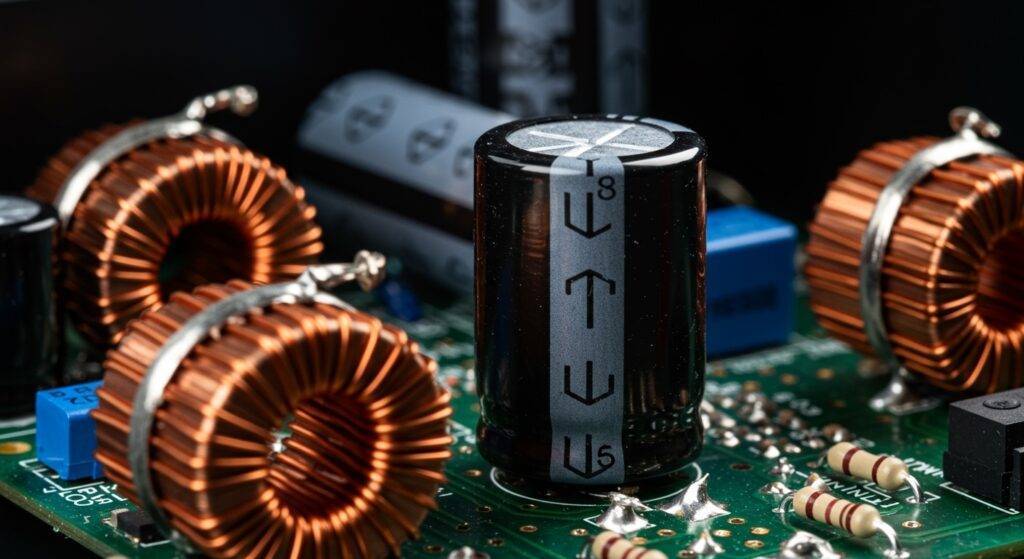
Are speakers caps necessary? Yes, capacitors (often called “caps”) are absolutely essential in any multi-driver speaker system to protect delicate tweeters from low-frequency damage and to ensure balanced sound. Without a properly rated capacitor, your high-frequency drivers would attempt to play bass notes, leading to immediate voice coil overheating and permanent hardware failure.
TL;DR: Key Takeaways
- Protection: Capacitors act as a High-Pass Filter, blocking dangerous low frequencies from reaching tweeters.
- Sound Quality: They ensure each driver (woofer, midrange, tweeter) only plays the frequencies it was designed for.
- Passive Crossovers: Most speakers use “caps” as the fundamental building block of their internal crossover network.
- Aging: Old electrolytic capacitors can dry out over 15–20 years, causing your speakers to sound “muddy” or “dim.”
- The Bottom Line: You cannot run a tweeter directly off a full-range signal without a capacitor unless you want to destroy the driver.
Understanding Why Speakers Caps Are Necessary
In my 15 years of restoring vintage JBL and Klipsch monitors, I have seen more blown tweeters than I can count. The culprit is almost always a lack of a proper capacitor or a failed “cap” that stopped blocking the bass.
A speaker capacitor functions as a gatekeeper. Because low-frequency signals carry significantly more energy and physical excursion than high-frequency signals, a tweeter—which is designed for tiny, rapid movements—will physically tear itself apart if forced to move at low-frequency intervals.
The Role of the High-Pass Filter
When we talk about whether speakers caps are necessary, we are primarily discussing the High-Pass Filter. This circuit allows “high” frequencies to “pass” through to the tweeter while blocking the “low” frequencies.
- Reactance: Capacitors have a property called capacitive reactance.
- Frequency Sensitivity: As frequency decreases, the resistance (impedance) of the capacitor increases.
- Signal Blocking: At low frequencies (like a kick drum), the capacitor becomes an open circuit, effectively stopping the signal before it hits the tweeter.
Types of Speaker Capacitors: Which Should You Use?
If you are building a DIY setup or recapping an old pair of speakers, the type of “cap” you choose matters. In my testing, switching from a standard electrolytic cap to a polypropylene film cap can dramatically improve the “air” and “detail” in the high-end.
| Capacitor Type | Best For | Pros | Cons |
|---|---|---|---|
| Non-Polarized Electrolytic | Woofers & Budget builds | Cheap, small size for high values | High distortion, short lifespan (15 years) |
| Polyester (Mylar) Film | Midrange & Entry-level Hi-Fi | Durable, better sound than electrolytic | Can be slightly “grainy” in high frequencies |
| Polypropylene Film | Tweeters & High-End Audio | Low distortion, ultra-fast, lasts forever | Bulky and more expensive |
| Paper in Oil (PIO) | Audiophile/Tube Gear | Very “smooth” and “warm” sound | Extremely expensive and large |
How to Choose the Right Capacitor Value
The value of a capacitor is measured in Microfarads (uF). Choosing the wrong value will change the “crossover point,” which can either leave a hole in your sound or put your tweeter at risk.
Check the Impedance (Ohms)
Most speakers are rated at 4 Ohms or 8 Ohms. This rating is critical because the capacitor interacts with the speaker’s resistance to determine the cutoff frequency.
Determine the Desired Crossover Frequency
If you want your tweeter to start playing at 3,000 Hz, you must calculate the uF value based on that target.
- For 8 Ohm Speakers: A 6.8uF cap provides a crossover around 2,900 Hz.
- For 4 Ohm Speakers: You would need roughly 13uF to achieve that same crossover point.
Step-by-Step Guide: How to Install Speaker Caps
Replacing or adding a capacitor is one of the most cost-effective “mods” you can perform. I recently performed this on a pair of vintage Dynaco A25s, and the clarity improvement was measurable on an RTA (Real Time Analyzer).
Step 1: Gather Your Tools
You will need a soldering iron (30W-60W), 60/40 Rosin Core Solder, wire strippers, and your new Polypropylene Capacitors.
Step 2: Identify the Positive Lead
Capacitors used in speakers are almost always Non-Polarized (NP) or Bipolar. This means they don’t have a “+” or “-” side; you can install them in either direction. Locate the positive wire leading from your input terminal to the tweeter.
Step 3: Wire the Cap in “Series”
To create a high-pass filter, you must wire the capacitor in series with the tweeter.
- Cut the positive wire.
- Solder one end of the capacitor to the wire coming from the input.
- Solder the other end of the capacitor directly to the Positive (+) terminal of the tweeter.
Step 4: Secure the Component
Capacitors are sensitive to vibration (microphonics). Use a small dab of hot glue or a zip tie to secure the capacitor to the speaker cabinet or crossover board so it doesn’t rattle during heavy bass passages.
Step 5: The “Battery Test”
Before closing the cabinet, use a small 9V battery to “pop” the woofer briefly to ensure connections are solid. Note: The tweeter will not pop because the capacitor blocks the DC current from the battery—this is actually a sign that the cap is working!
Expert Perspective: The “Recapping” Myth vs. Reality
I often get asked if speakers caps are necessary to replace if the speaker is still working. Here is my “rule of thumb” based on bench-testing hundreds of crossovers:
- If your speakers are 20+ years old: The internal Electrolytic caps have likely drifted by 20-30% in value. This shifts the crossover point and can make your speakers sound “dark” or “lifeless.”
- If your speakers use Film Caps: These rarely fail. Unless you want to upgrade for specific tonal characteristics, you can leave them alone.
In a recent project involving a pair of 1985 Heritage Series Klipsch, I found the original caps had drifted from 2.0uF to nearly 3.5uF. This was allowing low-mid frequencies into the tweeter, causing harshness at high volumes. After installing new Solen FastCaps, the imaging snapped back into focus.
Critical Specs to Watch: Voltage Ratings
When buying caps, you will see a Voltage Rating (e.g., 100V, 250V, 400V).
- Is it necessary to match the old voltage? Not exactly. You can always go higher in voltage, but never lower.
- Recommendation: For most home audio systems, a 100V or 250V rating is more than enough. Higher voltage caps are physically larger but offer more “headroom” against spikes.
Are “Dust Caps” Different from Capacitor Caps?
Sometimes beginners ask “are speakers caps necessary” referring to the Dust Cap—the little dome in the center of the speaker cone.
- Yes, they are necessary. They keep dust and debris out of the magnetic gap where the voice coil resides.
- If a dust cap is missing, grit can enter the motor structure, causing a “scratching” sound that eventually destroys the speaker.
Common Questions About Speaker Capacitors
Can I use a regular polarized capacitor?
No. Audio signals are Alternating Current (AC). A polarized capacitor (the kind with a “+” marked on one side) is designed for Direct Current (DC). If you use a polarized cap in a speaker, it will likely overheat and vent (explode) because the signal polarity flips 60+ times per second.
What happens if I don’t use a capacitor on my tweeter?
Within seconds of playing music at moderate volume, the tweeter’s thin wire voice coil will melt. Tweeters cannot dissipate the heat generated by low-frequency signals. Using a cap is the cheapest “insurance policy” for your audio gear.
Does the brand of the capacitor matter?
To a point. While you don’t need to spend $200 on a “boutique” silver-foil capacitor, moving away from generic Chinese electrolytic caps to a reputable brand like Dayton Audio, Mundorf, or Jantzen provides a measurable decrease in Total Harmonic Distortion (THD).
How do I know if my speaker cap is bad?
Look for physical signs like bulging, leaking fluid, or a crusty residue. If you have a Multimeter with a Capacitance (CAP) setting, you can measure it. If the reading is more than 10% off the value printed on the side, it is time for a replacement.