Quick Answer
The Klipsch RP-600M Reference Premiere bookshelf speakers are the best high-fidelity choice for a serious two-channel or home-theater system. They combine a 1-inch titanium LTS tweeter, a hybrid Tractrix horn, and 6.5-inch spun-copper cerametallic woofers. Pick the Edifier R1280T for budget active stereo, the Edifier M60 for desktop listening, or the Polk Monitor XT60 when you need 38Hz bass.
Pros
- Dual AUX inputs let you keep two devices connected at once, saving hassle of swapping cables
- Silk dome tweeter and 4-inch driver provide balanced, natural sound for music and movies
- Remote control offers convenient volume adjustment from a distance
- Wooden MDF enclosure with vinyl finish looks classic and reduces unwanted resonance
- Bass and treble knobs on the side panel allow quick tonal adjustments to suit your room
Cons
- No Bluetooth connectivity, so wireless streaming requires an external adapter
- No subwoofer output, limiting low-end extension for bass-heavy music or home theater
- Remote control only adjusts volume, not bass or treble, so you must walk to the speaker for EQ changes
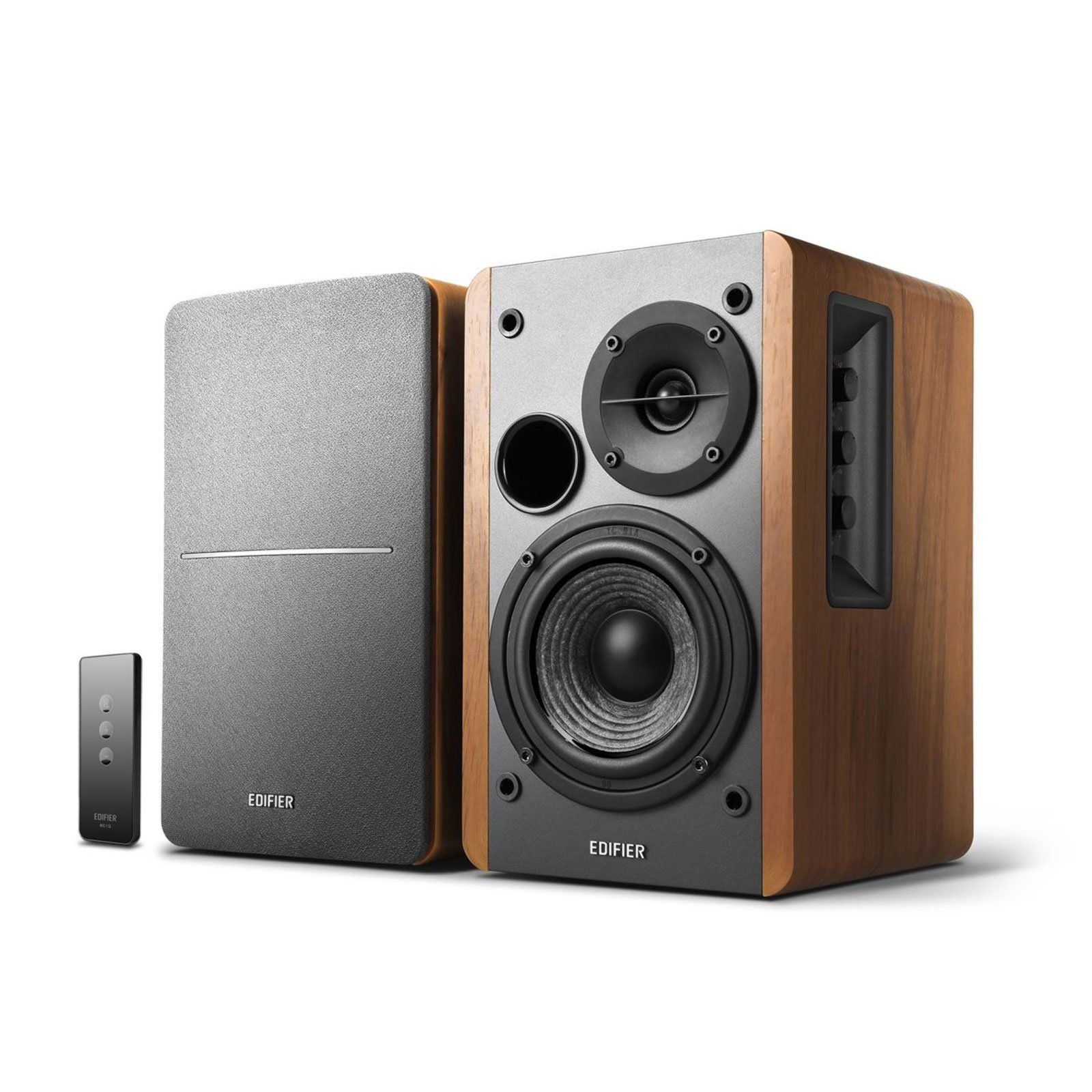
The Edifier R1280T is a pair of powered bookshelf speakers designed for near-field listening, making them a strong fit for desktop computer setups, small rooms, or anyone who wants an affordable stereo upgrade without a full receiver. They deliver a balanced, natural sound that suits music, podcasts, and casual movie watching, and they include a few practical features that simplify daily use.
At the heart of the R1280T are a 13mm silk dome tweeter and a 4-inch full-range driver, which together produce a smooth and detailed sound across mids and highs. The silk dome tweeter helps avoid the harshness some metal tweeters can have, while the 4-inch woofer provides enough punch for near-field listening. The built-in amplifier offers 42 watts RMS total power, which is ample for a desk or small room, filling the space with clear audio without distortion at moderate volumes.
The speakers are housed in a wooden MDF enclosure with a wood-effect vinyl finish, giving them a classic look that blends with most decor. The active speaker contains the amplifier and all controls, and the passive speaker connects to it via speaker wire. On the side panel of the active speaker, you'll find knobs for bass and treble, allowing you to tailor the sound to your preference and room acoustics. A remote control is included for volume adjustment, adding convenience when you're seated away from the speakers.
One of the standout features is the dual AUX inputs, which let you connect two devices at the same time, such as a computer and a phone, and switch between them without swapping cables. However, the R1280T lacks Bluetooth connectivity, so if you want to stream wirelessly, you'll need to add a Bluetooth adapter. Additionally, there is no subwoofer output, so if you crave deep bass for action movies or electronic music, you may want to consider a system with a separate sub or a different model with subwoofer connectivity.
Overall, the Edifier R1280T offers a compelling package for its price: natural sound, simple controls, and dual AUX inputs. The main reasons to hesitate are the lack of Bluetooth and subwoofer output, which may be deal-breakers for some. If you prioritize wireless streaming or powerful bass, you might be better served by a Bluetooth-enabled model or a 2.1 system. But for a reliable, no-fuss pair of powered speakers for your desk or small room, the R1280T is a solid choice.
Dual AUX Inputs: This feature allows you to connect two audio sources simultaneously, such as a computer and a smartphone, and switch between them using the remote or by simply pressing play on the desired device. It eliminates the need to unplug and replug cables, making it ideal for users who frequently switch between multiple devices.
Silk Dome Tweeter: The 13mm silk dome tweeter is designed to reproduce high frequencies smoothly and without harshness. Silk domes are known for their natural sound, reducing listening fatigue during long sessions. This benefits audiophiles and casual listeners who value clear, detailed highs.
4-Inch Full-Range Driver: This driver handles midrange and bass frequencies, providing a balanced sound signature. It's well-suited for near-field listening, where the listener is close to the speakers, such as at a desk. It delivers enough low-end for most music genres without needing a subwoofer in a small room.
Remote Control: The included remote lets you adjust the volume from across the room, adding convenience for users who are seated away from the speakers. It simplifies volume changes during movies or music without getting up, and it's particularly useful for home theater setups where the speakers are placed at a distance.
Side Panel Controls: The bass and treble knobs on the side of the active speaker allow you to fine-tune the sound to your preferences and room acoustics. This gives you control over the tonal balance, helping to compensate for room reflections or personal taste, and it's a feature often found on more expensive speakers.
Best For: The Edifier R1280T is best for desktop computer users, students, or anyone setting up a small room audio system on a budget. It's also a great choice for those who want to upgrade from built-in TV or monitor speakers without investing in a full receiver and passive speakers.
Consider Alternatives If: If you need wireless streaming via Bluetooth or Wi-Fi, you should look for a model with built-in Bluetooth. Similarly, if you want deep, room-shaking bass for home theater or bass-heavy music, a 2.1 system with a subwoofer output would be more appropriate. Also, if you need to connect to a TV with optical or coaxial inputs, this speaker only has analog AUX inputs, so you might need an adapter.
Setup and Daily Use: Setting up the Edifier R1280T is straightforward: place the speakers on a desk or shelf, connect the passive speaker to the active one with the included speaker wire, and plug in your audio source via the AUX cable. The side-panel knobs let you adjust bass and treble to your liking, and the remote controls volume. Daily use is simple: turn on the speaker, select your input, and adjust volume as needed.
Maintenance Requirements: The speakers require minimal maintenance. Wipe the wood finish with a dry cloth to remove dust. Avoid placing them in humid areas or near heat sources. The speaker grilles can be vacuumed gently if dust accumulates. No other regular upkeep is needed.
What Sets It Apart: The R1280T stands out for its combination of dual AUX inputs, remote control, and side-panel tone controls at a price point that's accessible. Many comparable powered speakers in this range require you to choose between convenience features, but this model offers a good balance. Its classic wood finish also gives it a timeless look that fits into various decor styles.
Placement: For best sound, place the speakers at ear level, angled toward the listening position, and a few feet away from walls to reduce bass buildup. On a desk, use isolation pads if possible to minimize vibration transfer.
Connections: The active speaker has two AUX inputs that accept 3.5mm or RCA cables. Connect your devices using the appropriate cables. The passive speaker connects to the active speaker with the included speaker wire, ensuring the wire is securely inserted into the spring clips.
Power: The active speaker needs to be plugged into a power outlet. There is no power switch on the speaker; instead, it enters standby mode when no audio is playing, and the remote can turn it on/off. This is convenient but may be surprising if you expect a physical switch.
Control Adjustments: Use the bass and treble knobs on the side panel to tune the sound. Start with them at the 12 o'clock position and adjust based on your preference and room acoustics. The remote only adjusts volume, so you'll need to walk to the speaker for tone changes.
Care: Dust the speakers regularly with a soft, dry cloth. Avoid harsh chemicals. Keep the speakers away from moisture and extreme temperatures. If the grilles become dusty, gently vacuum them with a brush attachment.
Pros
- Accurate studio-grade sound: Designed for music production, ensuring you hear your mix as intended.
- Compact size: Fits easily on a desk, making them perfect for small studios or home offices.
- Room tuning controls: High and low-frequency adjustments help compensate for room acoustics.
- Multiple input options: Balanced TRS, RCA, and aux inputs connect to a wide range of devices.
- Front headphone jack: Convenient for private listening without unplugging other cables.
Cons
- Limited bass response: The 3.5-inch woofers may not satisfy those seeking deep sub-bass for electronic music or home theater use.
- No Bluetooth: Wireless connectivity is absent, so you'll need a wired connection for phones or tablets.
- Power output may be modest: 50 watts total (25W per speaker) might not fill very large rooms at high volumes.
The PreSonus Eris 3.5 powered studio monitors are a pair of active near-field speakers designed for accurate audio reproduction in music production, gaming, and everyday desk use. They are an excellent choice for beginners in music creation, gamers who want precise positional audio, or anyone upgrading from computer speakers to a more trustworthy sound.
At the heart of these monitors is a 50-watt bi-amplified system that drives a 3.5-inch woven-composite woofer and a 1-inch silk-dome tweeter. This combination delivers a frequency response of 80 Hz to 20 kHz, providing clear mids and highs while producing tighter bass than typical multimedia speakers. The result is a balanced soundstage that lets you pick out details in your favorite tracks or mixes.
The rear panel includes acoustic tuning controls for high and low frequencies, allowing you to adjust the output to match your room's acoustics. This is a practical feature for desks placed near walls or in untreated rooms, as it helps minimize boominess or dullness without needing acoustic panels. The front panel offers an auxiliary input and a headphone jack, making it easy to connect a phone or listen privately.
Connectivity is versatile, with balanced TRS and RCA inputs on the rear, plus the front aux input. This means you can hook up an audio interface, mixer, game console, or turntable. However, note that these monitors are not Bluetooth-enabled, so wireless streaming requires an additional adapter. Also, the 3.5-inch woofers limit deep bass extension; if you produce bass-heavy music or want cinematic rumble, consider adding a subwoofer or larger monitors.
In summary, the PreSonus Eris 3.5 monitors offer a compelling package for their price: accurate sound, room-tuning flexibility, and multiple input options. They are best for near-field listening at a desk where space is limited. If you require room-filling volume or sub-bass impact, you may want to look at larger monitors or a subwoofer. But for most home studios and desktop setups, these monitors deliver dependable performance.
Bi-Amplified Design: Each speaker has a dedicated amplifier for the woofer and tweeter, ensuring clean power delivery and reducing distortion. This results in clearer audio at higher volumes, which is essential for critical listening.
Woven Composite Woofer: The 3.5-inch woofer is made from woven composite, which is lightweight yet rigid. This material helps produce tight, accurate bass without the muddiness often found in cheaper speakers, making it easier to hear bass lines and kick drums.
Silk Dome Tweeter: The 1-inch silk-dome tweeter smooths out high frequencies, reducing harshness that can cause listening fatigue. This is particularly beneficial for long mixing sessions or gaming marathons.
Acoustic Tuning Controls: High and low-frequency controls on the rear let you adjust the sound to your room's acoustics. For example, if your speakers are near a wall, you can cut the low end to prevent boomy bass. This feature helps you achieve accurate sound without expensive room treatment.
Versatile Connectivity: With balanced TRS, RCA, and front-panel aux inputs, you can connect a wide range of gear, from professional audio interfaces to consumer devices like phones and game consoles. The front headphone jack is a handy addition for private listening.
Best For: The PreSonus Eris 3.5 monitors are ideal for home studio beginners, gamers, and multimedia enthusiasts who need accurate, near-field sound in a compact setup. They are also a great upgrade for anyone who spends hours at a desk and wants to hear music, movies, and games with clarity.
Consider Alternatives If: If you need deep, room-shaking bass for electronic music production or cinematic home theater, these monitors may leave you wanting more. Consider larger monitors with bigger woofers or add a subwoofer. Additionally, if you require wireless streaming, you'll need to look for Bluetooth-enabled models or purchase a separate receiver.
Setup and Daily Use: Setting up is straightforward: place the speakers on your desk at ear level, angle them toward your listening position, and connect your audio source via the appropriate inputs. The front aux input is handy for quick phone connections. Use the tuning controls to adjust the sound to your liking.
Maintenance Requirements: These monitors are powered, so they require a power outlet. Keep them clean by dusting the cabinets and grilles regularly. There are no consumable parts, but ensure proper ventilation to avoid overheating. No special maintenance is needed beyond basic care.
What Sets It Apart: Compared to typical computer speakers, the Eris 3.5 offer studio-grade accuracy and tuning flexibility. They are designed for near-field listening, where the listener is close to the speakers, providing a more precise soundstage. This makes them a smart investment for anyone serious about audio quality in a compact form.
Computer and Audio Interfaces: The balanced TRS inputs connect directly to audio interfaces and mixers with balanced outputs, ensuring clean signal transfer in professional setups. You can also use RCA cables to connect to a computer's headphone jack or a basic sound card.
Gaming Consoles: Connect via RCA or the front aux input to a game console's audio output. Note that some consoles may require a headphone-to-RCA adapter.
Mobile Devices: The front-panel aux input is perfect for phones, tablets, and portable music players. Use a 3.5mm auxiliary cable to play music or stream videos.
Turntables: If your turntable has a built-in preamp, you can connect it via RCA. If not, you'll need an external phono preamp, as these monitors do not have a dedicated phono input.
Headphones: The front headphone jack allows you to listen privately, automatically muting the speakers when headphones are plugged in (if designed that way, but this is not specified). This is useful for late-night sessions.
Pros
- Wide soundstage delivers immersive audio for medium-sized rooms
- Easy Bluetooth pairing gets you listening quickly
- Bluetooth 5.2 ensures stable connection and future compatibility
- Classic Marshall aesthetic adds a stylish touch to decor
- Eco-friendly construction appeals to sustainability-minded buyers
Cons
- Plug-in only, so it's not portable for outdoor use
- No built-in voice assistant support
- Lacks multi-room or Wi-Fi streaming features found in some competitors
The Marshall Acton III is a plug-in Bluetooth home speaker designed for listeners who want Marshall's signature rock-inspired sound in a compact package. It's ideal for apartment dwellers or anyone looking to upgrade their desktop or bookshelf audio without a complex setup. The speaker delivers a wide stereo soundstage that fills a medium-sized room, making it a strong candidate for music lovers who prioritize audio quality and iconic design.
Key features include next-generation Bluetooth 5.2, which ensures a stable wireless connection and prepares the speaker for future Bluetooth capabilities. The 3.5mm aux input offers a wired option for devices without Bluetooth, such as turntables with a preamp. The front-panel bass and treble controls let you fine-tune the sound to your preference, a practical touch for tailoring output to different music genres or room acoustics.
The design is classic Marshall: a black vinyl-like finish with a gold front panel and the brand's signature script logo. The controls are simple and intuitive, with a pairing button and volume knob on top. The speaker is powered by a wall plug, so you don't have to worry about battery life, but that also means it's not portable. The build uses 70% recycled plastic and vegan materials, reflecting a more sustainable approach without compromising the iconic look.
While the Acton III excels in sound quality and ease of use, it has limitations. It's not battery-powered, so you can't take it outdoors or move it around the house without being near an outlet. It also lacks Wi-Fi connectivity, multi-room capabilities, and voice assistant support, which some competitors offer at this price point. If you need those smart features, you might look elsewhere.
Overall, the Marshall Acton III is a great choice for anyone who values classic design and room-filling sound in a stationary home speaker. Its main drawback is the lack of portability and smart features, so if you need a portable speaker or voice control, you should consider other options. For straightforward, high-quality Bluetooth listening, the Acton III delivers.
Room-Filling Sound: The Acton III produces a wide soundstage that fills a room with stereo audio. This means you get a more immersive listening experience compared to a single-point speaker, making it ideal for living rooms or bedrooms.
Simple Pairing: The speaker is designed for immediate use: just pair and play. No complex setup or app required, so you can start listening within seconds of unboxing. This is perfect for users who want a hassle-free experience.
Bluetooth 5.2: This latest Bluetooth version provides a stable, low-latency connection and is built to support future features. It ensures your speaker stays compatible with upcoming devices, protecting your investment.
3.5mm Input: The aux input allows you to connect non-Bluetooth devices like a CD player or a turntable with a preamp. This expands your source options and is useful for audiophiles with legacy gear.
Bass and Treble Controls: Physical knobs on the top let you adjust the sound to your liking. You can boost bass for hip-hop or cut treble for a softer sound, giving you control over the audio output.
Best For: The Marshall Acton III is best for music enthusiasts who want a stylish, stationary speaker with high-quality sound for their home. It suits those who appreciate classic rock aesthetics and prefer a simple Bluetooth setup without smart features.
Consider Alternatives If: If you need a portable speaker for travel or outdoor use, the Acton III's plug-in design is a drawback. Similarly, if you rely on voice assistants like Alexa or Google Assistant, or want multi-room audio, you'll need a smart speaker or a Wi-Fi-enabled system.
Setup and Daily Use: Setup is straightforward: plug in the speaker, turn it on, and pair your device via Bluetooth. The aux input is available for wired connections. Daily use involves adjusting volume and tone via the top knobs, and pairing is automatic once connected.
Maintenance Requirements: The speaker has no consumable parts, but you should keep it clean by wiping the surface with a dry cloth. Avoid exposing it to moisture or extreme temperatures. The fabric grille may attract dust, so occasional gentle vacuuming can help.
What Sets It Apart: The Acton III stands out with its iconic Marshall design and signature sound, which is often described as warm and punchy. It offers a more premium look compared to generic Bluetooth speakers, and the physical controls provide a tactile experience that many users prefer.
Brand: Marshall
Model: Acton III
Color: Black
Connectivity: Bluetooth 5.2, 3.5mm aux input
Power: Plug-in powered
Controls: Bass, treble, volume, pairing button
Materials: PVC-free build, 70% recycled plastic, vegan materials
Pros
- Sold as a matched pair, which spares the buyer assembling a stereo set from separate listings and matching finishes across purchase dates
- Passive operation suits anyone consolidating around one receiver or integrated amp, since volume, source switching, and room correction stay in a single box instead of spreading across powered cabinets
- Magnetic grille attachment benefits households that need the drivers covered day to day but want them off for critical listening, as the swap takes seconds and leaves no visible hardware
- Dual binding posts serve the buyer who expects to expand the system, allowing bi-amping from a multi-channel amp or bi-wiring without opening the cabinets
- Ebony finish and a single stated variant simplify matching a center channel or surrounds from the same Reference Premiere family if the system grows later
Cons
- The rear-firing port makes these a poor candidate for tight bookshelf cubbies or cabinets pushed flush to a wall, and no manufacturer-recommended clearance distance is supplied here to guide you
- No dimensions, weight, impedance, sensitivity, or amplifier power recommendation appear in the supplied data, so shelf fit, stand rating, and amp matching cannot be confirmed before you check the manufacturer listing
- Being passive, these require a separate amplifier or receiver plus speaker cable, and the supplied data does not state whether any cable, stands, or mounting hardware are included in the box
The Klipsch RP-600M Reference Premiere bookshelf speakers arrive as a pair in ebony and are aimed at a listener who already runs, or intends to run, a separate amplifier or receiver. That is the core ownership qualification. These are passive cabinets with no built-in power, no volume control, and no inputs beyond speaker terminals, so the job they do well is act as the front end of a two-channel or home theater system that someone else in the rack is powering. The strongest verified convenience is the matched pair packaging combined with dual binding posts, which means you can wire them conventionally today and move to bi-wiring or bi-amping later without buying different speakers.
Two supplied features shape daily placement more than anything else. The bass-reflex system vents through a rear-firing Tractrix port, so the space behind each cabinet is part of the sound, not dead space. Practically, that argues against sliding these into a closed shelf cubby or hard against drywall, and it means moving them a few inches during a furniture rearrangement is a change you will hear. The 6.5-inch spun copper Cerametallic woofers set the cabinet class: this is a mid-size bookshelf speaker rather than a desktop mini, which affects shelf depth, stand selection, and how much of a console top each one consumes.
The 1-inch titanium LTS vented tweeter sits on a hybrid Tractrix horn. For an owner, the relevant consequence is that horn-loaded designs tend to be directional, so toe-in angle and seating position become setup decisions worth spending time on rather than afterthoughts. The removable magnetic grilles help households that want the drivers protected during the week and uncovered for focused listening, since there are no push-pin holes left behind.
The supplied data includes a high average rating but no customer review excerpts, so there is no recurring owner signal here to separate from manufacturer claims. Everything above rests on stated features alone.
Buy if you have an amp, speaker cable, and wall clearance. Avoid if you need self-powered speakers or a flush cabinet install. Before purchasing, verify cabinet dimensions and weight, impedance and sensitivity, the recommended amplifier power range, and whether stands, jumpers, or cable ship in the box.
Best Ownership Fit: A household or listening room where a receiver or integrated amplifier already exists and there is open space behind the speakers, whether on stands, a wide console, or an open shelf that does not enclose the rear panel. Suits a listener comfortable stripping and terminating speaker wire and willing to experiment with placement. Frequency of use ranges from background listening to daily critical sessions; nothing in the supplied features suggests limits either way. Homes with pets or small children benefit from the magnetic grilles staying on between listening sessions.
Daily Workflow: Routine use is passive by design. Power and source selection happen at the amplifier, so the speakers themselves have no controls to touch day to day. The only regular interaction supported by the supplied data is removing and reattaching the magnetic grilles, and occasionally checking that the binding post connections remain tight after moving furniture. If you bi-wire or bi-amp, that is a one-time wiring decision rather than a daily step.
Likely Friction: The rear-firing Tractrix port is the recurring constraint. It makes wall proximity and cabinet enclosure genuine fit questions, and the supplied data gives no recommended clearance figure. Compounding this, no dimensions, weight, impedance, sensitivity, or amplifier power recommendation are supplied, so you cannot confirm shelf fit, stand weight rating, or amp compatibility from this listing alone.
Before You Buy: Measure your shelf or stand depth and the distance from the mounting surface to the wall, then verify the manufacturer's stated cabinet dimensions and recommended rear clearance for the port. Confirm impedance, sensitivity, and recommended amplifier power against what your receiver or amp delivers per channel; these figures are not supplied here. Check whether the pair ships with binding post jumpers installed, since removing them is required for bi-wiring and their inclusion is not stated. Confirm whether stands, wall mounts, or speaker cable are included or must be purchased separately.
Initial Placement: Because the bass-reflex port fires from the rear, position is the first setup decision, not the last. Give each cabinet open air behind it and expect to adjust distance from the back wall while listening. Enclosed cabinet installations and flush-to-wall placements work against this design. The supplied data does not state a minimum clearance, so confirm the manufacturer's placement guidance before committing to a shelf or built-in.
Wiring: These are passive speakers requiring a separate amplifier or receiver and speaker cable, neither of which is listed as included. The dual binding posts accept a standard single-cable connection with the factory jumpers in place, or two cable runs per speaker for bi-wiring, or separate amplifier channels for bi-amping. Verify with the manufacturer whether jumpers are installed from the factory and what termination types the posts accept, since bare wire, banana plug, and spade compatibility are not specified in the supplied data.
Aiming and Angle: The tweeter sits on a hybrid Tractrix horn, a design that concentrates output along an axis. Plan on spending time on toe-in angle and tweeter height relative to your seated ear level. This is a one-time setup investment rather than ongoing maintenance, but skipping it wastes the design.
Grille Handling: The magnetic grilles are described as strong, flexible, and removable, so they lift off and reseat without tools or exposed hardware. Store removed grilles flat and away from foot traffic to avoid creasing the frame. No cleaning instructions for the grille cloth, the ebony cabinet finish, or the copper woofer cones are supplied, so check the manufacturer's care guidance before using any cleaner or damp cloth on the drivers or finish.
Ongoing Maintenance and Parts: The supplied data lists no consumables, filters, or scheduled maintenance, which is consistent with a passive speaker. The only realistic recurring task is periodically confirming binding post tightness. Availability of replacement grilles, jumpers, or drivers is not stated here; contact the manufacturer or an authorized dealer for parts and warranty terms rather than assuming a service path exists.
Amplification Requirement: Nothing in the supplied feature list indicates built-in amplification, and the presence of binding posts confirms these are passive. Budget for a receiver or integrated amplifier and speaker cable if you do not already own them. Impedance, sensitivity, and a recommended power range are not supplied, so match to your amplifier only after checking the manufacturer's published specifications.
Bi-Wire and Bi-Amp Paths: The dual binding posts open two upgrade routes. Bi-wiring runs two cables from one amplifier channel per speaker; bi-amping drives the high and low sections from separate amplifier channels. Both require removing the factory jumpers and doubling your cable runs, which affects how you route and conceal wire behind furniture. Whether jumpers ship installed is not stated in the supplied data.
Physical Fit Unknowns: Cabinet height, width, depth, and weight are not supplied. Those four numbers determine whether these clear your shelf, whether a stand's top plate supports the footprint, and whether the stand's weight rating is adequate. Wall mounting compatibility, including any threaded inserts or keyhole slots, is likewise not stated. Verify all of it against the manufacturer's specification sheet before ordering stands or brackets.
System Expansion: The pair is part of the Reference Premiere line and finished in ebony, which makes matching a center channel or surround pair from the same family a reasonable path if the system grows. Confirm current finish availability and model matching directly with the manufacturer, since the supplied data covers only this bookshelf pair.
Pros
- Space-saving footprint suits tight desk setups
- Powerful sound for its size, ideal for near-field listening
- Versatile connectivity options for various devices
- Touch controls with auto-backlight are intuitive and convenient
- Bundled stands improve audio direction without extra purchase
Cons
- No user reviews yet, so long-term reliability is unverified
- Touch panel may be less precise than physical buttons for some users
- LDAC high-resolution streaming requires Android 8.0+ and may not work with all devices
The Edifier M60 Multimedia Speaker is a compact powered speaker system designed for desktop use. With a footprint of only 100mm wide by 168mm high per speaker, it suits small workspaces or cramped desks. The 66W RMS total output, distributed across 18W+18W mid-low and 15W+15W treble, provides robust sound for its size, making it a strong contender for near-field listening.
The speaker offers versatile connectivity: Bluetooth 5.3 with LDAC support for high-resolution wireless audio, USB-C for direct digital connection, and AUX for analog devices. This flexibility allows easy switching between a computer, smartphone, or tablet. The touch panel with auto-backlight is a modern convenience, though some users may prefer physical buttons for tactile feedback.
Included aluminum stands tilt the speakers at a 15-degree angle, directing sound toward ear level, which reduces distortion and improves clarity during extended listening sessions. This is a thoughtful addition that enhances the overall experience without requiring separate purchases.
However, the product has no customer reviews yet, so long-term durability and real-world performance are unverified. The touch controls, while sleek, may be less precise for quick adjustments. Additionally, LDAC high-resolution streaming requires an Android device running version 8.0 or later, so iPhone users won't benefit from this feature.
This speaker is best for users who prioritize space-saving design and versatile connectivity in a desktop setup. Those who prefer physical controls or need proven reliability may want to wait for more user feedback or consider alternatives with established track records. Before purchasing, verify the exact dimensions against your desk space and confirm compatibility with your devices.
Best Ownership Fit: Ideal for small home offices, dorm rooms, or compact workstations where desk space is limited. Suitable for users who want a powerful yet unobtrusive speaker system for daily computer use, music streaming, or video calls.
Daily Workflow: The speaker can be connected via USB-C to a computer for a stable digital connection, or via Bluetooth for wireless streaming from a phone or tablet. The touch panel provides easy access to volume and playback controls, with an auto-backlight that activates when your hand approaches. The included stands position the speakers at an optimal angle for listening.
Likely Friction: The lack of user reviews means you cannot rely on others' experiences regarding sound quality, durability, or customer support. The touch panel might be less responsive than physical buttons, and the LDAC feature is limited to Android devices.
Before You Buy: Measure your desk space to ensure the speakers fit, as each measures 100mm x 168mm x 147mm. Verify that your devices support Bluetooth 5.3 or have USB-C/AUX outputs. Check if the included stands are compatible with your setup. Confirm the power requirements and whether a subwoofer output is needed (not specified).
Setup: The Edifier M60 comes with a pair of speakers and aluminum stands. Attach the stands to the speakers using the provided hardware (if any). Place the speakers on a flat surface. Connect via Bluetooth, USB-C, or AUX. Power on and adjust volume using the touch panel. Download the EDIFIER ConneX app for extended functions.
Controls: The touch panel is cap-sensitive, with an automatic backlight that activates when your hand approaches. It turns off automatically to save energy. Use the app for additional EQ settings or other features.
Cleaning: Use a soft, dry cloth to wipe the speaker surfaces. Avoid using liquids or abrasive cleaners. The speaker grilles should be dusted gently to prevent buildup.
Maintenance: There are no user-replaceable parts mentioned. The speakers are powered by a Class-D amplifier, which is energy-efficient. No specific maintenance schedule is provided. For any issues, contact Edifier support.
Storage: When not in use, disconnect the cables and store the speakers in a dry place. The stands can be detached for compact storage.
Pros
- Horn-loaded tweeter offers efficient, detailed highs, ideal for listeners who value clarity
- Spun-copper woofers are lightweight and rigid, contributing to punchy bass
- Compact size suits small to medium rooms or desktop setups
- Rear-firing port allows flexible placement if you can keep space behind the speakers
- Black finish blends with most decor
Cons
- Rear-firing port requires at least several inches of clearance from walls to avoid muddied bass
- No grilles included? (Verify if grilles are included or sold separately)
- Sensitivity and impedance not specified; check if your amplifier can drive them effectively
The Klipsch R-51M bookshelf speakers are designed for music enthusiasts and home theater builders seeking a compact, high-efficiency speaker pair. Their core job is to deliver clear, dynamic audio in small to medium-sized rooms, and they achieve this through a combination of a 1-inch aluminum LTS tweeter with a 90x90 Square Tractrix Horn and dual 5.25-inch spun-copper IMG woofers. The horn-loaded tweeter is particularly notable for its controlled dispersion, which can help with imaging and detail at moderate volumes.
For daily use, the rear-firing bass-reflex port is a key consideration. It means the speakers need some breathing room behind them to avoid bass boom and muddiness. In a typical bookshelf or stand setup, you'll need to ensure at least a few inches of clearance from the wall. This is a practical constraint that affects placement and could be a dealbreaker for tight spaces.
The speakers' dimensions (13.3" x 7" x 8.5") make them easy to fit on bookshelves, stands, or desktops. However, the supplied data does not specify the included accessories, such as grilles or mounting brackets, so you should verify what's in the box before purchasing.
Customer reviews are not available, so we rely on the manufacturer's claims and typical Klipsch reputation. The brand is known for its dynamic sound, but individual results depend on your room acoustics and amplifier pairing. Since sensitivity and impedance are not provided, confirm that your receiver or amplifier can drive them adequately.
In summary, the R-51M is a solid choice for budget-conscious audiophiles who value clarity and can accommodate rear-port placement. Avoid if you need a wall-mount flush or have very limited space. Before buying, verify the included accessories, amplifier compatibility, and whether grilles are necessary for your household.
Best Ownership Fit: These speakers suit a music lover or home theater enthusiast with a small to medium room, who can place them on stands or shelves with some space behind. They are ideal for those who appreciate horn-loaded tweeters' efficiency and clarity.
Daily Workflow: Expect to connect them to an amplifier or receiver via standard speaker wire. The rear-firing port means you'll need to ensure clearance, but once placed, they operate passively with no daily adjustments. You'll simply enjoy music, movies, or gaming.
Likely Friction: The most significant friction is the rear-firing port, which requires careful placement to avoid bass boom. Additionally, without grilles, the exposed drivers may be vulnerable to curious pets or children, so you might need to purchase grilles separately if not included.
Before You Buy: Measure your intended placement to ensure at least 6-8 inches of clearance behind the speakers. Verify your amplifier's power output and impedance compatibility (since specs are not provided). Check the package contents to see if grilles, mounting brackets, or speaker wire are included. Also, consider the finish (black) and whether it matches your decor.
Setup: The speakers are passive and require connection to an amplifier or receiver via speaker wire. The rear-firing port dictates that you place them at least a few inches away from walls to allow bass to breathe. Position them at ear level for optimal soundstage. No powered subwoofer is included, so you may need one for deep bass if desired.
Controls: There are no controls on the speakers themselves; all volume and tone adjustments are made on your amplifier or source device.
Cleaning: Use a soft, dry cloth to dust the cabinets. Avoid using liquids or sprays near the drivers. If the drivers accumulate dust, a gentle brush or compressed air can be used, but be careful not to damage the cones.
Maintenance: The speakers have no user-serviceable parts. The drivers and tweeters are sealed units; if you notice any damage or malfunction, contact the manufacturer for repair options. Ensure the port is not blocked by objects or dust.
Replacement Parts: If grilles are not included and you need them, check with Klipsch or third-party sellers for compatible grilles. Speaker wire is not included, so purchase appropriate gauge wire for your setup.
Pros
- Hi-Res Audio certified for high-resolution music streaming from services like Apple Music and Amazon Music.
- Dolby Atmos, DTS:X, and Auro 3D compatibility ensures future-proofing for immersive audio formats.
- Passive radiators deliver surprising bass depth for a tower speaker, beneficial for music and movies without a sub.
- Modern design and premium build quality blend with various home decor styles.
- Timbre-matched with other MXT series speakers for a cohesive multi-channel soundstage.
Cons
- May require a subwoofer for deep bass impact in larger rooms or for action movie enthusiasts.
- Single speaker purchase; a stereo pair is needed for full stereo imaging, increasing cost.
- No built-in amplification; requires an external receiver or amplifier to power the speakers.
The Polk Monitor XT60 is a floorstanding tower speaker designed for home theater and music enthusiasts seeking high-resolution audio without breaking the bank. It is best suited for buyers building an affordable yet immersive home theater system, especially those who prioritize sound quality and compatibility with modern audio formats. The XT60 is Hi-Res Audio certified and supports Dolby Atmos, DTS:X, and Auro 3D, making it a versatile choice for both movies and music streaming.
Key features include a 1-inch tweeter for crisp high frequencies, a 6.5-inch dynamically balanced woofer for clear midrange, and dual 6.5-inch passive radiators that enhance bass response. This combination delivers a smooth and detailed soundstage, ideal for dialogue-heavy content and music with vocals. The passive radiators provide a surprising amount of low-end punch, reducing the immediate need for a subwoofer in smaller to medium-sized rooms.
Setup is straightforward: the speaker comes with rubber feet that work on both carpet and hardwood floors, offering stability and flexible placement. It requires an external amplifier or receiver, which is typical for passive speakers. The XT60 is part of the Monitor XT series, allowing you to expand into a complete system with matching bookshelf speakers, a center channel, height modules, and a subwoofer for a unified sound experience.
Overall, the Polk Monitor XT60 offers excellent value for its price, delivering high-resolution sound and modern audio compatibility. The main trade-off is that it does not produce the deepest bass; for large rooms or bass-heavy content, adding the MXT12 subwoofer is recommended. Those seeking a more compact or powered solution may consider bookshelf speakers or powered monitors instead.
Best For: Home theater enthusiasts on a budget who want an immersive, high-resolution audio experience without investing in separate components.
Why It Fits: The XT60 is Hi-Res Audio certified and supports Dolby Atmos, DTS:X, and Auro 3D, making it a future-proof choice for both movies and music streaming.
Think Twice If: You require deep, room-shaking bass for action movies or large spaces; you may need to add a subwoofer.
Bottom Line: Ideal for budget-conscious buyers seeking a quality tower speaker for an affordable home theater, provided you are willing to add a subwoofer for maximum impact.
High-Efficiency Design: The 1-inch tweeter and 6.5-inch woofer work with dual passive radiators to deliver smooth mids and bass, creating an immersive soundstage for movies, TV, and music.
Hi-Res Audio Certified: Enjoy high-resolution audio from streaming services like Apple Music, Amazon Music, and Spotify, with support for Dolby Atmos, DTS:X, and Auro 3D for a cinematic experience.
Timbre-Matched Series: Pair with other Monitor XT speakers (MXT20, MXT30, MXT90, MXT12) to create a cohesive, unified home theater system with seamless speaker-to-speaker blending.
Easy Placement: Rubber feet are designed for both carpet and hardwood floors, providing stability and flexible placement options in any room.
Pros
- Compact bookshelf design fits easily on shelves or stands, saving space while delivering room-filling sound
- Wall-mountable option allows for flexible placement in small rooms or to achieve optimal surround sound positioning
- Clear vocal reproduction enhances dialogue clarity for movies and TV shows
- Deep bass response for a speaker this size adds impact to action scenes and music without needing a subwoofer immediately
- Expandable system path lets you start with these and build a complete Polk surround sound setup over time
Cons
- Requires an external amplifier or AV receiver, so they are not powered speakers and won't work without one
- Bass response, while good for the size, may not satisfy bass-heavy music listeners who should consider adding a subwoofer
- No included speaker wire or mounting hardware, so you'll need to purchase those separately
The Polk Audio T15 bookshelf speakers are a practical entry point for anyone assembling a home theater system on a budget. They are designed to deliver clear, balanced sound with a surprising amount of bass for their compact size, making them suitable for movie nights, TV shows, and music listening in small to medium-sized rooms. If you are starting your first surround sound setup or upgrading from TV speakers, this pair offers a straightforward and affordable way to improve your audio experience.
The T15 features a 0.75-inch tweeter and a 5.25-inch Dynamic Balance driver, which work together to produce detailed highs and a warm midrange. The result is clear vocals and immersive sound that brings movies and dialogue to life. Even at low volumes, the speakers maintain a balanced output, so you can enjoy quiet scenes without straining to hear. This makes them a strong choice for apartment dwellers or those who watch late at night.
Setup is quick and uncomplicated: you simply connect speaker wire from your AV receiver to the spring-loaded terminals on the back of each speaker. No tools or complex calibration are required. The speakers are also wall-mountable, giving you flexibility in placement to achieve the best soundstage or to keep them out of the way in tight spaces. Their compact size means they can fit on bookshelves or stands without dominating the room.
While the T15 offers impressive performance for its price, it is not without limitations. Because they are passive speakers, they require an external amplifier or AV receiver, so they are not a standalone solution. Additionally, while the bass response is respectable for a bookshelf speaker, it may not satisfy listeners who crave deep, room-shaking low end for music or action movies. In such cases, adding a subwoofer is recommended, but that increases the overall cost.
In summary, the Polk Audio T15 speakers are a solid value for those building a budget home theater system. Their clear sound, easy setup, and expandable design make them an excellent starting point. However, if you need a powered speaker solution or demand powerful bass without a subwoofer, you may want to consider alternative options. For most entry-level home theater enthusiasts, these speakers deliver a significant upgrade over built-in TV audio at an accessible price.
Dynamic Balance Driver: The 5.25-inch driver is designed to minimize distortion and deliver smooth, accurate sound across the frequency range. This means you hear dialogue and instruments clearly, even at higher volumes, without harshness or muddiness.
Tweeter: The 0.75-inch tweeter handles high frequencies, producing crisp highs and detailed sound effects. This enhances the realism of movie soundtracks and adds sparkle to music, making vocals and cymbals sound natural.
Deep Bass Response: Despite their compact size, the T15 speakers are engineered to produce a surprising amount of bass. This adds impact to action scenes and music, making them a good choice for rooms where a subwoofer isn't practical.
Wall-Mountable Design: The speakers have keyhole mounts on the back, allowing you to hang them on walls. This is ideal for small spaces or for achieving optimal surround sound placement without floor-standing speakers.
Easy Setup: With simple spring-loaded terminals, you can connect speaker wire in minutes. This makes the T15 accessible for beginners who want to upgrade their home audio without professional installation.
Best For: The Polk Audio T15 speakers are best for budget-conscious home theater builders who want an affordable way to achieve clear, room-filling sound. They are also ideal for those who plan to expand their system over time, as they can serve as rear or surround speakers in a larger setup.
Consider Alternatives If: You need a powered speaker solution that doesn't require an external amplifier, or if you prioritize deep, powerful bass for music listening without a subwoofer. In those cases, consider powered bookshelf speakers or a system with a dedicated subwoofer.
Setup and Daily Use: Setup involves connecting the speakers to an AV receiver or amplifier using speaker wire. Once connected, you can place them on shelves, stands, or mount them on walls. Daily use is straightforward: just turn on your receiver and enjoy audio from your TV, streaming device, or music player.
Maintenance Requirements: The speakers require minimal maintenance. Wipe the cabinets with a dry cloth to remove dust. Avoid exposing them to moisture or extreme temperatures. Ensure the speaker wire connections are secure to prevent audio dropouts.
What Sets It Apart: The T15 offers a balanced combination of performance, price, and expandability. Polk Audio is a well-known brand with a reputation for reliable home audio, and these speakers provide a accessible entry point into a full surround sound system that can be built gradually.
The Polk Audio T15 speakers are passive, meaning they need to be powered by an external amplifier or AV receiver. They are compatible with most home theater receivers that have standard speaker wire outputs. They can be used as front left and right speakers, or as rear surround speakers in a 5.1 or 7.1 setup.
To expand your system, Polk offers matching components such as the T50 tower speakers, T30 center channel, and subwoofers. This allows you to build a complete, cohesive surround sound system over time, ensuring consistent sound quality across all channels.
When connecting, use 16-gauge or thicker speaker wire for best performance. Ensure that the receiver's impedance settings are compatible with the speakers' 8-ohm nominal impedance (as typical for this class). Always turn off the receiver before making connections to avoid damage.
Pros
- Detailed and accurate sound reproduction across a wide frequency range
- Compact footprint makes them easy to place on shelves or stands
- Wide dispersion super tweeter provides a spacious, immersive soundstage
- Hi-Res Audio support ensures high-resolution music playback
- Bass reflex design helps produce deeper bass than sealed enclosures of similar size
Cons
- 5.12-inch woofer may not deliver deep, powerful bass for large rooms or bass-heavy music
- No reviews yet, so long-term reliability and real-world performance are unverified
- Requires a compatible amplifier or receiver; not self-powered
The Sony SS-CS5M2 bookshelf speakers offer a compelling package for budget-conscious audiophiles seeking detailed, high-resolution sound in a compact form. These 3-way, 3-driver speakers are designed to fit small spaces while delivering a wide frequency response from 53 Hz to 50 kHz, covering the audible spectrum and beyond for Hi-Res audio formats. The best-fit buyer is someone setting up a stereo or home theater system in a small to medium room, who values clarity and soundstage over earth-shaking bass.
These speakers appear designed to solve the problem of getting high-fidelity sound without the bulk of floor-standing towers. The compact bookshelf design allows for flexible placement on shelves, stands, or desktops, making them ideal for apartments, offices, or dedicated listening rooms. The 3-way configuration with a 5.12-inch woofer, a high-precision tweeter, and a wide-dispersion super tweeter suggests a focus on accurate reproduction of vocals, instruments, and ambient details, with the super tweeter extending the high frequencies to create an expansive soundstage.
Key features translate into real-world benefits: the bass reflex enclosure helps produce surprisingly deep bass for the size, the reinforced cellular cone aims to minimize distortion, and the Hi-Res Audio certification ensures compatibility with high-resolution music files. The wide-dispersion super tweeter is particularly notable, as it can make the speakers sound larger than they are, filling the room with a convincing stereo image.
However, the 5.12-inch woofer has physical limits. While it can deliver satisfying bass for many genres, listeners who crave powerful, sub-20Hz impact or who have large rooms will likely need to add a subwoofer. Additionally, with no customer reviews yet, long-term reliability and real-world performance compared to the original SS-CS5 remain unknown. Potential buyers should also consider that these are passive speakers, requiring an external amplifier or AV receiver, and they are not designed for placement inside enclosed cabinets without proper ventilation.
In conclusion, the Sony SS-CS5M2 are a strong choice for those seeking a detailed, Hi-Res capable speaker system in a compact package. Their strengths lie in clarity, soundstage, and versatility. The primary reservation is the bass output, so if you prioritize deep, powerful low-end, consider a larger bookshelf speaker or budget for a subwoofer. Before purchasing, ensure your amplifier can handle the speaker's impedance and power requirements, and verify the physical dimensions will fit your intended placement.
Strong Match: Audiophiles on a budget who want high-resolution audio in a small space, such as a bedroom, office, or apartment living room.
Also Consider It If: You are building a home theater system with a subwoofer and need compact, accurate front or surround speakers that can handle dynamic soundtracks.
Not the Best Fit: If you listen to bass-heavy music (EDM, hip-hop) at high volumes or have a large open-concept room, these speakers may not deliver the visceral impact you desire without a subwoofer.
Decision in One Sentence: The Sony SS-CS5M2 bookshelf speakers are an excellent choice for detail-oriented listeners in small to medium rooms who can pair them with a subwoofer for full-range performance.
Consider It For:
- Detailed, accurate sound reproduction across a wide frequency range.
- Compact size that fits easily on shelves or stands.
- Hi-Res Audio support for high-resolution music files.
- Wide dispersion tweeter creates a spacious soundstage.
- Bass reflex design offers deeper bass than typical small speakers.
Pass If:
- You need deep, powerful bass without a subwoofer.
- You have a very large room that requires high volume levels and maximum output.
- You prefer powered speakers with built-in amplification.
- You are concerned about the lack of customer reviews and want proven long-term reliability.
3-Way, 3-Driver System: This design uses a dedicated woofer, tweeter, and super tweeter to handle different frequency ranges, reducing distortion and improving clarity.
5.12-Inch Woofer: The woofer handles low frequencies, providing the foundation of the sound. Its size is a compromise between bass extension and cabinet size.
High-Precision Tweeter: Reproduces mid-to-high frequencies, ensuring accurate vocals and instruments.
Wide Dispersion Super Tweeter: Extends the high frequencies beyond 20 kHz, enhancing spatial cues and creating a wider soundstage.
Bass Reflex Enclosure: A ported design that uses the rear wave of the woofer to reinforce bass output, yielding deeper and more efficient low-frequency reproduction.
Hi-Res Audio: Certified to reproduce frequencies up to 50 kHz, ensuring compatibility with high-resolution audio formats that exceed CD quality.
Pros
- The dedicated subwoofer is described as low profile with cable management, meaning the bass module can be tucked under a desk without dominating limited floor space.
- USB-C support means a single-cable digital connection is possible from a modern computer, avoiding dependence on a motherboard analog output of unknown quality.
- Bluetooth 5.3 lets the same speakers serve as a casual listening system for a phone when the computer is off, extending the value of the purchase beyond desk hours.
- A night mode in the companion app suggests level or dynamic range control for late listening, which matters in apartments and shared households.
- The aggregate customer rating sits at 4.6 out of 5, a favorable anecdotal signal, though the number of ratings behind it is not shown here.
Cons
- No specifications were supplied: no wattage, driver sizes, frequency response, subwoofer dimensions, or cable lengths, so acoustic capability and physical fit cannot be assessed from this data.
- The review count is not available alongside the 4.6 rating, so the rating could rest on a very small sample and should be weighted accordingly.
- Core functions including EQ, lighting, night mode, and music react mode are routed through the Klipsch Control app, which introduces a software dependency and, in the absence of stated platform requirements, an unverified compatibility question.
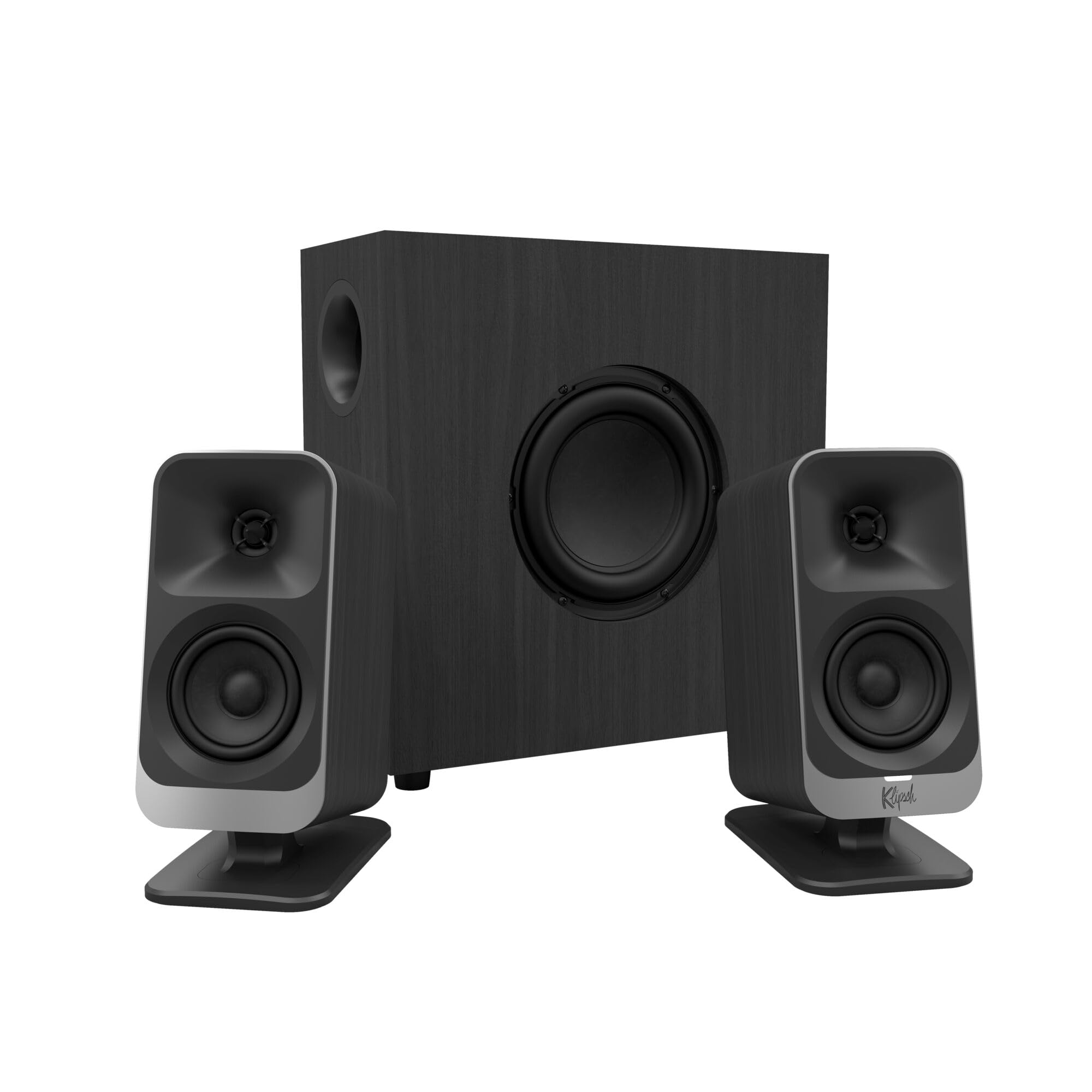
The Klipsch ProMedia Lumina 2.1 Computer Gaming System is a desktop 2.1 setup with a separate subwoofer, USB-C, AUX and Bluetooth 5.3 inputs, and app-controlled EQ and RGB lighting. It suits a desk-bound listener who wants real low-end separation and multiple sources on one pair of speakers. The principal reservation is that no power ratings, driver sizes, dimensions, or frequency response figures were supplied, so performance claims here remain manufacturer descriptions rather than verified numbers.
Positionally, this product is aimed at the gap between a soundbar and a component bookshelf system. Klipsch states the ProMedia line dates to 1999 and that this is a redesigned successor, which frames it as a familiar-name option for buyers who want desktop audio that is a deliberate purchase rather than whatever shipped with the monitor. The inclusion of RGB lighting and gaming language in the title signals the intended audience, though the described feature set is equally relevant to music and video playback.
The features that carry practical weight are the connectivity and the physical adjustments. Three inputs mean a work laptop over USB-C, a console or older machine over AUX, and a phone over Bluetooth can share the same speakers without rewiring. The subwoofer gain knob lets you correct for a room that reinforces bass, which is common when a sub sits in a desk corner. Tiltable stands address a real desktop problem, since satellites placed flat on a surface often aim below the listener. The app adds EQ, night mode, music react mode, and three lighting options, all of which are convenience layers rather than acoustic guarantees.
Limitations point some buyers elsewhere. Anyone who selects speakers by published wattage, driver diameter, or measured frequency response will not find those figures in the supplied material and should seek the manufacturer specification sheet before ordering. Buyers with no free floor or shelf area under the desk should confirm subwoofer dimensions, since none are given. Those who want a system that works fully without installing software, or who need confirmed support for a specific operating system, should verify app requirements first. Buyers seeking surround or a wider soundstage would be better served by a different format entirely.
The qualified recommendation is favorable for a desk user who values a discrete subwoofer and flexible inputs, and cautious for anyone buying on measured performance. The most important pre-purchase check is the manufacturer specification sheet: confirm subwoofer dimensions, cable lengths, output power, and which desktop and mobile platforms the Klipsch Control app actually supports.
Strong Match: A desktop user with a modern computer who wants dedicated speakers with a separate subwoofer instead of monitor or laptop audio, and who will use more than one source. The stated USB-C, AUX, and Bluetooth 5.3 inputs, the subwoofer gain knob, and the tiltable stands all point at someone setting up a permanent, adjustable workstation listening position.
Also Consider It If: You share a wall or a household and listen at odd hours. The described night mode in the Klipsch Control app, combined with the physical gain control on the subwoofer, gives two independent ways to limit low-frequency output, which is the part of a 2.1 system most likely to travel through floors and walls.
Not the Best Fit: Buyers who choose speakers on published numbers, or who have a tightly measured space. The supplied material lists no wattage, driver sizes, frequency response, or dimensions for any component, so neither acoustic capability nor physical fit can be established here. It is also not the right pick if you want a system that operates fully without a companion app, since EQ, lighting, and night mode are all described as app functions.
Decision in One Sentence: Buy the Klipsch ProMedia Lumina 2.1 if you are a multi-source desktop listener who wants a discrete subwoofer with hands-on gain control and app-based EQ, provided you first confirm the missing specifications and app platform support directly with the manufacturer.
Consider It For:
- Desk setups that need bass reproduction handled by a separate low-profile subwoofer rather than by small satellites alone.
- Users juggling several sources, since USB-C, AUX, and Bluetooth 5.3 are all listed as available inputs.
- Listeners who want tone shaping without external hardware, using the app's stated EQ control.
- Workstations where speaker aiming matters, thanks to the tiltable stands.
- Shared living situations, given the described night mode and the physical subwoofer gain knob.
Pass If:
- You need published output power, driver sizes, or frequency response to make the decision, as none were supplied.
- Your desk area is tightly constrained and you cannot verify subwoofer and satellite dimensions before ordering.
- You want lighting and EQ handled on-device, since these are described as app-dependent and no platform requirements are stated.
- You are weighting the 4.6 rating heavily, because the number of ratings behind it is not available here.
2.1 with a separate subwoofer: Two satellites handle midrange and treble while a third enclosure handles low frequencies. The practical benefit is that the desk speakers can stay small without giving up bass, and the bass module can be positioned independently. Klipsch describes the subwoofer as low profile with cable management, though no dimensions are provided.
Subwoofer gain knob: A physical control for how loud the bass module plays relative to the satellites. This matters because a sub placed in a desk enclosure or corner is typically reinforced by the boundaries around it, and a fixed level would sound heavy in one room and thin in another.
USB-C, AUX, and Bluetooth 5.3: USB-C allows a digital connection from a modern computer. AUX covers analog sources and older machines. Bluetooth 5.3 covers phones and tablets wirelessly. Having all three means the system is not tied to one device generation.
Tiltable stands: Angling the satellites upward directs the treble toward seated ear height. On a desk this tends to improve clarity and dialogue intelligibility, since high frequencies are directional and easily lost when drivers fire past the listener.
Klipsch Control app: Described as providing EQ, lighting control, night mode, and music react mode, with three color-changing options. Treat this as a manufacturer claim and confirm which operating systems are supported before buying, since the supplied material does not specify them.
Pros
- Claimed 14Hz to 27kHz frequency range suggests full-range playback, potentially removing the need for a separate subwoofer.
- AirPlay 2, Spotify Connect, and UPnP cover the most common streaming sources across Apple, Spotify, and local network libraries.
- The single-enclosure dark chrome design fits minimalist spaces where a multi-component system would not.
- App-based room tuning allows owners to adjust the speaker to their specific listening space.
- The stated 108dB output ceiling gives reason to expect high-volume headroom in larger rooms, pending verification.
Cons
- No customer review evidence was supplied, so setup experience, app stability, and real-world reliability remain unverified.
- Core audio claims, including zero distortion, 14Hz bass extension, and 108dB output, have no independent measurement backing.
- Documented connectivity lacks Bluetooth and wired inputs, and multi-unit stereo or multi-room pairing is not described in the supplied data.
The Devialet Phantom I 108dB Dark Chrome is a single-enclosure wireless speaker positioned as a full-range home audio system. Its best-fit buyer wants one visually distinctive speaker with deep bass, app-based control, and broad streaming support. The strongest reason to consider it comes from the supplied specs: a claimed 14Hz to 27kHz range and a stated 108dB output ceiling, figures that suggest one unit can cover sub-bass and loud listening without a separate subwoofer. The main evidence limitation is that no customer reviews or independent measurements were supplied, so every audible claim remains unverified.
Connectivity is the most concrete part of the offering. AirPlay 2 covers Apple devices, Spotify Connect serves Spotify subscribers, and UPnP handles music from local network libraries. An iPhone, Mac, or Spotify user can start playback directly without a cable, and owners of a home server or NAS can stream local files. The Devialet App is described as the control layer for setup, room-related speaker settings, and firmware updates, meaning the speaker depends on the app for configuration rather than working purely out of the box.
Customer feedback is effectively absent from the supplied material. No review excerpts were provided, and the listed rating cannot be attributed to any verified customer feedback. There is therefore no user consensus on setup difficulty, sound quality, reliability, or app stability. Describing this product as proven or popular would require evidence that was not supplied.
The trade-offs center on what the supplied data cannot establish: measured distortion at real listening levels, bass extension under room conditions, long-term durability, physical weight for shelving decisions, and warranty or support terms. Buyers expecting a literal multi-channel surround system should note that the surround-sound language refers to a single speaker's soundstage, not a documented multi-speaker layout. The supplied materials also do not show how units pair for stereo or multi-room playback.
The qualified verdict: the Phantom I 108dB earns a shortlist spot for an affluent buyer who values industrial design, streaming flexibility, and one-box bass, and who can audition the unit before purchase. The supplied evidence does not justify treating it as a proven, low-risk buy. Independent owner reports, a listening test, and confirmed warranty terms are necessary before committing.
Verified Product Facts: The supplied data documents a single-enclosure wireless speaker in Dark Chrome with listed dimensions of approximately 11 x 17.5 x 11.5 inches. It includes a claimed frequency range of 14Hz to 27kHz, a stated output ceiling of 108dB, and connectivity via AirPlay 2, Spotify Connect, and UPnP. The Devialet App is described as the control layer for setup, room settings, and updates, and a Devialet Intelligent Processor is cited as the onboard processing system.
Customer Signals: No review excerpts were supplied, and the accompanying rating cannot be attributed to any verified feedback. The evidence is insufficient to establish any usage pattern, and inferring a consensus would be unsupported.
Not Verified: Independent measurements of output, distortion, and bass extension; long-term reliability and build durability; warranty and support terms; physical weight and stand or wall-mounting requirements; app stability and setup experience; and whether multiple units can be paired into a stereo or multi-room configuration.
Evidence-Aware Verdict: The evidence supports considering this speaker for buyers who want a single premium wireless unit with app control and AirPlay 2, Spotify Connect, and UPnP streaming. It does not support conclusions about proven reliability, measured audio performance, or long-term value, and those questions should be resolved before purchase.
Compatibility: Supplied evidence documents AirPlay 2, Spotify Connect, and UPnP. Buyer impact: iOS and Mac users, Spotify subscribers, and local network libraries are covered without cables. Qualification: Bluetooth, wired inputs, and multi-unit pairing are not documented in the supplied data.
Controls and Setup: Supplied evidence describes the Devialet App as the setup and room-tuning layer with firmware updates. Buyer impact: placement-specific tuning is possible without touching the unit. Qualification: app reliability and ease of use are unverified, and the speaker may require the app for full configuration.
Performance Range: Supplied evidence claims 14Hz to 27kHz response, 108dB output, and zero distortion or saturation. Buyer impact: if accurate, one unit can serve as a full-range system without a subwoofer. Qualification: these figures are manufacturer claims with no independent measurement supplied.
Physical Fit: Supplied evidence lists dimensions of approximately 11 x 17.5 x 11.5 inches in Dark Chrome. Buyer impact: the enclosure is compact enough for shelves or stands in most rooms. Qualification: weight and mounting options are not supplied, so surface strength and stand compatibility must be confirmed before setup.
Ownership Cost: Supplied evidence places the product at a premium price tier within the category. Buyer impact: this is a considered purchase, so performance must justify the outlay. Qualification: value cannot be assessed without owner feedback and independent test results.
Durability and Support: Supplied evidence contains no warranty terms or reliability information. Buyer impact: long-term risk is unknown at this price tier. Qualification: confirm the specific seller's warranty, return, and support policy before ordering.
Color: Dark Chrome.
Dimensions: Listed as approximately 11.0 x 17.5 x 11.5 inches.
Product Group: Electronics.
Binding: Electronics.
Pros
- Wide frequency response (14Hz-27kHz) supports deep bass and detailed highs for full-range audio reproduction.
- Multiple wireless connectivity options (AirPlay 2, Spotify Connect, UPnP) accommodate various user ecosystems.
- Dedicated app allows for precise control and room-specific speaker calibration.
- Compact dimensions relative to its claimed sound output, allowing for flexible placement.
- Premium gold finish offers a distinctive aesthetic for modern interior design.
Cons
- High price point places it firmly in the luxury audio category, limiting accessibility for most buyers.
- Requires the Devialet app for full control and setup, which may be a hurdle for users preferring simple plug-and-play operation.
- No customer reviews are currently available to validate long-term reliability or real-world performance claims.
The Devialet Phantom I 108dB Gold is a premium wireless speaker engineered for audiophiles and design-conscious listeners who want a high-fidelity, compact system without the bulk of traditional separates. Its core purpose is to deliver powerful, detailed sound in a single, sculptural unit that serves as both a focal point and a source of room-filling audio.
The speaker's standout feature is its claim of zero distortion and zero saturation across a wide frequency range, from 14Hz to 27kHz. This suggests it can reproduce both deep sub-bass and crystalline highs without the sonic artifacts that often plague smaller or less sophisticated speakers. The inclusion of a dedicated Intelligent Processor aims to optimize this performance in real-time, adapting to content for consistent quality.
Physically, the Phantom I is a substantial yet compact unit with dimensions of approximately 11 x 17.5 x 11.5 inches. Its gold finish positions it as a statement piece for a living room, study, or dedicated listening area. Setup and control are managed through the Devialet App, which is required for initial configuration and ongoing fine-tuning of room settings, indicating a product designed for users comfortable with a software-driven experience.
A key consideration is the product's luxury positioning and associated cost. The lack of any customer reviews at the time of writing means prospective buyers must rely entirely on the manufacturer's specifications and claims. This absence of independent validation is a significant factor for any purchase decision, especially at this price tier. The requirement for app-based control also means it may not suit those who prefer immediate, physical controls.
In summary, the Devialet Phantom I 108dB Gold is a compelling choice for the dedicated audiophile seeking a visually striking, high-performance wireless speaker with advanced processing. The main reason to hesitate is the substantial investment without the backing of user reviews, and those prioritizing simplicity or a lower budget should explore other categories of audio equipment.
Implosive Soundstage: This feature aims to create a wide, immersive audio field that makes sound appear to come from beyond the speaker's physical boundaries. It benefits users who want a cinematic or concert-hall feel in their living space without installing a multi-speaker surround system.
Zero Distortion & Saturation: The speaker is engineered to maintain clarity even at high volumes, preventing the muddiness or harshness that can occur. This is critical for listeners who enjoy dynamic music genres or use the speaker for home theater, where clean peaks are essential.
Devialet Intelligent Processor: This internal chip dynamically optimizes the audio signal. It helps ensure consistent performance regardless of the music source or volume level, which is particularly useful for streaming varied content from different services.
Devialet App Control: The app is the primary interface for setup, calibration, and daily use. It allows users to tailor the speaker's output to their specific room acoustics, a valuable tool for achieving the best possible sound in a non-treated space.
Multi-Protocol Connectivity: Support for AirPlay 2, Spotify Connect, and UPnP means the speaker integrates smoothly with Apple devices, Spotify accounts, and local network libraries. This flexibility solves the common problem of connecting different devices and services to a single audio system.
Model: Phantom I 108dB
Color: Gold
Dimensions: 10.99 x 17.5 x 11.5 inches
Frequency Response: 14Hz - 27kHz
Connectivity: AirPlay 2, Spotify Connect, UPnP
Control: Via Devialet App
Apple Ecosystem: AirPlay 2 integration allows for seamless streaming from iPhones, iPads, and Macs. This makes it a strong choice for households heavily invested in Apple products, enabling easy multi-room audio and handoff between devices.
Spotify Users: Native Spotify Connect support lets users stream directly from the Spotify app on any device, bypassing the need for a separate intermediary. This is a convenient, direct solution for the millions of Spotify subscribers.
Local Network Libraries: UPnP compatibility means the speaker can access music files stored on a computer, NAS drive, or media server on the same home network. This is essential for users with large personal music collections in high-resolution formats.
General Bluetooth Note: While the product is listed in the 'Portable Bluetooth Speakers' category, the supplied features emphasize Wi-Fi-based protocols (AirPlay, UPnP) for high-fidelity streaming. Prospective buyers should verify Bluetooth version and codec support if wireless range from a phone is a primary need.
Pros
- All-in-one setup eliminates the need to match separate components or buy additional amplifiers
- Ortofon 2M Blue cartridge offers detailed sound that reveals nuances in vinyl recordings
- Bluetooth integration provides convenient switching between vinyl and digital streaming
- MDF wood plinth and isolation feet help minimize vibrations for stable, clear playback
- RIAA-standard phono preamp ensures accurate frequency response from vinyl records
Cons
- Significant weight at 44.65 pounds makes relocation difficult and requires sturdy furniture support
- Bundle pricing may exceed budget for listeners who only want basic vinyl playback
- White and white walnut finish may not match all room decors or existing audio equipment aesthetics
The Fluance Reference RT85 Turntable Bundle provides a complete, high-fidelity vinyl listening system for enthusiasts who want premium sound without assembling separate components. This package suits listeners ready to invest in quality analog playback and room-filling stereo sound, though its substantial weight and all-in-one design may challenge those with limited space or who prefer incremental upgrades.
The Ortofon 2M Blue cartridge stands out as the bundle's most significant component, delivering detailed, warm sound that reveals subtle nuances in vinyl recordings. Combined with the acrylic platter and servo motor, these elements work together to minimize resonance and maintain stable playback speed. The 120W Class D amplifier provides sufficient power for most living rooms, while the RIAA-standard phono preamp ensures accurate frequency response faithful to original recordings.
Design considerations include the high-mass MDF wood plinth and three-point vibration isolation feet, which help stabilize the turntable and reduce external interference. The white and white walnut finish offers a clean aesthetic, though the complete system weighs 44.65 pounds, requiring sturdy furniture and limiting placement flexibility. Setup appears straightforward with plug-and-play connections between components.
Potential drawbacks include the bundle's weight, which may make relocation difficult during moves or room rearrangements. Listeners with smaller spaces might find the bookshelf speakers too large, while those seeking component-by-component upgrades may prefer purchasing pieces separately. The premium pricing positions this bundle above entry-level systems but below ultra-high-end audiophile setups.
Verdict: The strongest reason to choose this bundle is its convenience in delivering a complete, high-quality vinyl system without component matching. The main hesitation is the significant weight and all-in-one design that limits future flexibility. Listeners who want to start with basic equipment and upgrade gradually should consider separate purchases, while those ready for a quality vinyl experience will appreciate this comprehensive package.
Ortofon 2M Blue Cartridge: This cartridge provides detailed, warm sound reproduction that reveals subtle nuances in vinyl recordings. It solves the problem of flat or lifeless playback by accurately tracking record grooves, benefiting listeners who want to hear the full depth of their vinyl collection.
120W Class D Amplifier: Delivers sufficient power for room-filling stereo sound without requiring separate amplification equipment. This integrated solution eliminates the complexity of matching components and provides enough volume for most living spaces.
Acrylic Platter: Reduces resonance and provides stable rotation speed for cleaner playback. The material helps minimize vibrations that could affect sound quality, benefiting listeners who want consistent performance from their turntable.
Bluetooth Connectivity: Allows seamless switching between vinyl playback and streaming music apps from mobile devices. This feature solves the limitation of traditional turntables by adding modern convenience for listeners who enjoy both analog and digital music sources.
RIAA-Standard Phono Preamp: Converts the turntable's phono signal to line level with accurate frequency response. This ensures recordings are reproduced as intended by the original artists, benefiting listeners who value authentic sound reproduction.
Vibration Isolation Feet: Three-point design helps minimize external vibrations that could affect playback quality. This feature is particularly valuable for listeners in apartments or homes with foot traffic, as it helps maintain stable, clear sound.
Dimensions: 23.45 x 16.5 x 13.1 Inches
Weight: 44.65 pounds
Color: White / White Walnut
Amplifier Power: 120W Class D
Cartridge: Ortofon 2M Blue
Speaker Size: 6.5 inch bookshelf speakers
Connectivity: Bluetooth enabled
Platter Material: Acrylic
Plinth Material: High mass MDF wood
Isolation System: 3-point vibration isolation feet
Initial Setup: The bundle appears designed for straightforward plug-and-play installation, with all components included and ready to connect. Listeners should expect to place speakers on appropriate surfaces and connect the turntable to the preamp and amplifier according to included instructions.
Placement Considerations: At 44.65 pounds total weight, the system requires sturdy furniture support and careful placement planning. The bookshelf speakers need stable surfaces, while the turntable benefits from level positioning to maintain playback quality.
Ongoing Maintenance: Vinyl playback systems typically require regular cleaning of the stylus and records to maintain sound quality. The acrylic platter may need occasional dusting, while the wood plinth should be kept away from direct sunlight to prevent fading.
Component Care: The Ortofon 2M Blue cartridge will eventually need replacement after extended use, which is standard for all turntable cartridges. Listeners should monitor sound quality for signs of wear and consider professional setup assistance if experiencing playback issues.
Pros
- Complete turntable system for vinyl enthusiasts who want high-fidelity sound without component matching
- Integrated amplification simplifies setup for users without existing audio equipment
- Premium cartridge and platter improve sound quality for serious listeners
- Bluetooth adds convenience for casual listening and streaming services
- Natural walnut finish suits living spaces and dedicated listening rooms
Cons
- Total weight of 44.65 pounds requires sturdy furniture and careful placement planning
- No customer reviews available to verify long-term reliability or real-world performance
- Dimensions (23.45 x 16.5 x 13.1 inches) require dedicated surface space and clearance
The Fluance Reference RT85 bundle is designed for vinyl enthusiasts seeking a complete, high-fidelity playback system without purchasing separate components. This system pairs a premium turntable with powered bookshelf speakers and a phono preamp, ideal for listeners who want exceptional analog sound quality in a single purchase. The strongest verified convenience is the integrated 120W Class D amplifier, which eliminates the need for a separate receiver or power amplifier, simplifying the signal path and reducing equipment clutter.
The turntable features an Ortofon 2M Blue cartridge, acrylic platter, and 3-point vibration isolation feet, components that collectively work to minimize resonance and improve tracking accuracy. The servo motor and S-type precision tonearm are designed to maintain consistent speed and proper alignment, which directly affects sound quality during playback. The MDF wood plinth provides mass to dampen vibrations, important for listeners in environments with foot traffic or nearby appliances.
The included PA10 phono preamp handles the critical task of converting the turntable's phono signal to line level with RIAA equalization, ensuring compatibility with the powered speakers. The Ai61 speakers contain the 120W amplifier and accept both analog input from the turntable and Bluetooth signals for digital streaming. This allows users to switch between vinyl records and music apps without reconfiguring connections.
The system's weight of 44.65 pounds and dimensions of 23.45 x 16.5 x 13.1 inches require a sturdy, dedicated surface with adequate clearance. The natural walnut finish suits living rooms or dedicated listening spaces, but potential buyers should verify furniture weight capacity and available space. The 0 review count means real-world durability, customer support experiences, and long-term performance remain unverified by actual users.
This system is best for vinyl enthusiasts who want premium sound quality without assembling separate components, and who have appropriate space for the equipment. Buyers should avoid this if they need compact equipment, have lightweight furniture, or prefer extensive customer reviews before purchasing. Verify included cables, power requirements, and warranty terms with the manufacturer before purchase.
Best Ownership Fit: This system suits vinyl enthusiasts in homes with dedicated listening spaces or sturdy furniture, who want high-fidelity sound without component matching, and who listen regularly enough to justify premium equipment.
Daily Workflow: The expected routine involves placing records on the acrylic platter, using the S-type tonearm for playback, and switching to Bluetooth for digital streaming through the same speakers. The integrated amplification means no separate equipment to power on or configure.
Likely Friction: The most significant ownership consideration is the system's weight (44.65 pounds) and dimensions, which require sturdy furniture and careful placement planning that cannot be easily changed once set up.
Before You Buy: Verify furniture weight capacity and available surface space for the 23.45 x 16.5 x 13.1 inch footprint. Check what cables and accessories are included, as the description does not specify. Confirm power requirements and outlet availability near the intended placement location. Verify warranty terms and return policy given the lack of customer reviews.
Initial Setup: The product description indicates a plug-and-play setup with no separate amplifier required, but specific assembly steps, included cables, and connection procedures are not detailed. Buyers should verify what components require assembly versus come pre-assembled.
Component Connections: The system connects the turntable to the phono preamp, then to the powered speakers, with Bluetooth pairing for digital devices. The exact cable types, lengths, and connection points should be confirmed with the manufacturer.
Placement Requirements: The 44.65-pound total weight requires a sturdy, level surface capable of supporting the equipment without wobble. The 3-point vibration isolation feet on the turntable suggest it should be placed away from heavy foot traffic or vibrating appliances.
Cleaning Access: The acrylic platter and MDF plinth will require regular dusting and cleaning, but specific cleaning instructions or recommended products are not provided. The tonearm and cartridge will need periodic cleaning for optimal performance.
Consumables & Replacement: The Ortofon 2M Blue cartridge will eventually need replacement after extended use, but the replacement interval and compatible cartridges are not specified. Buyers should verify cartridge replacement procedures and costs.
Storage Considerations: The system's dimensions require permanent placement rather than frequent moving or storage. The weight makes relocation a multi-person task that should be planned carefully.
Space Requirements: The system dimensions of 23.45 x 16.5 x 13.1 inches require a dedicated surface with clearance around all sides for ventilation and operation. The 44.65-pound weight demands furniture rated for at least 50 pounds to ensure safety margin.
Power Needs: The system includes a turntable, phono preamp, and powered speakers that all require electrical power. The number of outlets needed and power consumption are not specified, requiring verification before placement.
Audio Compatibility: The phono preamp converts the turntable signal to line level, making it compatible with the included speakers. The Bluetooth functionality allows connection to smartphones, tablets, and computers for digital streaming.
Existing Equipment: This is a complete system that does not require additional amplification, but buyers with existing audio equipment should verify if components can be integrated or if the system operates independently only.
Pros
- Scalable coverage: stacking up to 12 cabinets creates wide, even sound distribution for event crews working large stages.
- Angle presets remove guesswork from aiming the array, helping operators set up coverage quickly in unfamiliar rooms.
- Powered Class-D design cuts rack gear, so mobile performers can run each cabinet without separate amplifiers.
- All-birch plywood construction suits musicians and production companies that move and mount gear frequently.
- DSP with three presets lets churches and meeting halls switch between spoken word and music in one cabinet.
Cons
- Each 82.5-pound cabinet is physically demanding to carry, stack, and mount, which limits solo operators and small crews.
- The 5000W rating is P.M.P.O. peak output and no continuous wattage is supplied, so sustained output claims are unverified.
- There are no verified customer reviews yet, so real-world performance and durability remain unconfirmed for early buyers.
The PRORECK PR-210BP is a powered dual 10-inch line array speaker made for event sound operators, live performers, and houses of worship that need wide, even coverage from a scalable rig. Its strongest verified advantage is the array design: up to 12 cabinets can be stacked and fastened together, each with its own Class-D amplifier, so one model can cover a single speech event or a full multi-cabinet stage system. The main qualification is that the product has no verified customer reviews yet, so performance claims remain untested in the field.
The six preset mounting angles (0, 2, 4, 6, 8, and 10 degrees) let an operator aim coverage to match room shape, which matters for speech clarity in churches and meeting halls as much as for music outdoors. The DSP with three preset modes removes the need for an external processor when switching between spoken word and music. Each cabinet pairs two 10-inch woofers with a 3-inch ferrite driver, so a single box delivers full-range output instead of requiring separate top cabinets.
Setup has a real physical cost. Each cabinet weighs 82.5 pounds and measures 32 by 18 by 12.5 inches, so a several-cabinet array needs a crew, a solid mounting plan, and a vehicle sized for the load. The all-birch plywood enclosure is built for repeated packing and unpacking, which suits mobile crews. No battery power, wireless operation, or subwoofer integration is specified, so plan for wired power and signal to each cabinet.
The PR-210BP makes sense for production-minded buyers who want expandable line array coverage in a powered, DSP-equipped format. The main trade-off is between the headline number and the practical reality: 5000W is a P.M.P.O. peak rating with no continuous figure supplied, and each cabinet is heavy enough to demand proper lifting technique. A solo acoustic performer or a buyer covering a small room should consider a lighter single powered PA cabinet instead.
Best For: Mobile event sound crews and live production teams that need stackable, wide-coverage stage sound and already account for professional transport and mounting.
Why It Fits: Up to 12 PR-210BP cabinets can be stacked and fastened together with per-cabinet Class-D amplification, six angle presets, and three DSP modes, which supports scaling from a single meeting to a large outdoor stage.
Think Twice If: You are a solo performer or small-venue buyer who wants one lightweight, portable speaker, since each 82.5-pound cabinet is heavy and the power rating is peak, not continuous.
Bottom Line: Buy the PR-210BP if you need expandable, powered line array coverage for events; qualify the decision by confirming your crew and vehicle can handle the weight and by treating the 5000W claim as a peak figure.
Array Scalability: Up to 12 PR-210BP cabinets can be stacked and fastened together, letting one product line grow from a single speaker to a full stage array.
Powered Simplicity: A built-in Class-D amplifier powers each cabinet, so no external amplifier rack is needed for basic operation.
Coverage Control: Six preset angles from 0 to 10 degrees allow the array curve to be adjusted for different room and venue shapes.
Venue Presets: Three DSP preset modes adapt the sound character for applications such as speech and staged performance.
Full-Range Design: Two 10-inch woofers plus a 3-inch ferrite driver deliver full-range output from a single enclosure.
Drivers: Two 10-inch woofers and one 3-inch ferrite driver per cabinet.
Amplifier and DSP: Built-in Class-D amplifier rated at 5000W P.M.P.O. peak, with three preset modes; no continuous wattage figure is supplied.
Angles and Capacity: Six preset mounting angles at 0, 2, 4, 6, 8, and 10 degrees, with up to 12 cabinets stackable.
Dimensions and Weight: 32 by 18 by 12.5 inches and 82.5 pounds per cabinet.
Enclosure: All-birch plywood construction.
Pros
- Upgraded bass response addresses a common shortcoming of compact bookshelf speakers, allowing for fuller sound in medium rooms
- High sensitivity rating of 90 dB means the speakers can produce ample volume without requiring extremely powerful amplification
- Support for bi-wiring/bi-amplification provides an upgrade path for enthusiasts seeking to fine-tune their system's performance
- Wide frequency range from 44 Hz to 22,000 Hz covers most audible content, reducing the immediate need for a subwoofer in many applications
- Multiple finish options allow the speakers to integrate aesthetically into various room decors
Cons
- Zero customer reviews provide no real-world validation of sound quality, reliability, or long-term satisfaction
- The speakers are passive and require a separate amplifier or receiver, adding an unmentioned cost and complexity to the total system
- The claimed optimal room size of 10 to 40 m² suggests they may not deliver sufficient volume or bass impact in very large or open-plan living spaces
The Triangle Borea BR04 bookshelf speakers aim to deliver a refined, high-fidelity listening experience in a compact form, positioning themselves as an upgrade within the popular Borea range. They appear designed for the listener who wants a noticeable step up in sound quality for music and movies without dedicating space to large floor-standing towers.
The core of the BR04's appeal lies in its driver configuration. The manufacturer claims the EFS silk-dome tweeter paired with a waveguide ensures clear and detailed high frequencies, while the cellulose pulp midrange/bass driver is engineered for natural warmth and vocal clarity. This combination suggests a sound signature that prioritizes tonal accuracy, particularly for voice-centric content.
Key specifications translate into practical benefits. A frequency range extending down to 44 Hz indicates these speakers can produce meaningful bass without a subwoofer in smaller to mid-sized rooms, as suggested by the 10 to 40 m² optimal range. The 90 dB sensitivity is a favorable figure, meaning they should achieve satisfying listening levels with a moderate amount of amplifier power. The inclusion of dual binding posts for bi-wiring or bi-amplification is a thoughtful feature for users looking to optimize their signal path.
A primary limitation for prospective buyers is the complete lack of user reviews. This means all performance claims are based solely on manufacturer specifications, with no independent or anecdotal verification of sound quality, build consistency, or potential issues. Furthermore, as passive speakers, the BR04s require a separate amplifier or AV receiver, a necessary component whose cost and compatibility are not included in the product package.
For the listener seeking a versatile, well-specced bookshelf speaker for a dedicated listening room or as part of a home theater system, the Triangle Borea BR04 presents a technically promising option. The most critical pre-purchase step is to audition them if possible, or at minimum, ensure your amplification is adequately matched to their specifications, given the absence of community feedback to guide this decision.
Strong Match: An audio enthusiast building or upgrading a stereo Hi-Fi system or home theater in a medium-sized room (like a living room or den) who values clear vocals and detailed sound and is comfortable selecting and pairing their own amplification.
Also Consider It If: You are looking for high-quality, passive bookshelf speakers to serve as front or surround channels in a modular home cinema setup, prioritizing tonal accuracy over sheer volume.
Not the Best Fit: A buyer seeking a simple, all-in-one powered speaker solution without needing a separate amplifier, or someone with a very large, open-concept space requiring the output of larger floor-standing speakers.
Decision in One Sentence: The Triangle Borea BR04 is a technically capable, versatile passive bookshelf speaker for the informed buyer building a separate system, but its value is unproven without user reviews or included amplification.
Consider It For:
- The potential for upgraded, detailed sound with clear vocals and extended bass in a compact cabinet.
- System flexibility via bi-wiring/bi-amplification support for future upgrades.
- Versatility for use as either primary stereo speakers or part of a multi-channel home theater.
- A high sensitivity rating that makes them easier to drive with a wider range of amplifiers.
- Availability in multiple finishes to match different interior decors.
Pass If:
- You require proven performance backed by customer reviews before purchasing.
- You need a complete, powered speaker solution that does not require a separate amplifier.
- Your listening space is very large and demands the higher output and deeper bass of larger speaker formats.
- You are unwilling to invest in potentially high-quality amplification to realize the speakers' full potential.
EFS Silk-Dome Tweeter with Waveguide: This high-frequency driver is designed to produce smooth, detailed treble. The waveguide helps control sound dispersion, potentially creating a more focused and consistent listening experience across a wider area of the room.
Cellulose Pulp Driver: This material for the midrange/bass cone is often chosen for its natural damping properties, which can help produce a warm, uncolored sound with particular strength in reproducing the human voice accurately.
Bi-Wiring/Bi-Amplification Capability: The dual binding posts allow you to run separate amplifier signals to the high and low-frequency drivers. This can reduce interference between the frequencies, potentially leading to cleaner sound, and offers a clear upgrade path for your audio system.
High Sensitivity (90 dB): This specification indicates how efficiently the speakers convert amplifier power into sound. A higher number like 90 dB means the speakers will play louder with less power, making them compatible with a broader range of amplifiers and receivers.
Pros
- The multi-driver layout, with three woofers and three tweeters described by the manufacturer, points to a speaker designed for scale and coverage rather than desktop-nearfield listening, which matters if you want music to carry across a room.
- Line-in support means a turntable or CD player can feed the speaker directly, so buyers with legacy analog gear are not forced into a separate amplifier purchase to get sound out of it.
- AirPlay 2 support gives Apple-device owners a system-level way to send audio without living inside a single app, which reduces friction for households already on iPhones, iPads, or Macs.
- The stated stereo behavior across one or two units gives a documented upgrade path: start with a single horizontal speaker, add a second later, and the pair reconfigures itself rather than requiring manual channel setup.
- A rating in the low 4s across more than a thousand customer entries suggests broadly satisfied owners, though this is aggregate sentiment rather than verified performance.
Cons
- No battery, Bluetooth, waterproofing, or portability claim appears anywhere in the supplied information, so this should be treated as a stationary, mains-powered, network-dependent speaker until you confirm otherwise.
- The supplied data includes no amplifier wattage, frequency response, dimensions, weight, or connectivity specifications, which leaves buyers who compare on measurements without anything to compare.
- No voice assistant, microphone, or smart-home control is mentioned, and no warranty term is stated beyond the inclusion of warranty documentation in the box, so both should be verified directly with the seller or brand.
The Sonos Five in black is a large, mains-oriented wireless speaker aimed at a listener who wants one capable music source in a living room, study, or listening corner and who is comfortable controlling it through the Sonos app or Apple AirPlay 2. Its strongest argument is the described six-driver arrangement built around three woofers in a sealed cabinet. The principal reservation is how little verified specification data accompanies it.
Positionally, this looks designed for the gap between a small voice-assistant speaker and a separates system. It does not ask you to buy an amplifier, choose speaker cable, or manage a rack, but it also does not pretend to be a portable or a kitchen-counter convenience device. The presence of a 3.5 mm line-in signals a further intent: the brand expects some owners to arrive with a turntable or CD player and to want that source integrated rather than orphaned. That is a meaningful editorial signal about who this product is for.
Translating the stated features into consequences, the sealed enclosure and high-excursion woofers are the manufacturer's explanation for controlled bass, which in practice tends to matter most in rooms where a ported speaker would boom. The two angled side tweeters and one center tweeter describe an attempt to spread sound sideways while keeping vocals anchored, useful when listeners are not seated in a narrow sweet spot. The orientation logic is the most practical detail: a single unit lying horizontally plays stereo, while two upright units each collapse to mono and split channels, so buying a second speaker later changes the system's behavior automatically.
The limitations are mostly gaps rather than flaws. Nothing supplied indicates battery operation, Bluetooth, water resistance, a built-in microphone, or voice control, so buyers who need portability, an offline pairing option, outdoor placement, or hands-free commands should look toward a product category explicitly built for those things. Likewise, buyers who specify by wattage, frequency response, or physical footprint will not find those numbers here, and no substitute figures should be assumed.
The qualified verdict: recommended for a network-connected household that wants one substantial music speaker with an analog input and an optional second-unit path, and not recommended for anyone whose purchase depends on portability, Bluetooth, or published measurements. Before buying, confirm the speaker's dimensions and power requirements against your intended shelf or stand, and confirm the exact warranty terms with the seller.
Strong Match: A listener setting up a dedicated music spot in a medium or large room who wants app-driven control and room-filling output from a single unit. The three-woofer sealed design and triple-tweeter layout are the manufacturer's case for scale and width, and the ability to start with one horizontal speaker and later add a second upright unit gives this buyer a defined path rather than a dead end.
Also Consider It If: You own a turntable or CD player and have been looking for a way to hear it without assembling a separate amplifier and passive speaker chain. The 3.5 mm line-in is a distinct piece of evidence pointing at that use case, and it is the feature most likely to be decisive for analog-source owners.
Also Consider It If: Your household runs on Apple hardware. Stated AirPlay 2 support means audio can be sent at the system level from an iPhone, iPad, or Mac rather than only from inside one app, which lowers the daily friction of actually using the speaker.
Not the Best Fit: Anyone who needs to move the speaker between rooms, take it outdoors, pair a phone over Bluetooth, or issue voice commands. None of those capabilities appear in the supplied information, and a purchase that depends on them should not be made on assumption. The same applies to buyers who select equipment by published amplifier power or frequency response, since neither is provided here.
Decision in One Sentence: Buy the Sonos Five in black if you want one stationary, network-controlled music speaker with an analog line-in and a second-unit stereo path, but only after confirming its dimensions, power needs, and warranty terms, and not if portability, Bluetooth, or documented measurements are part of your requirement.
Consider It For:
- A single-speaker music setup in a room where you want output to carry rather than stay at a desk, supported by the stated three-woofer, three-tweeter configuration.
- Direct connection of a turntable or CD player through the 3.5 mm line-in, without adding a receiver to the chain.
- Apple-centric households that want AirPlay 2 as a system-level route to playback alongside the Sonos app.
- Buyers who may want stereo later, given the described automatic switch to mono channels when two upright units are paired.
- Rooms where controlled bass matters more than maximum output, since the sealed architecture is the brand's stated approach to limiting internal reverb.
Pass If:
- You need portability, battery power, or outdoor use, none of which is indicated in the supplied information.
- Bluetooth pairing or offline playback from a phone is a requirement, as only app control and AirPlay 2 are stated.
- You compare speakers by amplifier wattage, frequency response, dimensions, or weight, since none of those figures are provided and none should be inferred.
- You want voice assistant control or smart-home integration, which is not mentioned among the described features.
Sealed cabinet with three woofers: A sealed enclosure has no port to the outside air, and the brand credits this design with eliminating reverb and echo inside the cabinet. For a buyer, the practical reading is that this is a bass approach favoring control and definition over the looser, louder low end that ported designs often produce. Take the description as a manufacturer claim rather than a measured result.
Three tweeters, two of them angled: The two side tweeters are described as creating spatial extension, while the center tweeter is described as optimizing vocals. In use, that arrangement is generally intended to widen the perceived sound field so listeners spread around a room still hear something coherent, while keeping voices anchored to the middle instead of drifting to one side.
Orientation-aware stereo: This is the least obvious feature and the most useful to understand before buying. A single unit placed horizontally reproduces stereo on its own. Two units placed upright each switch to mono and take one channel, producing wider separation. That means your shelf or stand needs to accommodate the orientation you actually intend, and a future second purchase changes how the first speaker behaves.
The 3.5 mm line-in: This is the analog bridge. A turntable, CD player, or other device can connect directly, which removes the need for a separate amplifier for that source. Buyers connecting a turntable should confirm whether their deck has a built-in phono preamplifier, since a bare phono output and a line-level input are not the same thing, and the supplied information does not address that detail.
Control paths: The Sonos app and Apple AirPlay 2 are the stated methods of control. Both depend on a working home network, so treat reliable Wi-Fi coverage at the speaker's intended location as a prerequisite rather than an afterthought.
Pros
- The EFS silk-dome tweeter with waveguide is designed for clear, detailed high frequencies without harshness.
- A cellulose pulp midrange/bass driver aims to reproduce natural vocal timbre and mid-range warmth.
- Dual binding posts enable bi-wiring or bi-amplification for potential sound quality improvements.
- Sensitivity of 90 dB suggests it can achieve satisfying volume levels without requiring an extremely powerful amplifier.
- The compact dimensions allow placement on shelves or stands in spaces where larger speakers might not fit.
Cons
- As a renewed product, it may show minor cosmetic wear and lacks the full warranty of a new unit.
- The provided frequency range starts at 44 Hz, which may not satisfy listeners seeking deep, powerful sub-bass without a subwoofer.
- Zero customer reviews are available to validate real-world performance, reliability, or the quality of the renewal process.
The Triangle Borea BR04 is a compact bookshelf speaker pair designed for listeners who want detailed, natural sound for stereo music or home theater in small to medium-sized rooms. It is best suited for someone setting up a dedicated listening space or enhancing a media room who prioritizes vocal clarity and a balanced sound signature over extreme bass output.
At its core, the BR04 uses a 25mm EFS silk-dome tweeter with a waveguide and a cellulose pulp midrange/bass driver. This combination is engineered to deliver clear high frequencies and a warm, natural midrange, which is particularly beneficial for vocals and acoustic instruments. The redesigned crossover architecture aims to separate frequency processing for cleaner sound reproduction.
The speakers have a compact footprint, measuring about 12.4 by 8.7 by 16.7 inches and weighing 19 pounds each. The Black Ash finish offers a neutral look, and the manufacturer states six finishes are available. The inclusion of double binding posts is a key physical feature, allowing for advanced wiring configurations that some users may want to explore.
A significant consideration is the product's renewed status. While this makes the speakers more affordable, it means they are not new and may have cosmetic imperfections. The lack of any customer reviews for this specific renewed listing makes it impossible to gauge the consistency of the renewal process or long-term durability from other buyers' experiences.
In summary, the strongest reason to consider the Borea BR04 is its focus on accurate midrange and vocal reproduction in a versatile, compact form factor. The main reason to hesitate is the uncertainty that comes with a renewed product lacking user feedback. Buyers who need guaranteed new condition or who prioritize deep, room-shaking bass should look at other options, possibly including a model with a larger woofer or a dedicated subwoofer.
EFS Silk-Dome Tweeter with Waveguide: This component handles high-frequency sounds like cymbals and vocal sibilance. The waveguide is designed to improve the dispersion and clarity of these sounds, aiming for a wider listening sweet spot and less harshness. It benefits listeners who enjoy detailed, airy treble without fatigue.
Cellulose Pulp Midrange/Bass Driver: This driver is responsible for the core of the sound, including vocals and most instruments. Cellulose pulp is a material chosen for its natural damping properties, which can help reduce distortion and provide a warmer, more natural tone. It is key for listeners who prioritize realistic vocal reproduction.
Bi-Wiring/Bi-Amplification Capability: The double binding posts allow you to run separate speaker cables for the high and low frequencies. This can potentially reduce interference between the signals and allow for more precise tuning if you use separate amplifiers. It is a feature appreciated by audiophiles who want to optimize their system.
Redesigned Crossover Architecture: The crossover is the electronic circuit that splits the audio signal between the tweeter and the woofer. A redesigned version aims to improve the accuracy of this split, leading to a smoother transition between frequencies and a more coherent overall sound. This contributes to the speaker's high-fidelity goal.
90 dB Sensitivity Rating: This specification indicates how loud the speaker will play with a given amount of amplifier power. A rating of 90 dB is moderately efficient, meaning the BR04 should produce good volume levels with most standard home audio receivers without requiring an exceptionally powerful amplifier.
Brand: Triangle
Model: Borea BR04 (Renewed)
Speaker Type: 2-Way Bookshelf
Tweeter: 25mm EFS Silk Dome with Waveguide
Driver Material: Cellulose Pulp
Frequency Response: 44 Hz - 22,000 Hz
Sensitivity: 90 dB
Recommended Room Size: 10 to 40 m² (approx. 108 to 430 sq ft)
Binding Posts: Double (supports bi-wiring/bi-amplification)
Dimensions (each): 12.36 x 8.66 x 16.73 inches
Weight (each): 19 pounds
Color/Finish: Black Ash
Best For: This speaker is ideal for the listener building a stereo system for music or a front/surround channel setup for home theater in a small to medium room. It suits someone who values clear, natural vocal reproduction and detailed sound over thunderous bass.
Consider Alternatives If: You require a brand-new product with a full manufacturer warranty, as this is a renewed item. You also should look elsewhere if your listening room is very large or if you demand deep, powerful bass performance without adding a separate subwoofer.
Setup and Daily Use: These are passive speakers that require an external amplifier or receiver. They can be placed on speaker stands, shelves, or wall-mounted (with appropriate brackets, not included). The bi-wiring posts offer an optional advanced setup path for those with compatible equipment.
Maintenance Requirements: Standard care includes dusting with a soft, dry cloth. Avoid using chemical cleaners. As a renewed product, its internal components have been inspected, but long-term maintenance needs are typical for any passive speaker.
What Sets It Apart: The BR04 distinguishes itself with its focus on midrange accuracy and vocal timbre through its specific driver materials and waveguide-equipped tweeter. Its compact size and bi-wiring capability offer flexibility that some competing models in this class may not provide.
Pros
- High power handling: 100W RMS recommended and 125W max, suited to owners investing in an external amplifier.
- Component design with separate 1 inch silk dome tweeters enables better staging than a single coaxial driver.
- In-line Linkwitz-Riley crossovers provide clean filtering without the need for separate crossover boxes.
- Mounting hardware is included and sizing is built around many factory speaker openings.
- Durable build with steel frame, rugged grille, poly-mica cone, and double-roll rubber surround for door duty.
Cons
- Component layout requires separate tweeter and crossover mounting, adding install time and complexity for DIY buyers.
- The 3 Ohm, 100W RMS design needs a compatible amplifier or head unit, so stock radio owners may not get the full benefit.
- Independent customer feedback is not yet available, so real-world sound quality and reliability remain unverified.
The AudioControl PNW Series 6.5 inch component car speaker set is a pair of woofers plus separate 1 inch tweeters engineered for people replacing factory door speakers. The ideal buyer is an audio enthusiast who values sound quality over a simple drop-in install and plans to power the speakers with a dedicated amplifier. Its strongest reason for consideration is the 100W RMS recommended power rating supported by an FEA-designed motor and anodized voice coil former for heat management. The main qualification is that installation takes more planning than a coaxial swap, since tweeters and crossovers must be mounted separately.
The included second-order Linkwitz-Riley high-pass and low-pass crossovers split the signal between woofer and tweeter, which helps reduce distortion and protect each driver. The poly-mica coated cone and double-roll rubber surround are meant to keep mids and bass precise at higher output, and the rear-dampened hybrid silk dome tweeters extend the high end. In daily use these features translate to cleaner sound at volume rather than just louder playback.
The set is built to fit many modern factory speaker locations and ships with mounting hardware, so it can work in OEM or custom spots. Fit details include a 7.05 inch overall diameter with grille, a 5.59 inch cut out, and a 2.36 inch mounting depth for the woofers, while the tweeters need a 1.85 inch cut out and 0.63 inch mounting depth. The 3 Ohm impedance means you should confirm your amplifier or head unit can drive it before purchase.
The PNW Series is a credible high-fidelity component upgrade for buyers who already own or plan to buy a compatible amp and accept a more involved install. The main trade-off is that the separate tweeters, crossovers, and 3 Ohm load require more wiring and placement decisions than a standard 6.5 inch coaxial set. Buyers who want a quick factory speaker swap should consider a coaxial replacement instead. Those who want detailed staging and will mount tweeters properly get the most from this set.
Best For: A car or truck owner upgrading factory door speakers who wants component-level staging and plans to run a dedicated amplifier.
Why It Fits: The set carries a 100W RMS recommended rating with heat-dissipating motor design and includes in-line Linkwitz-Riley crossovers to support clean high-volume playback.
Think Twice If: You want a quick drop-in coaxial replacement, your factory system cannot comfortably drive a 3 Ohm set at roughly 100W RMS, or you have no suitable mounting spot for the separate tweeters.
Bottom Line: Buy this if you are investing in a real amplifier and are comfortable with a more involved component install, but choose a coaxial set if you want a faster, less complex factory swap.
Configuration: 6.5 inch component set with separate 1 inch tweeters, sold as a pair.
Power: 100W RMS recommended amplifier power, up to 125W max.
Impedance: 3 Ohm.
Crossover: In-line second-order Linkwitz-Riley high-pass and low-pass filters.
Woofer Fit: 7.05 inch overall diameter with grille, 5.59 inch cut out, 2.36 inch mounting depth.
Tweeter Fit: 2.13 inch overall diameter, 1.85 inch cut out, 0.63 inch mounting depth.
Installation Scope: Designed to fit many modern factory speaker locations and includes mounting hardware for OEM or custom placement.
Clearance Check: Verify door depth against the 2.36 inch woofer mounting depth before purchase.
Tweeter Placement: Plan a location that supports a 1.85 inch cut out, such as a dash, sail panel, or door.
Amplifier Match: Confirm the head unit or amp can drive a 3 Ohm load at the recommended 100W RMS level to get the intended output.
Protection: The rugged grille and edge-enhanced steel frame reduce the chance of damage during install and daily use.
Pros
- The included AT95E cartridge provides clear, detailed sound right out of the box, saving you an immediate upgrade cost.
- Built-in preamp lets you connect directly to powered speakers or a receiver's AUX input, simplifying setup.
- The heavy MDF plinth and isolation feet minimize unwanted vibrations, preserving audio fidelity.
- Belt drive design and adjustable counterweight allow for fine-tuning tracking force, protecting your records.
- Walnut finish adds a classic, furniture-grade aesthetic that fits well in a living space.
Cons
- The built-in preamp is not defeatable, which may limit connection to high-end external phono stages.
- The AT95E cartridge is not user-swappable without rewiring, reducing upgrade flexibility.
- Lacks automatic stop or return, requiring manual lift at record's end to prevent stylus wear.
The Fluance RT81 Elite High Fidelity Vinyl Turntable is a compelling entry point for those new to vinyl or seeking a straightforward, quality playback solution. With its Audio-Technica AT95E cartridge and built-in preamp, it offers a balanced, warm sound that most casual listeners will appreciate. However, its sealed design and lack of upgrade options may deter audiophiles who plan to expand their system later.
This turntable appears designed for the listener who wants a plug-and-play experience without sacrificing audio quality. It solves the common problems of setup complexity and external preamp costs by integrating essential components. The high-mass MDF plinth and isolation feet address vibration issues, a key factor in turntable performance, making it a thoughtful choice for a first serious turntable.
The Audio-Technica AT95E cartridge is a well-regarded entry-level moving magnet design, known for its elliptical stylus that tracks grooves accurately. This translates to clear vocals and detailed highs. The built-in Texas Instruments preamp provides a clean signal to powered speakers or a receiver's auxiliary input, eliminating the need for a separate phono stage. The adjustable counterweight and anti-skate allow for proper tonearm setup, ensuring optimal tracking and reduced record wear.
While the RT81 excels in its intended market, it has limitations. The preamp cannot be bypassed, so if you later invest in a high-end external phono stage, you cannot use it with this turntable without modification. The cartridge is also not user-replaceable with a different model without soldering, limiting upgrade paths. Additionally, the lack of automatic stop means you must manually lift the tonearm at the end of a record to avoid stylus damage, a consideration for those who prefer convenience.
In conclusion, the Fluance RT81 is a solid choice for beginners and casual vinyl enthusiasts who value simplicity and sound quality. Its main pre-purchase check should be your long-term plans: if you anticipate upgrading your audio system significantly, you may want to consider a turntable with a switchable preamp and user-swappable cartridge. Otherwise, the RT81 offers excellent value for its price.
Strong Match: The clearest supported buyer profile is a first-time turntable owner who wants a high-quality analog experience without the complexity of separate components. The built-in preamp and easy setup make it ideal for connecting to powered speakers.
Also Consider It If: A secondary use case is a casual listener upgrading from a cheaper suitcase-style player. The RT81's superior tracking and vibration isolation will noticeably improve sound quality and reduce record wear.
Not the Best Fit: A buyer who plans to build a high-end audiophile system with external phono stages and interchangeable cartridges will find the RT81's sealed design limiting. Its lack of automatic stop may also be a drawback for those who prefer hands-off operation.
Decision in One Sentence: Buy the Fluance RT81 if you want a reliable, great-sounding turntable with minimal fuss, but consider alternatives if you foresee extensive upgrades.
Consider It For:
- Its high-performance AT95E cartridge delivers detailed audio right out of the box.
- The built-in preamp simplifies connectivity, working with most powered speakers or receivers.
- The heavy MDF plinth and isolation feet effectively dampen vibrations, preserving sound clarity.
- Adjustable counterweight and anti-skate allow for precise tonearm calibration, protecting your vinyl.
- The walnut finish adds a touch of elegance to any room.
Pass If:
- You plan to use an external phono preamp; the built-in one cannot be bypassed.
- You want the flexibility to upgrade the cartridge later; the AT95E is not easily swappable.
- You prefer automatic turntables that stop at the end of a record.
Audio-Technica AT95E Cartridge: This moving magnet cartridge features an elliptical diamond stylus that tracks record grooves more precisely than conical styli, resulting in better channel separation and lower distortion.
Built-in Preamp: The integrated Texas Instruments preamp amplifies the phono signal to line level, so you can connect directly to powered speakers or a receiver's AUX input without buying a separate phono stage.
High-Mass MDF Plinth: The cabinet is made of medium-density fiberboard, a dense material that resists resonance. Combined with isolation feet, it prevents vibrations from the floor or speakers from reaching the stylus.
Aluminum Platter and Rubber Mat: The aluminum platter provides stable rotational speed, while the rubber mat adds damping and helps grip the record, reducing slippage.
Adjustable Counterweight and Anti-Skate: These controls let you set the correct tracking force and side pressure, ensuring the stylus sits optimally in the groove, reducing wear on both stylus and records.
Comparison Table
These four models cover the main high-fidelity paths: a high-sensitivity passive bookshelf, a budget active pair, a compact DSP desktop monitor, and a tower designed to reach 38Hz without a subwoofer. Specs below are manufacturer-stated design features, not independent lab measurements.
| Product | Key Spec | Best For | Price Tier |
|---|---|---|---|
| Klipsch RP-600M Reference Premiere | 1-inch titanium LTS tweeter, hybrid Tractrix horn, 6.5-inch spun-copper cerametallic woofers; dual binding posts; passive | Serious two-channel or home-theater setups with a separate amp | Mid to premium (under $500, speakers only) |
| Edifier R1280T | Built-in amplification, dual RCA inputs, no wireless | Budget plug-and-play stereo | Budget ($100–$200) |
| Edifier M60 | Onboard DSP, Bluetooth 5.3 with LDAC, USB-C input | Desktop and near-field listening | Mid-range |
| Polk Monitor XT60 | Dynamically balanced woofer plus dual passive radiators; 38Hz low-end extension; tower | Deep bass and dual-purpose music/home theater | Mid to premium |
The Differences Explained
High-fidelity shopping usually collapses into three practical choices: whether the speaker is active or passive, how low it can play in your room, and how you will feed it a signal. The models above disagree on all three. The numbers that follow are manufacturer specifications or category benchmarks from typical hi-fi buying criteria, not a substitute for in-room measurement.
Active Cabinets vs. Passive Speakers That Need an Amp
The Klipsch RP-600M is a passive bookshelf. There is no amplifier, DAC, or Bluetooth radio in the cabinet. You supply a separate integrated amplifier or AV receiver, then connect speaker cable to dual binding posts that support bi-wire or bi-amp hookups. That is extra hardware and extra cost, but it is also the classic upgrade path: keep the speakers and change the amp, DAC, or streamer later.
The Edifier R1280T and Edifier M60 take the opposite route. Both are active (powered) speakers, with amplification built into the cabinet and crossovers intended to match those specific drivers. The R1280T is the simpler box: plug in dual RCA sources and you have stereo. The M60 adds DSP and a direct USB-C path so a computer can skip a noisy onboard sound card. In price-tier terms, active bookshelves and compact monitors dominate the $100–$200 entry band, while $200–$400 is where audiophile-grade passive bookshelves and higher-performance active desktops overlap. Above $400 you typically see towers and more elaborate active systems.
Neither architecture is automatically “more hi-fi.” Active designs reduce the number of variables. Passive designs let you scale power and source quality independently. If you do not already own an amplifier, the Edifier pair is the lower-friction start. If you want a long-term two-channel foundation, the Klipsch layout is the one built for that.
Bass Depth: 38Hz Towers vs. Bookshelves vs. Near-Field Boxes
Manufacturer frequency ranges are easy to inflate. A useful reality check is whether the speaker is expected to run full-range or to hand the bottom octave to a subwoofer. Premium full-range towers are often marketed as reaching 30Hz and below without a sub. In this group, the Polk Monitor XT60 is the bass specialist: Polk specifies low-end extension to 38Hz, using a dynamically balanced woofer with dual passive radiators rather than relying on a small ported box that can chuff when pushed.
The Klipsch RP-600M uses 6.5-inch woofers in a bookshelf cabinet. That size can produce satisfying mid-bass in a small-to-medium room, but it is not the same claim as a 38Hz tower. The Edifier M60 is a near-field desktop monitor; compact cabinets lose low-end authority as you move into a large living room. The R1280T sits in the budget active bookshelf class, where the design goal is musical midrange and usable stereo, not sub-40Hz slam.
Room size matters as much as the driver. A tower in a small bedroom can overload the space and muddy the soundstage. A desktop monitor in an open-plan living room will sound thin at the bottom. Rear-ported cabinets generally need about 12 to 24 inches of clearance from the wall; tight placement against drywall commonly produces bloated bass. If the speaker must sit near a wall, a front-ported or sealed design is the safer acoustic match. Isolation pads or spikes still matter on desks and floors, because cabinet vibration transferred into furniture adds distortion that no driver spec will list.
How You Connect: RCA, LDAC, USB-C, or Bare Speaker Wire
Source quality is the other split. The Edifier R1280T is analog-first: dual RCA inputs and no wireless. That keeps the chain simple and inexpensive, and it avoids Bluetooth compression entirely, but you will not stream from a phone without a separate dongle or a source that already has RCA.
The Edifier M60 is the connectivity-dense option. It specifies Bluetooth 5.3 with the LDAC codec, onboard DSP, and USB-C. LDAC is a high-resolution wireless protocol; it is not a bit-perfect analog feed, but it is a clear step up from basic SBC Bluetooth. USB-C is the more important hi-fi feature on a desk, because it can send a digital signal straight into the speaker and bypass a typical computer sound card.
The Klipsch RP-600M has no wireless stack and no analog preamp input. You run speaker wire from an amplifier that already converted the signal. Dual posts allow bi-wiring or bi-amping if your amp supports it. The Polk XT60, as a passive tower in this comparison, follows the same amplifier-and-speaker-cable model. For active wireless shopping in general, look for LDAC or aptX HD/Adaptive plus at least one wired path (optical, USB-C, or RCA) so you are not locked to Bluetooth.
Sensitivity, Impedance, and Why “Peak Watts” Mislead
Speaker sensitivity is measured in dB at 1 watt/1 meter. A rating of 90dB or above is efficient: it takes relatively little amplifier power to play loudly. Speakers at 85dB or below need more current to come alive. If your amp is modest, 88dB or higher is the practical floor. Klipsch rates the RP-600M as a high-sensitivity design and positions it as an easy partner for a wide range of amplifiers. That is a manufacturer efficiency claim, not a measured in-room loudness test.
Nominal impedance is usually 4, 6, or 8 ohms. Four-ohm loads draw more current; entry-level receivers that are not rated for low-impedance speakers can overheat. Match the amp’s continuous RMS output to the speaker’s recommended power range. Ignore peak, “max,” and PMPO wattage. Those numbers inflate marketing sheets and say almost nothing about clean, continuous output.
Frequency-response marketing is equally slippery. A stated range without a tolerance can be optimistic. A +/− 3dB window is the conventional way to show that the speaker stays relatively even across its operating band. None of the models here are accompanied in this comparison by independent THD or off-axis plots, so treat published curves and “high-res” stickers as claims until you can hear the pair in a room like yours.
Individual Reviews
Klipsch RP-600M Reference Premiere
The Klipsch RP-600M Reference Premiere is the top pick in this comparison for listeners building a serious two-channel or home-theater system. Klipsch specifies a 1-inch titanium LTS tweeter loaded by a hybrid Tractrix horn, 6.5-inch spun-copper cerametallic woofers, and dual binding posts for bi-wire or bi-amp use. It is a passive speaker, so an external amplifier or AV receiver is required.
The strength of this design is the combination of horn-loaded treble, a 6.5-inch mid-woofer, and high manufacturer-rated sensitivity. That package is aimed at detail, dynamics, and an easy amp match, which is why it is the under-$500 “best overall” foundation in this roundup. You can grow the system around it instead of replacing the speakers first.
The trade-off is completeness. The price of the speakers is not the price of a working system. You still need amplification, and there is no onboard streaming. Independent test data is not cited here to confirm real-world response beyond Klipsch’s supplied specifications, so a home audition still matters more than the brochure.
Edifier R1280T
The Edifier R1280T is the budget active choice. Amplification is built in, so there is no separate amp to buy. Dual RCA inputs cover a typical TV, turntable preamp, or 3.5mm-to-RCA computer cable. It is a self-contained stereo pair aimed at people who want two-channel sound without assembling a rack.
Its appeal is musical ease rather than feature count. The stated character is warm and forgiving, with stereo separation and midrange texture that punch above a $100–$200 active speaker. For small rooms and first hi-fi systems, that combination of built-in power and analog inputs is hard to beat on convenience.
The limitation is connectivity. There is no wireless. If your daily source is a phone, you need another box in the chain. It is also not the speaker you buy for deep, tactile bass or a large living room. Treat it as a compact active bookshelf, not a full-range tower substitute.
Edifier M60
The Edifier M60 is the desktop and near-field pick. Edifier specifies onboard DSP, Bluetooth 5.3 with LDAC, and a USB-C input. That is a different job from the R1280T: close-up computer listening, low-clutter desks, and a digital path that can bypass a noisy PC sound card.
LDAC plus USB-C is the practical high-fidelity argument. Wireless is convenient; USB-C is the cleaner route when the computer is the source. DSP lets the manufacturer shape the small cabinet’s response rather than leaving a raw driver in a tiny box. The stated aesthetic is compact and modern, which matches the use case.
Do not expect tower-like low end. Near-field monitors trade cabinet volume for placement flexibility. In a large, open room the bottom octave will thin out, and Bluetooth—even LDAC—still sits below a good wired analog or USB chain for purist listening. This is the right box beside a monitor, not the right box for cinematic bass.
Polk Monitor XT60
The Polk Monitor XT60 is the tower for listeners who want physical bass and a larger scale than a bookshelf can offer. Polk specifies a dynamically balanced woofer with dual passive radiators and low-frequency extension to 38Hz. That is the only model in this set with a published reach into the 30Hz region without invoking an external subwoofer.
Passive radiators are the interesting hardware choice. Instead of a conventional port that can chuff when driven hard, the XT60 uses dual radiators to move air at low frequencies. For music with real weight, and for movies in a dual-purpose living room, that is the point of buying a tower in the mid-to-premium band.
Towers need space. In a small bedroom they can overload the room and blur imaging. You also need an amplifier, as with any passive speaker, and placement still governs bass quality. If your room is modest and your listening is near-field, the M60 or R1280T is the more proportional tool. If you want 38Hz-class extension and home-theater impact, this is the one built for it.
Which One Should You Buy?
If you already own an amplifier—or you want a system you can upgrade for years—buy the Klipsch RP-600M. It is the best overall high-fidelity speaker in this comparison: a 1-inch titanium LTS tweeter, hybrid Tractrix horn, 6.5-inch cerametallic woofers, high manufacturer-rated sensitivity, and dual posts for bi-wire or bi-amp. That is the purist two-channel path, and it also slots into a home-theater receiver. Budget the amp separately; the speaker price is not a complete system.
If you want music in the room this week with no extra boxes, buy the Edifier R1280T. Dual RCA and built-in amplification make it the best budget hi-fi pair here, provided you can live without Bluetooth. If the speakers will sit on a desk next to a computer, skip the R1280T and take the Edifier M60 instead. DSP, USB-C, and LDAC Bluetooth 5.3 are the features that match near-field use. Do not stretch a compact desktop monitor across a large living room and expect authoritative bass.
If bass impact and movie scale are the priority, and the room is medium to large, buy the Polk Monitor XT60. The 38Hz specification and dual passive radiators are the reason it exists in this list. Match the tower to a receiver that can drive it cleanly, keep it out of tiny bedrooms, and treat room placement as part of the product. Across all four, buy for the room you have: active simplicity for small spaces, Klipsch for a growing two-channel rig, Polk when you need the extra low-frequency reach.
FAQ
Do I need a separate amplifier for high-fidelity speakers?
Only if the speakers are passive. The Klipsch RP-600M and the Polk Monitor XT60 need an external amplifier or AV receiver. The Edifier R1280T and Edifier M60 are active; the amp is already in the cabinet. Sensitivity still matters on the passive side: high-sensitivity designs are easier for modest amps, while low-sensitivity (about 85dB or below) speakers want more current. Use RMS power ratings, not peak wattage.
Is Bluetooth good enough for high-fidelity listening?
It depends on the codec and the alternative. Basic Bluetooth is convenient, not a hi-fi endpoint. The Edifier M60 specifies Bluetooth 5.3 with LDAC, which is a high-resolution wireless option, but a wired USB-C or analog RCA connection still avoids wireless compression. The R1280T has no wireless at all. For the Klipsch and Polk, Bluetooth quality is a property of the amplifier or streamer you pair with them, not of the speaker.
Can a bookshelf speaker replace a subwoofer?
Usually not if you care about the lowest octave. Premium towers are often aimed at 30Hz and below; the Polk XT60 is specified to 38Hz with dual passive radiators, which is the closest this group gets to subwoofer-free full-range playback. A 6.5-inch bookshelf such as the RP-600M and compact desktops such as the M60 are not substitutes for that reach. Add a sub when the room is large or the music and movies demand tactile bass.
Should I buy towers or bookshelves for a living room?
Buy towers when the room can take the extra low-frequency energy and you want scale without a sub. Buy bookshelves when the room is small or you will add a sub later. A tower in a cramped bedroom often sounds thick; a near-field monitor in a large open plan often sounds bass-light. Rear-ported cabinets want roughly 12 to 24 inches of space behind them. Measure the wall gap before you fall in love with a rear-port design.
Which specs actually predict sound quality?
Driver size and materials describe the design, they do not guarantee the result. Prioritize architecture (active vs. passive), a realistic frequency claim with a +/− 3dB tolerance if published, sensitivity around 88–90dB or higher for smaller amps, and an impedance your amplifier is rated to drive (4, 6, or 8 ohms). Cabinet build and placement will color the sound as much as the tweeter metal. Treat peak power, vague “high-res” labels, and unverified frequency extremes as marketing until you hear the pair.
Affiliate Disclosure
This article contains affiliate links, including Amazon links. If you buy through those links, we may earn a commission at no additional cost to you. We are a participant in the Amazon Services LLC Associates Program, an affiliate advertising program designed to provide a means for sites to earn advertising fees by linking to Amazon.com. Product details above follow manufacturer-stated specifications from the models discussed; independent laboratory measurements are not claimed here. Prices and availability change; check the listing before you buy.