Table of Contents

43 sections 15 min read

Quick Answer

The Edifier S360DB delivers the deepest bass in this roundup via a 75W 8-inch subwoofer and 155W total output. For a sub-free 2.0 pair, the Edifier S3000MKII reaches 38Hz with 6.5-inch aluminum woofers and 256W RMS. Tight budgets favor the Polk Audio T15, which extends to 60Hz.

1

Sanyun SW208 Review: 3-Inch Active Bluetooth 5.0

In Stock
9.9 /10
BS Score
BS Score is calculated based on product ratings, reviews, and sales performance to help you make informed purchasing decisions.
Updated: Aug 18, 2026
Last update on Aug 18, 2026 / Affiliate links / Images, Product Titles, and Product Highlights from Amazon Creators API.
Pros & Cons

Pros

  • Active design with 30W per channel rating means one pair handles amplification and playback, cutting the cost and clutter of an external amp
  • USB connection with an onboard 24-bit DAC gives laptop and PC users a way to bypass a noisy or weak built-in sound output
  • Bluetooth 5.0 support makes the same speakers usable for phone playback without unplugging the computer cable
  • Physical treble and bass controls let you tame harsh highs or add weight for games and movies without opening an equalizer app
  • Sanyun lists a noise-filtering chip and EU ER2 energy standard compliance, aimed at quiet standby and low idle draw for speakers left powered on all day

Cons

  • Three-inch drivers in a small cabinet limit deep bass output, so bass-focused listeners and anyone filling a large room will likely still want a subwoofer
  • No dimensions, weight, frequency response, driver configuration, or included cable list is supplied, which makes desk clearance and connection planning harder to confirm before buying
  • Carbon fiber drivers, multi-layer voice coils, and HiFi sound quality are manufacturer claims rather than independently verified measurements, so treat the audio descriptions as marketing positioning
Detailed Review

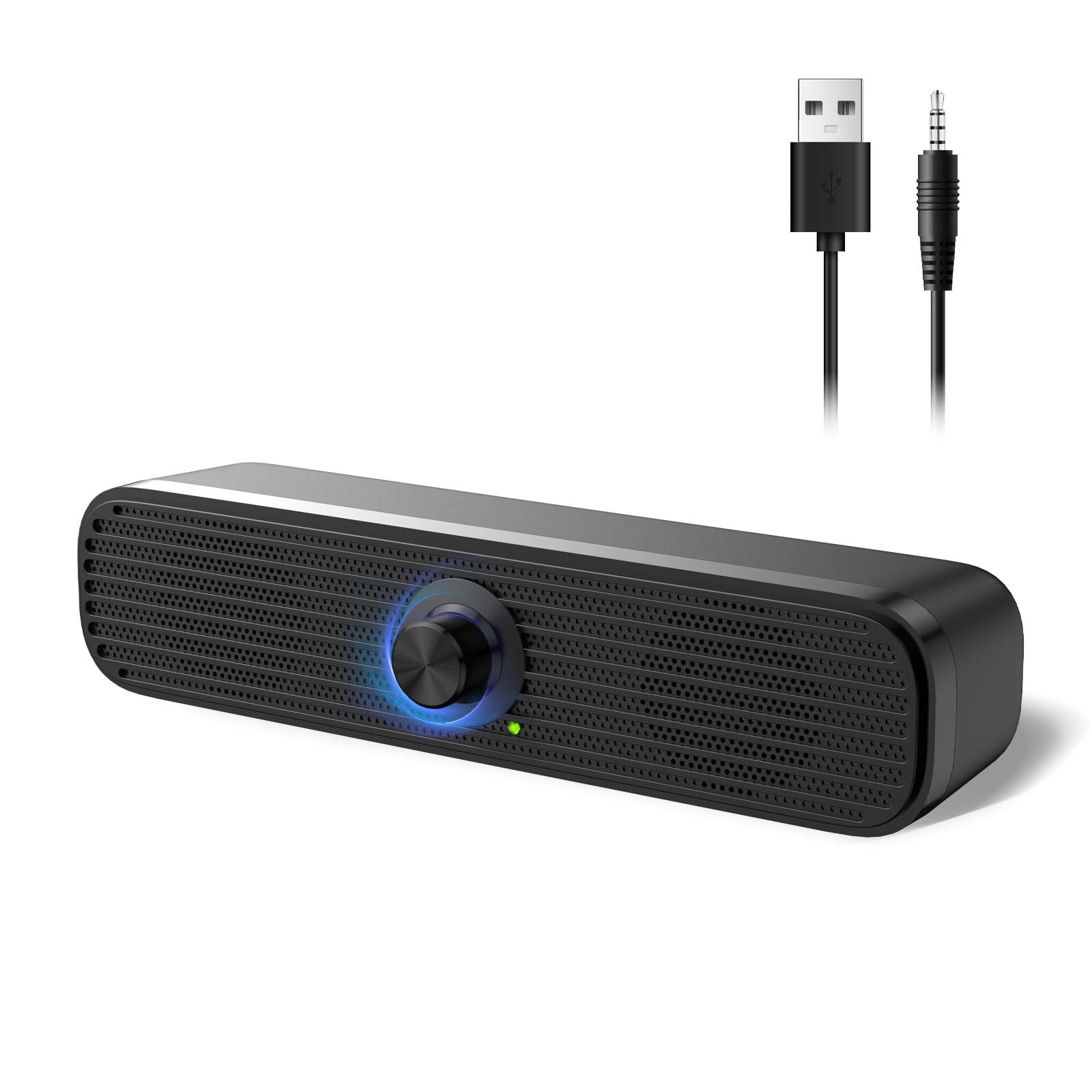
The Sanyun SW208 is a pair of active 3-inch bookshelf speakers built for desktop and small-space stereo listening, and it makes the most sense for a PC, console, or laptop user who wants better sound than built-in speakers without adding a separate amplifier. USB digital input with an onboard DAC is the headline reason to consider it. The qualification is size: 3-inch drivers set a practical ceiling on bass depth and room-filling volume.

Three connection and control features shape daily use. The USB path uses a built-in 24-bit DAC that takes the digital audio signal directly from the computer, which matters if your machine's analog headphone jack introduces hiss or sounds thin. Bluetooth 5.0 covers phone and tablet playback, so the same pair serves the desk during work hours and casual streaming afterward. Sanyun rates the system at 30W per channel, a figure aimed at nearfield listening rather than party volume.

Physical controls sit on the side of the main speaker: total volume plus separate treble and bass knobs. That layout is genuinely useful for mixed content, letting you add low-end weight for games and pull it back for voice-heavy podcasts without touching system settings. The cabinets follow a direct/reflective bookshelf design, and Sanyun describes the drivers as carbon fiber with multi-layer voice coils. A noise-filtering chip is claimed to keep standby quiet, with the design referencing the EU ER2 energy standard.

The gaps are worth naming. No dimensions, weight, frequency response range, or cable inventory is supplied, so verify desk clearance and which cables ship in the box before ordering. Small drivers mean the bass knob can add perceived warmth but cannot manufacture true low-frequency extension; anyone scoring films or bass-driven music should plan on a subwoofer or step up to larger woofers. The sound-quality descriptions come from the manufacturer, not measured testing.

Buy the SW208 if you want a self-contained desktop stereo pair with USB digital input, Bluetooth, and hands-on tone knobs. Hesitate if you need documented specifications or deep bass from the speakers alone. Large-room listeners and home theater buyers should look at bigger powered monitors or a subwoofer-equipped system instead.

Key Features Explained

Built-in 24-bit DAC over USB: Connecting by USB lets the speakers receive the digital audio signal from your computer and handle the digital-to-analog conversion themselves, rather than depending on the PC's internal sound circuitry. This helps most if your laptop or desktop produces audible hiss, interference from other components, or weak output through its headphone jack. Office and gaming desks benefit the most.

Bluetooth 5.0 wireless input: Wireless streaming means a phone or tablet can play through the same pair without unplugging anything from the computer. For a desk that serves double duty as a work station and a casual listening spot, this removes cable swapping entirely. Bluetooth remains a compressed transmission path, so the USB route stays the better option for critical listening.

Separate treble and bass knobs: Tone controls on the side of the main speaker let you shape sound in seconds. Turn bass up for game explosions and film effects, back it down for spoken-word content that would otherwise sound muddy, and adjust treble if cymbals or dialogue feel sharp. Anyone who switches between music, meetings, and gaming will use these regularly.

30W per channel active design: Because amplification is built in, there is no receiver or external amp to buy, wire, or find space for. That keeps the total footprint to two cabinets plus power, which suits crowded desks and small apartments. The rating targets nearfield and small-room use rather than large open spaces.

Direct/reflective bookshelf cabinet: Sanyun describes the SW208 as using a standard bookshelf speaker system with both direct and reflective output, intended to create a sense of stereo width from a compact enclosure. Practically, this means placement is fairly forgiving on a shelf or desk. Results still depend on your room surfaces and how far apart the two cabinets sit.

Quiet standby and energy compliance: An onboard chip is claimed to filter input noise so the speakers stay silent when idle, with the design referencing the EU ER2 energy standard. For speakers that live on a desk and stay powered through the workday, low idle noise and reduced standby draw are the difference between forgetting they exist and hearing a constant hum.

Compatibility

Best match: A desktop or laptop computer is the natural pairing, since the USB connection is where the 24-bit DAC comes into play and where the SW208 offers the clearest advantage over built-in audio. Windows and macOS machines with a free USB port are the intended scenario. Verify port type and whether an adapter is needed for USB-C-only laptops.

Phones and tablets: Bluetooth 5.0 covers modern smartphones, tablets, and most laptops with wireless audio. This is the path for casual streaming, podcasts, and background music, and it works without disturbing whatever is already plugged in by cable.

Gaming setups: Sanyun positions the SW208 for PC and monitor gaming, and the tone knobs support that use by letting you boost low frequencies for effects. Console owners should confirm their system's audio output options first, because the supplied information covers USB and Bluetooth rather than a full list of analog or optical inputs.

What is not confirmed: The available product data does not specify a 3.5mm analog input, RCA jacks, optical input, cable lengths, or which cables are included. If you plan to connect a turntable, TV, or older audio source, check the listing details or ask the seller before purchasing, since compatibility with those devices cannot be confirmed from the information provided.

Buyer's Guide

Best For: Desk-based listeners who want a step up from monitor or laptop speakers without building a component system. Home office workers, students in dorms or small apartments, and PC gamers who sit within a few feet of their speakers get the most from the 3-inch active design, the USB digital connection, and the side-mounted tone controls.

Consider Alternatives If: You want speakers that carry a living room, deliver deep low-end without help, or connect to a turntable, TV, or receiver. Larger powered monitors with bigger woofers, or a 2.1 system with a dedicated subwoofer, address those needs more directly. Buyers who require published frequency response and dimension specs before committing should also look elsewhere or confirm details with the seller.

Setup and Daily Use: Expect a two-cabinet arrangement with one main speaker carrying the controls. Connect by USB to a computer for the DAC path or pair over Bluetooth 5.0 for phone playback, then set overall volume and dial in treble and bass by ear for the content you are playing. Because the amplification is built in, no receiver setup is involved.

What Sets It Apart: The combination of a USB digital input with an onboard DAC plus separate analog treble and bass knobs is the distinguishing element. Many compact desktop speakers offer one or the other, leaving tone shaping to software. Having both means you can bypass questionable PC audio hardware and still adjust the sound physically, which suits users who switch between music, games, and voice calls throughout the day.

2

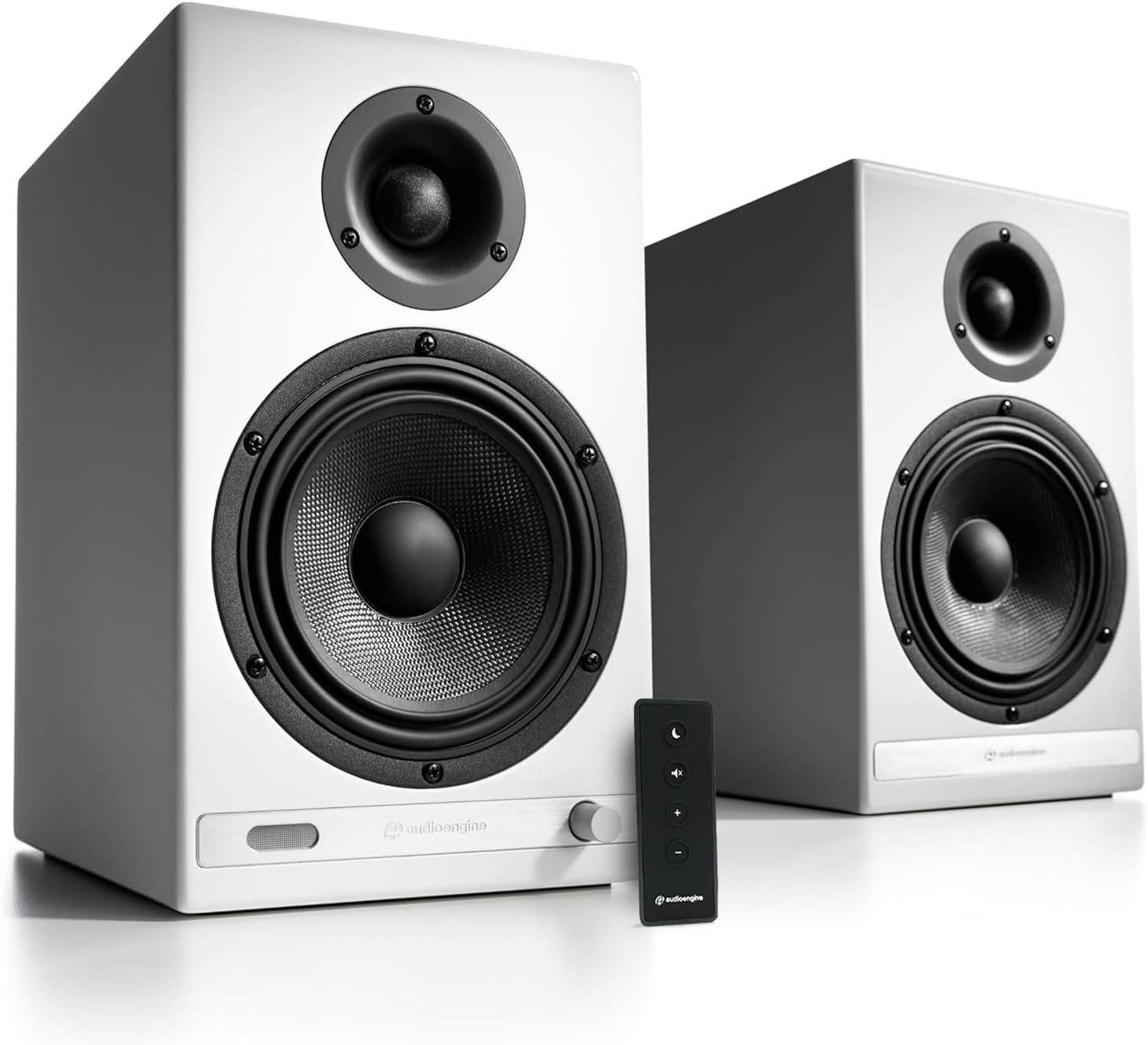
Audioengine HD6 Powered Bookshelf Speakers

In Stock
9.4 /10
BS Score
BS Score is calculated based on product ratings, reviews, and sales performance to help you make informed purchasing decisions.
Updated: Aug 18, 2026
Last update on Aug 18, 2026 / Affiliate links / Images, Product Titles, and Product Highlights from Amazon Creators API.
Pros & Cons

Pros

  • Audiophiles get high-fidelity sound with a built-in DAC, eliminating the need for a separate receiver.
  • Versatile connectivity (Bluetooth, optical, RCA, 3.5mm) suits turntables, TVs, computers, and streaming devices.
  • Furniture-grade craftsmanship with real wood veneer enhances home décor.
  • Magnetic grilles and aluminum remote add convenience and aesthetic appeal.
  • 3-year warranty and 30-day trial provide peace of mind for a significant investment.

Cons

  • Large footprint and weight may require sturdy, spacious stands or shelves; dimensions not provided.
  • No published power consumption or standby mode details, so energy use is unknown.
  • Setup instructions and specific cable lengths are not specified; verify compatibility with your devices.
Detailed Review

The Audioengine HD6 powered bookshelf speakers are designed for audio enthusiasts who want high-fidelity sound without the complexity of a separate amplifier. With hand-built cabinets, custom 5.5-inch woofers, and 1-inch silk dome tweeters, they deliver a frequency response of 50Hz to 22kHz, promising clear and detailed audio. The built-in 24-bit DAC processes digital signals up to 24-bit/192kHz, which can improve sound quality when connected to a TV, computer, or streaming device.

Connectivity is a strong point: Bluetooth 5.0 with aptX HD enables high-resolution wireless streaming up to 100 feet, while optical, RCA, and 3.5mm inputs offer flexibility for turntables, TVs, and other gear. The speakers are powered (150W total, 50W RMS per channel), so no external receiver is required, simplifying setup. The included aluminum remote and necessary cables add convenience.

In daily use, the Bluetooth range and multiple inputs mean you can switch between devices easily. However, the speakers are substantial in size, and their weight and footprint will require sturdy furniture or stands. The real wood veneer cabinets are attractive but may need gentle cleaning to maintain their finish.

While the manufacturer claims audiophile-grade sound, customer reviews are not available to confirm real-world performance. The absence of published dimensions and setup instructions is a notable gap. Buyers should verify the physical size, clearance, and compatible devices before purchasing.

These speakers are ideal for someone who values sound quality and wants a complete, elegant system without a receiver. They may not suit those with limited space or who prefer a minimalist setup. Before buying, confirm the physical dimensions, weight, and placement options, and check that your devices have the appropriate outputs.

Ownership Snapshot

Best Ownership Fit: These speakers are best for a dedicated listening room, living room, or home office where space is not constrained and the user values high-fidelity audio with versatile connectivity. They suit an enthusiast who appreciates a complete, furniture-grade system.

Daily Workflow: Expect to place the speakers on sturdy stands or shelves at ear level. Use the remote to switch between Bluetooth, optical, RCA, or 3.5mm inputs. The DAC will process digital signals from your TV or computer, potentially improving sound quality. Bluetooth streaming allows wireless playback from your phone or tablet.

Likely Friction: The main friction is the physical size and weight; they are not compact bookshelf speakers. Without published dimensions, fitting them into existing furniture may be a challenge. Also, the lack of detailed setup instructions could lead to initial configuration uncertainty.

Before You Buy: Verify the physical dimensions and weight to ensure they fit your space and that your furniture can support them. Check that your devices have the necessary outputs (optical, RCA, or 3.5mm) or Bluetooth capability. Confirm the included cables and their lengths are adequate for your setup. Since power consumption is not specified, consider if energy usage is a concern.

Setup & Maintenance

Setup: The speakers are powered, so you simply connect them to a power source and your audio sources. Use the included cables for wired connections or pair via Bluetooth. The remote controls volume and input selection. However, specific setup steps, such as speaker placement or calibration, are not provided; consult the manufacturer's manual for optimal positioning.

Controls: The aluminum remote offers convenience, but the speakers likely have manual controls as well, though not specified. The magnetic grilles can be removed for cleaning or aesthetic preference.

Cleaning: The real wood veneer cabinets should be dusted with a soft, dry cloth. Avoid harsh chemicals. The grilles may be gently vacuumed or brushed, but specific care instructions are not supplied.

Maintenance: As an electronic device, no routine maintenance is mentioned. The 3-year warranty covers defects, but replacement parts or service details are not provided. For any issues, contact Audioengine support.

Storage: If you need to store the speakers, keep them in a dry, climate-controlled environment. Use original packaging if available to protect the finish.

Compatibility & Fit

Inputs: The speakers accept optical, RCA, and 3.5mm analog connections, making them compatible with most TVs, computers, turntables (with a phono preamp), and streaming devices. Bluetooth 5.0 with aptX HD supports high-resolution audio from compatible smartphones and tablets.

DAC: The built-in 24-bit DAC handles digital signals up to 24-bit/192kHz, so any device sending digital audio via optical or USB (if supported) can benefit. However, USB input is not listed, so verify your device's output options.

Physical Fit: Dimensions and weight are not provided, so you must measure your intended placement area. The 5.5-inch woofer and 1-inch tweeter suggest a compact but not tiny enclosure. Ensure adequate clearance around the speakers for airflow and to avoid vibration.

Accessories: The package includes a remote and all necessary cables, but the types of cables (e.g., optical, RCA) are not specified. Confirm that the included cables match your source devices, or purchase additional cables if needed.

3

Polk Audio T15 Bookshelf Speakers Pair

Polk Audio
In Stock
9.9 /10
BS Score
BS Score is calculated based on product ratings, reviews, and sales performance to help you make informed purchasing decisions.
Updated: Aug 18, 2026
Last update on Aug 18, 2026 / Affiliate links / Images, Product Titles, and Product Highlights from Amazon Creators API.
Pros & Cons

Pros

  • Compact bookshelf design fits easily on shelves or stands, saving space while delivering room-filling sound
  • Wall-mountable option allows for flexible placement in small rooms or to achieve optimal surround sound positioning
  • Clear vocal reproduction enhances dialogue clarity for movies and TV shows
  • Deep bass response for a speaker this size adds impact to action scenes and music without needing a subwoofer immediately
  • Expandable system path lets you start with these and build a complete Polk surround sound setup over time

Cons

  • Requires an external amplifier or AV receiver, so they are not powered speakers and won't work without one
  • Bass response, while good for the size, may not satisfy bass-heavy music listeners who should consider adding a subwoofer
  • No included speaker wire or mounting hardware, so you'll need to purchase those separately
Detailed Review

The Polk Audio T15 bookshelf speakers are a practical entry point for anyone assembling a home theater system on a budget. They are designed to deliver clear, balanced sound with a surprising amount of bass for their compact size, making them suitable for movie nights, TV shows, and music listening in small to medium-sized rooms. If you are starting your first surround sound setup or upgrading from TV speakers, this pair offers a straightforward and affordable way to improve your audio experience.

The T15 features a 0.75-inch tweeter and a 5.25-inch Dynamic Balance driver, which work together to produce detailed highs and a warm midrange. The result is clear vocals and immersive sound that brings movies and dialogue to life. Even at low volumes, the speakers maintain a balanced output, so you can enjoy quiet scenes without straining to hear. This makes them a strong choice for apartment dwellers or those who watch late at night.

Setup is quick and uncomplicated: you simply connect speaker wire from your AV receiver to the spring-loaded terminals on the back of each speaker. No tools or complex calibration are required. The speakers are also wall-mountable, giving you flexibility in placement to achieve the best soundstage or to keep them out of the way in tight spaces. Their compact size means they can fit on bookshelves or stands without dominating the room.

While the T15 offers impressive performance for its price, it is not without limitations. Because they are passive speakers, they require an external amplifier or AV receiver, so they are not a standalone solution. Additionally, while the bass response is respectable for a bookshelf speaker, it may not satisfy listeners who crave deep, room-shaking low end for music or action movies. In such cases, adding a subwoofer is recommended, but that increases the overall cost.

In summary, the Polk Audio T15 speakers are a solid value for those building a budget home theater system. Their clear sound, easy setup, and expandable design make them an excellent starting point. However, if you need a powered speaker solution or demand powerful bass without a subwoofer, you may want to consider alternative options. For most entry-level home theater enthusiasts, these speakers deliver a significant upgrade over built-in TV audio at an accessible price.

Key Features Explained

Dynamic Balance Driver: The 5.25-inch driver is designed to minimize distortion and deliver smooth, accurate sound across the frequency range. This means you hear dialogue and instruments clearly, even at higher volumes, without harshness or muddiness.

Tweeter: The 0.75-inch tweeter handles high frequencies, producing crisp highs and detailed sound effects. This enhances the realism of movie soundtracks and adds sparkle to music, making vocals and cymbals sound natural.

Deep Bass Response: Despite their compact size, the T15 speakers are engineered to produce a surprising amount of bass. This adds impact to action scenes and music, making them a good choice for rooms where a subwoofer isn't practical.

Wall-Mountable Design: The speakers have keyhole mounts on the back, allowing you to hang them on walls. This is ideal for small spaces or for achieving optimal surround sound placement without floor-standing speakers.

Easy Setup: With simple spring-loaded terminals, you can connect speaker wire in minutes. This makes the T15 accessible for beginners who want to upgrade their home audio without professional installation.

Buyer's Guide

Best For: The Polk Audio T15 speakers are best for budget-conscious home theater builders who want an affordable way to achieve clear, room-filling sound. They are also ideal for those who plan to expand their system over time, as they can serve as rear or surround speakers in a larger setup.

Consider Alternatives If: You need a powered speaker solution that doesn't require an external amplifier, or if you prioritize deep, powerful bass for music listening without a subwoofer. In those cases, consider powered bookshelf speakers or a system with a dedicated subwoofer.

Setup and Daily Use: Setup involves connecting the speakers to an AV receiver or amplifier using speaker wire. Once connected, you can place them on shelves, stands, or mount them on walls. Daily use is straightforward: just turn on your receiver and enjoy audio from your TV, streaming device, or music player.

Maintenance Requirements: The speakers require minimal maintenance. Wipe the cabinets with a dry cloth to remove dust. Avoid exposing them to moisture or extreme temperatures. Ensure the speaker wire connections are secure to prevent audio dropouts.

What Sets It Apart: The T15 offers a balanced combination of performance, price, and expandability. Polk Audio is a well-known brand with a reputation for reliable home audio, and these speakers provide a accessible entry point into a full surround sound system that can be built gradually.

Compatibility

The Polk Audio T15 speakers are passive, meaning they need to be powered by an external amplifier or AV receiver. They are compatible with most home theater receivers that have standard speaker wire outputs. They can be used as front left and right speakers, or as rear surround speakers in a 5.1 or 7.1 setup.

To expand your system, Polk offers matching components such as the T50 tower speakers, T30 center channel, and subwoofers. This allows you to build a complete, cohesive surround sound system over time, ensuring consistent sound quality across all channels.

When connecting, use 16-gauge or thicker speaker wire for best performance. Ensure that the receiver's impedance settings are compatible with the speakers' 8-ohm nominal impedance (as typical for this class). Always turn off the receiver before making connections to avoid damage.

4

Saiyin Powered Bluetooth Bookshelf Speakers

In Stock
9.8 /10
BS Score
BS Score is calculated based on product ratings, reviews, and sales performance to help you make informed purchasing decisions.
Updated: Aug 18, 2026
Last update on Aug 18, 2026 / Affiliate links / Images, Product Titles, and Product Highlights from Amazon Creators API.
Pros & Cons

Pros

  • Bluetooth 5.3 provides stable wireless audio from a variety of devices
  • Wide range of inputs (optical, coaxial, 3.5mm, RCA) makes it easy to connect TVs, computers, and turntables
  • Active speakers with built-in amplifier simplify setup and save space
  • Remote control offers convenient volume and input adjustments from across the room
  • Compact footprint fits nicely on a bookshelf or desk

Cons

  • Turntable compatibility is limited: requires a turntable with Bluetooth output or a preamp for phono-level output
  • Small woofer size may not deliver deep bass for bass-heavy music or home theater
  • Requires PCM/Stereo output from source devices to avoid cracking or no sound, which may be an issue with some TVs
Detailed Review

The Saiyin Powered Bluetooth Bookshelf Speakers are a versatile, all-in-one stereo speaker system designed for casual listeners and vinyl enthusiasts who want a simple setup without a separate amplifier. They are ideal for small to medium rooms, desktop use, or as a TV sound upgrade, thanks to their multiple connectivity options and compact size. However, they are not for audiophiles seeking high-end sound or deep bass.

At the heart of these speakers is Bluetooth 5.3, which allows you to stream music wirelessly from your smartphone, tablet, Mac, or PC without messy cables. For those who prefer wired connections, the speakers offer optical and coaxial inputs, as well as a 3.5mm headphone jack and dual RCA inputs. This makes them compatible with a wide range of devices, including TVs, computers, CD players, and even turntables, provided the turntable has a line-out or Bluetooth output. If your turntable only has a phono output, you will need a preamp.

The speakers are active, meaning they have a built-in amplifier, so you do not need a separate receiver or preamp. The main speaker houses the amplifier and connects to the passive speaker via speaker wire. Control is handled via buttons on the top of the main speaker or through the included remote, which also lets you switch inputs, adjust volume, and mute. The remote is replaceable, and it is even compatible with Fire TV sticks for added convenience.

One notable limitation is the speaker's compact size, which uses a 3.75-inch woofer and 0.5-inch silk dome tweeter. While this can produce clear mids and highs, it may not satisfy those who crave deep, room-shaking bass. Additionally, the speakers only work with standard audio outputs; you must set your source to output PCM/Stereo/non-surround signals to avoid cracking noises or no sound. This could be an issue with some TVs that default to surround sound formats.

Overall, the Saiyin Powered Bluetooth Bookshelf Speakers offer excellent value for the price, providing a simple, versatile setup with good sound quality for casual listening. They are best for those who want an easy-to-use speaker system for music, TV, or vinyl without the clutter of a full amplifier setup. However, if you require robust bass or have a turntable with only a phono output, you may need to consider alternatives or additional equipment.

Key Features Explained

Bluetooth 5.3: This feature enables wireless streaming from your smartphone, tablet, Mac, or PC, eliminating the need for messy cables. It ensures a stable connection and easy pairing, making it perfect for casual listening and quick setup.

Multiple Wired Inputs: With optical, coaxial, 3.5mm, and RCA inputs, you can connect a variety of devices such as TVs, CD players, computers, and turntables. This versatility means you can use the speakers as a hub for all your audio sources.

Active Design with Built-in Amplifier: The speakers have a built-in amplifier, so you don't need a separate receiver or preamp. This simplifies setup and saves space, making them ideal for small rooms or desktops.

Remote Control: The included remote allows you to adjust volume, mute, and switch between inputs from across the room. It also works with Fire TV sticks, adding convenience for streaming devices.

Compact Size with Silk Dome Tweeter: The speakers feature a 0.5-inch silk dome tweeter and a 3.75-inch woofer, delivering clear highs and mids. The compact design fits easily on bookshelves or desks, but it may not provide deep bass.

Compatibility

Bluetooth Devices: Pair with smartphones, tablets, Macs, and PCs for wireless audio streaming. Bluetooth 5.3 ensures a stable connection.

Wired Devices: Use the optical, coaxial, 3.5mm, or RCA inputs to connect TVs, computers, CD players, and other audio sources with standard outputs.

Turntables: To use a turntable, it must have Bluetooth output or a line-out connection. If your turntable only has a phono output, you will need a preamp or phono stage.

Important Note: The speakers only work with standard audio outputs. Ensure your source is set to output PCM/Stereo/non-surround signals to avoid cracking noise or no sound.

Buyer's Guide

Best For: The Saiyin Powered Bluetooth Bookshelf Speakers are ideal for casual listeners, students, or anyone setting up a simple stereo system for a small room, office, or dorm. They are also a great option for those who want to upgrade their TV sound without investing in a full home theater system.

Consider Alternatives If: You are an audiophile seeking high-fidelity sound with deep bass, or if you have a turntable with only a phono output and do not want to buy a separate preamp. In such cases, you might need larger speakers with more powerful woofers or a dedicated phono input.

Setup and Daily Use: Setting up these speakers is straightforward: connect the passive speaker to the main speaker using the included speaker wire, plug in the power, and connect your audio source via Bluetooth or wired inputs. Use the remote or top buttons to switch inputs and adjust volume. For daily use, you can enjoy music from your phone, TV, or computer with just a few taps.

Maintenance Requirements: These speakers require minimal maintenance. Keep them dust-free by wiping with a soft cloth, and ensure the connections are secure. The remote is replaceable, so you can order a new one if lost.

What Sets It Apart: The combination of Bluetooth 5.3, multiple wired inputs, and a built-in amplifier at this price point makes these speakers a versatile and cost-effective solution. They offer the convenience of wireless streaming and the flexibility of wired connections, all without needing extra equipment.

5

RIOWOIS Powered Bookshelf Speakers for Record

In Stock
9.5 /10
BS Score
BS Score is calculated based on product ratings, reviews, and sales performance to help you make informed purchasing decisions.
Updated: Aug 18, 2026
Last update on Aug 18, 2026 / Affiliate links / Images, Product Titles, and Product Highlights from Amazon Creators API.
Pros & Cons

Pros

  • Versatile connectivity: Bluetooth, AUX, Optical, and TV-ARC cover most modern and legacy devices.
  • Receiver-free design simplifies setup and saves space, ideal for beginners or minimalists.
  • Remote control provides convenient access to volume, input switching, and sound effects from across the room.
  • TV-ARC compatibility allows you to use your TV remote to control speaker volume, integrating seamlessly with your TV.
  • Reinforced MDF cabinet helps minimize unwanted vibrations and crackling for cleaner sound.

Cons

  • Not compatible with receivers or amplifiers, which may surprise users expecting to integrate them into an existing stereo system.
  • Optical and ARC cables are not included, so you'll need to purchase them separately for TV connections.
  • Bluetooth turntable compatibility is limited: your turntable must have a Bluetooth transmitter, not just a receiver, so many built-in speaker turntables won't work.
Detailed Review

The RIOWOIS Powered Bookshelf Speakers DS6701NP are a practical choice for anyone who wants to upgrade their audio without the complexity of a full stereo receiver. They are designed for direct connection to turntables, computers, TVs, and phones, making them ideal for vinyl enthusiasts, casual listeners, and TV viewers who value simplicity. However, before buying, you must verify that your turntable has a Bluetooth transmitter if you plan to use it wirelessly, as many turntables with built-in speakers only have Bluetooth receivers.

These powered speakers eliminate the need for an amplifier or receiver, which simplifies setup and saves space. They offer Bluetooth 5.3 for wireless streaming from any smart device, plus multiple wired inputs: AUX for record players or computers, and Optical and TV-ARC for TVs. The TV-ARC feature is particularly useful because it lets you control the speaker volume with your existing TV remote, integrating the speakers into your home theater setup without extra remotes.

The reinforced MDF cabinet is designed to reduce crackling sounds and vibrations, and the wood grain finish with rounded corners adds a classic touch to any room. The included remote and on-speaker buttons provide convenient control over volume, power, input selection, and three sound effects, giving you flexibility in how you adjust the audio to your preference.

One limitation to note is that these speakers are not compatible with receivers or amplifiers, so they are not suitable for users who already have a stereo system and want to add speakers. Additionally, the optical and ARC cables are not included, so you will need to purchase them separately for TV connections. For Bluetooth turntable use, you must confirm your turntable has a Bluetooth output; otherwise, you'll need to use the AUX input.

In summary, the RIOWOIS Powered Bookshelf Speakers are a solid choice for those seeking a straightforward, multi-input speaker system for a turntable, computer, or TV. The strongest reason to buy is the combination of wireless and wired connectivity with remote control at an accessible price point. The main hesitation should be if you have a turntable without Bluetooth output or if you prefer to integrate speakers into an existing amplifier-based system. In those cases, you may want to consider a different type of speaker.

Key Features Explained

Receiver-Free Design: These speakers have built-in amplification, so you can plug your audio source directly into them without needing a separate receiver or amplifier. This simplifies setup and saves money and space, making them ideal for beginners or anyone wanting a compact audio solution.

Bluetooth 5.3 Streaming: The latest Bluetooth version ensures stable, low-latency wireless audio from your phone, tablet, or laptop. You can stream music, podcasts, or audiobooks without dealing with cables, and the connection range is sufficient for most rooms.

Multiple Wired Inputs: With AUX, Optical, and TV-ARC inputs, you have flexible options for connecting different devices. AUX works with most turntables and computers, while Optical and ARC are preferred for TVs, offering better audio quality and the convenience of TV remote control via ARC.

Remote and Button Control: The included remote lets you adjust volume, power, switch inputs, disconnect Bluetooth, and cycle through three sound effects from across the room. The main speaker also has buttons for direct control, so you're not dependent on the remote.

Reinforced MDF Cabinet: The cabinet is made from reinforced MDF, which is denser and less resonant than cheaper materials, helping to minimize crackling and distortion. The wood grain finish and rounded corners also add aesthetic appeal to your space.

Compatibility

Turntable Compatibility: To use these speakers wirelessly with a turntable, your turntable must have a Bluetooth transmitter (output) for connecting to Bluetooth speakers. If your turntable only has a Bluetooth receiver (input) for connecting to mobile phones, it will not work with these speakers. Always check your turntable's specs before ordering.

TV Connection: For TV use, you can connect via Optical or TV-ARC. The TV-ARC feature allows you to control the speaker volume with your TV remote, but you'll need an ARC-enabled TV and an ARC cable (not included). Optical connection requires a TV with an optical output and an optical cable (also not included). Note that these inputs are not compatible with Dolby or DTS surround sound signals; your TV must be set to output PCM/Stereo/Non-surround audio.

Other Devices: You can connect computers, smartphones, tablets, and other devices via AUX or Bluetooth. The AUX input is standard and works with most devices that have a headphone jack or line-out.

Receiver/Amplifier Incompatibility: These are powered speakers and are not designed to be used with external receivers or amplifiers. Plugging them into an amplifier's speaker outputs could damage them. Use them only as direct-connect speakers.

Setup & Maintenance

Setup: Setting up the speakers is straightforward. Place the speakers on a stable surface, connect the included audio cable between the main and passive speaker, and then connect your audio source via Bluetooth, AUX, Optical, or ARC. Plug the main speaker into a power outlet and turn it on. Use the remote or buttons to select the appropriate input.

Bluetooth Pairing: To pair a Bluetooth device, press the BT button on the remote or speaker to enter pairing mode, then select the speakers from your device's Bluetooth list. The connection is stable with Bluetooth 5.3.

TV-ARC Setup: For TV-ARC, connect an ARC cable (not included) from the TV's ARC port to the speaker's ARC input, then set your TV's audio output to ARC or PCM. You may need to adjust your TV's audio settings to ensure proper sound.

Maintenance: These speakers require minimal maintenance. Wipe the cabinet with a soft, dry cloth to remove dust. Avoid exposing them to moisture or extreme temperatures. Periodically check that the cables are secure and not damaged. There are no user-replaceable parts, so if you encounter issues, contact the manufacturer.

6

Sanyun SW208 3" Active Bluetooth 5.0 Bookshelf

In Stock
9.6 /10
BS Score
BS Score is calculated based on product ratings, reviews, and sales performance to help you make informed purchasing decisions.
Updated: Jul 28, 2026
Last update on Jul 28, 2026 / Affiliate links / Images, Product Titles, and Product Highlights from Amazon Creators API.
Pros & Cons

Pros

  • Active design with built-in amplification eliminates the need for a separate receiver.
  • Multiple connectivity options (Bluetooth, USB, likely AUX) offer flexibility.
  • Dual adjustment knobs allow users to tailor sound to preference.
  • Compact size fits well on desks or shelves.
  • Energy-saving standby mode may reduce power consumption.

Cons

  • No verified independent measurements of sound quality or power output.
  • Customer feedback is currently unavailable, so real-world reliability and performance are unconfirmed.
  • Unknown compatibility with all devices and potential for Bluetooth codec limitations.
Detailed Review

The Sanyun SW208 is a pair of active bookshelf speakers with a compact footprint, making them a potential fit for desktop setups or small rooms. The manufacturer supplies key specifications: a 30W x 2 carbon fiber driver configuration, Bluetooth 5.0, a built-in 24-bit DAC for USB connections, and manual treble/bass controls. These features suggest a versatile, user-adjustable listening experience, but the supplied data is promotional and not independently verified.

For a buyer seeking an affordable, space-saving speaker system with wireless convenience, the SW208 offers a plausible solution. The inclusion of a USB DAC is notable at this price point, as it may improve audio quality when connected directly to a computer. However, the actual sound performance—clarity, bass response, and overall fidelity—remains unmeasured in our data. We cannot confirm the manufacturer's claims of 'HiFi' sound.

Customer reviews are not provided, so we have no anecdotal evidence regarding durability, ease of use, or sound quality from real users. This is a significant gap, as such feedback often reveals issues like Bluetooth dropouts, hiss, or build quality problems that are not apparent from specifications.

Trade-offs to consider: the small 3-inch drivers may not satisfy those seeking room-filling sound or deep bass. There is also no information on the included cables or remote control, and the availability of an AUX input is not explicitly stated. For critical listening or larger spaces, a larger speaker system with subwoofer might be a safer choice.

In conclusion, the SW208 appears to be a feature-rich budget option, but the evidence is limited to manufacturer claims. It is a reasonable consideration for casual listening on a desk, but we cannot recommend it without reservation due to the lack of independent testing and customer feedback.

Evidence Breakdown

Verified Product Facts: The product is an active bookshelf speaker pair with a wood finish. It features Bluetooth 5.0, a USB connection with a built-in 24-bit DAC, and manual treble/bass controls. The speaker drivers are claimed to be carbon fiber and rated at 30W x 2. It also includes a standby mode that is said to be energy-saving.

Customer Signals: No customer reviews were supplied, so there are no recurring themes or attributed experiences to summarize. The evidence is insufficient to establish any pattern of user satisfaction or dissatisfaction.

Not Verified: The supplied data does not verify sound quality, including frequency response and distortion levels. Long-term durability and reliability are unknown. Compatibility with various devices (e.g., TVs, gaming consoles) and Bluetooth codec support (e.g., aptX) are not specified. Warranty details and customer support quality are also not provided.

Evidence-Aware Verdict: The evidence supports that the SW208 offers specific features and specifications, but it cannot support claims about actual audio performance or long-term satisfaction. The decision to purchase should be based on the feature set and price, with an understanding that independent verification is lacking.

Decision Factors

Connectivity: The SW208 provides Bluetooth 5.0 and USB with a DAC. This supports wireless streaming from phones and tablets, and a direct digital connection to computers. However, the absence of an AUX input is not confirmed, which may be a limitation for older devices.

Sound Customization: Manual treble and bass knobs allow users to adjust the sound to their preference, which is a practical feature for different room acoustics and content types. The actual range of adjustment is unknown.

Size and Placement: The compact bookshelf design is suitable for small spaces like desks or shelves. The direct/reflective speaker system is claimed to allow flexible placement, but the optimal positioning is not verified.

Power and Performance: The 30W x 2 rating suggests adequate volume for near-field listening, but without sensitivity or impedance data, the actual loudness and efficiency are unclear. For larger rooms, this may be insufficient.

Ownership Cost: The price is budget-friendly, but the lack of warranty information means potential repair costs are unknown. Energy-saving features may reduce electricity bills slightly, but the impact is minimal.

7

Edifier S360DB 2.1 Bookshelf Speaker System

Edifier
In Stock
9.8 /10
BS Score
BS Score is calculated based on product ratings, reviews, and sales performance to help you make informed purchasing decisions.
Updated: Aug 18, 2026
Last update on Aug 18, 2026 / Affiliate links / Images, Product Titles, and Product Highlights from Amazon Creators API.
Pros & Cons

Pros

  • Built-in amplifier simplifies setup: no external receiver or amp needed, saving space and cost
  • High-resolution audio support ensures detailed sound reproduction for critical listening
  • Powerful 155W total output fills medium to large rooms with clear, dynamic audio
  • Bluetooth aptX provides better than standard wireless audio quality for compatible devices
  • Dedicated subwoofer enriches low-end frequencies, enhancing movies and music

Cons

  • Bluetooth 4.1 is older and lacks support for the latest codecs like LDAC or aptX HD, which may affect audiophiles
  • Bookshelf speakers may require stands or proper placement to achieve optimal soundstage, which could be an extra cost
  • No mention of built-in voice assistants or smart features, so it won't integrate with smart home ecosystems
Detailed Review

The Edifier S360DB is a 2.1-channel bookshelf speaker system with a wireless subwoofer, designed for people who want high-quality sound for gaming, movies, and music without the complexity of a full component audio system. It's ideal for gamers, home theater enthusiasts, and music lovers who value deep bass and clear highs in a medium to large room. The system delivers 155 watts of total power from its built-in amplifier, so you can plug in your source and play immediately, without needing a separate receiver.

The most significant feature is the integrated Texas Instruments TAS5754M amplifier, which provides 40 watts per channel for the satellite speakers and 75 watts for the subwoofer. This setup eliminates the need for an external amplifier, simplifying setup and reducing clutter. Additionally, the system supports Hi-Res Audio, meaning it can handle high-resolution audio files with sample rates up to 96kHz, ensuring you hear fine details in your favorite tracks. Bluetooth 4.1 with Qualcomm aptX offers CD-quality wireless streaming from compatible devices, though it's not the latest version.

In terms of design, the bookshelf speakers are compact enough to fit on a desk or shelf, but for optimal soundstage, you may want to place them on stands at ear level. The subwoofer adds substantial low-end punch, making action scenes and music with heavy bass more immersive. The system is self-powered, so no external amplifier is required, and it offers multiple connectivity options, though the specific inputs are not listed in the data.

A notable limitation is the Bluetooth version: 4.1 is older and doesn't support newer codecs like aptX HD or LDAC, which might be a drawback for audiophiles who stream high-resolution audio wirelessly. Additionally, the system lacks smart features such as voice assistants, so it won't integrate with smart home setups. If you're looking for a fully wireless, smart speaker, this might not be the best fit.

Overall, the Edifier S360DB is a strong choice for gamers and home theater fans who want powerful, detailed sound with minimal setup. Its built-in amplifier and subwoofer deliver impressive performance for the price. However, if you require the latest Bluetooth codecs or smart functionality, you might want to consider other options. For most users seeking a straightforward, high-quality 2.1 system, this is a solid investment.

Key Features Explained

Built-in Amplifier (Texas Instruments TAS5754M): This amplifier powers the speakers and subwoofer, eliminating the need for an external receiver. It simplifies setup and reduces equipment costs, making it ideal for users who want a plug-and-play audio system.

Hi-Res Audio Support: The system can process high-resolution audio files with sample rates up to 96kHz, preserving the nuances in recordings. This benefits audiophiles who listen to lossless files or high-quality streaming services.

Bluetooth 4.1 with Qualcomm aptX: This wireless technology provides CD-quality sound when paired with aptX-enabled devices. It's convenient for streaming from phones or tablets, though older Bluetooth versions may have slightly higher latency compared to newer standards.

2.1 Channel Configuration with Dedicated Subwoofer: The separate subwoofer handles low frequencies, delivering deep bass that enhances movies, games, and music. This setup is particularly effective for action-packed content where impact matters.

155W Total Power Output: With 40W per satellite and 75W for the subwoofer, the system can fill a medium to large room with clear, dynamic sound. It's suitable for living rooms, dens, or gaming setups where volume and clarity are important.

Compatibility

Bluetooth Devices: The system supports Bluetooth 4.1 with Qualcomm aptX, so it pairs with smartphones, tablets, and computers that support aptX for high-quality wireless audio. Older devices without aptX will still work but may not achieve the same fidelity.

Wired Sources: While the specific inputs are not listed, the system likely includes standard analog and digital connections that allow hookup to TVs, CD players, and gaming consoles. This makes it versatile for various home entertainment sources.

No Smart Features: The S360DB lacks built-in voice assistants or smart home integration, so it won't respond to voice commands or be part of a multi-room audio network. It's a traditional speaker system focused on sound quality rather than smart functionality.

Room Size: With 155W of power, it's best suited for medium to large rooms. In small spaces, the bass might be overwhelming, so you may need to adjust the subwoofer level or placement.

8

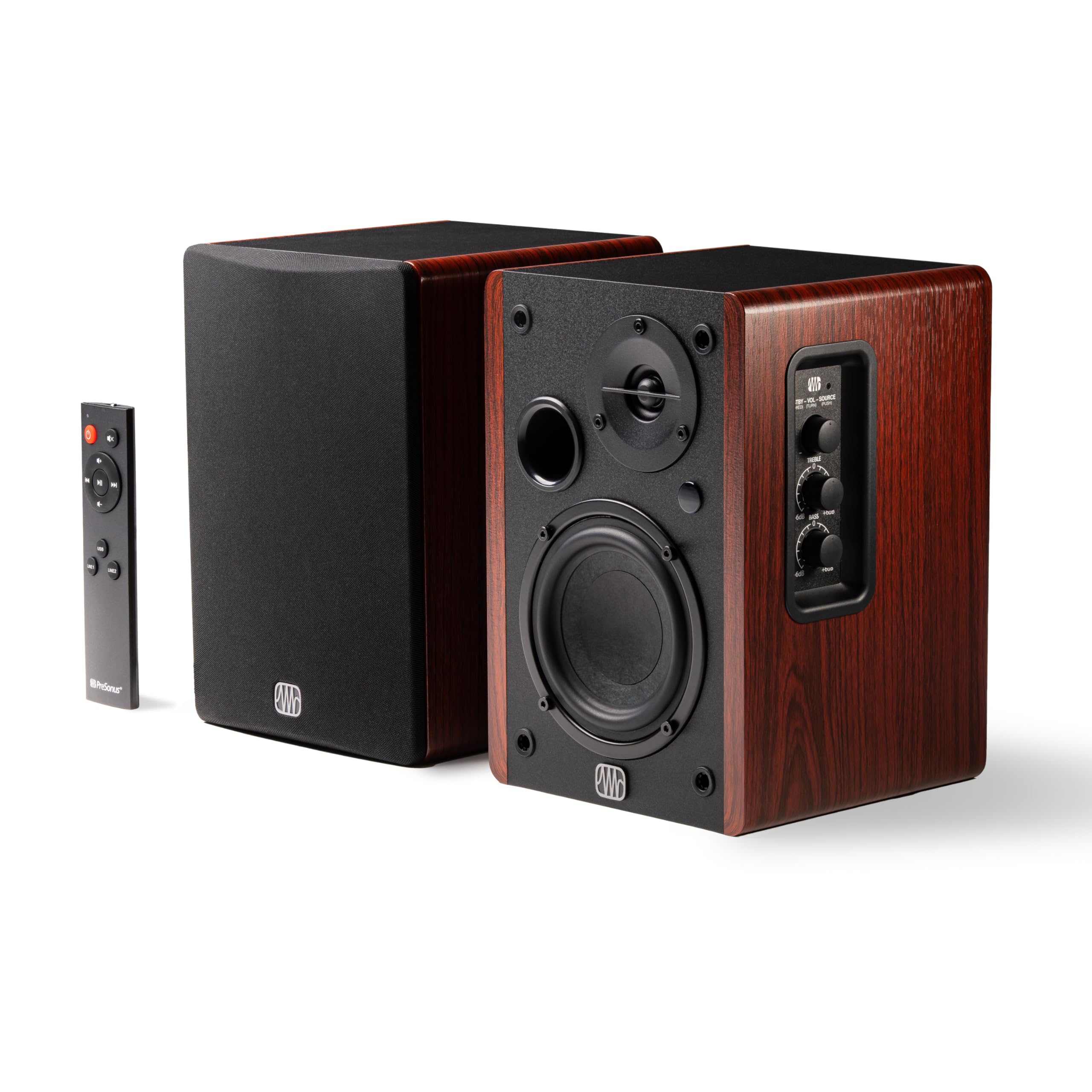
PreSonus Eris Accent Powered Bookshelf Speakers

In Stock
9.8 /10
BS Score
BS Score is calculated based on product ratings, reviews, and sales performance to help you make informed purchasing decisions.
Updated: Aug 18, 2026
Last update on Aug 18, 2026 / Affiliate links / Images, Product Titles, and Product Highlights from Amazon Creators API.
Pros & Cons

Pros

  • Studio-style sound quality at an affordable price point, ideal for near-field listening.
  • Multiple input options (USB-C and RCA) provide flexibility for connecting various devices.
  • Onboard tone controls allow for sound customization without needing external EQ.
  • Subwoofer output enables easy system expansion for deeper bass.
  • Remote control adds convenience for adjusting volume from a distance.

Cons

  • Limited bass extension due to 4-inch woofer, may not satisfy those seeking deep low end without a subwoofer.
  • No Bluetooth or wireless connectivity, limiting placement and source options.
  • Power output is modest (25W per channel), may not fill large rooms at high volumes.
Detailed Review

The PreSonus Eris Accent powered bookshelf speakers are designed for listeners who want studio-quality sound in a compact, affordable package. They are best for desktop setups, small rooms, or as a first upgrade for a turntable, offering a balanced frequency response and flexible connectivity. However, they are not meant for bass-heavy listening or large spaces without a subwoofer.

Key features include a 4-inch woofer and ½-inch silk dome tweeter with a 2.8kHz crossover, delivering clear highs, rich mids, and punchy bass. The 50W total power (25W per channel) provides ample volume for near-field listening. Onboard Volume, Treble, and Bass controls allow you to tailor the sound to your room or preference, which is a practical touch for users who want to fine-tune without external equipment.

Setup is straightforward: connect your source via USB-C or RCA, plug in the power, and use the included speaker wire to connect the passive speaker. The remote control adds convenience for adjusting volume or playback from your chair. The RCA sub-out lets you add a subwoofer later if you need deeper bass, making the system expandable.

In conclusion, the PreSonus Eris Accent is a solid choice for budget-conscious listeners seeking accurate, studio-inspired sound for near-field use. The main trade-off is the limited bass extension, so those who prioritize deep low end should consider a larger speaker or plan to add a subwoofer. For general music, movies, or gaming at a desk, these speakers deliver excellent value.

Buyer Snapshot

Best For: A home office worker or student setting up a desktop audio system, or a vinyl enthusiast connecting a turntable to powered speakers.

Why It Fits: The PreSonus Eris Accent offers studio-quality sound with a 4-inch woofer and silk dome tweeter, plus multiple inputs (USB-C and RCA) and a remote control, making it versatile for desk or turntable use.

Think Twice If: You need deep bass without a subwoofer, or you want Bluetooth connectivity for wireless streaming.

Bottom Line: For its price, the PreSonus Eris Accent is a strong performer for near-field listening, but be prepared to add a subwoofer if you crave more low end.

Key Features

Power Output: 50W total (25W per channel) delivers enough volume for desktop or small room use.

Driver Complement: 4-inch woofer and ½-inch silk dome tweeter with a 2.8kHz crossover ensure balanced audio reproduction.

Frequency Response: 55Hz–20kHz range covers the essential spectrum for music, movies, and gaming.

Connectivity: USB-C and RCA inputs accommodate modern and legacy devices; RCA sub-out allows for subwoofer expansion.

Control: Onboard volume, treble, and bass controls plus included remote provide easy sound customization.

9

Edifier S3000MKII Powered Bookshelf Speakers

Edifier
In Stock
9.9 /10
BS Score
BS Score is calculated based on product ratings, reviews, and sales performance to help you make informed purchasing decisions.
Updated: Aug 18, 2026
Last update on Aug 18, 2026 / Affiliate links / Images, Product Titles, and Product Highlights from Amazon Creators API.
Pros & Cons

Pros

  • Wireless connection between speakers offers flexible placement without a long cable run.
  • Planar tweeters and 6.5-inch woofers produce clear, detailed audio with deep bass.
  • Multiple input options including Bluetooth, USB, and likely others support various sources.
  • Hi-Res Audio certified and aptX HD support high-resolution streaming from compatible devices.
  • Included wireless remote provides convenient control from across the room.

Cons

  • Premium price point may be a barrier for budget-conscious buyers.
  • Large bookshelf speakers require ample shelf or stand space and may not fit small rooms.
  • Wireless remote is IR, so it requires line-of-sight to the speaker for operation.
Detailed Review

The Edifier S3000MKII audiophile active speakers are a premium wireless bookshelf system designed for listeners who demand high-resolution audio without the hassle of traditional speaker wires. They suit home audio enthusiasts, music producers, and anyone building a serious stereo setup for music, movies, or gaming. The core appeal is the wireless connection between the left and right speakers, which opens up placement options while maintaining uncompressed signal transmission.

The standout feature is the wireless left/right setup, which uses proprietary 5.8GHz and 5.2GHz dual-band technology to ensure low-latency, real-time sync between the two active speakers. This eliminates the need for a long speaker cable, making it easier to place speakers on separate stands or across a room. For audio quality, the planar diaphragm tweeters deliver precise, airy highs, while the 6.5-inch long-throw aluminum mid-bass drivers produce powerful, distortion-free bass. This combination is ideal for genres like classical, jazz, and electronic, where detail and impact matter.

Connectivity is versatile: Bluetooth 5.0 with aptX HD decoding supports high-quality wireless streaming from phones and tablets, and USB audio inputs accept up to 24-bit/192kHz signals for near-lossless playback from a computer. The included wireless IR remote lets you adjust volume, switch sources, and change modes from your seat. The active design means each speaker has its own amplification, so you don't need a separate receiver.

However, the S3000MKII is a significant investment and physically large, so it may overwhelm small rooms or desks. The IR remote requires line-of-sight, which can be a minor annoyance if the speakers are placed behind furniture. Also, because it's a powered speaker system, you won't be able to pair it with your own amplifier if you prefer a traditional setup.

Overall, the Edifier S3000MKII is a compelling choice for audiophiles who want a clean, high-resolution wireless setup with impressive bass and detail. The main reason to hesitate is the price, and if you don't need the wireless convenience or have limited space, a more traditional wired system might offer better value. But for those who prioritize flexibility and sound quality, these speakers deliver a premium experience.

Key Features Explained

Wireless Left/Right Speaker Setup: This feature allows the two speakers to connect wirelessly to each other, eliminating the need for a speaker cable between them. It simplifies placement, letting you position speakers farther apart or in awkward spots without tripping over wires. This is especially beneficial for living rooms or home theaters where a clean look matters.

Dual-Band Wireless Connection: Using both 5.8GHz and 5.2GHz bands ensures a stable, high-speed connection between the speakers. This guarantees uncompressed signal transmission and real-time synchronization, which is crucial for maintaining audio integrity and avoiding lip-sync issues in movies. It's a technical advantage that directly improves the listening experience.

Planar Diaphragm Tweeters: These tweeters use a thin, flat diaphragm to produce sound, which results in lower distortion and more accurate high frequencies compared to traditional dome tweeters. You'll hear clearer vocals, cymbals, and string instruments, making it a key feature for critical listening and audiophile-grade sound.

6.5-Inch Long-Throw Aluminum Mid-Bass Drivers: These drivers are designed to move more air, producing deeper and more impactful bass without distortion. The aluminum diaphragm adds stiffness, reducing coloration. This makes the speakers suitable for bass-heavy music genres and action movies, delivering a room-shaking experience.

Bluetooth 5.0 with aptX HD and Hi-Res Audio: With aptX HD, you can stream high-resolution audio wirelessly from compatible devices, preserving more detail than standard Bluetooth. The Hi-Res Audio certification ensures the speakers can reproduce frequencies up to 40kHz, and USB input supports 24-bit/192kHz, making them ideal for studio monitoring and serious music enjoyment.

Setup & Maintenance

Placement: Because the left and right speakers connect wirelessly, you can place them on stands, shelves, or a media console without running a cable between them. However, they are large bookshelf speakers, so ensure your surface can support their weight and size. For best stereo imaging, position them at ear level and form an equilateral triangle with your listening position.

Initial Connection: The speakers are active, meaning they have built-in amplifiers. You'll need to connect the primary speaker to a power source and then pair the secondary speaker wirelessly. The proprietary dual-band connection should automatically establish, but you may need to follow the manual for initial pairing. The wireless remote is IR, so point it at the front of the speaker for reliable control.

Input Sources: Connect your TV, computer, or phone via Bluetooth, USB, or other available inputs (likely optical or RCA, though not specified). For the best quality, use a USB connection from a computer to support high-resolution audio up to 24-bit/192kHz.

Maintenance: These speakers require minimal upkeep. Dust the drivers and cabinets with a soft, dry cloth. Avoid exposing them to moisture or extreme temperatures. Since they are active, ensure proper ventilation around the amplifiers to prevent overheating. No special maintenance is needed beyond that.

Performance & Use Cases

Music Listening: The planar tweeters and powerful woofers make these speakers excellent for critical music listening. They deliver detailed highs, clear mids, and deep bass, suitable for genres from classical to electronic. The Hi-Res Audio support ensures you hear every nuance in high-quality recordings.

Home Theater: With 6.5-inch woofers and room-filling output, these speakers can serve as a stereo pair for TV and movies. The wireless connection ensures no delay between speakers, so dialogue and effects stay in sync. They can produce impactful bass without a separate subwoofer, though adding one would enhance the lowest frequencies.

Gaming: The low-latency wireless connection is advantageous for gaming, as it minimizes audio lag. The detailed soundstage helps you pinpoint directional cues in games. The speakers' power can create an immersive experience, but they may be overkill for casual gaming setups.

Studio Work: The flat frequency response and high-resolution capabilities make them suitable for near-field monitoring in home studios. The USB input allows direct connection to a computer for accurate playback. However, professionals might prefer dedicated studio monitors with more neutral tuning.

10

OHAYO 60W Computer Speakers Review

In Stock
9.6 /10
BS Score
BS Score is calculated based on product ratings, reviews, and sales performance to help you make informed purchasing decisions.
Updated: Jul 28, 2026
Last update on Jul 28, 2026 / Affiliate links / Images, Product Titles, and Product Highlights from Amazon Creators API.
Pros & Cons

Pros

  • Versatile connectivity options (Bluetooth, RCA, AUX, USB) let you switch between devices without re-cabling.
  • Carbon fiber drivers and tweeter contribute to clear highs and defined mid-bass, enhancing music and gaming immersion.
  • MDF enclosure helps reduce unwanted resonance for cleaner audio at moderate volumes.
  • Compact footprint saves desk space while still delivering substantial sound output.
  • Front volume knob provides convenient control without reaching around the back.

Cons

  • No independent bass or treble controls, limiting tonal adjustment to system EQ or source settings.
  • Rear bass port requires clearance from walls or objects to perform optimally, which may not suit all desk layouts.
  • No subwoofer output, so deep low-end extension is limited compared to systems with a separate sub.
  • No mention of included cables or remote control, so you may need to purchase additional accessories.
  • Zero customer reviews at time of writing means long-term reliability and real-world performance are unverified.
Detailed Review

The OHAYO 60W Computer Speakers are a compact stereo pair designed to upgrade desktop audio for music, gaming, and everyday computing. With a 4.4-star rating (though no verified reviews yet), they promise a balanced soundstage and flexible connectivity at a budget-friendly price point. The best fit is a user who wants a simple, space-saving speaker system with multiple input options and solid audio quality for a small room or desk setup.

Positioned as an entry-level bookshelf speaker, the OHAYO set aims to replace tinny built-in monitor or laptop speakers with a more immersive listening experience. The 0.75-inch silk dome tweeter handles high frequencies, while the 3-inch carbon fiber full-range driver covers mid and bass tones. The rear bass port is intended to reinforce low-end depth, though this design requires some space behind the speakers to work effectively.

Key features include Bluetooth 5.3 for wireless streaming, along with RCA, AUX, and USB inputs, making it compatible with PCs, laptops, TVs, smartphones, and even turntables (with a preamp). The MDF wooden enclosure is a plus, as it helps reduce cabinet resonance for cleaner sound. The front volume knob is convenient, but note that there are no separate tone controls, so you'll rely on your source device's EQ for adjustments.

Limitations are minimal but relevant: the rear port means you can't place these flush against a wall, and the lack of a subwoofer output means deep bass enthusiasts might want a system with a separate sub. Also, with no customer reviews yet, long-term durability and real-world performance are unproven. If you need more powerful low-end or room-filling volume, consider a larger speaker system or one with a dedicated subwoofer.

Overall, the OHAYO speakers offer a compelling package for the price, especially for desktop users who value connectivity and space efficiency. Before buying, ensure your desk allows for rear port clearance and that you're comfortable with the lack of tone controls. If those points are acceptable, these speakers are a solid bet for everyday audio.

Who Should Buy It

Strong Match: The OHAYO 60W speakers are ideal for desktop PC or laptop users who want a compact, good-sounding upgrade from built-in speakers, with enough connectivity to switch between a computer, phone, and other devices.

Also Consider It If: Gamers looking for an affordable stereo setup that delivers clear positional audio and a bit of bass punch will appreciate the 30W per channel output and Bluetooth 5.3 for wire-free convenience.

Not the Best Fit: Audiophiles or home theater enthusiasts who demand deep, room-shaking bass or precise tonal adjustments should look elsewhere, as these speakers lack a subwoofer output and independent bass/treble controls.

Decision in One Sentence: If you need a versatile, space-saving desktop speaker set with multiple inputs and balanced sound, the OHAYO 60W speakers are a reasonable choice, provided you can accommodate the rear bass port and don't require advanced tuning.

Reasons to Consider or Pass

Consider It For:

  • Multiple input options (Bluetooth 5.3, RCA, AUX, USB) allow seamless connection to various devices.
  • Compact design with MDF enclosure saves desk space while reducing resonance for cleaner audio.
  • Carbon fiber drivers and tweeter promise detailed highs and rich mid-bass, enhancing music and gaming.
  • Front volume knob provides easy access for quick adjustments.
  • Affordable price point for a 60W stereo system with these features.

Pass If:

  • You need deep bass or room-filling volume for a large room; these are best for near-field listening.
  • You prefer to fine-tune sound with physical bass/treble knobs; this model lacks them.
  • You have limited space behind the speakers, as the rear bass port requires clearance.
  • You want verified user feedback; as of now, there are no customer reviews to gauge long-term reliability.
11

Edifier S355DB 2.1 Powered Bookshelf Speakers

Edifier
In Stock
9.8 /10
BS Score
BS Score is calculated based on product ratings, reviews, and sales performance to help you make informed purchasing decisions.
Updated: Aug 18, 2026
Last update on Aug 18, 2026 / Affiliate links / Images, Product Titles, and Product Highlights from Amazon Creators API.
Pros & Cons

Pros

  • Wireless subwoofer placement flexibility benefits users wanting clean setup without long cables.
  • Hi-Res certification ensures high-fidelity audio for critical listeners.
  • Tri-amped active crossover with DSP provides precise sound reproduction for balanced audio.
  • Bluetooth multipoint allows easy switching between phone and computer for multitaskers.
  • App-based EQ customization suits users who want to tune sound to their room or content.

Cons

  • No wired subwoofer connection may be a limitation for users who prefer traditional wired setups.
  • Bluetooth 6.0 is relatively new; compatibility with older devices could be a concern.
  • No optical or coaxial inputs might restrict connection to some TVs or DACs.
Detailed Review

The Edifier S355DB is a 2.1 powered bookshelf speaker system designed for home theater, desktop, and gaming setups. It is best for listeners who want high-resolution audio and deep bass in a compact form. The system is Hi-Res Audio certified and supports up to 24-bit/96kHz, ensuring fine detail in music and movie soundtracks. However, it lacks some connectivity options like optical or coaxial inputs, which may limit its compatibility with certain TVs or audio sources.

The speakers feature 3.5-inch aluminum cone mid-bass drivers and 1.5-inch titanium dome tweeters, delivering clear stereo sound. The 8-inch wireless subwoofer uses a 5.8GHz connection to avoid cable clutter, and the tri-amped active crossover with DSP ensures precise audio reproduction. The Bluetooth 6.0 with multipoint allows seamless switching between two devices, which is convenient for users who alternate between phone and computer.

Setup is straightforward, with the main speaker housing controls and connections. You can adjust volume, bass, and treble via knobs on the speaker, the included remote, or the EDIFIER ConneX app. The app offers four preset EQs and custom equalization, giving you control over the sound profile. The wireless subwoofer can be placed anywhere within range, offering flexibility in room layout, but it requires power and a clear line of sight for best performance.

Overall, the Edifier S355DB is a strong contender for those seeking high-quality, room-filling sound with minimal wiring. Its main trade-off is the lack of wired subwoofer connection and limited digital inputs, which might deter users with older audio equipment. If you need more connectivity options, consider a traditional wired 2.1 system. But for wireless convenience and high-res audio, this is a solid choice.

Buyer Snapshot

Best For: Home theater enthusiasts and gamers who want a compact, high-resolution 2.1 speaker system with wireless bass.

Why It Fits: The Hi-Res Audio certification and 150W power deliver detailed, room-filling sound, while the wireless subwoofer simplifies placement and reduces cable clutter.

Think Twice If: You need optical or coaxial inputs for older TVs or audio interfaces, or you prefer a wired subwoofer connection for maximum reliability.

Bottom Line: If you value wireless convenience and high-res audio and can work with Bluetooth and analog inputs, the Edifier S355DB is a worthy investment.

Key Features

High-Resolution Audio: Certified Hi-Res and Hi-Res Wireless, supporting up to 24-bit/96kHz for detailed sound.

Wireless Subwoofer: 8-inch subwoofer connects via 5.8GHz, eliminating cable clutter and offering flexible placement.

Bluetooth 6.0 Multipoint: Pair two devices simultaneously and switch audio seamlessly between them.

App Control: EDIFIER ConneX app provides four presets and custom EQ for personalized sound.

Multiple Control Methods: Adjust settings via speaker knobs, remote, or app for convenience.

12

Klipsch R-51M Bookshelf Speakers (Pair)

Klipsch
In Stock
9.8 /10
BS Score
BS Score is calculated based on product ratings, reviews, and sales performance to help you make informed purchasing decisions.
Updated: Aug 18, 2026
Last update on Aug 18, 2026 / Affiliate links / Images, Product Titles, and Product Highlights from Amazon Creators API.
Pros & Cons

Pros

  • Horn-loaded tweeter offers efficient, detailed highs, ideal for listeners who value clarity
  • Spun-copper woofers are lightweight and rigid, contributing to punchy bass
  • Compact size suits small to medium rooms or desktop setups
  • Rear-firing port allows flexible placement if you can keep space behind the speakers
  • Black finish blends with most decor

Cons

  • Rear-firing port requires at least several inches of clearance from walls to avoid muddied bass
  • No grilles included? (Verify if grilles are included or sold separately)
  • Sensitivity and impedance not specified; check if your amplifier can drive them effectively
Detailed Review

The Klipsch R-51M bookshelf speakers are designed for music enthusiasts and home theater builders seeking a compact, high-efficiency speaker pair. Their core job is to deliver clear, dynamic audio in small to medium-sized rooms, and they achieve this through a combination of a 1-inch aluminum LTS tweeter with a 90x90 Square Tractrix Horn and dual 5.25-inch spun-copper IMG woofers. The horn-loaded tweeter is particularly notable for its controlled dispersion, which can help with imaging and detail at moderate volumes.

For daily use, the rear-firing bass-reflex port is a key consideration. It means the speakers need some breathing room behind them to avoid bass boom and muddiness. In a typical bookshelf or stand setup, you'll need to ensure at least a few inches of clearance from the wall. This is a practical constraint that affects placement and could be a dealbreaker for tight spaces.

The speakers' dimensions (13.3" x 7" x 8.5") make them easy to fit on bookshelves, stands, or desktops. However, the supplied data does not specify the included accessories, such as grilles or mounting brackets, so you should verify what's in the box before purchasing.

Customer reviews are not available, so we rely on the manufacturer's claims and typical Klipsch reputation. The brand is known for its dynamic sound, but individual results depend on your room acoustics and amplifier pairing. Since sensitivity and impedance are not provided, confirm that your receiver or amplifier can drive them adequately.

In summary, the R-51M is a solid choice for budget-conscious audiophiles who value clarity and can accommodate rear-port placement. Avoid if you need a wall-mount flush or have very limited space. Before buying, verify the included accessories, amplifier compatibility, and whether grilles are necessary for your household.

Ownership Snapshot

Best Ownership Fit: These speakers suit a music lover or home theater enthusiast with a small to medium room, who can place them on stands or shelves with some space behind. They are ideal for those who appreciate horn-loaded tweeters' efficiency and clarity.

Daily Workflow: Expect to connect them to an amplifier or receiver via standard speaker wire. The rear-firing port means you'll need to ensure clearance, but once placed, they operate passively with no daily adjustments. You'll simply enjoy music, movies, or gaming.

Likely Friction: The most significant friction is the rear-firing port, which requires careful placement to avoid bass boom. Additionally, without grilles, the exposed drivers may be vulnerable to curious pets or children, so you might need to purchase grilles separately if not included.

Before You Buy: Measure your intended placement to ensure at least 6-8 inches of clearance behind the speakers. Verify your amplifier's power output and impedance compatibility (since specs are not provided). Check the package contents to see if grilles, mounting brackets, or speaker wire are included. Also, consider the finish (black) and whether it matches your decor.

Setup & Maintenance

Setup: The speakers are passive and require connection to an amplifier or receiver via speaker wire. The rear-firing port dictates that you place them at least a few inches away from walls to allow bass to breathe. Position them at ear level for optimal soundstage. No powered subwoofer is included, so you may need one for deep bass if desired.

Controls: There are no controls on the speakers themselves; all volume and tone adjustments are made on your amplifier or source device.

Cleaning: Use a soft, dry cloth to dust the cabinets. Avoid using liquids or sprays near the drivers. If the drivers accumulate dust, a gentle brush or compressed air can be used, but be careful not to damage the cones.

Maintenance: The speakers have no user-serviceable parts. The drivers and tweeters are sealed units; if you notice any damage or malfunction, contact the manufacturer for repair options. Ensure the port is not blocked by objects or dust.

Replacement Parts: If grilles are not included and you need them, check with Klipsch or third-party sellers for compatible grilles. Speaker wire is not included, so purchase appropriate gauge wire for your setup.

13

Marshall Acton III Bluetooth Home Speaker Review

Marshall
In Stock
9.5 /10
BS Score
BS Score is calculated based on product ratings, reviews, and sales performance to help you make informed purchasing decisions.
Updated: Aug 18, 2026
Last update on Aug 18, 2026 / Affiliate links / Images, Product Titles, and Product Highlights from Amazon Creators API.
Pros & Cons

Pros

  • Wide soundstage delivers immersive audio for medium-sized rooms
  • Easy Bluetooth pairing gets you listening quickly
  • Bluetooth 5.2 ensures stable connection and future compatibility
  • Classic Marshall aesthetic adds a stylish touch to decor
  • Eco-friendly construction appeals to sustainability-minded buyers

Cons

  • Plug-in only, so it's not portable for outdoor use
  • No built-in voice assistant support
  • Lacks multi-room or Wi-Fi streaming features found in some competitors
Detailed Review

The Marshall Acton III is a plug-in Bluetooth home speaker designed for listeners who want Marshall's signature rock-inspired sound in a compact package. It's ideal for apartment dwellers or anyone looking to upgrade their desktop or bookshelf audio without a complex setup. The speaker delivers a wide stereo soundstage that fills a medium-sized room, making it a strong candidate for music lovers who prioritize audio quality and iconic design.

Key features include next-generation Bluetooth 5.2, which ensures a stable wireless connection and prepares the speaker for future Bluetooth capabilities. The 3.5mm aux input offers a wired option for devices without Bluetooth, such as turntables with a preamp. The front-panel bass and treble controls let you fine-tune the sound to your preference, a practical touch for tailoring output to different music genres or room acoustics.

The design is classic Marshall: a black vinyl-like finish with a gold front panel and the brand's signature script logo. The controls are simple and intuitive, with a pairing button and volume knob on top. The speaker is powered by a wall plug, so you don't have to worry about battery life, but that also means it's not portable. The build uses 70% recycled plastic and vegan materials, reflecting a more sustainable approach without compromising the iconic look.

While the Acton III excels in sound quality and ease of use, it has limitations. It's not battery-powered, so you can't take it outdoors or move it around the house without being near an outlet. It also lacks Wi-Fi connectivity, multi-room capabilities, and voice assistant support, which some competitors offer at this price point. If you need those smart features, you might look elsewhere.

Overall, the Marshall Acton III is a great choice for anyone who values classic design and room-filling sound in a stationary home speaker. Its main drawback is the lack of portability and smart features, so if you need a portable speaker or voice control, you should consider other options. For straightforward, high-quality Bluetooth listening, the Acton III delivers.

Key Features Explained

Room-Filling Sound: The Acton III produces a wide soundstage that fills a room with stereo audio. This means you get a more immersive listening experience compared to a single-point speaker, making it ideal for living rooms or bedrooms.

Simple Pairing: The speaker is designed for immediate use: just pair and play. No complex setup or app required, so you can start listening within seconds of unboxing. This is perfect for users who want a hassle-free experience.

Bluetooth 5.2: This latest Bluetooth version provides a stable, low-latency connection and is built to support future features. It ensures your speaker stays compatible with upcoming devices, protecting your investment.

3.5mm Input: The aux input allows you to connect non-Bluetooth devices like a CD player or a turntable with a preamp. This expands your source options and is useful for audiophiles with legacy gear.

Bass and Treble Controls: Physical knobs on the top let you adjust the sound to your liking. You can boost bass for hip-hop or cut treble for a softer sound, giving you control over the audio output.

Buyer's Guide

Best For: The Marshall Acton III is best for music enthusiasts who want a stylish, stationary speaker with high-quality sound for their home. It suits those who appreciate classic rock aesthetics and prefer a simple Bluetooth setup without smart features.

Consider Alternatives If: If you need a portable speaker for travel or outdoor use, the Acton III's plug-in design is a drawback. Similarly, if you rely on voice assistants like Alexa or Google Assistant, or want multi-room audio, you'll need a smart speaker or a Wi-Fi-enabled system.

Setup and Daily Use: Setup is straightforward: plug in the speaker, turn it on, and pair your device via Bluetooth. The aux input is available for wired connections. Daily use involves adjusting volume and tone via the top knobs, and pairing is automatic once connected.

Maintenance Requirements: The speaker has no consumable parts, but you should keep it clean by wiping the surface with a dry cloth. Avoid exposing it to moisture or extreme temperatures. The fabric grille may attract dust, so occasional gentle vacuuming can help.

What Sets It Apart: The Acton III stands out with its iconic Marshall design and signature sound, which is often described as warm and punchy. It offers a more premium look compared to generic Bluetooth speakers, and the physical controls provide a tactile experience that many users prefer.

Specifications

Brand: Marshall

Model: Acton III

Color: Black

Connectivity: Bluetooth 5.2, 3.5mm aux input

Power: Plug-in powered

Controls: Bass, treble, volume, pairing button

Materials: PVC-free build, 70% recycled plastic, vegan materials

14

ULTIMEA BS-3 Review: 3-Way Powered Bookshelf

In Stock
9.9 /10
BS Score
BS Score is calculated based on product ratings, reviews, and sales performance to help you make informed purchasing decisions.
Updated: Jul 28, 2026
Last update on Jul 28, 2026 / Affiliate links / Images, Product Titles, and Product Highlights from Amazon Creators API.
Pros & Cons

Pros

  • Genuine three-way driver layout with a 1-inch tweeter, 2.75-inch midrange, and 5.25-inch woofer per side, which is uncommon at this size and helps midrange content stay distinct from low frequencies
  • Wide input selection covering HDMI ARC, optical, USB, RCA, and Bluetooth means most people can connect a TV and a computer simultaneously and switch sources instead of unplugging cables
  • Powered design with onboard amplification simplifies setup for first-time buyers who do not want to research amplifier matching or speaker impedance
  • ULTIMEA app EQ plus Music, Movie, and Game modes gives non-technical listeners a fast way to adjust tone without navigating menus on a rear panel
  • SUB OUT and SPK OUT connections keep the system expandable, so a subwoofer can be added later when budget allows rather than requiring a full replacement

Cons

  • A 70W RMS total rating and a stated 50Hz low-frequency limit make this a better match for bedrooms, desktops, and small living rooms than for large open spaces or listeners who want deep sub-bass without adding a subwoofer
  • The grille-free design exposes the drivers permanently, which is a real concern in homes with young children or pets that could contact a tweeter or midrange cone
  • No published information is available here on cabinet dimensions, weight, warranty terms, or whether a remote is included, so buyers with tight shelf space or specific placement needs should confirm those details before ordering
Detailed Review

The ULTIMEA BS-3 is a powered stereo bookshelf speaker pair built for someone who wants one compact system to serve a TV, a computer, and a phone without adding a receiver. Its strongest argument is a true three-way driver layout combined with HDMI ARC, a combination not common in small active speakers. The qualification: a 70W RMS rating points toward smaller rooms rather than large open spaces.

The three-way arrangement matters more than the spec sheet suggests. Each cabinet carries a 1-inch tweeter, a 2.75-inch midrange driver, and a 5.25-inch woofer, meaning voices sit on a driver dedicated to that range instead of sharing duty with the bass driver. In practice, that design choice is aimed at TV dialogue and vocal-forward music, which is where many compact two-way speakers struggle when the low end gets busy. ULTIMEA also cites over 96dB max SPL and a 50Hz to 20kHz range, along with BassMX low-frequency enhancement, though these are manufacturer figures rather than independently verified measurements.

Connectivity is where the BS-3 earns its keep as a single-system solution. HDMI ARC handles TV audio on one cable and positions the pair as a soundbar alternative with wider left-right separation. Optical, USB, and RCA cover monitors, computers, media players, and turntables that already have a built-in preamp. Bluetooth 6.0 with Auracast support handles casual streaming. The ULTIMEA app adds EQ plus Music, Movie, and Game presets, and the grille-free cabinets put the driver array on display for a modern desktop or studio look.

The compromises are worth weighing. Exposed drivers look sharp but offer no physical protection, a genuine issue in households with kids or pets. The 50Hz stated floor means action movies and bass-heavy genres will benefit from the SUB OUT and an external powered subwoofer, which is an added expense. Anyone furnishing a large living room or wanting reference-level output should look at higher-powered active monitors or a separate amplifier and passive speaker setup.

Buy the BS-3 if you want clear dialogue and real stereo width from a receiver-free system with genuine TV connectivity. Hesitate if your room is large or your listening leans bass-heavy without a subwoofer budget. Buyers needing protected drivers or published cabinet dimensions should confirm those details first.

Key Features Explained

True Three-Way Driver Design: Each cabinet splits sound across a 1-inch tweeter, a 2.75-inch midrange driver, and a 5.25-inch woofer instead of the usual two-driver arrangement. Handing the midrange its own driver means vocals and dialogue are not competing with bass reproduction on the same cone. Listeners who watch dialogue-heavy shows or listen to acoustic and vocal music benefit most from this separation.

HDMI ARC TV Connection: A single HDMI ARC cable carries audio from the TV to the speakers and typically allows the TV remote to control volume, which removes the second remote most stereo setups require. This turns the BS-3 into a direct soundbar alternative while preserving real left-right stereo placement. Anyone who wants better TV sound without a home theater receiver gains the most here.

Built-In Amplification: Because the BS-3 is an active system rated at 70W RMS, no separate receiver or amplifier is needed. That eliminates the usual research about impedance matching, amplifier power, and speaker wire gauge that discourages first-time buyers. It also saves shelf space and one power outlet, which matters on a desk or in a bedroom where equipment stacks are impractical.

SUB OUT and SPK OUT Ports: The SUB OUT jack lets you add an external powered subwoofer later, converting the system from 2.0 to 2.1 without replacing anything you already own. This makes the BS-3 a reasonable staged purchase for buyers who want to spread cost over time, and it addresses the stated 50Hz low-frequency limit for movies and bass-forward music.

App EQ With Three Listening Modes: The ULTIMEA app provides EQ adjustment plus Music, Movie, and Game presets, so tone changes happen on your phone rather than through rear-panel controls you cannot see. Buyers who use one pair of speakers for several different activities get the most value, since a movie mix and a music playlist rarely want identical tuning.

Bluetooth 6.0 With Auracast: Wireless streaming from a phone, tablet, or laptop covers casual listening without cables, and Auracast support adds compatibility with newer broadcast audio features as they roll out. This is convenience-oriented rather than critical-listening oriented, but it means guests can play music without touching your wired setup.

Buyer's Guide

Best For: Apartment dwellers, desktop listeners, and small living room owners who want one stereo pair to handle TV, computer, and streaming duties. The combination of HDMI ARC, optical, USB, RCA, and Bluetooth means a single system can sit between a monitor and a television without cable swapping. It also suits vinyl listeners whose turntable already includes a built-in preamp.

Consider Alternatives If: Your room is large, you host loud gatherings, or you want cinema-level bass without adding a subwoofer. A 70W RMS rating and a stated 50Hz low-frequency floor set practical limits. Buyers who already own a quality receiver may get more value from passive speakers, and households with young children or pets may prefer speakers with protective grilles, since the BS-3 exposes its drivers by design.

Setup and Daily Use: Expect a straightforward process: place the pair, run power, then connect your primary source through HDMI ARC for a TV or USB and optical for a computer. Because amplification is built in, there is no receiver configuration involved. Day to day, source switching and Bluetooth pairing handle most needs, while the ULTIMEA app manages EQ and the Music, Movie, and Game presets.

What Sets It Apart: Most compact powered speakers in this general category use a two-way driver layout, so the dedicated 2.75-inch midrange driver here is the meaningful differentiator, alongside HDMI ARC rather than optical alone. That pairing addresses the two most common complaints about small active speakers: muddled dialogue and awkward TV connection. Verify cabinet dimensions and included accessories with the seller before ordering, since those details are not supplied here.

Compatibility

Televisions: HDMI ARC is the preferred connection and requires a TV with an HDMI port labeled ARC or eARC, which most sets from roughly the last decade include. If your TV lacks ARC, the optical input serves as a fallback, though volume control may then need to happen on the speakers rather than through the TV remote. Confirm your specific TV's port labeling before you rely on ARC.

Computers and Monitors: USB and optical inputs cover desktop and laptop connections, and RCA handles older sound cards or audio interfaces with line-level analog outputs. This flexibility makes the BS-3 workable as a desktop pair for home studio listening, general work, and gaming, particularly with the Game listening mode available in the ULTIMEA app.

Turntables: Vinyl playback works through the RCA input only if the turntable has a built-in phono preamp, which the product data specifies. Turntables with a bare phono output will need an external preamp added between the deck and the speakers, an extra cost that record collectors should budget for before purchase.

Subwoofers and Additional Speakers: The SUB OUT jack accepts an external powered subwoofer with a line-level input, letting the system expand to 2.1. A SPK OUT connection is also present. Match any added subwoofer using its own input specifications, since crossover behavior and level matching depend on the subwoofer you choose.

Mobile Devices: Bluetooth 6.0 provides broad compatibility with current phones, tablets, and laptops, and it remains backward compatible with older Bluetooth devices. Auracast features depend on your source device supporting the same broadcast standard, so treat that capability as forward-looking rather than something every existing phone can use today.

15

Edifier R1280DBs Powered Bookshelf Speakers

Edifier
In Stock
9.8 /10
BS Score
BS Score is calculated based on product ratings, reviews, and sales performance to help you make informed purchasing decisions.
Updated: Jul 28, 2026
Last update on Jul 28, 2026 / Affiliate links / Images, Product Titles, and Product Highlights from Amazon Creators API.
Pros & Cons

Pros

  • Versatile connectivity: Bluetooth 5.0, optical, coaxial, and line-in cover almost any source
  • Subwoofer output with automatic detection and crossover makes adding a sub simple
  • Soundfield Spatializer enhances stereo imaging for a wider soundstage
  • Side panel bass and treble controls allow quick sound adjustment to taste
  • Remote control offers convenient access to volume, mute, and input selection from across the room

Cons

  • 42W RMS output may be modest for large rooms or those who listen at very high volumes
  • No built-in Wi-Fi or multi-room support, so streaming is limited to Bluetooth
  • Wood grain finish may not match all modern decor styles
Detailed Review

The Edifier R1280DBs are a pair of powered bookshelf speakers designed for music lovers and home theater enthusiasts who want a simple, high-quality audio solution without a full receiver. With Bluetooth 5.0, optical and coaxial inputs, and a subwoofer output, these speakers are a great fit for anyone looking to upgrade their TV sound, connect a computer, or stream music from a phone or tablet. They offer a balanced, distortion-free listening experience in a compact package, but their power output means they are best for smaller to medium-sized rooms.

One of the standout features is the connectivity options. Bluetooth 5.0 allows for easy wireless streaming from any compatible device, while the optical and coaxial inputs ensure a lossless connection to TVs and computers, which is ideal for movies and gaming. The subwoofer output with automatic detection and built-in crossover lets you add a subwoofer later without needing extra equipment, giving you flexibility to expand your system as your needs grow.

The speakers themselves feature a 13mm silk dome tweeter and a 4-inch woofer, which together produce clear highs and decent midrange. The Soundfield Spatializer enhances the stereo image, making the sound feel wider and more immersive. The side panel controls for bass, treble, and volume give you quick access to EQ adjustments, and the included remote control allows you to change inputs, adjust volume, and mute from across the room, adding convenience to daily use.

However, the 42W RMS output is not extremely powerful, so if you have a large room or like to listen at very high volumes, you may find the speakers straining. Additionally, they lack Wi-Fi connectivity, so you won't have multi-room audio or high-resolution streaming over your network. The wood grain finish, while classic, may not appeal to everyone's aesthetic.

In conclusion, the Edifier R1280DBs are a solid choice for those who want a versatile, easy-to-use speaker system for a bedroom, office, or small living room. They offer excellent connectivity and sound quality for the price, and the subwoofer output is a valuable feature for future expansion. If you need more power or Wi-Fi streaming, you might consider other options, but for most casual listeners, these speakers deliver great value.

Key Features Explained

Bluetooth 5.0: This allows you to stream music wirelessly from your smartphone, tablet, or laptop without dealing with messy cables. It ensures a stable connection and is perfect for quick, casual listening sessions.

Optical and Coaxial Inputs: These digital inputs provide a lossless connection to your TV or computer, preserving the original audio quality. This is ideal for watching movies or playing games where sound clarity matters.

Subwoofer Output: This lets you connect a powered subwoofer to add deeper bass. The automatic detection and built-in crossover make it easy to integrate, so you can enjoy a fuller sound without complex setup.

Soundfield Spatializer: This feature widens the stereo image, making the sound seem more spacious and immersive. It's great for music and movies, creating a more engaging listening experience.

Remote Control: The included remote lets you control volume, mute, and input selection from across the room. It adds convenience, especially when the speakers are placed at a distance or mounted on a wall.

Buyer's Guide

Best For: The Edifier R1280DBs are best for individuals or households looking to upgrade their TV or computer audio without a full home theater receiver. They are also great for small to medium-sized rooms like bedrooms, offices, or dorm rooms, where their compact size and versatile inputs shine.

Consider Alternatives If: If you have a large living room or frequently host parties where high volume is essential, you might need speakers with more power or a larger driver. Also, if you prefer a wireless multi-room system, these speakers lack Wi-Fi, so you'd need to look at smart speakers.

Setup and Daily Use: Setting up the speakers is straightforward: place the active speaker on a shelf or stand, connect the passive speaker with the included cable, and plug in the power. You can then connect your TV via optical cable, your computer via USB or aux, or simply pair your phone via Bluetooth. The remote control and side panel knobs make daily adjustments easy.

Maintenance Requirements: These speakers require minimal maintenance. Just dust the cabinets occasionally with a soft cloth, and avoid exposing them to moisture. There are no consumables to replace, so you can enjoy them for years with proper care.

What Sets It Apart: Unlike many powered speakers in this price range, the R1280DBs offer both optical and coaxial inputs plus a subwoofer output, giving you flexibility that is often reserved for more expensive models. The combination of Bluetooth 5.0 and a remote control also makes them particularly user-friendly.

Compatibility

Bluetooth Devices: With Bluetooth 5.0, you can connect any smartphone, tablet, Mac, or laptop that supports Bluetooth audio streaming. This includes both iOS and Android devices, as well as Windows and macOS computers.

TVs and Computers: The optical and coaxial inputs allow you to connect to TVs and computers that have these outputs. Most modern TVs have an optical output, and many computers have either optical or coaxial outputs. This ensures a lossless digital connection for high-quality sound.

Subwoofer Expansion: The subwoofer output lets you add any powered subwoofer with a line-level input. This is a great way to enhance bass performance without needing a separate amplifier.

Other Audio Sources: The line-in input (likely a 3.5mm aux) allows you to connect devices like CD players, MP3 players, or older computers that lack digital outputs. This makes the speakers versatile for various setups.

16

Edifier R1280DB Powered Bluetooth Bookshelf

Edifier
In Stock
9.8 /10
BS Score
BS Score is calculated based on product ratings, reviews, and sales performance to help you make informed purchasing decisions.
Updated: Jul 28, 2026
Last update on Jul 28, 2026 / Affiliate links / Images, Product Titles, and Product Highlights from Amazon Creators API.
Pros & Cons

Pros

  • Three input paths in one pair let you leave a TV connected over optical or coaxial while still streaming from a phone over Bluetooth, with source switching handled from the remote.
  • The powered design removes the need for a receiver or standalone amplifier, which is useful in apartments, dorm rooms, and desk setups with no space for an AV rack.
  • Digital inputs mean the signal reaches the speakers without passing through a TV headphone output, helpful when a television has poor or missing analog audio out.
  • Remote volume and input control makes the pair workable as a small TV audio system rather than only a desktop setup you have to reach for.
  • Side panel bass and treble knobs allow direct correction for a bright, hard desk surface or a heavily furnished room without relying on software EQ.

Cons

  • The 4 inch bass driver and 42W RMS rating point clearly at near field and small room use, so anyone covering a large open space or wanting deep low end should plan on a subwoofer or larger speakers.
  • Tone controls sit on the side of the powered cabinet instead of on the remote, which is awkward if that speaker is pushed tight against a wall or hemmed in on a shelf.
  • Only one cabinet is powered, so placement depends on reaching an outlet and linking the two speakers, and the supplied listing details do not cover dimensions, frequency response, Bluetooth codec support, or warranty terms that some buyers will want confirmed first.
Detailed Review

The Edifier R1280DB is a powered bookshelf speaker pair for desks, bedrooms, and small living rooms where a separate receiver is unwanted. It suits buyers who want Bluetooth streaming plus optical and coaxial digital inputs in one wood grain cabinet set rated at 42W RMS. The main qualification is scale, since a 4 inch bass driver is built for near field listening.

Input flexibility is the strongest practical argument here. Bluetooth covers phones, tablets, PCs, and Macs for casual listening without cables. Optical and coaxial connections matter more for anyone pairing the speakers with a television or computer, since they carry the signal in digital form all the way to the speakers instead of relying on a TV headphone output. Toggling between sources from the remote turns the pair into a simple two box system for a room that doubles as a workspace.

Driver duties are split between a 4 inch bass unit and a 13mm silk dome tweeter, with amplification rated at 42W RMS. Controls sit on the active cabinet, where side panel knobs handle bass and treble while the remote covers volume and input selection. The black wood grain finish is intended to blend into a shelf or media console rather than announce itself.

There are real limits. A 4 inch woofer moves only so much air, so deep bass and high volume in a large room are not what this design targets, and buyers with either goal should budget for a subwoofer or bigger speakers. The tone knobs are also less convenient than remote based EQ when the powered speaker is wedged against a wall. Supplied product details stop short of dimensions, frequency response, Bluetooth codec support, and warranty terms, so measure your shelf and confirm those points on the listing.

The strongest reason to choose this pair is consolidation, with one set of speakers serving a TV over optical or coaxial and a phone over Bluetooth and nothing in between. The main reason to hesitate is output scale, because near field sizing shows up quickly in a big room or with bass forward music. Anyone who needs room filling volume, or a setup that hides completely behind a screen, is better served by a soundbar with a subwoofer or a larger amplified system.

Key Features Explained

Bluetooth wireless input: This is the feature most buyers will use daily, since it lets an iPhone, Android device, tablet, PC, or Mac send audio with no cable run across a desk or room. It solves the clutter problem of a permanently tethered source and benefits anyone who switches between devices, though a wired input is still the more predictable choice for critical listening.

Optical and coaxial digital inputs: These are the reason the pair works as TV audio rather than just desktop audio. Both carry the signal digitally to the speakers, which Edifier describes as a lossless connection, and they sidestep televisions with weak or absent analog outputs. Buyers should check which digital output their TV or computer actually offers before assuming a match.

4 inch bass driver and 13mm silk dome tweeter: The driver pairing sets the character and the ceiling. A 4 inch woofer is sized for near field and small room duty, handling voices, acoustic material, and general listening at moderate levels, while the silk dome tweeter covers treble. Listeners who want physical low end in a large room will still want a subwoofer alongside.

42W RMS powered design: Built in amplification means the system is complete out of the box, with no receiver, integrated amp, or speaker selector to buy. That matters most in apartments, dorms, and offices where there is no room for a component stack. It also fixes the amplification at one level, so there is no upgrade path on the amp side later.

Remote control: Volume and input toggling from the remote is what makes the pair usable from a couch instead of only from arm's length. For a bedroom or small living room TV setup, that removes the daily annoyance of reaching behind or beside a cabinet. Note that the remote covers volume and source, while tone shaping stays on the speaker itself.

Side panel bass and treble knobs: Physical EQ knobs on the active speaker let you compensate for the room instead of the recording. A bright, bare desk or a hard walled room often benefits from a treble trim, while a shelf placement close to a wall may call for less bass. The catch is access, since a tightly placed speaker makes those knobs hard to reach.

Compatibility

Phones, tablets, and computers: Bluetooth is the simplest path and is listed as working with iPhone, Android, tablet, PC, and Mac sources. For a laptop that moves between rooms, this avoids docking cables entirely. A computer that stays put may be better served by a wired digital connection, which is not subject to pairing or wireless interference.

Televisions: Compatibility depends on your TV having an optical or coaxial digital audio output. Most modern sets include optical, but confirm it on your specific model, especially on very new or very old televisions. Where that output exists, the speakers can act as the main TV audio without a receiver in the chain.

Desktop and console setups: The same digital inputs suit computers and devices that output optical or coaxial, and the remote makes it practical to switch between a wired source and a Bluetooth device without unplugging anything. That flexibility fits a desk that serves as both a work station and a media corner.

Analog sources such as turntables: The supplied product details list Bluetooth, optical, and coaxial connections only. Anyone planning to connect a turntable, cassette deck, or other analog gear should verify on the listing whether an analog input is present and whether a phono preamp is required, rather than assuming a match from this information alone.

What to confirm before ordering: Supplied details do not state Bluetooth codec support, cabinet dimensions, or which cables are included in the box. Buyers with a specific shelf depth, a preferred codec, or an existing cable set should check those items on the product page so the setup works on day one.

Buyer's Guide

Best For: Someone furnishing a desk, bedroom, home office, dorm, or small living room who wants better sound than built in TV or laptop speakers without assembling a component system. The combination of Bluetooth for phones and digital inputs for a TV or computer covers two very different listening habits with one purchase, which is the practical appeal for a room that serves more than one purpose.

Consider Alternatives If: Your room is large and open, you listen at high volume, or bass weight is a priority, because a 4 inch driver and a 42W RMS rating are aimed at near field distances. A subwoofer equipped soundbar makes more sense if you want the smallest possible visual footprint under a TV, and a passive speaker plus amplifier setup makes more sense if you want to upgrade components separately over time.

Setup and Daily Use: Expect a two cabinet arrangement in which one speaker is the active unit carrying the controls and the connections, so its placement should account for power and for reaching the second speaker. Day to day, the remote handles volume and switching between Bluetooth and the digital inputs, while bass and treble are set once from the side knobs and mostly left alone.

What Sets It Apart: Compared with the typical Bluetooth only desktop speaker, the inclusion of both optical and coaxial digital inputs is the differentiator, since it lets the same pair serve as TV audio rather than just a phone accessory. The wood grain finish and shelf oriented shape also read as furniture rather than computer gear, which matters in a living space where the speakers stay visible.

17

Edifier R1280DB Powered Bluetooth Bookshelf

Edifier
In Stock
9.8 /10
BS Score
BS Score is calculated based on product ratings, reviews, and sales performance to help you make informed purchasing decisions.
Updated: Aug 18, 2026
Last update on Aug 18, 2026 / Affiliate links / Images, Product Titles, and Product Highlights from Amazon Creators API.
Pros & Cons

Pros

  • Combines Bluetooth, optical, and coaxial connectivity in one pair, so a single set of speakers can serve a desk, a TV, and a phone
  • Powered configuration removes the cost, shelf space, and wiring complexity of an external amplifier
  • Physical bass and treble controls on the active speaker allow real tonal adjustment instead of forcing you into software EQ
  • Remote control for volume and input toggling makes couch-distance listening and source switching practical
  • A 4 inch woofer paired with a 13mm silk dome tweeter targets near-field listening, where compact speakers usually perform best

Cons

  • The 4 inch driver and 42W RMS rating point toward small rooms and desktop distances, so buyers wanting deep bass or high volume in a large space will likely want a subwoofer or a larger system
  • Bass and treble knobs sit on the side of the active speaker, which can be awkward to reach if you push that speaker into a corner or against a wall
  • One speaker needs power and a connecting cable to the other, so the pair is not fully wireless and placement is limited by cable reach and outlet location
Detailed Review

The Edifier R1280DB is a powered bookshelf speaker pair built for the listener who wants respectable sound from a desk, a small living room, or a TV stand without assembling a component stereo system. Amplification is built in, and the connection list covers Bluetooth plus optical and coaxial digital inputs. The qualification worth stating up front is size: these are 4 inch, 42W RMS near-field speakers, not a large-room solution.

Connectivity is the main practical argument for this model. Optical and coaxial inputs let you run a direct digital line from most TVs and computers, which is useful because many modern TVs no longer offer a usable analog output. Bluetooth handles the casual case, letting an iPhone, Android phone, tablet, PC, or Mac stream without cabling. The remote adds volume control and input toggling, so switching between a TV feed and a phone does not require standing up and reaching behind the speaker.

Driver configuration is a 4 inch bass unit paired with a 13mm silk dome tweeter, a layout aimed at controlled sound at close and moderate listening distances. The cabinets use a wood grain finish, which tends to blend into desks and shelving better than gloss plastic. Bass and treble knobs live on the side panel of the active speaker, giving you direct tonal adjustment rather than depending on whatever EQ your source device provides.

The limitations follow from the format. A single 4 inch woofer per cabinet and a 42W RMS rating suggest this pair suits near-field and small-room use rather than a large open plan space or bass-heavy movie playback. Only one speaker is powered and carries the controls, so it needs an outlet and a run of cable to its partner, and pushing it into a tight corner makes those side knobs harder to reach. Anyone wanting real low-end extension should plan on a subwoofer or a bigger system.

Buy the R1280DB if you value one compact pair that can serve a computer, a television, and a phone through separate inputs with no receiver in the chain. Hesitate if your room is large or your listening leans toward deep bass. Home theater buyers and large-space listeners should look at a larger tower or a system with dedicated subwoofer support instead.

Key Features Explained

Optical and Coaxial Digital Inputs: These solve the most common TV audio headache, which is a television with no practical analog output. A direct digital connection from a TV or computer keeps the signal in the digital domain until the speaker converts it, and it usually means the TV remote or menu can manage source routing. Buyers pairing speakers with a flat panel TV or a desktop PC benefit most.

Bluetooth Wireless Streaming: Bluetooth covers casual listening from an iPhone, Android device, tablet, PC, or Mac. This matters when a guest wants to play something, or when you would rather not tether a laptop to the desk with a cable. It suits people who switch sources often, though anyone doing critical listening will generally prefer one of the wired digital inputs.

Built-In Amplification: Because the speakers are powered, you do not need a separate receiver or integrated amp. That removes an entire purchase, a shelf's worth of space, and a set of speaker wire runs from the project. First-time buyers and small apartment listeners gain the most, since the whole system reduces to two cabinets, a power cord, and one source cable.

Side Panel Bass and Treble Controls: Physical tone knobs on the active speaker let you compensate for the room and the placement. A speaker pushed near a wall often sounds boomy, and a desk setup can sound thin, both of which respond to knob adjustment. The catch is location: side mounting means you should leave that speaker accessible rather than wedging it into a corner.

Remote Control: The included remote handles volume and input switching, which changes how usable these speakers are across the room. Under a TV, reaching a side-mounted volume knob every time is impractical, and the remote removes that friction. Anyone using the pair for television or seated listening will use this more than they expect.

4 Inch Woofer and 13mm Silk Dome Tweeter: This driver pairing is a near-field oriented design, meaning it is tuned to sound coherent at desk and small-room distances. Silk dome tweeters are commonly chosen for a less aggressive treble character. The consequence for buyers is straightforward: expect clarity at moderate distances rather than the output and low-end weight of a larger cabinet.

Compatibility

Televisions: The optical and coaxial inputs are the relevant ones here, and the supplied product information states these digital inputs are intended to connect to most TVs. Check your TV's rear panel for an optical output port before buying, since some sets route audio only over HDMI ARC. If your TV lacks a digital audio output, you will need to confirm an alternative connection path.

Computers: Desktop and laptop users can connect through the digital inputs where the machine provides them, or stream over Bluetooth from a PC or Mac. For a desk setup, the near-field driver design and the side panel tone controls both work in your favor, since you sit close and can reach the knobs.

Phones and Tablets: Bluetooth pairing is listed for iPhone, Android, and tablet devices, which covers the everyday streaming case without any cable. This is the simplest way to get audio playing quickly, and the remote lets you manage volume from the speaker side rather than fumbling with the phone.

Placement and Power: One speaker in the pair is the active unit, meaning it holds the amplification, the controls, and the input connections. It requires an outlet, and the second speaker connects to it. Plan your shelf or desk layout around cable reach and around keeping that active speaker's side panel accessible if you intend to use the bass and treble knobs.

What Is Not Confirmed: The supplied product information does not specify Bluetooth version, codec support, cable lengths, or included accessories beyond the remote. If any of those details are decision-critical for your setup, verify them on the current product listing before ordering.

Buyer's Guide

Best For: The R1280DB fits a desktop workstation, a bedroom, a home office, a dorm, or a modest living room where a TV needs better sound than its built-in drivers provide. It suits the buyer who wants one pair of speakers to handle several sources and who has no interest in shopping for a separate amplifier. The mix of digital inputs and Bluetooth makes it flexible for a household with multiple devices.

Consider Alternatives If: A large open plan room, a serious home theater build, or bass-forward listening will expose the limits of a 4 inch woofer and a 42W RMS rating. Look toward floor-standing speakers, a system with subwoofer support, or a full receiver-based setup in those cases. Buyers who need multi-channel surround decoding should also look elsewhere, since this is a stereo pair.

Setup and Daily Use: Expect to position the two cabinets, connect the passive speaker to the active one, plug the active speaker into an outlet, and run either an optical or coaxial cable from your TV or computer, or pair over Bluetooth. Day to day, the remote handles volume and input switching, while the side knobs get set once for your room and then mostly left alone.

What Sets It Apart: Compared with passive bookshelf speakers, the built-in amplification removes an entire component purchase from the equation. Compared with basic Bluetooth-only speakers, the optical and coaxial inputs plus the remote make this pair genuinely usable as a TV audio upgrade rather than a phone accessory. That combination, in a wood grain cabinet with physical tone controls, is the practical differentiator.

18

Edifier R1280DBs Active Bluetooth Bookshelf

Edifier
In Stock
9.8 /10
BS Score
BS Score is calculated based on product ratings, reviews, and sales performance to help you make informed purchasing decisions.
Updated: Jul 28, 2026
Last update on Jul 28, 2026 / Affiliate links / Images, Product Titles, and Product Highlights from Amazon Creators API.
Pros & Cons

Pros

  • Versatile connectivity: Bluetooth, optical, coaxial, and line-in suit multiple devices.
  • Subwoofer output future-proofs the system for bass enthusiasts.
  • Soundfield Spatializer enhances stereo imaging for immersive listening.
  • Remote control offers convenience from across the room.
  • Side panel EQ knobs allow personalized sound tuning.

Cons

  • No built-in subwoofer means bass-heavy listeners may need to purchase one separately.
  • The 4-inch drivers may not satisfy those seeking very loud or deep bass in large rooms.
  • Remote control requires line of sight and may be less convenient for some users.
Detailed Review

The Edifier R1280DBs is a pair of active Bluetooth bookshelf speakers designed for everyday listening at home. It is best for people who want a simple, compact speaker system that can connect to TVs, computers, and mobile devices without extra equipment. The strongest verified reason to consider it is its combination of Bluetooth 5.0, optical/coaxial inputs, and a subwoofer output, all in a 42W RMS package. The main qualification is that it lacks a built-in subwoofer, so those wanting deep bass may need to add one.

Key features translate into practical benefits: Bluetooth 5.0 enables wire-free streaming from phones or laptops; optical and coaxial inputs ensure lossless audio from TVs and computers; and the subwoofer output with auto crossover detection lets you easily add a powered subwoofer for richer low-end. The 13mm silk dome tweeter and 4-inch woofer deliver clear mids and highs, while the Soundfield Spatializer widens the soundstage.

Setup is straightforward: the active speaker houses all controls and connections, and the passive speaker connects via included speaker wire. The side panel knobs for volume, bass, and treble allow quick adjustments, and the wireless remote adds convenience for switching inputs or muting. The compact size fits on desks, shelves, or TV stands, but you'll need space for the speakers and any additional subwoofer.

Overall, the Edifier R1280DBs offers excellent versatility and sound quality for its class, making it a strong choice for mixed-use audio. The main trade-off is the lack of a built-in subwoofer; if you prioritize deep bass without extra components, consider a 2.1 system or add a subwoofer to this setup.

Buyer Snapshot

Best For: The Edifier R1280DBs is ideal for home listeners who want a compact, versatile speaker system for TV, music, and computer audio.

Why It Fits: It offers multiple inputs (Bluetooth, optical, coaxial, line-in) and a subwoofer output, making it adaptable to various sources and future expansion.

Think Twice If: You need deep bass from a single unit, have a very large room, or require smart assistant features.

Bottom Line: Choose the Edifier R1280DBs for reliable, clear sound with flexible connectivity, but plan to add a subwoofer if bass is critical.

Key Features

Bluetooth 5.0: Stream wirelessly from smartphones, tablets, or laptops without cables.

Optical and Coaxial Inputs: Connect to TVs and computers for lossless audio transmission.

Subwoofer Output: Add a powered subwoofer easily with auto crossover detection.

Soundfield Spatializer: Enhances stereo imaging for a wider soundstage.

Remote and Side Controls: Adjust volume, bass, treble, and input modes conveniently.

19

Edifier MR3 Powered Studio Monitor Speakers

Edifier
In Stock
9.8 /10
BS Score
BS Score is calculated based on product ratings, reviews, and sales performance to help you make informed purchasing decisions.
Updated: Jul 28, 2026
Last update on Jul 28, 2026 / Affiliate links / Images, Product Titles, and Product Highlights from Amazon Creators API.
Pros & Cons

Pros

  • Balanced TRS inputs allow professional-grade connection to audio interfaces, a rare feature at this price.
  • Bluetooth with multi-point connection enables seamless switching between devices.
  • Customizable sound via the Edifier ConneX app and physical mode switch.
  • Compact 3.5-inch drivers and 1-inch tweeters fit well on a desk.
  • Hi-Res certification suggests a wide frequency response for critical listening.

Cons

  • No independent measurements or verified performance data are available to confirm the claimed frequency response and output.
  • Lack of customer reviews means no real-world reliability or sound quality signals.
  • The app's functionality and long-term support are unverified.
Detailed Review

The Edifier MR3 is a pair of powered studio monitor speakers designed for desktop use, offering a blend of connectivity and sound customization. They are best suited for budget-conscious music producers, video editors, or casual listeners who value input flexibility. The strongest supported reason to consider them is the inclusion of balanced TRS inputs, which are typically found on more expensive monitors, along with Hi-Res Audio certification.

Verified features include a frequency response of 52Hz to 40kHz, 18W*2 RMS output, and a peak SPL of 92.5dB. These specifications suggest adequate volume for near-field listening, but without independent measurements, their real-world performance remains unverified. The MDF cabinet is claimed to reduce distortion, a common construction choice that is likely beneficial, but its effectiveness is not proven.

Customer signals are limited because the product has no reviews at the time of writing. Therefore, any claims about sound quality or reliability are unsupported. The absence of reviews is a significant gap for a product in this category, where user feedback often highlights issues like hiss, driver quality, or connectivity quirks.

Trade-offs include the lack of a subwoofer output, which may be a limitation for those seeking deep bass. Additionally, the 3.5-inch drivers may not satisfy users wanting room-filling sound. If you need a speaker with proven performance or extensive user feedback, considering alternatives with more reviews might be safer.

Verdict: The Edifier MR3 is a compelling option on paper, but the evidence is insufficient for a confident recommendation. It may be a good fit for early adopters willing to take a chance, but cautious buyers should wait for more data.

Evidence Breakdown

Verified Product Facts: The MR3 features Hi-Res Audio certification, a frequency response of 52Hz to 40kHz, and 18W*2 RMS output. It offers balanced TRS, RCA, AUX, and Bluetooth connectivity with multi-point support. The speakers include 3.5-inch mid-low drivers and 1-inch tweeters, and an MDF cabinet. The Edifier ConneX app provides EQ adjustments and sound modes.

Customer Signals: No customer reviews were supplied, so there is insufficient evidence to identify any patterns regarding sound quality, reliability, or user satisfaction. The lack of reviews is a notable gap.

Not Verified: The actual acoustic performance (frequency response accuracy, distortion levels) has not been independently measured. Long-term durability and build quality are unverified. The functionality and stability of the Edifier ConneX app are unknown. Warranty coverage and after-sales support are not specified. Compatibility with various audio interfaces or computers is not confirmed.

Evidence-Aware Verdict: The supplied evidence supports that the MR3 has a versatile feature set and is positioned as an affordable option with professional connectivity. However, it does not support claims about sound quality, reliability, or user satisfaction. Decisions should be made with the understanding that these aspects are unverified.

Decision Factors

Connectivity: The MR3 offers balanced TRS, RCA, AUX, and Bluetooth with multi-point. This is a strong advantage for users with audio interfaces or multiple devices. Buyer impact: high flexibility, but Bluetooth latency is not specified.

Sound Performance: Verified specs suggest a wide frequency range and decent output, but no measurements confirm real-world accuracy. Buyer impact: uncertain, especially for critical listening.

Controls and Customization: Physical mode switch and app-based EQ provide personalization. Buyer impact: good for tailoring sound, but app reliability is unverified.

Size and Placement: Compact 3.5-inch drivers are ideal for small desks, but they limit bass extension. Buyer impact: suitable for near-field use, not for large rooms.

Ownership Cost: At $99.98, the price is competitive for features, but without reviews, potential hidden costs like returns or repairs are unknown. Buyer impact: moderate risk.

20

Klipsch R-41M Reference Bookshelf Speakers Pair

Klipsch
In Stock
9.5 /10
BS Score
BS Score is calculated based on product ratings, reviews, and sales performance to help you make informed purchasing decisions.
Updated: Aug 18, 2026
Last update on Aug 18, 2026 / Affiliate links / Images, Product Titles, and Product Highlights from Amazon Creators API.
Pros & Cons

Pros

  • High sensitivity (90dB) means they play loudly with modest amplification, ideal for lower-powered receivers.
  • Horn tweeter provides crisp, articulate highs that enhance dialogue and vocal clarity for movies and podcasts.
  • Compact footprint allows placement on bookshelves or desks without dominating the room.
  • Solid MDF construction minimizes cabinet resonance, improving overall sound purity.
  • Pair configuration offers stereo imaging for an immersive listening experience.

Cons

  • Limited bass extension (68Hz) may disappoint listeners who prefer deep bass without a subwoofer.
  • Requires careful placement (tweeter at ear level) to get the best soundstage, which may not suit all rooms.
  • Black textured vinyl finish may not match high-end decor preferences.
Detailed Review

The Klipsch R-41M Reference Bookshelf Speakers (pair) are designed for budget-conscious audiophiles and home theater enthusiasts who want high-efficiency, detailed sound in a compact package. The strongest verified reason to consider them is their horn-loaded tweeter and high sensitivity (90dB), which deliver crisp, dynamic audio even with modest amplification. The main qualification is their limited bass extension, so you may need a subwoofer for deep low-end.

Key features include a 1-inch aluminum LTS tweeter mated to a 90x90 square Tractrix Horn, which provides clear, detailed highs and wide dispersion. The 4-inch spun-copper IMG woofer handles midrange and bass, offering punchy sound for vocals and instruments. The Linear Travel Suspension (LTS) tweeter minimizes distortion for accurate reproduction, and the reinforced MDF cabinet reduces vibration for cleaner audio.

Setup is straightforward: connect speaker wires to the binding posts and place them on stands or bookshelves. They are compact (11.3" H x 5.75" W x 7.9" D) and weigh 7 lbs each, making them easy to position. For best sound, place them at ear level and toe them toward the listening position. They handle 50W continuous and 200W peak, so they work well with most receivers.

In conclusion, the Klipsch R-41M offers excellent value for small to medium rooms, delivering clear, efficient sound. The trade-off is the lack of deep bass, so buyers who crave sub-50Hz output should consider adding a subwoofer or opting for larger floor-standing speakers.

Buyer Snapshot

Best For: Budget-conscious audiophiles and home theater enthusiasts in small to medium rooms who value clarity and efficiency.

Why It Fits: The horn tweeter and high sensitivity deliver detailed, dynamic sound that fills a room without requiring a high-powered amplifier.

Think Twice If: You need deep bass for music like hip-hop or action movies without a subwoofer, or if you have a large open space that demands higher output.

Bottom Line: If you prioritize clear, efficient sound in a compact design, the Klipsch R-41M is a solid choice, but be prepared to add a subwoofer for full-range performance.

Key Features

Horn Tweeter: The 1-inch aluminum LTS tweeter with 90x90 Tractrix Horn provides clear, focused highs and wide sound dispersion.

Woofer: The 4-inch spun-copper IMG woofer delivers punchy midrange and adequate bass for a compact speaker.

High Efficiency: With 90dB sensitivity, these speakers produce louder sound with less power, making them ideal for lower-powered amps.

Low Distortion: The Linear Travel Suspension (LTS) tweeter minimizes distortion for detailed, accurate audio.

Cabinet Construction: Reinforced MDF reduces vibration and coloration, improving sonic accuracy.

Key Specifications

Frequency Response: 68 Hz - 21 kHz +/- 3dB

Impedance: 8 ohms

Sensitivity: 90dB @ 2.83V/1M

Power Handling: 50W continuous / 200W peak

Dimensions: 11.3" H x 5.75" W x 7.9" D (each)

Weight: 7 lbs (3.2 kg) each

Comparison Table

Product Key Spec Best For Price Tier
Edifier S360DB 8-inch 75W wireless sub, 155W total, 40Hz Rooms that need bass you can feel Powered 2.1
Edifier S3000MKII 6.5-inch aluminum woofers, 38Hz, 256W RMS Premium 2.0 music without a separate sub Premium ($500+)
Audioengine HD6 5.5-inch Kevlar woofers, 24-bit DAC, aptX HD Desktop-to-living-room powered listening Premium ($500+)
PreSonus Eris Accent 4-inch woven composite woofer, 55Hz, sub-out Accurate mixes with room to add a sub later Mid-range ($100–$300)
Polk Audio T15 Rear-ported passive pair, 60Hz Budget hi-fi with a separate receiver Under $130
BESTISAN Active 3-inch woofers with DSP-enhanced low-mids Small desks and bedrooms Ultra-budget (under $100)

The Differences Explained

2.0 Bookshelf Pairs Versus a True 2.1 System

The largest gap in this comparison is architecture. Five of the six picks are conventional 2.0 pairs: two cabinets, two woofers, and whatever low end those woofers can move. The Edifier S360DB is the exception. It is a 2.1 system with compact satellites plus a dedicated 8-inch wireless subwoofer rated at 75W, inside a 155W total package. That extra driver is why it can produce 40Hz energy you feel in a gaming room or den, while a 3-inch ultra-budget cone cannot physically reproduce 30Hz sub-bass. If desk space is tight but you still want rumble, the 2.1 layout is the honest shortcut.

A strong 2.0 pair can still go surprisingly low. The Edifier S3000MKII reaches 38Hz from 6.5-inch aluminum alloy woofers and 256W RMS, which is why it can make a standalone sub optional for rock, jazz, and acoustic music. It still will not match the 20Hz physical rumble of a 10-inch or 12-inch home-theater sub. Choose 2.1 when movies and electronic music are the priority; choose a large-woofer 2.0 pair when you want one elegant stereo image and already-deep musical bass.

Woofer Size, Cabinet Design, and Low-End Limits

Driver diameter sets the ceiling more than any DSP slogan. Ultra-budget powered models such as the BESTISAN Active use 3-inch woofers. They can sound warmer than their size suggests when a DSP chip boosts lower-mid frequencies, but that is an illusion of weight, not true sub-bass. Step into the mid-range and the picture changes. The PreSonus Eris Accent uses a 4-inch woven composite woofer and extends to 55Hz. The Polk Audio T15, a rear-ported passive classic, reaches 60Hz. Mid-range cabinets in this class also move to denser MDF, which reduces the muddy cabinet resonance that makes cheap plastic boxes boom and then collapse.

Premium designs add both cone area and stiffer materials. The Audioengine HD6 uses 5.5-inch Kevlar woofers; the Edifier S3000MKII uses 6.5-inch aluminum alloy woofers with planar diaphragm tweeters. Those materials stay rigid while moving air, which keeps transients tight instead of flabby. Frequency-response marketing still needs a grain of salt: a speaker quoted at 40Hz at -10dB will sound thinner than one specified at 45Hz +/- 3dB. Among the models with published low-end figures here, the S3000MKII (38Hz), S360DB (40Hz), Eris Accent (55Hz), and T15 (60Hz) are the clearest paper trail. Porting matters too. Rear-ported boxes such as the T15 use wall boundaries to reinforce bass, but they need 6–12 inches of clearance. Front-ported designs are more forgiving when the speaker must sit close to a wall.

Built-In Amplification Versus a Separate Receiver

Active (powered) speakers dominate this roundup because the amplifier is matched to the driver and the crossover is active. That combination is why modern powered monitors often sound tighter in the bass than similarly priced passive systems. The S360DB, S3000MKII, HD6, Eris Accent, and BESTISAN Active all include amplification, so you skip a separate receiver. The Polk Audio T15 does not. It is a passive pair: you must add a stereo amplifier, which raises the real-world cost but leaves a path for later upgrades.

Power figures are not interchangeable. Peak wattage is a marketing number; RMS is the continuous output that actually holds a bass note. As a buying rule, look for at least 30W RMS per channel on active speakers. The two Edifier systems publish much larger totals: 256W RMS on the S3000MKII and 155W on the S360DB, with 75W reserved for the sub. Class D amplification is the preferred topology for bass because it delivers current quickly and stays efficient, which keeps kick drums fast rather than sluggish. If you later decide the low end is still not enough, a dedicated sub-out—present on the Eris Accent, and worth seeking on any active pair—lets you add a powered sub without replacing the speakers.

Wireless Standards and the Digital Path

Wireless is convenient until it compresses the low end. The S360DB uses Bluetooth 4.1, an older standard than the Bluetooth 5.0+ found on several rivals in this set. That can mean less efficient pairing and shorter reliable range. If you stream often, Bluetooth 5.0 with aptX or aptX HD is the better target because it reduces the compression that dulls bass transients. The Audioengine HD6 is the clearest example on the digital side: it includes a built-in 24-bit DAC and aptX HD Bluetooth, so phone and laptop sources stay cleaner before they ever hit the Kevlar woofers.

The S3000MKII takes a different wireless approach: left-to-right speaker connectivity, so you are not running a speaker cable across the room. That does not replace a high-quality source, but it does keep a premium 2.0 pair practical in a living room. Physical bass and treble knobs, or acoustic-space switches on the rear panel, remain useful regardless of wireless generation. They let you tame a boomy corner without drowning the midrange. Treat Bluetooth as a convenience input; use a wired analog or digital connection when you are judging how deep and clean a speaker really goes.

Individual Reviews

Edifier S360DB

The S360DB is the strongest bass system in this comparison because it does not ask a small woofer to do a subwoofer’s job. Compact satellites handle the mids and highs, while a dedicated 75W, 8-inch wireless subwoofer supplies the 40Hz foundation. Total output is 155W, and the built-in amplifier means you do not need a separate receiver. That 2.1 layout suits gaming rooms, living rooms, and dens where you want chest-thump without a wall of hi-fi gear.

The practical upside is footprint. Satellites stay on a desk or shelf, the sub tucks on the floor, and you still get low-end that a standard 2.0 pair in this size cannot match. Placement is more flexible than a large rear-ported bookshelf box, and the wireless sub removes one cable from the clutter.

The tradeoff is the wireless link to your source. Bluetooth 4.1 is older than the Bluetooth 5.0+ used on several rivals, so pairing can be less efficient and range can be shorter. If you sit far from the speakers or hop between many devices, that age shows. For music-only listeners who want a single elegant pair, a large-woofer 2.0 system may still be the cleaner aesthetic.

Edifier S3000MKII

If you want bookshelf speakers that make a separate sub feel optional, the S3000MKII is the premium 2.0 answer. It uses 6.5-inch aluminum alloy woofers and planar diaphragm tweeters, with a published reach down to 38Hz and 256W RMS of internal power. Wireless left-to-right speaker connection keeps the stereo pair usable without a long speaker cable across the floor. This is the Best Overall / Best Premium pick in the group for listeners who want scale, not a 2.1 satellite-and-sub look.

Aluminum cones give the woofers the rigidity to move a lot of air without flexing, which is what keeps deep notes from turning into one long boom. High-current internal amplification and DSP tuning are what this class uses to hold that 38Hz region with control. For rock, jazz, and acoustic records in a medium room, the S3000MKII can replace a cheap add-on sub and still sound like a proper stereo pair.

It lives in the $500-and-up tier, so it is the wrong first click for a dorm desk. It also cannot fully reproduce the 20Hz rumble of a 10-inch or 12-inch theater sub. If your library is mostly EDM, action movies, or games with LFE tracks, keep a subwoofer in the plan even with woofers this large.

Audioengine HD6

The HD6 sits in the same premium powered class, but it is the more musical all-rounder for mixed desktop and living-room use. Its 5.5-inch Kevlar woofers are the reason the bass sounds tight and fast rather than oversized. Kevlar’s stiffness helps the cone stay pistonic on sudden kick-drum hits, which is the difference between punch and smear. Audioengine also builds in a 24-bit DAC and aptX HD Bluetooth, so digital sources are converted and streamed with less of the compression that usually thins out low frequencies.

That combination—serious woofers plus a proper DAC—is why the HD6 works as a hybrid: it can sit on a desk for nearfield listening and still fill a small living room without begging for a receiver. Bass here is described best as controlled and musical, not as a substitute for an 8-inch sub.

You pay premium-tier money ($500+) for that finish and the built-in digital path. If your only goal is maximum rumble per dollar, the S360DB’s dedicated sub still wins on sheer low-end. If you want one powered pair with a high-quality wireless and DAC chain, the HD6 is the more complete 2.0 box.

PreSonus Eris Accent

The Eris Accent is the studio-leaning active monitor in this set, not a party speaker. A 4-inch woven composite woofer and a bass response down to 55Hz give it real low-end for its size, but the tuning priority is a flat, accurate presentation so mixes translate to other systems. That makes it the Best Value Active Monitor for content creators, podcasters, and home-studio users who still want physical bass, not a hyped loudness curve.

Being powered, it is plug-and-play: no extra amp, active crossover, and a cabinet in the denser mid-range MDF class rather than hollow plastic. A dedicated sub-out is the expansion path. If 55Hz is not enough later, you add a powered sub instead of replacing the monitors. In the $100–$300 band, that is a more honest upgrade story than buying 3-inch desktop speakers and hoping DSP will invent sub-bass.

The 4-inch driver will not shake a large living room the way a 6.5-inch premium pair or an 8-inch 2.1 sub will. If you mix on it, keep playback at sensible levels; small woofers distort first when you chase chest-thump. Treat it as a truthful nearfield speaker with room to grow, not as a home-theater replacement.

Polk Audio T15

The T15 is the budget passive play: classic rear-ported cabinets, a warm bass signature down to 60Hz, and a street price under $130. It will outclass cheap plastic computer speakers as soon as you pair it with a decent budget stereo receiver. That is the deal. You are buying cabinets and drivers, not a complete system, which is why it remains the Best Budget Passive choice rather than an out-of-the-box desktop kit.

Rear ports help the T15 use nearby walls to reinforce low end, which is how a modest pair reaches 60Hz with real warmth. The same ports are the main setup rule. Place them flush against a wall and you choke the port, which produces bloated, muddy bass that covers the midrange. Leave 6–12 inches of clearance. Compare amplifier power in RMS, not peak, when you shop for the matching receiver.

There is no built-in amp, no DAC, and no Bluetooth in the speaker itself. Total cost is the speakers plus the electronics. For a first hi-fi shelf system that can grow, that is a feature. For a one-box desktop, an active model in the same $100–$300 neighborhood is simpler.

BESTISAN Active

BESTISAN Active speakers represent the ultra-budget powered tier: under $100, typically 3-inch woofers, and DSP that boosts lower-mid frequencies so small rooms feel warmer. They are compact, they have a built-in amplifier, and they make sense on a crowded desk or in a small bedroom where a 6.5-inch cabinet will not fit. Saiyin-style 3-inch models occupy the same niche.

What they cannot do is cheat physics. A 3-inch driver cannot reproduce 30Hz sub-bass. The DSP trick adds warmth around the lower mids; it does not create the long wavelengths of an 8-inch sub or a 6.5-inch premium woofer. At high volume, small cones also run out of excursion first, which is when distortion and port noise appear.

Buy this class for convenience and size, not for home-theater slam. If you already know you want rumble in a small footprint, skip this tier and go to a 2.1 system such as the S360DB. If you only need clear, slightly warm computer audio, the ultra-budget 3-inch active box is enough.

Which One Should You Buy?

If you want the deepest musical 2.0 pair and budget is secondary, buy the Edifier S3000MKII. The 6.5-inch aluminum woofers, planar tweeters, 38Hz extension, and 256W RMS make a separate sub optional for most albums, and the wireless left-to-right link keeps the living-room layout clean. If you want that same powered convenience with a 5.5-inch Kevlar woofer, a 24-bit DAC, and aptX HD for phones and laptops, the Audioengine HD6 is the better hybrid for desk-plus-room duty. Both sit in the $500-and-up class, and both still lose to a large dedicated sub on 20Hz movie effects.

If money is the constraint, start with the Polk Audio T15. For under $130 you get rear-ported cabinets that reach 60Hz, provided you add a receiver and give the ports 6–12 inches of air. Creators who need flat bass and a growth path should take the PreSonus Eris Accent: 4-inch woven composite driver, 55Hz, and a sub-out in the $100–$300 band. Ultra-budget desktops can live with a 3-inch BESTISAN Active, as long as you accept DSP warmth instead of true sub-bass.

If the desk is small but the room must rumble, the Edifier S360DB is the decisive 2.1 buy. Compact satellites, an 8-inch 75W wireless sub, 155W total, and 40Hz output beat any 2.0 pair of similar shelf size. Live with Bluetooth 4.1, or run a cable, and you get the physical low end the rest of this list only approaches.

FAQ

Can bookshelf speakers really replace a dedicated subwoofer?

High-end 2.0 pairs such as the Edifier S3000MKII can deliver punchy bass down to 38Hz, which is enough for rock, jazz, and acoustic music in a typical room. They cannot fully replicate the 20Hz rumble of a 10-inch or 12-inch subwoofer. For home theater and electronic dance music, a sub is still the right add-on. A 2.1 system such as the S360DB, with its 8-inch 75W sub and 40Hz reach, closes more of that gap without a full tower-and-sub stack.

How large a woofer do I need for bass I can feel?

Plan on at least a 5-inch woofer if you want physical presence from a 2.0 pair. Three-inch ultra-budget drivers, even with DSP, cannot reproduce 30Hz waves. In this group, the Eris Accent’s 4-inch cone reaches 55Hz, the T15 reaches 60Hz, the HD6 uses 5.5-inch Kevlar, and the S3000MKII uses 6.5-inch aluminum. If the cabinet must stay tiny, an 8-inch sub in a 2.1 system is the reliable way to get felt bass.

Should I buy active or passive speakers for better bass?

Active speakers include the amplifier and an active crossover, so the amp is matched to the driver. That is why powered models have dominated recent testing for tightness at a given price. Passive speakers such as the Polk T15 need an external amp, which costs more up front but allows later upgrades. For bass specifically, look at RMS power rather than peak, and treat 30W RMS per channel as a practical floor on active pairs.

Why do rear-ported speakers need space behind them?

A bass-reflex port is a tuned tube that boosts low-end efficiency. On a rear-ported pair such as the T15, that tube uses the wall as a boundary to reinforce bass. Push the cabinet flush to the wall and you choke the port, which causes bloated, boomy low end and can add port chuffing—turbulent air noise on big bass notes. Leave 6–12 inches of clearance. Front-ported speakers are more forgiving in tight placement.

Is peak power or RMS power the number that matters?

RMS. Peak power is a short burst figure used in marketing. RMS describes continuous output, which is what holds a bass line without clipping. When you compare the S3000MKII’s 256W RMS or the S360DB’s 155W total (75W to the sub) with a budget receiver for the T15, use RMS on every box. Ignore peak watts when you are shopping for low-end control.

Affiliate Disclosure

This article contains affiliate links, including Amazon Associate links. If you click a link and buy, we may earn a commission at no extra cost to you. We may earn from qualifying purchases as an Amazon Associate. Rankings and notes above are based on the published specifications and design traits of each model—woofer size, low-frequency rating, amplifier power, and connectivity—not on paid placement. Always check the current listing for price, stock, and the latest firmware or accessory details before you buy.