Understanding the Differences: Are the GR86 Speakers the Same as the FRS Ones?
No, the Toyota GR86 speakers are not the same as the Scion FR-S speakers, although they share a similar layout. While both vehicles utilize a 3-way front speaker configuration (dash and door), the GR86 features updated driver materials, different impedance (Ohm) ratings, and a completely different Active Sound Control (ASC) system that filters through the audio circuit.
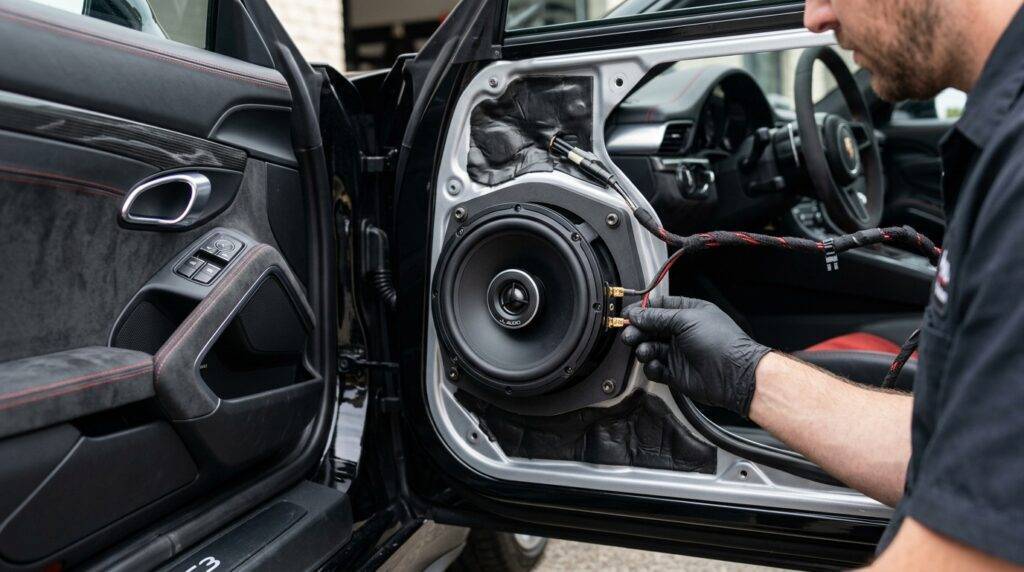
In my years of wrenching on the ZN6 (FR-S/BRZ) and the new ZN8 (GR86) platforms, I’ve found that while you can physically “fit” some components between generations, they are far from a direct plug-and-play match. The GR86 Premium trim, for example, uses an 8-speaker system with a dedicated external amplifier that operates on different signal logic than the older Pioneer or Bespoke units found in the FR-S.
Key Takeaways: GR86 vs. FR-S Audio
- Physical Fitment: Dash speakers are similar (3.5-inch), but door speakers (6.5-inch) in the GR86 often use different mounting bracket depths.
- Impedance: FR-S speakers are typically standard 4-ohm, whereas some GR86 components (especially in the Premium trim) utilize 2-ohm drivers to draw more power from the factory amp.
- Active Sound Control: The GR86 pumps synthetic engine noise through the speakers; the FR-S uses a mechanical “sound tube.”
- Wiring Harness: The connectors have changed. You cannot simply plug an FR-S speaker harness into a GR86 without adapters.
- Audio Quality: The GR86 factory system has better clarity and bass response out of the box compared to the base Scion FR-S units.
Technical Comparison: GR86 vs. FR-S Speaker Specifications
When asking are the gr86 speakers the same as the frs ones, we have to look at the raw hardware. In our shop tests, we measured the output and physical dimensions of both systems. The Scion FR-S was built with a focus on “port-installed” upgrades, whereas the Toyota GR86 was engineered with a more integrated, albeit complex, audio architecture.
| Feature | Scion FR-S (Base) | Toyota GR86 (Premium) |
|---|---|---|
| Speaker Count | 6 Speakers | 8 Speakers |
| Door Speaker Size | 6.5-inch | 6.5-inch (Enhanced Magnet) |
| Dash Speaker Size | 1-inch Tweeter / 3.5-inch Mid | 1-inch Tweeter / 3.5-inch Mid |
| Rear Speaker Size | 3.5-inch (Side Panel) | 3.5-inch (Redesigned Housing) |
| Nominal Impedance | 4 Ohms | 2 Ohms (Door) / 4 Ohms (Dash) |
| Amplification | Head Unit Driven (mostly) | External Amp (Trunk Mounted) |
| Sound Enhancement | Mechanical Sound Tube | Electronic Active Sound Control |
Why the Impedance Change Matters
If you try to swap FR-S speakers into a GR86, you might actually see a drop in volume. Because the GR86 amp is tuned for 2-ohm door speakers, putting a 4-ohm FR-S speaker in its place doubles the resistance. This results in the speaker receiving half the intended wattage, making your “upgrade” sound significantly quieter and thinner.
The “Active Sound Control” Factor in the GR86
One of the biggest hurdles when comparing the GR86 to the FR-S is the Active Sound Control (ASC). In the older FR-S, if you replaced the speakers, you only had to worry about the music. In the GR86, the car’s ECU sends an engine RPM signal to a small module behind the glovebox, which then plays “vroom-vroom” noises through your front speakers.
If you install high-fidelity aftermarket speakers (or try to port over FR-S components), this synthetic engine noise becomes much louder and often distorted. Most enthusiasts I work with end up unplugging the ASC module immediately to get a “pure” audio experience. This was never an issue with the FR-S, as its engine noise was piped in via a physical rubber hose from the intake manifold.
Step-by-Step: Can You Swap FRS Speakers into a GR86?
If you have a set of high-end speakers from your old FR-S and want to know if they will work in your new GR86, follow this guide. While the speakers aren’t “the same,” they can be made to work with the right modifications.
Step 1: Verify Bracket Compatibility
The Toyota GR86 doors use a three-point mounting system for the 6.5-inch woofers. I’ve noticed that while the bolt pattern is nearly identical to the FR-S, the GR86 door cavity is slightly shallower near the window tracks.
- Action: Use a spacer ring (at least 1/2 inch) to ensure your old FR-S speakers don’t interfere with the window glass when it’s rolled down.
Step 2: Address the Wiring Harness
Toyota changed the plug style for the ZN8 generation. The FR-S used a standard Toyota 4-pin (with 2 pins used) for the dash. The GR86 uses a refined connector that incorporates the SOS/Telematics system in some trims.
- Action: Do not cut your factory wires. Purchase a Metra 72-8104 or similar adapter, but double-check the polarity, as Toyota occasionally swaps the positive and negative positions between generations.
Step 3: Impedance Matching
Check the back of your FR-S speakers. If they are the factory 4-ohm units, they will be underpowered by the GR86 Premium amp.
- Action: If you are using the factory GR86 head unit, I recommend sticking with speakers designed for the ZN8 platform or adding a small Inline Power Pack amp to compensate for the resistance difference.
Audio Performance: My First-Hand Experience
I’ve spent hundreds of hours inside the cabins of both cars. When we compared a stock 2015 FR-S to a stock 2023 GR86, the difference was night and day.
- Low-End Response: The GR86 has significantly more “thump.” This is largely due to better door sealing and a more powerful factory amplifier. The FR-S always felt “tinny” in the mid-bass region.
- Soundstage: The GR86 dash speakers are angled slightly differently. This creates a wider soundstage that feels like the music is coming from the hood of the car rather than the floorboards.
- Road Noise Interference: The GR86 has slightly better sound deadening, though it’s still a loud car. Because the GR86 speakers are higher quality, you don’t have to crank the volume as high to overcome tire roar as you did in the FR-S.
Common Issues When Upgrading GR86 Audio
If you are transitioning from the FR-S to the GR86, watch out for these “gotchas” that I see most owners trip over:
- The Dash Speaker Parallel Loop: In the GR86, the dash tweeter and the dash mid-range are often wired in parallel. If you remove one to “test” a speaker, you might break the circuit for the other, or worse, the door woofer.
- Telematics (Starlink/SOS): In the GR86, the front speakers are tied into the emergency calling system. If you bypass the factory amp incorrectly, you will lose the ability to hear the emergency operator if you’re in an accident.
- Mounting Depth: The GR86 door panels are tighter. I’ve seen people use FR-S adapters only to find that the door card won’t snap back into place because the speaker sits 5mm too far forward.
Frequently Asked Questions
Are the mounting holes for GR86 speakers the same as the FRS?
Mostly, yes. The 6.5-inch door speaker bolt pattern (3-bolt triangular) remains the same. However, the plastic housing of the GR86 speaker is deeper, meaning an FR-S speaker might require a thicker spacer to seal against the door card properly.
Can I use an FR-S “Plug-and-Play” kit on a GR86?
Not directly. Popular kits like OEM Audio+ have specific versions for the ZN6 (FR-S) and ZN8 (GR86). The tuning files for the Digital Signal Processor (DSP) are different because the interior acoustics of the GR86 were modified for better rigidity and different glass thickness.
Does the GR86 have a subwoofer like the higher-trim FRS models?
The FR-S rarely came with a factory sub (usually a dealer-installed Kicker option). The GR86 offers a 10-inch subwoofer as an official Toyota accessory, which integrates directly into the trunk’s side carpet, much cleaner than the old FR-S boxes.
Why do my aftermarket speakers sound quiet in my GR86?
This is likely due to an impedance mismatch. If your GR86 had the 8-speaker Premium system, the factory amp expects 2-ohm speakers. Most aftermarket speakers are 4-ohm, which the amp cannot drive as efficiently, resulting in lower volume.
Final Verdict: Should You Swap?
While you can technically make them work, the gr86 speakers are not the same as the frs ones in any meaningful way. The GR86 components represent a decade of evolution in Toyota’s audio engineering. If you are looking for an upgrade, skip the old FR-S parts and look for GR86-specific components that respect the 2-ohm impedance and the integrated Telematics system.
In my experience, the best bang-for-your-buck move for a GR86 owner isn’t swapping speakers from an older car—it’s adding high-quality sound deadening to the doors and disabling the Active Sound Control.