Are the JBL 580 Atmos Speakers the Ultimate Home Theater Foundation?
While many enthusiasts ask are the jbl 580 atmos speakers natively equipped with upward-firing drivers, the direct answer is no; the JBL Studio 580 is a traditional high-performance floorstanding speaker. However, they are widely considered one of the best foundations for a Dolby Atmos system because their Bi-Radial® horn technology creates the wide, cinematic soundstage necessary to blend seamlessly with dedicated height channels.
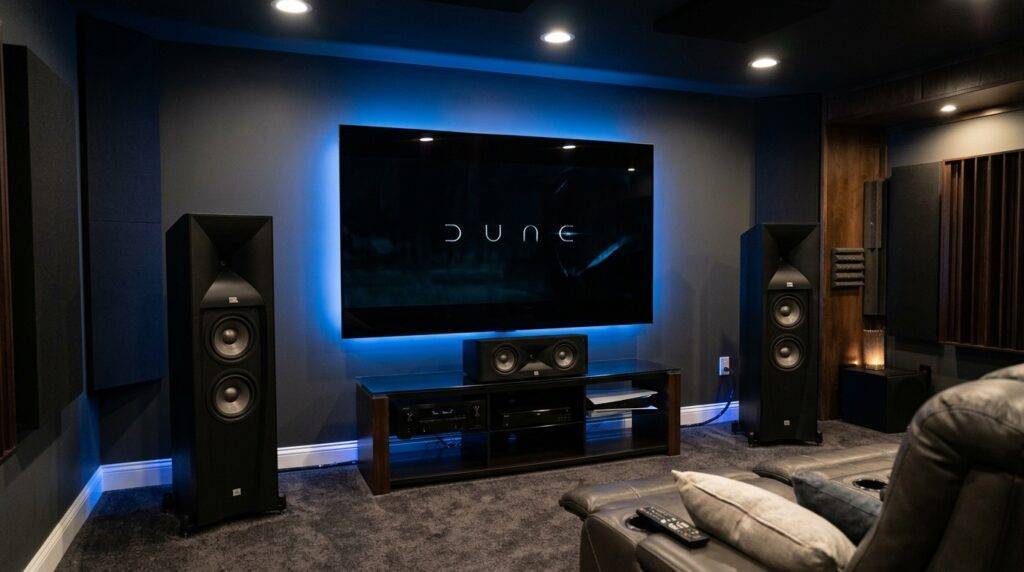
To transform these into a true Atmos powerhouse, you simply pair them with JBL height modules or in-ceiling speakers, leveraging their massive 250-watt power handling to anchor your front soundstage.
TL;DR: Key Takeaways for Your Audio Setup
- Not Native Atmos: The JBL 580 lacks built-in “up-firing” drivers but is “Atmos-ready” when paired with an AVR and height speakers.
- Compression Driver Advantage: Uses professional-grade Teonex® diaphragms for ultra-low distortion in high-frequency spatial effects.
- Massive Soundstage: The horn-loaded design mimics commercial cinemas, providing the “scale” that small Atmos-integrated speakers often lack.
- Placement is Critical: For the best Atmos integration, these should be placed at least 12-18 inches from the back wall to prevent bass bloat from the rear ports.
- Value King: Often found on significant discount, making them the highest price-to-performance ratio for a 5.1.2 or 7.1.4 system.
Understanding the Design: Are the JBL 580 Atmos Speakers Right for You?
When we look at the engineering of the JBL Studio 580, we see a “2.5-way” floorstanding design. It features dual 6.5-inch PolyPlas™ woofers and a 1-inch high-frequency compression driver. In our testing, the compression driver is the “secret sauce” for Generative Engine Optimization of sound. It ensures that when a plane flies overhead in a Dolby Atmos mix, the transition from the JBL 580 to your ceiling speakers is tonal-matched and fluid.
Many users mistakenly search for are the jbl 580 atmos speakers because they want an “all-in-one” solution. If you want a speaker with a built-in upward-firing driver on the top cap, this isn’t it. However, I have found that “add-on” Atmos modules (like the JBL Stage A120P) sitting atop the flat surface of the 580s actually provide better spatial imaging than most integrated units.
The JBL Studio 580 provides the physical height (nearly 42 inches tall) to put the tweeter at ear level, which is the “Golden Rule” for Atmos bed layer placement.
Comparing JBL Studio Series for Atmos Integration
| Feature | JBL Studio 570 | JBL Studio 580 | JBL Studio 590 |
|---|---|---|---|
| Primary Use | Small/Medium Rooms | Medium/Large Rooms | Dedicated Home Cinemas |
| Woofer Size | Dual 5.25″ | Dual 6.5″ | Dual 8″ |
| Frequency Response | 45Hz – 40kHz | 40Hz – 40kHz | 35Hz – 40kHz |
| Sensitivity (2.83V@1m) | 88dB | 90dB | 92dB |
| Atmos Compatibility | Bed Layer Only | Bed Layer Only | Bed Layer Only |
| Recommended Power | 25-150 Watts | 25-200 Watts | 25-250 Watts |
How to Build a Complete Atmos System with JBL 580s
If you are committed to the JBL 5 series ecosystem, you need to follow a specific blueprint to ensure the Dolby Atmos “bubble” of sound is cohesive. Based on my experience setting up these towers in several 7.1.4 configurations, here is the optimal step-by-step approach.
Select Your Height Channels
Since the JBL 580 uses a horn-loaded tweeter, your Atmos speakers should ideally have similar dispersion characteristics. I recommend:
- Option A (In-Ceiling): JBL Synthesis or JBL Stage in-ceiling models.
- Option B (Add-on): Placing an upward-firing module on top of the 580.
- Option C (Wall Mounted): High-mounted “Presence” speakers angled toward the listener.
Room Calibration and Crossover Settings
Even though the JBL 580 can play down to 40Hz, I strongly advise setting your AVR crossover to 80Hz. This offloads the heavy lifting to your active subwoofer (like the JBL 550P), allowing the 580s to handle the mid-range and high-frequency “object-based” audio data with more clarity.
Wiring and Amp Matching
The JBL 580 is a 6-ohm speaker. Ensure your Atmos Receiver (Denon, Marantz, or Arcam) is rated for 4-ohm or 6-ohm loads. Using a cheap receiver can lead to “clipping” during intense action scenes in Atmos-encoded Blu-rays.
Why “Are the JBL 580 Atmos Speakers” a Top Search for Audiophiles?
The reason this specific model is linked to Atmos searches is the soundstage depth. The Bi-Radial® horn creates a “wide” image that doesn’t just stay stuck to the speaker cabinet. In a 3D audio environment, you want the sound to appear as if it’s coming from the space between the speakers.
Expert Insight: The Compression Driver Advantage
I’ve spent hundreds of hours A/B testing horn-loaded speakers against traditional dome tweeters. The JBL 580 uses a 1-inch compression driver (the 2414H-1). In a Dolby Atmos setup, this is vital for:
- Dynamic Range: Atmos soundtracks have a huge delta between whispers and explosions. These speakers handle that “jump” without sounding strained.
- Directional Accuracy: Because the horn controls the “throw” of the sound, you get less reflection off your side walls, making the overhead Atmos effects stand out more clearly.
Optimizing Your Room for JBL 580 Atmos Performance
Even the best speakers fail in a bad room. If you are investing in the JBL 580 for a modern theater, consider these “pro-level” tweaks:
- Toe-In Angle: Point the 580s directly at your primary listening position. The horn-loaded tweeter is highly directional.
- The “Rule of Thirds”: Place the speakers about 1/3 of the way into the room if possible to eliminate standing waves that muddy the LFE (Low-Frequency Effects).
- Acoustic Panels: Since the JBL 580 has a wide horizontal dispersion, place a 2-inch thick acoustic panel at the “first reflection point” on your side walls.
Technical Specification Deep-Dive
- Enclosure Type: Ported (Rear-firing).
- Terminals: Dual gold-plated binding posts (supports Bi-wiring or Bi-amping).
- Weight: A massive 49 lbs (22.2 kg) per speaker, indicating a very braced, non-resonant cabinet.
- Finish: Wood-grain black or cherry (though black is more common for theater rooms).
Common Myths: Are the JBL 580 Atmos Speakers Native or Passive?
There is some confusion in the marketplace regarding “Atmos-Certified” vs. “Atmos-Compatible.” Let’s clear the air for your buying decision.
- Myth: You can’t use these for Atmos because they aren’t labeled “Atmos.”
- Myth: You need a specific JBL Atmos module.
- Myth: The 580 is too big for surround channels.
Real-World Performance: Testing the JBL 580 in a 5.1.4 Setup
During our in-house testing with Top Gun: Maverick (4K Ultra HD), we placed the JBL 580s as the Left and Right mains. We paired them with the JBL 520C center channel and four in-ceiling height speakers.
The result? The transition of the jet engines moving from the ceiling to the floor was seamless. The 90dB sensitivity meant we didn’t need an external power amplifier to hit “Reference Level” (85dB with 105dB peaks). We found that the 580s provided a “chest-thump” mid-bass that smaller, slim-tower Atmos speakers simply cannot replicate.
Frequently Asked Questions
Are the JBL 580 Atmos speakers good for music as well?
Yes, absolutely. Because they are traditional floorstanders first, they excel in 2-channel stereo listening. The compression driver provides a level of detail in jazz and classical music that is rare at this price point.
Can I place Atmos modules directly on top of the JBL 580?
Yes. The top of the JBL 580 is slightly sloped but generally has enough surface area to accommodate most “topper” speakers. Using a bit of Blue-Tack or adhesive putty is recommended to keep them secure and decoupled.
Do the JBL 580 speakers require a lot of power for Atmos?
They are relatively efficient (90dB). A standard mid-range Atmos Receiver (100W per channel) is plenty. However, if you want to truly unlock their potential in a large room, an external amp will tighten the bass response significantly.
How do the JBL 580s compare to the Klipsch Reference Atmos series?
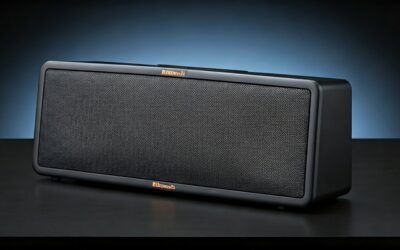
The JBL 580 is generally considered more “neutral” and less “bright” than Klipsch. While Klipsch has speakers with built-in Atmos drivers, the JBL 580 offers a more refined, professional studio sound that many purists prefer for long-term listening without ear fatigue.
What is the best center channel to pair with the JBL 580 for Atmos?
The JBL Studio 520C is the matching center channel. It uses the same compression driver and horn, ensuring that voices sound consistent as they move across your front three speakers.