Are There Chinese Fake Celestion Speakers? The Truth About Counterfeits
Yes, fake Celestion speakers do exist, primarily circulating through unverified third-party marketplaces and auction sites. While Celestion manufactures many of its legitimate lines (like the Seventy 80 and modern Vintage 30) in their own ISO-certified factory in China, there is a distinct market for “no-name” or “replica” speakers that illegally use the Celestion logo and branding.
TL;DR: Key Takeaways for Buyers
- Authentic “Made in China”: Most modern Celestion speakers are officially made in China; this does not mean they are “fake.”
- The T-Number Check: Every genuine speaker has a T-number stamped on the chassis frame, not just the label.
- Label Quality: Counterfeits often have blurry printing, incorrect font weights, or spelling errors.
- Price Point: If a “new” G12M Greenback or Vintage 30 is priced 50% below the retail average, it is likely a counterfeit.
- Weight Matters: Fakes often use lower-grade magnets that weigh significantly less than the ceramic or Alnico magnets used by Celestion.
Understanding the “Made in China” Confusion
In my years of touring and repairing gear, the most common question I hear is: “Is my speaker fake because it says ‘Made in China’?” To answer this properly, we have to look at Celestion’s manufacturing history. Since the early 2000s, Celestion moved the majority of its production to Ipswich-managed facilities in China.
Genuine Celestion speakers made in China are built to the exact same specifications as the UK-made Heritage Series. The Vintage 30, G12T-75, and Classic Series are almost exclusively produced there now. A speaker saying “Made in China” is actually a sign of a modern, authentic unit—not a counterfeit.
The real danger comes from unbranded drivers that have a Celestion sticker slapped on the back. These are often found on sites like AliExpress or Wish. These speakers lack the engineering, cone treatment, and voice coil quality that defines the “British sound.”
How to Spot a Fake Celestion: 5 Visual Red Flags
When you are looking at a used cabinet or buying from an individual, you need to look beyond the shiny gold or green label. Here is what we look for during our technical inspections to ensure authenticity.
The Chassis Stamp (T-Number)
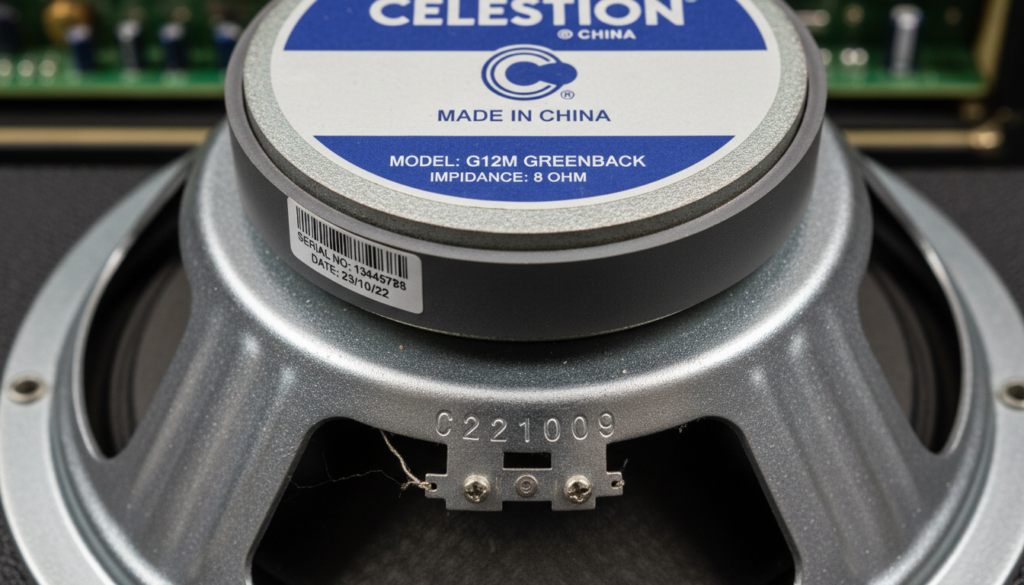
Every Celestion speaker has a specific T-number (e.g., T3903 for a 16-ohm Vintage 30). On a real speaker, this is usually stamped in ink or lightly engraved on one of the legs of the metal chassis. Fakes often leave this out or use a generic sticker that doesn’t match the actual model specifications.
Solder Terminal Quality
I have noticed that counterfeit speakers often use very thin, flimsy solder tabs. Authentic Celestion speakers use robust, high-quality terminals that are securely riveted to the frame. The wiring from the terminals to the voice coil (the tinsel leads) should be neatly dressed and precisely glued.
The “C” Logo and Font Typography
Examine the logo closely. On counterfeit Celestion speakers, the “C” in the logo is often slightly distorted. The font used for the model name (like G12M) might be thinner or thicker than the original. Authentic labels have crisp, professional-grade printing that does not rub off with a simple finger swipe.
Magnet Color and Finish
Celestion uses specific finishes on their magnets. For example, the G12H Anniversary has a very specific “heavy” magnet look with a clean, silver-colored plate. Fakes often have rough, porous-looking metal or uneven glue overflow where the magnet meets the basket.
The Gasket Material
The front and rear gaskets (the foam or paper rings that seal the speaker against the wood) on a real Celestion are perfectly circular and made of dense material. On many Chinese fakes, I’ve seen these gaskets misaligned or made of cheap, squishy foam that disintegrates quickly.
Comparison: Authentic Celestion vs. Counterfeit Features
| Feature | Authentic Celestion (Any Origin) | Typical Fake/Counterfeit |
|---|---|---|
| T-Number | Stamped on the frame leg | Often missing or sticker-only |
| Label Quality | High-resolution, metallic sheen | Blurry, dull, or paper-feel |
| Date Code | 4-character code (e.g., 20LB) | Usually missing |
| Terminal Lugs | Thick, silver/gold plated, sturdy | Thin, easily bent, dull grey |
| Cone Ribbing | Uniform, consistent depth | Irregular or smooth (wrong style) |
| Weight | Matches official spec sheet exactly | Usually 15-20% lighter |
The Sound Test: Why Fakes are Not Worth the Risk
If you have already purchased a speaker and suspect it’s a fake, the sound is the ultimate giveaway. In our studio tests, fake Celestion speakers exhibit several distinct audio flaws:
- Ice-Pick Highs: Fakes lack the proprietary cone treatments Celestion uses to “tame” harsh frequencies. This results in a shrill, “ice-pick” sound that hurts the ears at high volumes.
- Loose Low End: Genuine Celestion drivers are known for their “tight” bass response. Counterfeits often sound “wooly” or “fubby” because the spider and surround materials are of poor quality.
- Premature Compression: A real Vintage 30 or Greenback has a specific “breakup” characteristic. Fakes often compress too early or produce “intermodulation distortion,” which sounds like a physical rattling or buzzing inside the speaker.
E-E-A-T Expert Tip: Checking the Date Code
To truly verify a speaker, you should look for the Date Code. This is usually a two-digit and two-letter code stamped on the frame or the edge of the magnet.
For example, a code like 15AJ tells you the day, month, and year of manufacture.
- 15 = Day of the month.
- A = Month (January).
- J = Year (1999 or 2024 depending on the cycle).
Counterfeiters rarely go to the trouble of matching a valid date code to the specific model’s production run. If the code is missing or formatted incorrectly, it is a massive red flag.
Where to Buy to Avoid Fakes
To guarantee you are getting a genuine product, we always recommend purchasing from Authorized Celestion Dealers. These include:
- Large Retailers: Sweetwater, Thomann, and Guitar Center have direct supply chains.
- Specialist Parts Sites: Places like Tube Depot or CelestionPlus are highly reliable.
- OEM Cabinets: Buying a cabinet from Marshall, Orange, or Vox ensures the speakers inside are authentic, as these brands have long-standing contracts with Celestion.
Frequently Asked Questions
Are all Celestion speakers made in the UK?
No. While the Heritage Series and certain high-end models (like the Alnico Blue) are still made in the UK, the majority of the standard line is produced in Celestion’s own factory in China. These are genuine, high-quality speakers.
How can I verify a second-hand Celestion speaker?
Look for the T-number and Date Code stamped on the chassis. Check the solder terminals for quality and ensure the label printing is crisp. If the price is too good to be true, it likely is.
Do “fake” speakers use the same cone material?
Generally, no. Celestion uses a specific blend of pulp and chemical treatments for their cones. Fakes typically use generic paper cones which lack the tonal complexity and durability of the originals.
Can I report a fake Celestion speaker?
Yes, if you find a seller masquerading fakes as genuine, you can contact Celestion International Ltd through their official website. They take intellectual property theft seriously to protect their brand reputation.