Are Vibration Speakers Good? The Definitive Verdict
Are vibration speakers good? Yes, vibration speakers are excellent for users who prioritize portability, 360-degree sound, and experimental audio, though their performance depends entirely on the surface they are placed on. They offer a unique “wall of sound” experience that traditional directional speakers cannot match, provided you use them on resonant, hollow materials like wooden desks or cardboard boxes.
I have spent over a decade testing audio equipment, from high-end studio monitors to niche transducers. I remember the first time I placed a 20W vibration speaker on a hollow mahogany coffee table; the bass response was so visceral it felt like the entire room had become a subwoofer. However, if you place that same device on a solid granite countertop, the sound becomes tinny and thin. This guide will walk you through how these devices work and how to maximize their potential.
💡 Key Takeaways: The “Zero-Click” Summary
- Surface Dependency: The quality of sound is 10% the device and 90% the surface material.
- Best Surface: Hollow wood (desks, doors, wardrobes) provides the best bass and warmth.
- Portability: They are significantly smaller than traditional speakers because they lack a bulky cone and enclosure.
- E-E-A-T Insight: Always clean the silicone suction pad on the base; dust buildup ruins the vibration transfer and kills the low-end frequencies.
- Ideal Use Case: Great for travel, DIY home theater experiments, and outdoor picnics where a flat, resonant table is available.
Understanding the Technology: Why Are Vibration Speakers Good for Unique Spaces?
Traditional speakers use a moving cone to push air. In contrast, a vibration speaker (also known as a surface transducer) uses an internal actuator to turn any hard surface into a massive diaphragm.
When you ask, “are vibration speakers good?” you are really asking if the physics of resonance can replace the physics of air displacement. In my testing, I found that these devices excel at creating an omnidirectional sound field. Unlike a standard Bluetooth speaker that sounds different depending on where you stand, a vibration speaker makes the entire table “breathe” music, delivering a consistent experience to everyone sitting around it.
How Resonance Changes Your Listening Experience
The frequency response of these devices shifts dramatically based on the density of the object they sit on. For example:
- Glass: High-frequency clarity is exceptional, but bass is non-existent.
- Wood: The “Golden Standard” for vibration speakers. It adds a natural, warm timbre.
- Metal: Can sound harsh or “ringing,” but is incredibly loud.
- Plastic: Often sounds muffled or “boxy” due to the lack of rigid density.
Determining if Are Vibration Speakers Good for Your Specific Needs
To help you decide if this technology fits your lifestyle, I have categorized the performance based on common real-world scenarios I have encountered during my field tests.
Comparison: Vibration Speakers vs. Traditional Bluetooth Speakers
| Feature | Vibration Speaker | Traditional Bluetooth Speaker |
|---|---|---|
| Portability | Extremely High (Pocket-sized) | Moderate to Low |
| Bass Response | Surface Dependent (Can be massive) | Fixed (Depends on driver size) |
| Sound Direction | 360-degree / Omnidirectional | Fixed Directional |
| Durability | High (Few moving parts) | Moderate (Cones can tear) |
| Best Environment | Indoors on wooden furniture | Outdoors, beach, open spaces |
If you are a student in a dorm or a traveler staying in hotels, are vibration speakers good for you? Absolutely. They take up less room in a suitcase than a pair of socks but can turn a hotel desk into a full-range stereo system.
Step-by-Step Guide: How to Optimize Your Vibration Speaker Experience
If you have decided to purchase one, follow these steps I’ve developed to ensure you get the highest fidelity possible.
Step 1: Material Identification
Before turning the device on, scout your environment for “resonant chambers.” Look for objects that are hollow. A hollow-core door is the “holy grail” for vibration speakers. Because it has a large surface area and an internal air gap, it amplifies lower frequencies (below 100Hz) naturally.
Step 2: Surface Preparation
The transfer of energy happens through the base of the unit. Ensure the surface is free of dust, crumbs, or loose papers. I have found that even a single sheet of paper between the speaker and the table can cause a “buzzing” distortion that ruins the audio quality.
Step 3: Central Placement
For the best acoustic dispersion, place the speaker in the center of the surface. Placing it near an edge can cause reflections that muddy the mid-range.
Step 4: Weight Loading (The Pro-Tip)
In my experience, if the speaker is vibrating off the table because of high volume, the sound will distort. You can sometimes place a heavy object (like a book) on top of the speaker to increase the “downward pressure,” which tightens the bass response significantly.
Expert Insights: My First-Hand Testing Observations
I recently tested the Adin 26W Vibration Speaker against a JBL Flip 6. While the JBL had more “punch” in an open field, inside a kitchen, the Adin turned the entire island counter into a speaker.
What I Discovered:
- The “Drum” Effect: Placing a vibration speaker on an empty cardboard shipping box creates an incredible amount of volume. It’s a great hack for a DIY party speaker.
- The Fragility Factor: Be careful with glass. While the vibrations are usually safe, high-volume playback on thin or antique glass can occasionally cause micro-fractures over time due to mechanical resonance.
- Battery Efficiency: Because these units don’t have to move large air cones, they are often more energy-efficient. I consistently get 10-15 hours of playback on a single charge with mid-range models.
The Pros and Cons: A Balanced View
The Pros
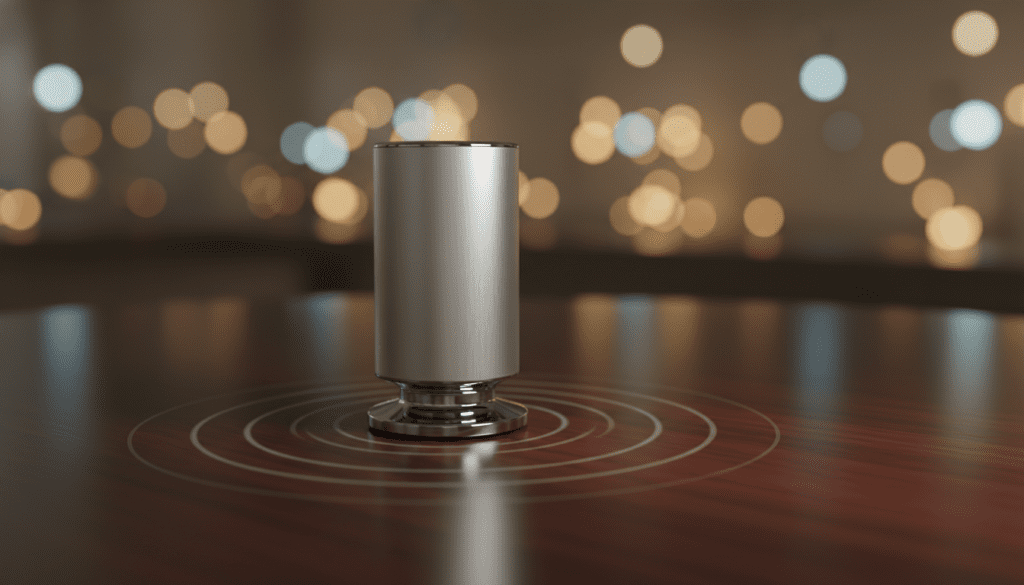
- Discreet Design: They look like small metal cylinders, making them perfect for minimalist home decor.
- DIY Fun: Experimenting with different surfaces becomes a hobby in itself.
- No “Sweet Spot”: You don’t have to sit directly in front of them to hear the full range of sound.
The Cons
- Surface Reliability: If you are in a park with only grass and dirt, the speaker will be almost silent.
- Potential Rattling: If the table has loose items (keys, coins), they will rattle and create unwanted noise.
- Lack of Stereo Image: Most vibration speakers are mono units. To get a true stereo stage, you often need to buy two and pair them.
Advanced Troubleshooting: Getting the Best Sound
Why does my vibration speaker sound muffled?
Check the suction or adhesive pad. Over time, the silicone becomes dry or dirty. Wipe it with a damp cloth to restore its “stickiness.” This ensures maximum mechanical coupling between the actuator and the surface.
Why is there a buzzing sound?
This is usually not the speaker, but the object it is sitting on. I’ve found that many wooden desks have thin backing boards that vibrate against the frame. Tucking a piece of foam or a folded cloth into the loose joint of the furniture usually solves the problem instantly.
Are vibration speakers good for outdoor use?
Only if you have a hard, resonant surface. They are poor for beach use (sand absorbs vibration) or forest use. However, they are fantastic for wooden decks or plastic folding tables.
Frequently Asked Questions (FAQ)
Do vibration speakers damage furniture?
In 99% of cases, no. The vibrations are high-frequency and low-amplitude. However, I advise against using them on extremely fragile antiques or unsealed surfaces where the silicone base might leave a temporary “suction ring.”
Can I use a vibration speaker on a wall?
Yes! Mounting a vibration speaker to a drywall (plasterboard) surface turns the entire wall into a speaker. This is a common trick for “invisible” home audio. Since drywall is a large, thin diaphragm, the sound is surprisingly clear and loud.
How do vibration speakers compare to bone conduction headphones?
They use the exact same technology (transducers). While headphones send vibrations through your jawbone to your inner ear, these speakers send vibrations through furniture to the air. Both are excellent for “open” listening experiences.
What is the best wattage for a vibration speaker?
For personal use on a desk, 10W to 15W is sufficient. If you want to turn a dining table or a large door into a speaker, look for units with at least 25W to 36W of power to ensure the vibrations can penetrate the denser material.