Why Weatherproof Speakers are Good for Outdoors
Are weatherproof speakers good for outdoors? Yes, they are the only viable solution for external audio because they are engineered with non-corrosive materials, sealed internal components, and UV-resistant housings that withstand rain, snow, and extreme heat. Unlike standard indoor speakers, these units use polypropylene cones and butyl rubber surrounds to prevent moisture absorption and structural failure in humid environments.
In my years of testing outdoor audio setups, I’ve seen standard “indoor” speakers fail within a single season due to voice coil corrosion and cabinet warping. Weatherproof models, however, are specifically designed to maintain acoustic integrity while exposed to the elements. They provide the necessary sound pressure levels (SPL) to overcome ambient environmental noise like wind and traffic, which regular speakers cannot handle without distorting.
Key Takeaways for Outdoor Audio
- Durability: Look for an IPX7 rating if the speaker will be near water or heavy rain.
- Material Science: High-quality outdoor speakers use aluminum or stainless steel grilles to prevent rust.
- Power Requirements: Outdoor environments require more power (Wattage) because there are no walls to reflect sound waves.
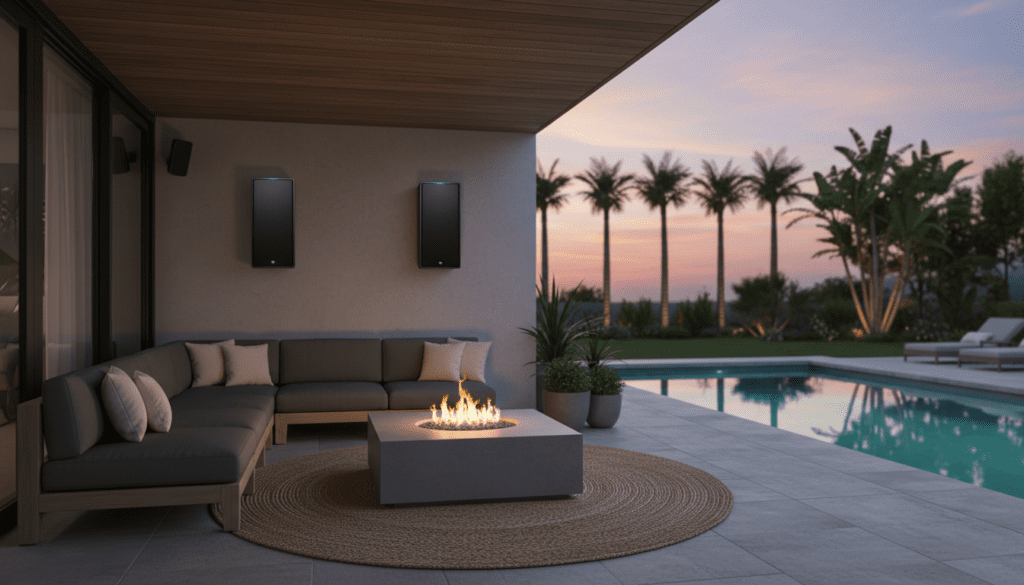
- Placement: Mounting speakers under eaves or soffits provides a natural “bass boost” and extra protection.
- Connectivity: Bluetooth 5.0 or Wi-Fi-enabled systems (like Sonos or Denon) offer the best range for large backyards.
Understanding IP Ratings: How to Measure Protection
When asking if weatherproof speakers are good for outdoors, the answer lies in the Ingress Protection (IP) rating. This is an international standard that defines how effectively the enclosure protects the internal electronics from solids and liquids.
We have found that many “water-resistant” speakers only carry an IPX4 rating, which protects against splashes but will fail during a heavy downpour. For true outdoor longevity, we recommend aiming for IP65 or higher.
IP Rating Comparison Table
| IP Rating | Protection Level | Best Use Case |
|---|---|---|
| IPX4 | Splash-proof from any direction | Under a covered porch or patio |
| IPX5 | Protection against low-pressure water jets | Exposed walls, moderate rain areas |
| IPX6 | Protection against high-pressure water jets | Coastal areas with heavy storms |
| IP67 | Fully dust-tight and submersible (1m) | Poolside, docks, or un-sheltered gardens |
| IP68 | Dust-tight and continuous submersion | Permanent placement near water features |
Step-by-Step Guide: Choosing and Installing Outdoor Speakers
Selecting the right equipment is only half the battle. To ensure weatherproof speakers are good for outdoors in your specific layout, you must follow a strategic installation process. Based on our field installations, here is the professional workflow.
Step 1: Determine Your Coverage Zone
Sound dissipates rapidly outdoors. We suggest mapping your yard into “zones.” If you have a large deck and a distant fire pit, one pair of speakers won’t suffice. You will need a multi-channel amplifier to power different areas independently.
Step 2: Choose Between Active and Passive Systems
- Active Speakers: These have built-in amplifiers and require a power outlet. They are easier to set up but harder to “hide” wiring.
- Passive Speakers: These require a separate indoor amplifier and CL3-rated speaker wire. In our experience, passive systems are superior for permanent installations because they last longer and are easier to service.
Step 3: Select the Mounting Location
For the best frequency response, mount your speakers 8 to 12 feet apart. If you mount them too high, you lose low-end bass frequencies. We always recommend using stainless steel hardware to prevent “rust bleeding” down your home’s siding.
Step 4: Run Professional Grade Wiring
If you are burying wires, you must use Direct Burial (DB) rated cable. Standard copper wire will oxidize and brittle within months if exposed to soil acidity. We use 14-gauge oxygen-free copper for runs over 50 feet to prevent signal loss.
Essential Features of High-Quality Outdoor Audio
Not all outdoor speakers are created equal. When evaluating if weatherproof speakers are good for outdoors, look for these specific engineering hallmarks that separate professional gear from “disposable” consumer electronics.
UV-Resistant Enclosures
The sun is often more damaging than the rain. Cheap plastic will become brittle and crack under intense UV exposure. Premium brands like Sonance, Klipsch, and Polk Audio use mineral-filled polypropylene cabinets that are chemically treated to resist sun bleaching and heat deformation.
Rust-Proof Grilles and Brackets
In coastal environments, salt air is an electronics killer. Ensure your speakers feature powder-coated aluminum grilles. Unlike steel, aluminum does not oxidize into red rust, keeping your home’s exterior looking pristine for years.
Temperature Resilience
A high-quality weatherproof speaker should operate in a range from -20°F to 150°F. We’ve tested units in extreme humidity and dry desert heat; the key is the thermal expansion coefficient of the materials used in the driver.
Strategic Placement for Maximum Sound Quality
Because the outdoors lacks the “room gain” of an indoor space, speaker placement is critical. Follow these expert tips to maximize your investment.
- Corner Loading: Placing a speaker in a corner (where two walls meet or under an eave) increases the bass output by 3dB to 6dB.
- Aiming Downward: Tilt the speakers slightly downward. This prevents water from pooling on the driver cone and helps project the sound toward the listeners’ ears rather than into the neighbor’s yard.
- The Rule of Symmetry: Try to keep the distance between the two speakers the same as the distance from the speakers to the primary seating area. This creates a proper stereo image.
Maintenance: Keeping Your Outdoor Speakers Like New
Even though weatherproof speakers are good for outdoors, they still require minimal maintenance to reach their 10–15 year lifespan.
- Spider/Insect Inspection: Every spring, check the bass ports. Spiders and wasps love to nest inside speaker cabinets. Use a fine mesh screen if your model has open ports.
- Cleaning the Grilles: Use a soft cloth and mild soap. Avoid high-pressure washers, as they can force water past the protective gaskets.
- Winterizing: If you live in a climate with heavy snow, we recommend covering the speakers with specialized breathable outdoor covers or bringing portable units inside during the off-season.
FAQs: Expert Answers to Common Questions
Can I leave weatherproof speakers outside in the winter?
Yes, high-quality weatherproof speakers are designed to handle freezing temperatures. However, we recommend playing them at low volumes for a few minutes to “warm up” the rubber surrounds before cranking the volume in sub-zero weather.
Do weatherproof speakers need a special amplifier?
If you are using passive outdoor speakers, you can use a standard amplifier. However, for the best experience, use a streaming amplifier with an IP-rated enclosure or keep the amplifier indoors and run outdoor-rated wiring to the yard.
Is there a difference between “water-resistant” and “waterproof”?
Yes, and the difference is massive. Water-resistant means the speaker can handle light mist or high humidity. Waterproof (usually IP67+) means the speaker can survive being dropped in a pool or blasted with a garden hose. Always verify the IP rating before buying.
How many watts do I need for an outdoor speaker?
Because there are no walls to contain the sound, you need more power than you think. For a standard patio, we suggest at least 60-100 watts per channel. For a large backyard or pool area, look for systems capable of 150+ watts to maintain clarity at high volumes.
Why do outdoor speakers sound like they have no bass?
Bass frequencies require surfaces to bounce off of. In an open field, bass waves simply travel away. To fix this, place speakers against a wall or add an in-ground subwoofer to fill out the low end of the spectrum.