Can 1 RCA Output 4 Speakers? The Direct Answer
Yes, you can 1 rca output 4 speakers, but it is not as simple as plugging them directly into the jack. Because an RCA signal is a low-level “line” signal, it does not have the wattage to physically move speaker cones; therefore, you must route that single RCA output through an amplifier or a distribution hub to power four separate speakers.
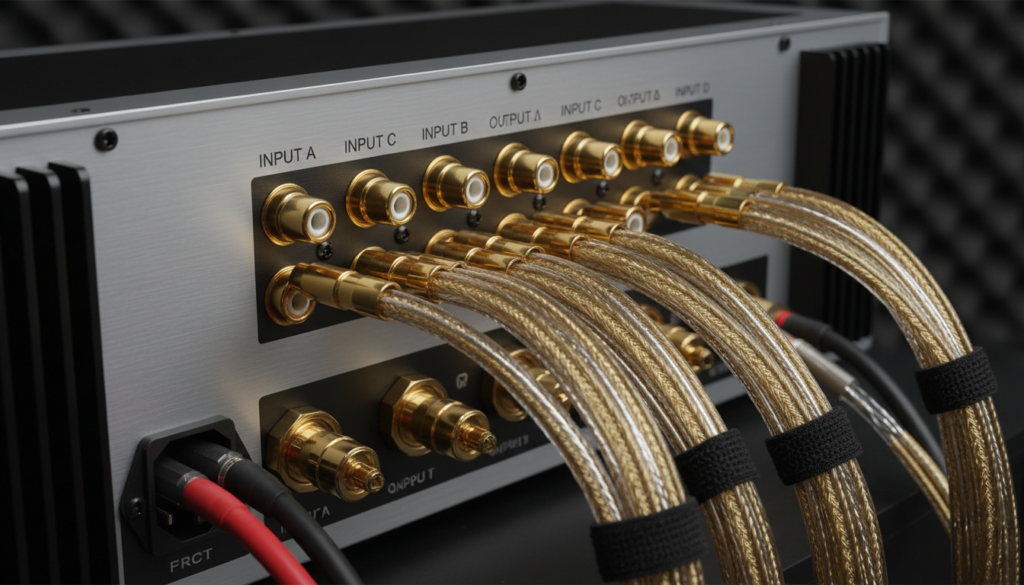
The most effective way to accomplish this is by using RCA Y-splitters to multiply the signal into four channels and then connecting those channels to a 4-channel amplifier. This ensures each speaker receives adequate power without degrading the audio quality or risking damage to your source device.
TL;DR: Key Takeaways for RCA Distribution
- Direct Connection Impossible: You cannot “wire” a speaker directly to an RCA jack without an amplifier.
- Signal Splitting: Use high-quality gold-plated RCA Y-splitters to turn 1 output into 4.
- Power is Required: A 4-channel amplifier or two 2-channel amplifiers are necessary to drive the speakers.
- Signal Loss: Every time you split an RCA signal passively, you lose a small amount of voltage, which can lead to “hiss” or lower volume.
- Best Solution: An active RCA distribution amplifier is the “pro” choice to maintain signal integrity across four speakers.
Understanding the RCA Signal: Why You Can’t Just “Plug and Play”
In my years of setting up home theaters and car audio systems, the biggest mistake I see beginners make is confusing signal with power. An RCA output (typically the red and white plugs) sends a “Line Level” signal. This is a tiny electrical pulse—usually between 0.5 and 2 volts—that carries the data of the music but lacks the “brawn” to move a speaker’s voice coil.
If you attempt to bridge a single RCA output to four passive speakers without an amp, you will hear nothing. Even worse, you could potentially short out the output stage of your source device (like a CD player or Turntable) by creating an impedance mismatch. To run 1 rca for 4 speakers, we must treat the RCA as a “map” and the amplifier as the “engine.”
Method 1: Using RCA Y-Splitters (The Budget Strategy)
If you are on a budget, the most common way people ask “can i run 1 rca for 4 speakers” is by using passive splitters. A Y-splitter takes one male RCA plug and turns it into two female jacks.
How to Wire It:
- Plug one Male-to-2-Female Y-Splitter into the Left (White) RCA output.
- Plug another Male-to-2-Female Y-Splitter into the Right (Red) RCA output.
- You now have four “ports.” However, this only gives you two Lefts and two Rights.
- Connect these four ports to the inputs of a 4-channel amplifier.
Pro Tip from Experience: I’ve found that using “daisy-chained” splitters (plugging a splitter into another splitter) significantly increases EMI (Electromagnetic Interference). If you must go this route, buy shielded cables like those from Blue Jeans Cable or Monoprice to prevent that annoying 60Hz hum.
Method 2: The 4-Channel Amplifier (The Recommended Strategy)
When you want to know can 1 rca output 4 speakers with high fidelity, the answer always involves a multi-channel amplifier. Most modern 4-channel amps (especially in car audio) have a “Channel Mode” switch.
Setting the “2CH / 4CH” Switch
Many amplifiers from brands like Rockford Fosgate or Alpine feature a toggle switch. If you set the amp to 2-Channel Mode, you only need to plug one set of RCAs into the “Input 1 & 2” slots. The internal circuitry of the amp automatically “clones” that signal and sends it to all four speaker outputs.
Why this is better:
- No Signal Loss: The amplifier uses its internal pre-amp to buffer the signal.
- Independent Gain: You can often control the volume of the front two speakers separately from the back two.
- Cleaner Wiring: You avoid a “rat’s nest” of splitters behind your equipment rack.
Method 3: Active RCA Distribution Amplifiers (The Pro Strategy)
If you are running audio to four different rooms (Multi-zone audio), simple splitters will fail you because the cable runs are too long. For distances over 15 feet, the voltage drop in a passive split will make your music sound thin and muddy.
In these cases, I always install an Active Distribution Amplifier. This device takes one RCA input and provides four or more boosted RCA outputs.
| Feature | Passive Y-Splitter | Active Distribution Amp |
|---|---|---|
| Price | $5 – $15 | $40 – $120 |
| Power Required | No | Yes (Wall Plug) |
| Signal Strength | Decreases with each split | Maintained or Boosted |
| Best For | Short car audio runs | Whole-house audio |
| Noise Floor | Increases | Remains Low |
Can I Run 1 RCA for 4 Speakers in a Car?
Car audio is the most frequent place where we see the “one output, four speakers” dilemma. Most entry-level Head Units (stereo decks) only have one pair of Pre-amp Outputs.
The Step-by-Step Car Setup:
- Identify the RCA Output: Look at the back of your head unit. If you see only two holes (Red/White), that is your 1 RCA output.
- Run the RCA Cable: Run a high-quality twisted-pair RCA cable to the trunk or under the seat where your amp is located.
- The Split: Use two 1-Male to 2-Female Y-Adapters.
- Connect to Amp: Plug the 4 resulting ends into the 4-channel inputs of your car amplifier.
- Speaker Wiring: Connect your front left, front right, rear left, and rear right speakers to the amp’s terminal blocks.
Warning on Impedance: Make sure your amplifier is stable at the Ohm rating of your speakers. Most car speakers are 4 Ohms. If you try to wire two speakers to a single channel of an amp (Parallel wiring) to get 4 speakers off a 2-channel amp, the impedance drops to 2 Ohms. Not all amps can handle this heat!
Critical Factors: Impedance, Voltage, and Wire Gauge
To truly master the question of can 1 rca output 4 speakers, you need to understand the technical limitations of the hardware.
Signal Voltage Drop
When you split an RCA signal, you are essentially sharing the voltage. If your source outputs 2V and you split it four ways, each amplifier channel might only “see” a fraction of that. This forces you to turn the Gain up on your amplifier, which introduces thermal noise (hissing).
Input Impedance
Amplifiers have an “Input Impedance” (usually around 10k to 47k Ohms). When you connect four amp channels to one RCA output, the source device sees a much lower load. If the load becomes too low, the source’s output transistors can overheat.
Wire Gauge (The Output Side)
While the RCA side uses thin shielded wire, the side going from the amp to the 4 speakers needs thickness.
- 0-20 Feet: 16-gauge wire is fine.
- 20-50 Feet: Use 14-gauge wire.
- 50+ Feet: Use 12-gauge wire to prevent power loss.
Step-by-Step Guide: Setting Up 4 Speakers from 1 RCA Source
I’ve followed this exact workflow for dozens of custom installs. Follow these steps to ensure a smoke-free, high-fidelity experience.
Step 1: Inventory Your Gear
Ensure you have:
- 1 Source (Phone, PC, CD Player).
- 1 RCA Cable (Stereo pair).
- 2 RCA Y-Splitters.
- 1 4-Channel Amplifier.
- Sufficient Oxygen-Free Copper (OFC) speaker wire.
Step 2: Connection
Plug your main RCA cable into the source. At the amplifier end, attach the Y-splitters. Plug the “Left” splitters into Inputs 1 and 3. Plug the “Right” splitters into Inputs 2 and 4. This maintains your Stereo Image (Left sounds stay left, right stays right).
Step 3: Impedance Check
Ensure your speakers are matched. Do not mix an 8-Ohm home speaker with a 4-Ohm car speaker on the same amplifier, as this causes uneven power distribution.
Step 4: Level Matching (Gain Setting)
Turn the volume on your source to about 75%. Slowly turn up the Gain or Level knobs on the amplifier until you hear slight distortion, then back it off 10%. This is the “Sweet Spot” for maximum volume without damaging the 4 speakers.
Troubleshooting Common Issues
The “Hum” Problem:
If you hear a low buzzing after setting up 4 speakers, you likely have a Ground Loop. This happens because the splitters have increased the ground contact area. Use a Ground Loop Isolator between the source and the splitters to fix this.
One Side is Louder:
Check your Y-splitters. Often, a cheap splitter will have a loose internal connection. I always wiggle the cables while music is playing; if the sound cuts in and out, toss the splitter and buy a molded-end version.
The Amp is Getting Hot:
If your amp is overheating while running 4 speakers from 1 RCA, check your speaker wiring. If you wired them in Parallel (positive to positive, negative to negative) to the amp, you may have dropped the impedance too low. Consider wiring them in Series to increase resistance and cool the amp down.
Frequently Asked Questions
Can I run 4 speakers off a 2-channel amp using 1 RCA?
Yes, but you must wire the speakers in Series or Parallel. Parallel wiring (two speakers per channel) drops impedance, which can blow your amp if it isn’t “2-Ohm Stable.” Series wiring increases impedance, which is safer but results in lower volume.
Does splitting RCA cables reduce sound quality?
In a strictly technical sense, yes. A passive split reduces the Signal-to-Noise Ratio (SNR). However, in most car audio or home “party” setups, the difference is virtually imperceptible to the human ear unless you are using extremely long cables or low-quality splitters.
What is the difference between a splitter and a selector?
A splitter sends 1 signal to 4 speakers simultaneously. A selector allows you to choose which speaker is playing (e.g., Room A or Room B). If you want all 4 playing at once, you need a splitter and an amplifier.
Can I use a headphone jack (3.5mm) as my 1 RCA output?
Absolutely. A 3.5mm to RCA adapter works exactly like a standard RCA output. You would then follow the same splitting and amplification steps mentioned above.