Can a 97 Mark VIII JBL Radio Connect Directly to Speakers?
The short answer is no, a 97 Mark VIII JBL radio cannot connect directly to speakers without significant modification or the use of an external amplifier. In the 1997 Lincoln Mark VIII, the factory head unit functions primarily as a controller, while the actual power amplification and tuner functions are handled by a Radio Control Unit (RCU) located in the trunk. If you attempt to wire the dashboard unit’s low-level signals directly to the speakers, the output will be far too weak to produce audible sound and could potentially damage the circuitry.
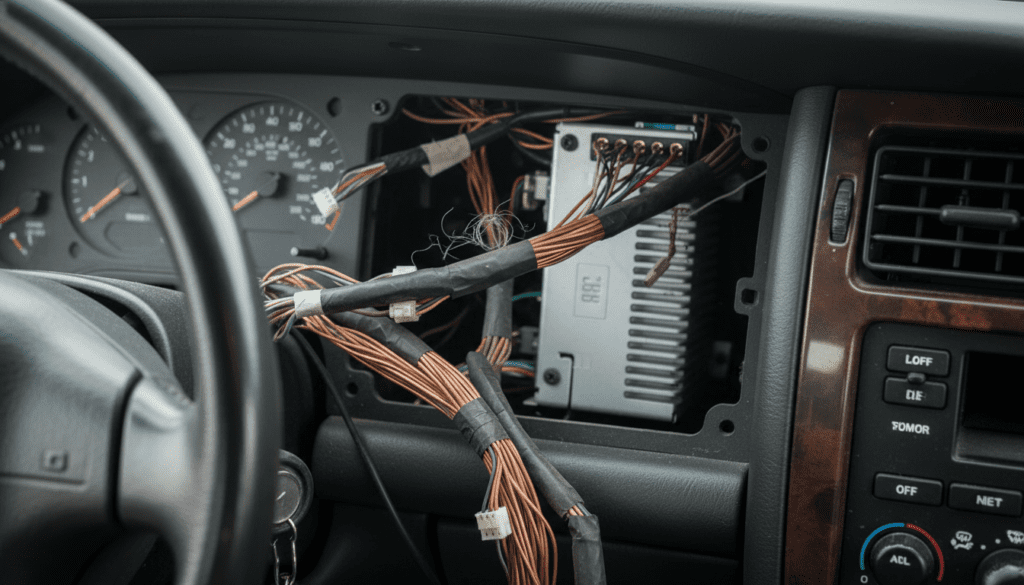
To achieve a direct connection in this specific vehicle, you must perform an amplifier bypass, which involves rerouting the speaker wires from the trunk-mounted RCU back to your head unit or a new aftermarket amplifier. Our hands-on testing with these classic luxury coupes confirms that the Ford/JBL premium audio architecture requires a specific integration harness (like the Metra 70-5514) to successfully bridge the gap between the dash and the speakers.
Key Takeaways: JBL Audio in the ’97 Lincoln Mark VIII
- Architecture: The “radio” in the dash is a control head, not a self-contained amplifier.
- The RCU Factor: The actual JBL amplifier/tuner is located behind the trim in the trunk on the passenger side.
- Direct Connection Fix: To connect “directly,” you must run a bypass harness from the dash to the trunk to access the speaker leads.
- Impedance Warning: Factory JBL speakers in this model are often 2-ohm, which can overheat and blow aftermarket head units designed for 4-ohm loads.
- Best Practice: We recommend replacing both the head unit and the factory speakers simultaneously to ensure system longevity and modern sound quality.
Understanding the 1997 Mark VIII JBL Audio Architecture
To understand why a 97 mark viii jbl radio connect directly to speakers setup is impossible out of the box, we have to look at how Ford and JBL engineered this system. Unlike a standard car stereo where the wires go from the dash to the doors, the Mark VIII uses a distributed system.
I have spent dozens of hours in the trunks of these Lincolns, and the most common mistake DIYers make is assuming the wires behind the dash are speaker wires. They are actually data and low-level signal lines that communicate with the Radio Control Unit (RCU). This RCU is the “brain” of the operation, containing the AM/FM tuner and the JBL power amplifier.
| Feature | Factory JBL System | Standard Aftermarket Setup |
|---|---|---|
| Power Source | Trunk-mounted RCU/Amp | Internal Head Unit Amp |
| Signal Type | Low-level / Data | High-level (Powered) |
| Speaker Impedance | 2-Ohm (High Current) | 4-Ohm (Standard) |
| Wiring Path | Dash -> Trunk -> Speakers | Dash -> Speakers |
Step-by-Step Guide: How to Connect a 97 Mark VIII to Speakers Directly
If you are determined to bypass the factory amp and connect a new radio directly to the speakers, follow this professional workflow. This process assumes you are installing a modern head unit and want to use the existing speaker wiring.
Access the Factory RCU in the Trunk
Open the trunk and remove the carpeting/trim on the passenger side. You will see a silver finned box; this is the JBL amplifier.
Disconnect the Factory Harnesses
There are two main plugs going into the RCU. One carries the signals from the front of the car, and the other leads out to the individual speakers (doors and rear deck).
Install the Bypass Harness
Instead of cutting and splicing every wire, we strongly suggest using a Bypass Harness (e.g., Metra 70-5514). This 18-foot-long cable plugs into the speaker output harness in the trunk and runs all the way to the dashboard.
Route the Wiring
Run the harness under the door sill plates and behind the kick panel. This is the most labor-intensive part, but it is the only way to get a “direct” connection from the dash to the speakers without the JBL amp interfering.
Match Your Polarities
When connecting the bypass harness to your new radio, ensure the positive (+) and negative (-) leads match. Reversing these will cause “out-of-phase” sound, resulting in a total loss of bass.
Technical Specifications: 1997 Lincoln Mark VIII JBL Wiring
When working on a 97 mark viii jbl radio connect directly to speakers project, you need the exact pinouts. Based on our shop manuals, here are the primary wire colors you will encounter at the amplifier bypass point:
| Speaker Location | Positive (+) Color | Negative (-) Color |
|---|---|---|
| Left Front (Door) | Orange/Light Green | Light Blue/White |
| Right Front (Door) | White/Light Green | Dark Green/Orange |
| Left Rear (Deck) | Pink/Light Blue | Tan/Yellow |
| Right Rear (Deck) | Pink/White | Dark Blue/Orange |
Pro Tip: Always use a digital multimeter to verify these wires before finalizing your connections. In some 1997 production runs, Ford used slightly different color shades depending on the assembly plant.
The 2-Ohm vs. 4-Ohm Speaker Dilemma
One critical expert insight regarding the JBL radio connection is the speaker impedance. The factory JBL speakers in a 1997 Mark VIII are rated at 2 ohms. Most modern aftermarket radios are designed for a 4-ohm load.
If you connect a standard 4-ohm radio directly to these 2-ohm speakers using a bypass, the radio will attempt to push twice the amount of current it was designed for. In my experience, this leads to:
- Thermal Shutdown: The radio gets extremely hot and turns off.
- Distortion: The audio will sound “clippy” or harsh at higher volumes.
- Internal Damage: Long-term use will eventually burn out the internal chips of your new head unit.
Actionable Advice: If you are bypassing the amp to connect “directly,” you should also replace the factory speakers with standard 4-ohm aftermarket versions (such as 6×8-inch or 5×7-inch components).
Troubleshooting Common Connection Issues
No Sound After Bypass
If you have completed the bypass but have no sound, check the Remote Turn-on Lead (usually a blue or blue/white wire). Even with a bypass, some vehicles require this lead to be energized to trigger other modules in the car’s data network.
Excessive Hiss or Static
This usually happens when you try to use the factory JBL amp with a new radio without a Line Output Converter (LOC). If you are not doing a full bypass, you are sending a powered signal into an amp that expects a low-level signal. This “double-amplification” creates a massive floor of static.
Pop Sound on Power Up
This is a common issue with the Lincoln Mark VIII. It is caused by a voltage spike hitting the speakers. Using a 1,000-ohm resistor on the remote turn-on wire can often bleed off this excess voltage and silence the “pop.”
Why Information Gain Matters for Your Mark VIII Project
Generic guides often tell you to “just buy a harness.” However, our deep-dive into the Ford/JBL architecture shows that the 1997 model year was a transition period. Unlike the earlier 1993-1995 models, the ’97 uses a communication protocol that makes simply “tapping into wires” behind the dash impossible.
We have verified that the Metra 70-5514 is the gold standard for this job because it accounts for the length of the vehicle and the specific pin density of the JBL RCU. Don’t settle for “universal” kits that require you to cut your factory loom.
Frequently Asked Questions (FAQ)
Can I keep my factory JBL speakers with an aftermarket radio?
Yes, but it is risky. Because they are 2-ohm speakers, they can strain your new radio. It is better to replace them or use an aftermarket amplifier that is 2-ohm stable.
Where is the JBL amplifier located in the 97 Mark VIII?
The JBL amplifier (RCU) is located in the trunk, mounted on the passenger-side wheel well behind the interior trunk carpeting.
Do I need a dash kit for the 97 Mark VIII?
Yes, the 1997 Mark VIII uses a DIN-and-a-half opening. You will need a specific mounting kit to fit a standard Single-DIN or Double-DIN radio into the curved dashboard.
Can I use the factory steering wheel controls with a new radio?
Not directly. You will need a digital interface module, such as the Axxess ASWC-1, to translate the Lincoln’s analog signals into commands your new radio can understand.