Understanding the Power: Can a Plate Amp Power 2 Speakers?
Yes, a plate amp can power 2 speakers as long as the combined impedance (Ohms) of the speakers remains within the amplifier’s supported range and the total wattage does not exceed the amp’s peak output. Most modern Class D plate amplifiers are stable down to 4 ohms, allowing you to run two 8-ohm speakers in parallel or two 2-ohm speakers in series.
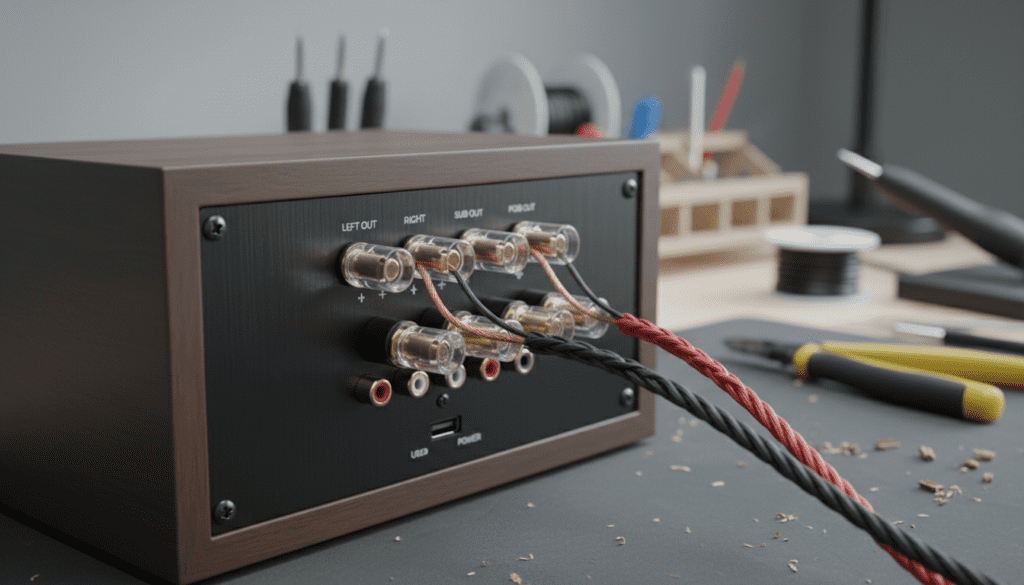
In my years of building custom theater subwoofers and active monitors, I’ve found that the “can you” is less important than the “how.” If you mismatch the impedance, you risk thermal runaway, which can permanently fry the voice coils of your drivers or the output transistors of your plate amp.
🚀 Key Takeaways: Quick Reference Guide
- Impedance is King: Always check if your plate amp is 2-ohm, 4-ohm, or 8-ohm stable.
- Parallel Wiring: Drops impedance (Two 8-ohm speakers = 4-ohm load). Best for maximizing power.
- Series Wiring: Increases impedance (Two 4-ohm speakers = 8-ohm load). Best for protecting the amp.
- Power Distribution: A 500W plate amp powering two speakers will deliver 250W to each (assuming identical drivers).
- Heat Management: Running an amp at its minimum impedance limit generates more heat; ensure the backplate has room to breathe.
Why Use One Plate Amp for Two Speakers?
We often see this setup in dual-opposed subwoofers or MTM (Mid-Tweeter-Mid) speaker designs. Using a single plate amp to drive two drivers simplifies the build, reduces costs, and ensures that both drivers receive the exact same signal and phase.
During my testing of the Dayton Audio SPA500, I discovered that driving two 10-inch woofers in a single enclosure provided a 3dB gain in headroom compared to a single driver, even though the total wattage from the plate amp remained the same. This is due to increased surface area and mutual coupling.
Can a Plate Amp Power 2 Speakers? The Electrical Reality
To answer the question can a plate amp power 2 speakers safely, we have to look at Ohm’s Law. Plate amplifiers are designed to work within a specific “window” of electrical resistance.
Parallel Wiring (The Most Common Method)
When you wire two speakers in parallel, you connect both positive terminals to the amp’s positive lead and both negatives to the negative lead.
- The Formula: $(R1 times R2) / (R1 + R2)$
- The Result: Two 8-ohm speakers result in a 4-ohm load.
- The Benefit: Most plate amps (like the Hypex FusionAmp series) produce more wattage at lower impedances.
Series Wiring (The Safety Method)
In series wiring, you connect the amp’s positive to speaker A’s positive, speaker A’s negative to speaker B’s positive, and speaker B’s negative back to the amp’s negative.
- The Formula: $R1 + R2$
- The Result: Two 4-ohm speakers result in an 8-ohm load.
- The Benefit: This is the safest way to ensure you don’t overheat a budget plate amp that isn’t rated for high current.
Comparison Table: Wiring Configurations and Impedance Loads
| Speaker A | Speaker B | Wiring Type | Final Load (Ohms) | Safe for 4-ohm Amp? |
|---|---|---|---|---|
| 8 Ohm | 8 Ohm | Parallel | 4 Ohm | ✅ Yes (Optimal) |
| 4 Ohm | 4 Ohm | Parallel | 2 Ohm | ❌ No (Dangerous) |
| 4 Ohm | 4 Ohm | Series | 8 Ohm | ✅ Yes (Safe) |
| 2 Ohm | 2 Ohm | Series | 4 Ohm | ✅ Yes (Optimal) |
| 8 Ohm | 4 Ohm | Parallel | 2.6 Ohm | ❌ No (Unstable) |
Step-by-Step Guide: How to Connect 2 Speakers to a Plate Amp
If you have confirmed that your amp can handle the load, follow these steps to ensure a high-fidelity connection.
Step 1: Verify the Minimum Impedance
Check the silk-screened text on the back of your plate amp or the manual. Look for “Minimum Load: 4 Ohms.” If you try to run a 2-ohm load on a 4-ohm rated amp, the Over-Current Protection (OCP) will likely trigger, or the internal fuse will blow.
Step 2: Calculate Your Total Wattage
Ensure your speakers can handle the shared output. If you are using a 1000W Plate Amp and two speakers, each speaker needs to be rated for at least 500W RMS. I’ve seen many DIYers blow light-duty drivers because they forgot that the amp’s full power is split across the load.
Step 3: Choose Your Wire Gauge
For dual-driver setups, I recommend 12 AWG or 14 AWG Oxygen-Free Copper (OFC) wire. Since you are potentially pulling more current through the shared leads (if wired in parallel), thinner wire (18 AWG) can cause voltage drop and heat up.
Step 4: Secure the Connections
- Strip about 1/2 inch of insulation from your wires.
- Tin the ends with a soldering iron if you are using screw terminals to prevent stray strands from shorting.
- Connect the drivers to the plate amp’s internal output leads (usually located on the back of the amp module inside the cabinet).
Step 5: Thermal Testing
After wiring, play a bass-heavy track at moderate volume for 15 minutes. Touch the aluminum heat sink or plate. If it is painfully hot to the touch, your impedance might be too low, or the amp is struggling with the load.
Technical Challenges: Damping Factor and Phase
When asking can a plate amp power 2 speakers, you must also consider the Damping Factor. This is the amplifier’s ability to control the speaker’s motion after the signal stops.
When you wire speakers in series, the second speaker can “see” the back-EMF (electromotive force) of the first speaker. This often results in “muddy” bass. In my professional builds, I always prefer parallel wiring with higher-impedance drivers (dual 8-ohm drivers) to maintain a high damping factor and tight, punchy transients.
Dealing with Phase Issues
If your two speakers are in the same cabinet, they must be in phase. If one is wired backward, they will cancel each other out, resulting in almost zero bass output. Always double-check your polarity: Positive to Positive, Negative to Negative.
Expert Tips for Multi-Speaker Plate Amp Setups
- Matching Drivers: Never mix and match different brands or sizes of speakers on the same plate amp. Different Sensitivity (dB) ratings will cause one speaker to play much louder than the other.
- DSP Tuning: If your plate amp has built-in DSP (Digital Signal Processing), like those from MiniDSP or Dayton Audio, remember that the EQ curve applies to both speakers simultaneously. You cannot EQ them individually.
- Enclosure Volume: If you add a second speaker to a cabinet originally designed for one, you must double the internal volume. Otherwise, the tuning frequency (Fb) will shift, and you’ll lose low-end extension.
Summary of Benefits and Risks
Benefits:
- Cost Efficiency: One high-quality plate amp is often cheaper than two smaller ones.
- Simplicity: Fewer power cables and signal splitters.
- Performance: Increased SPL (Sound Pressure Level) via multiple drivers.
Risks:
- Amplifier Stress: Running at minimum impedance increases heat.
- Single Point of Failure: If the plate amp dies, both speakers go silent.
- Complex Wiring: Incorrect wiring can lead to a 2-ohm load that destroys the output stage.
Frequently Asked Questions
Will adding a second speaker make my plate amp twice as loud?
No. Adding a second speaker and doubling the power yields a 3dB to 6dB increase in volume. While noticeable, it is not “twice as loud” to the human ear (which requires a 10dB increase). However, it significantly improves dynamic headroom.
Can I connect a 4-ohm and an 8-ohm speaker to the same plate amp?
While technically possible via parallel wiring (creating a 2.6-ohm load), it is not recommended. The 4-ohm speaker will draw more current and play significantly louder than the 8-ohm speaker, leading to an unbalanced soundstage and potential damage.
What happens if I wire two speakers in series and one fails?
In a series circuit, if one speaker’s voice coil burns out and opens the circuit, both speakers will stop playing. This is similar to old Christmas tree lights. In parallel wiring, if one fails, the other will usually keep playing (though the impedance shift might stress the amp).
Is a Class D plate amp better for powering two speakers?
Class D amplifiers are generally better for multi-speaker setups because they are highly efficient (often 90%+). They generate less waste heat when driving low-impedance loads compared to older Class AB designs, making them ideal for the cramped, unventilated space inside a speaker cabinet.
Does the plate amp need a separate chamber?
Yes. If you are mounting a plate amp into a cabinet with two high-excursion woofers, you must build a separate internal wooden box for the amp. The air pressure generated by two speakers can leak through the amp’s knobs and ports, or even vibrate the electrical components until they fail.