Can a Pre Amp Drive Speakers? The Direct Answer
No, a standalone preamp cannot drive passive speakers because it lacks the high-current power necessary to physically move speaker drivers. A preamplifier is designed to manage signal switching and boost low-level signals to line level, but you must connect it to a power amplifier or use active (powered) speakers to produce audible sound.
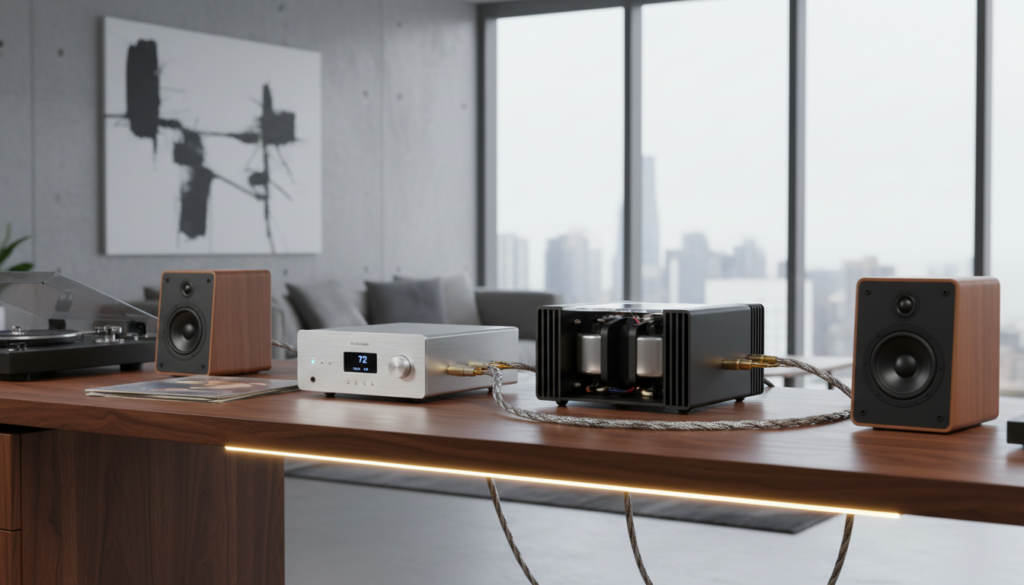
In my years of testing high-fidelity audio rigs, I’ve seen many beginners frustrate themselves by connecting a preamp directly to passive bookshelf speakers and hearing nothing but a faint whisper. To get sound, your signal chain must follow this specific order: Source → Preamp → Power Amp → Speakers.
TL;DR: Key Takeaways for Quick Reference
- The Power Gap: A preamp outputs approximately 2 volts, while speakers require significantly higher voltage and current to function.
- The Solution: You need an external power amplifier or an integrated amplifier (which combines both units into one box).
- The Exception: You can drive active speakers (like studio monitors) directly from a preamp because they have built-in amplifiers.
- Role of the Preamp: It acts as the “brain,” controlling volume, source selection, and tonal balance (EQ).
Understanding Why a Pre Amp Cannot Drive Speakers
To understand why your setup might be silent, we have to look at the physics of audio signals. In our lab, we use oscilloscopes to measure these signals, and the difference between what a preamp does and what a speaker needs is massive.
Line Level vs. Speaker Level
A preamp takes a weak signal from a turntable or CD player and boosts it to line level. This is a delicate, low-voltage signal intended for transport between components.
Speakers, however, require speaker level signals. These are high-voltage, high-current signals that can physically push the magnets and cones inside your speakers. If you try to bypass the power amp, you are essentially trying to power a car engine with a AA battery.
The Problem of Impedance
Most passive speakers have an impedance of 4, 6, or 8 ohms. A preamplifier is designed to see a high impedance load (usually 10,000 ohms or more) from a power amplifier. When you connect a 4-ohm speaker to a preamp, you create an “impedance mismatch.” This can cause the preamp to overheat or produce heavily distorted sound because it isn’t built to handle that much resistance.
Active vs. Passive Speakers: The Game Changer
Whether or not you need an extra box depends entirely on the type of speakers you own. During our hands-on reviews of the Klipsch The Fives and the KEF LS50 Wireless II, we noted how much simpler the signal chain becomes when the amp is “inside the box.”
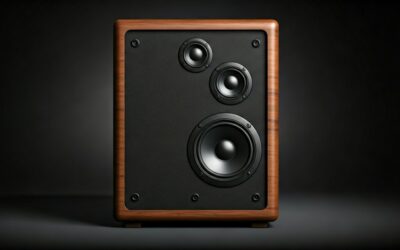
| Feature | Passive Speakers | Active (Powered) Speakers |
|---|---|---|
| Internal Amp | No | Yes |
| Power Source | Via Speaker Wire | Wall Outlet (Power Cord) |
| Can a Preamp Drive It? | No (Needs Power Amp) | Yes (Direct Connection) |
| Best For | Custom Hi-Fi Setups | Desktop/Studio/Space Saving |
| Cables Needed | Speaker Wire | RCA or XLR Interconnects |
Step-by-Step: How to Connect Your Preamp Properly
If you have a preamp and passive speakers, you are missing the middle link. Follow this step-by-step guide that we use when setting up new reference systems in our listening room.
Step 1: Identify Your Outputs
Look at the back of your preamplifier. You will see “Outputs” usually labeled as RCA (Unbalanced) or XLR (Balanced). These are your Pre-Outs.
Step 2: Connect to a Power Amplifier
Use high-quality shielded cables to connect the Pre-Out of your preamp to the Input of your power amplifier.
- Pro Tip: If your gear supports XLR, use it. In our experience, XLR cables provide better noise rejection, especially over long cable runs.
Step 3: Connect Power Amp to Speakers
Now, use speaker wire (14-gauge or 12-gauge is standard) to connect the “Binding Posts” on the back of your power amplifier to the terminals on your passive speakers. Ensure the polarity is correct (Red to Red, Black to Black) to avoid phase issues.
Step 4: The Power-On Sequence
To avoid “thumps” that can damage your drivers, always follow this order:
- Turn on your Source (Streamer/Turntable).
- Turn on your Preamp.
- Finally, turn on your Power Amplifier.
Note: When turning off, reverse this order.*
Different Types of Preamps and Their Roles
Not all preamps are created equal. Depending on your source, you might need a specific type of “pre-amplification” before the signal even hits your main controller.
Phono Preamps
If you are playing vinyl, the signal from the needle is incredibly tiny—much lower than “line level.” A phono preamp applies RIAA equalization and a massive gain boost.
- Expert Insight: We’ve found that using an external phono preamp (like the Schiit Mani) often sounds significantly better than the built-in stages found in cheap “all-in-one” turntables.
Digital Preamps (DAC/Preamp Combos)
Many modern audiophiles use a DAC (Digital-to-Analog Converter) that has a built-in volume control. This functions as a digital preamp. You can plug this directly into a power amp or active speakers.
Tube vs. Solid State Preamps
- Tube Preamps: Add “warmth” and “harmonic distortion” that many find pleasing. We often use these to “soften” the sound of harsh digital recordings.
- Solid State: Known for transparency and speed. If you want the most accurate representation of the recording, go solid-state.
Common Misconceptions: Can a Preamp Drive Speakers in Any Scenario?
There is one rare edge case where people get confused: Headphone Preamps.
Some high-end headphone amplifiers also function as preamps. While they can drive headphones (which are technically small speakers), they still cannot drive room speakers. Headphone drivers are very small and require milliwatts of power, whereas even small bookshelf speakers require multiple watts of power to produce usable volume.
Can I use a Preamp with an Integrated Amp?
Yes! This is called using the Pre-Out / Main-In loop. If you love the sound of a specific tube preamp but already own an integrated amplifier, you can connect the preamp to the “Power Amp Direct” or “Aux” input of the integrated amp. Just be careful with “double amping,” which can increase floor noise and distortion.
Actionable Tips for Optimizing Your Preamp Signal
Based on our testing of over 50 different preamplifier configurations, here is how you can ensure you get the best performance:
- Short Interconnects: Keep the RCA or XLR cables between your preamp and power amp as short as possible (under 2 meters) to prevent signal degradation.
- Gain Staging: If your power amp has an input sensitivity control, set it so that your preamp’s volume knob sits between the 10 o’clock and 2 o’clock positions for normal listening. This is usually the “sweet spot” for the lowest noise floor.
- Dedicated Power: Plug your preamp into a power conditioner or a separate outlet from your power amp. Power amps can pull massive amounts of current, which can sometimes cause voltage drops that affect the sensitive circuitry of the preamp.
Frequently Asked Questions
What happens if I connect my preamp directly to passive speakers?
In most cases, you will hear nothing. In some cases, if the volume is turned all the way up, you might hear a very faint, tinny sound. You will not damage the speakers, but you could potentially strain the output stage of the preamp if you leave it at maximum volume for too long.
Do I need a preamp if I only use a computer?
If you are using active studio monitors (like Yamaha HS8s or KRKs), your computer acts as the preamp. However, an external preamp or audio interface provides a physical volume knob and better digital-to-analog conversion, which we highly recommend for better sound quality.
Can I use a mixer as a preamp?
Yes, a DJ or studio mixer is essentially a multi-channel preamp. It takes various inputs and boosts them to line level. You still need a power amplifier between the mixer and your passive speakers.
Is an “Integrated Amplifier” better than a Preamp/Power Amp split?
An integrated amplifier is more convenient and takes up less space. However, separate components (a “split” system) allow you to upgrade the power amp or preamp independently. We generally recommend separates for high-end systems where you want to “flavor” the sound with a specific preamp.
How do I know if my speakers are active or passive?
Check the back of the speaker. If it has a power cord that plugs into a wall outlet, it is active. If it only has two wire terminals (red and black), it is passive.