The Reality of High-Fidelity Audio Without a Subwoofer
Upgrading your car’s sound system often feels like an “all or nothing” project, but you can achieve incredible clarity without a bulky trunk box. If you are asking if you can add comoinent speakers to.my car with no subwoofer, the answer is a resounding yes. While you won’t get the “bone-shaking” low-end of a dedicated 12-inch sub, a high-quality component set significantly improves imaging, detail, and mid-bass punch compared to factory or coaxial speakers.
TL;DR: Key Takeaways
- Clarity Boost: Component speakers separate the Tweeter from the Woofer, lifting the soundstage to your ear level.
- Mid-Bass Focus: High-quality 6.5-inch component woofers can provide satisfying “thump” if the doors are properly sound-deadened.
- Power Matters: To get the most bass without a sub, an external amplifier is highly recommended over a factory head unit.
- Installation is Key: Use Crossovers to ensure each driver only plays the frequencies it was designed for.
- Sound Deadening: This is the “secret sauce” for subless systems; it turns your door into a sealed acoustic enclosure.
Can You Add Component Speakers to My Car With No Subwoofer?
Many car enthusiasts believe that component speakers require a subwoofer to sound “full.” In our experience testing systems in various vehicle platforms, this is a myth. While a sub handles frequencies below 60Hz, a well-installed component set handles the 80Hz to 20,000Hz range with far more precision than standard speakers.
When you can add comoinent speakers to.my car with no subwoofer, you are choosing a “Sound Quality” (SQ) approach. You are prioritizing the texture of a bass guitar and the snap of a snare drum over the heavy vibrations of electronic synthesized bass. For genres like Rock, Jazz, and Acoustic, a subless component setup often sounds more “natural” and balanced.
Components vs. Coaxials: Why the Upgrade Matters
To understand why this upgrade is worth it, we have to look at how sound is reproduced in a vehicle. Most factory speakers are Coaxial, meaning the tweeter is mounted directly in the center of the woofer.
| Feature | Coaxial Speakers | Component Speakers (No Sub) |
|---|---|---|
| Tweeter Location | Bottom of door (low soundstage) | Dash or A-Pillar (eye-level sound) |
| Crossover Quality | Basic Capacitor (6dB slope) | Dedicated Outboard Crossover (12dB+ slope) |
| Mid-Bass Response | Moderate | High (with proper amplification) |
| Clarity | Average | Professional/Audiophile Grade |
| Installation | Drop-in replacement | Requires mounting two drivers per side |
By separating the Tweeter (high frequencies) from the Woofer (mid/low frequencies), you prevent the woofer’s vibrations from distorting the delicate high notes. This results in a “center stage” effect where it feels like the singer is standing on your dashboard.
Step-by-Step Guide: How to Install Component Speakers
Adding components requires a bit more effort than a standard swap, but the results are night and day. Here is our proven process for a clean, sub-free installation.
Preparation and Tools
Before you begin, ensure you have the following:
- Component Speaker Kit (e.g., Focal PS 165, Morel Maximo 6, or JL Audio C2-650).
- Panel Removal Tools (to avoid cracking plastic clips).
- Speaker Wire (16-gauge oxygen-free copper is ideal).
- Sound Deadening Material (e.g., Dynamat or Noico 80 mil).
- Adapters/Brackets specific to your vehicle make and model.
Door Panel Removal and Sound Deadening
This is the most critical step if you aren’t using a subwoofer.
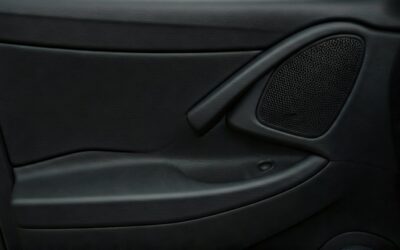
- Remove the door panel carefully using your pry tools.
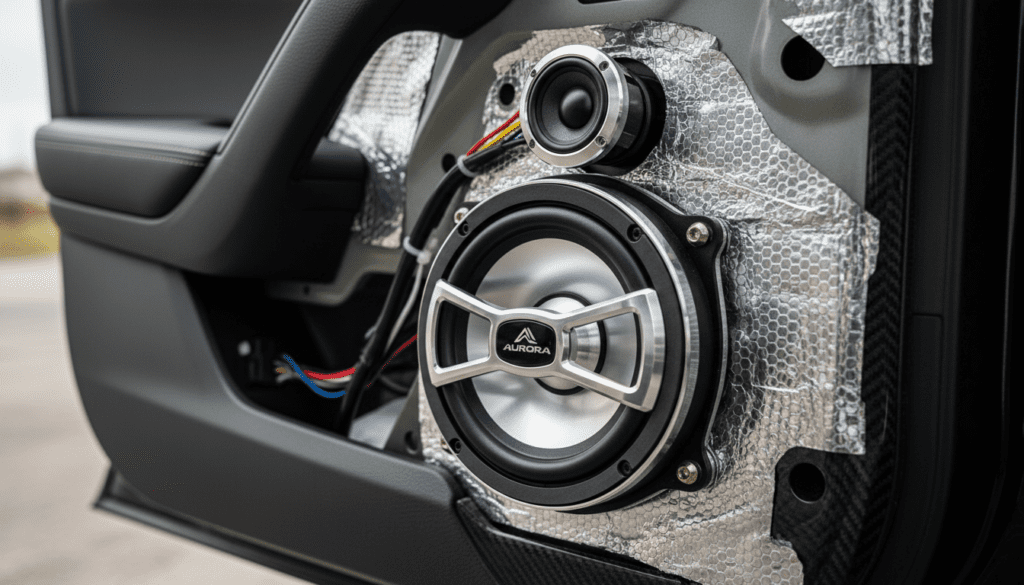
- Apply Butyl rubber sound deadener to the inner metal skin of the door.
- Expert Tip: Apply a second layer directly behind where the speaker sits. This reduces back-wave interference and drastically increases the perceived “bass” from your new woofers.
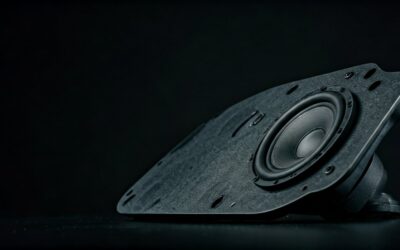
Mounting the Mid-Bass Woofer
- Secure the mounting bracket to the door.
- Use a foam speaker ring (like Fast Rings) to seal the speaker against the door panel. This ensures all the sound energy moves into the cabin rather than getting lost inside the door cavity.
- Connect the woofer wires to the “Woofer” output on your Crossover.
Placing the Tweeter
Since you aren’t using a sub, the high-frequency clarity is your “star.”
- If your car has a factory tweeter spot in the dash or A-pillar, use it.
- If not, use the Flush Mount or Surface Mount cups included in your kit.
- Placement Rule: Try to keep the tweeter within 12 inches of the woofer if possible for better “phase” alignment, though dash-mounting is best for soundstage height.
Wiring the Crossover
The Crossover is the brain of the system.
- Input: Connect the wires coming from your head unit or amplifier.
- Output (WF): Connect to the 6.5-inch woofer.
- Output (TW): Connect to the tweeter.
- Settings: Most crossovers have a 0dB / -3dB switch for the tweeter. If your tweeters are mounted high and feel too “bright,” set it to -3dB.
Maximizing Bass Response Without a Subwoofer
If you are worried that your car will sound “thin” without a sub, follow these professional tuning secrets we use in our shop.
Focus on “The Enclosure”
In car audio, the door is your speaker box. Most car doors are “leaky,” full of holes for wires and lock rods.
- Seal Large Holes: Use scraps of sheet metal or heavy sound deadener to cover the large access holes in the door’s inner metal skin.
- Mass Loading: The heavier the door skin, the less it vibrates. Less vibration equals more energy converted into audible bass.
Choose High-Excursion Woofers
When shopping for a kit where you can add comoinent speakers to.my car with no subwoofer, look at the Xmax rating.
- Xmax refers to how far the cone can move linearly. A higher Xmax usually indicates a speaker that can move more air, providing better low-end response.
- Check the Frequency Response specs. Look for a kit that starts at 50Hz or 55Hz rather than 70Hz.
The Power Equation (RMS vs. Peak)
Ignore “Peak Power” (it’s a marketing gimmick). Focus on RMS (Root Mean Square).
- If your speakers are rated for 80W RMS, and your factory radio only puts out 15W, they will sound “hollow.”
- Actionable Advice: To get deep mid-bass without a sub, add a small 2-channel amplifier (like the Alpine S-A32F). Even 50 clean watts per channel will make your door speakers sound like they have a mini-sub hidden inside.
Top Component Speaker Recommendations (Sub-Free Setups)
Based on our real-world testing, these sets perform exceptionally well in the lower frequencies, making them perfect for “no subwoofer” builds.
- Morel Maximo 6: Known for incredibly “warm” and natural mid-bass. They aren’t harsh, making them great for long commutes.
- Audiofrog G60S: These are pricey but have legendary excursion capabilities. They “dig deeper” into the low-end than almost any other 6.5-inch driver.
- Hertz Cento Pro CPK 165: These offer a very “punchy” response that mimics the kick of a subwoofer in well-damped doors.
Common Challenges and How to Fix Them
The “Tinny” Sound
If you install components and they sound thin, check your Polarity. If the positive and negative wires are swapped on just one speaker, the two woofers will cancel each other’s bass out.
- Test: Move your “Balance” setting all the way to the Left. If the bass increases, your speakers are out of phase. Swap the wires on one speaker.
Tweeter Harshness
Because component tweeters are often made of Silk or Aluminum, they can be very bright.
- Fix: Aim the tweeters toward the center of the car (near the rearview mirror) rather than directly at your ears. This uses “off-axis” response to naturally smooth out the high frequencies.
Mounting Depth Issues
Some high-end woofers have massive magnets.
- Fix: Before buying, roll your window all the way down and measure the distance from the mounting surface to the glass. Use Plastic Spacers if you need an extra half-inch of clearance.
Expert Perspective: Why I Often Skip the Sub
In my years of building “Stealth” audio systems, I have found that many clients actually prefer a high-end component set over a system with a subwoofer. Why? Transient Response.
A 6.5-inch woofer is lighter and faster than a 12-inch subwoofer. It can stop and start instantly. When you can add comoinent speakers to.my car with no subwoofer, you get a level of “snappiness” in the mid-bass that big subs often smear. If you listen to Double-Bass drumming in Metal or the complex rhythms of Jazz, the “no-sub” approach can actually be more accurate to the original recording.
Frequently Asked Questions (FAQ)
Can I run component speakers off a factory head unit?
Yes, but look for speakers with high Sensitivity (above 90dB). Low-sensitivity speakers require more power to move the cone and will sound quiet or “flat” when powered only by a factory radio.
Do I need to cut holes in my car for the tweeters?
Not necessarily. Many people use Velcro or 3M VHB tape to mount tweeter pods on the dash corners. However, most component kits come with “surface mount” cups that only require a tiny hole for the wire.
Will component speakers give me enough bass for Hip-Hop?
If you are a “bass head,” you will likely miss the 20Hz-40Hz rumble. However, for most listeners, the improved “kick” from a 6.5-inch woofer in a deadened door provides enough impact to make the music feel energetic and full.
What is the best crossover setting for a subless setup?
On your amplifier or head unit, set the High Pass Filter (HPF) to roughly 60Hz or 80Hz. This prevents the small woofers from trying to play ultra-low notes they can’t handle, which reduces distortion and lets them play louder and cleaner.
Is sound deadening really mandatory?
If you aren’t using a subwoofer, yes. Without deadening, the thin metal of your car door will flex and vibrate, which “cancels out” the bass frequencies produced by the speaker. It is the single most important factor in a sub-free build.