Understanding Why Alternator Noise on Speakers Can Be Seen on Oscilloscope
Yes, alternator noise on speakers can be seen on oscilloscope screens as a distinct AC ripple or “sawtooth” waveform riding on the 12V DC signal. When your audio system picks up this interference, the oscilloscope allows you to visualize the exact frequency and amplitude of the alternator whine, helping you determine if the issue is a failing rectifier diode or a simple ground loop.
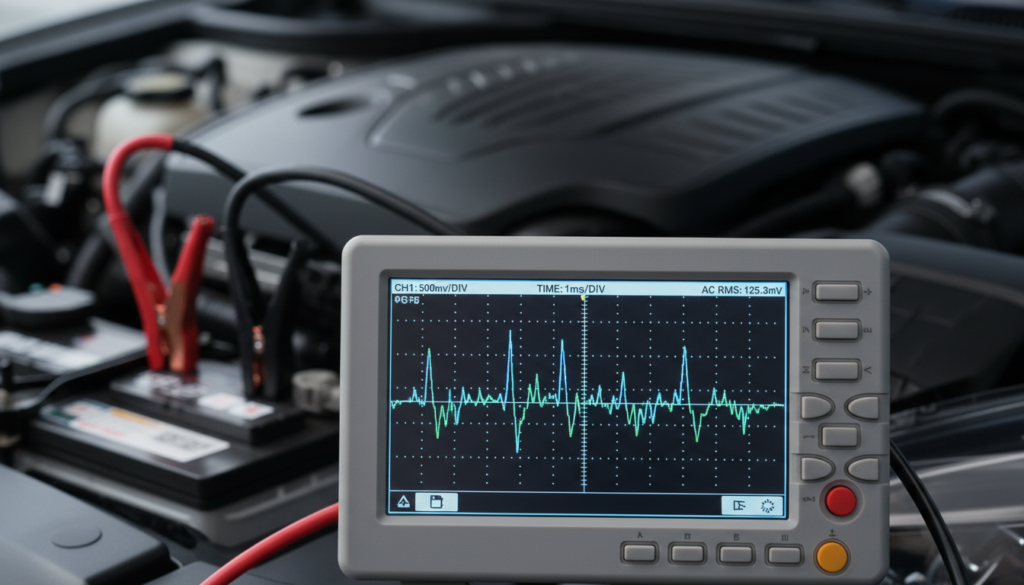
In my years of troubleshooting high-end car audio builds, I have found that visual confirmation is the only way to move beyond guesswork. By connecting a scope to your power leads or RCA outputs, you can see the precise moment the electrical system’s “noise floor” exceeds acceptable levels.
TL;DR: Key Takeaways for Alternator Analysis
- Visual Confirmation: Alternator noise appears as a repetitive AC ripple on top of the DC voltage line.
- Identify the Culprit: A healthy alternator has a small ripple; a blown diode shows massive, sharp spikes.
- Setting the Scope: Always use AC Coupling on your oscilloscope to “zoom in” on the noise while ignoring the 12.6V–14.4V DC base.
- Frequency Check: Noise frequency increases linearly with Engine RPM, which confirms the alternator is the source.
- Actionable Fix: If the ripple is over 0.5V AC, your alternator’s internal voltage regulator or diodes are likely failing.
The Science Behind Alternator Whine in Audio Systems
To understand why alternator noise on speakers can be seen on oscilloscope displays, we must look at how a car’s charging system works. An alternator produces Three-Phase Alternating Current (AC), which is then converted to Direct Current (DC) by a bridge rectifier (a set of diodes).
No rectifier is perfect. Even a brand-new alternator leaves behind a tiny amount of “residual ripple.” This ripple becomes audible as a high-pitched whine that fluctuates with engine speed.
Why the Oscilloscope is Essential
Standard multimeters are often too slow to catch high-frequency transients. An oscilloscope samples the voltage thousands of times per second, allowing you to see:
- Amplitude: How “tall” the noise spikes are (measured in millivolts).
- Frequency: How often the spikes occur.
- Shape: Whether the wave is a smooth sine-like ripple or a jagged mess indicating hardware failure.
Tools Required for Accurate Noise Analysis
Before you start poking around your amplifier’s power terminals, ensure you have the right equipment. I recommend a portable digital storage oscilloscope (DSO) for automotive work.
| Tool | Purpose | Importance |
|---|---|---|
| Digital Oscilloscope | Visualizes the voltage ripple and frequency. | Essential |
| 10x Attenuator Probe | Protects the scope from high-voltage transients. | High |
| Digital Multimeter (DMM) | Checks static DC voltage and ground resistance. | Moderate |
| Test Tones (0dB 1kHz) | Used to load the system during audio testing. | Optional |
Step-by-Step: Can Alternator Noise on Speakers Be Seen on Oscilloscope?
Follow this procedure to identify if your alternator noise is coming from the charging system or being induced through your RCA cables.
Step 1: Prepare the Oscilloscope Settings
To see the noise, you must “strip away” the 14.4V DC signal.
- Set your scope to AC Coupling. This centers the waveform at 0V on the screen, showing only the “fluctuations.”
- Set the Vertical Scale (Volts/Div) to 100mV or 200mV.
- Set the Time Base (Sec/Div) to 1ms or 2ms to start.
Step 2: Testing at the Battery and Alternator
Start the engine and hold it at a steady 1,500 RPM.
- Place the probe on the Alternator B+ terminal and the ground clip on the alternator case.
- Observe the waveform. A healthy system shows a consistent, small ripple (usually under 50mV–100mV).
- If you see large “missing” chunks in the waveform or spikes exceeding 500mV, a rectifier diode has likely failed.
Step 3: Testing at the Amplifier Terminals
Move your probe to the Amplifier’s positive and negative power inputs.
- If the ripple here is significantly higher than at the battery, you have a voltage drop or a poor grounding point causing impedance issues.
- In my experience, a “dirty” ground is the #1 cause of noise showing up on the scope at the amp but not at the battery.
Step 4: Testing the RCA Signal (The Audio Path)
This is where we confirm if alternator noise on speakers can be seen on oscilloscope outputs.
- Disconnect the RCAs from the amp and connect the scope probe to the center pin and the ground clip to the outer shield.
- With the engine running, look for that same sawtooth ripple.
- If it appears on the RCA signal, the noise is being “injected” by the Head Unit or picked up via Electro-Magnetic Interference (EMI) because the cables are run too close to main power wires.
Interpreting Waveform Patterns
Knowing what you are looking at is half the battle. Use this table to diagnose your specific alternator noise pattern.
| Waveform Shape | Likely Cause | Recommended Action |
|---|---|---|
| Small, Uniform Sawtooth | Normal residual ripple. | Check Ground Loops or add a Power Capacitor. |
| Large, Erratic Spikes | Failing Rectifier Diode. | Replace the Alternator. |
| High-Frequency “Fuzz” | Ignition noise (Spark plugs/coils). | Check spark plug wires and resistor plugs. |
| Random Voltage Drops | Worn alternator brushes. | Service or replace the alternator. |
Expert Insights: Why “Seeing” the Noise Changes Everything
When I worked on a 2018 competition build, we had a whine that wouldn’t quit. We swapped the head unit, the RCAs, and even the amplifier. It wasn’t until we hooked up an oscilloscope that we saw a 1.2V peak-to-peak ripple on the main power line.
The alternator was charging fine (14.2V on a multimeter), but the scope revealed one of the six internal diodes was intermittent. A multimeter is a “liar” in these scenarios because it averages the voltage. The oscilloscope reveals the truth of the electrical transients.
The Role of Ground Loops
If the scope shows a clean signal at the alternator but a noisy signal at the amp, you are dealing with a Ground Loop. This happens when the head unit and the amplifier are grounded at points with different electrical potentials.
- Pro Tip: Use the scope to measure the “AC voltage” between the head unit chassis and the amplifier ground. Anything above 0.1V AC is a recipe for noise.
Practical Solutions to Eliminate Alternator Noise
Once you have confirmed that alternator noise on speakers can be seen on oscilloscope captures, use these fixes:
The “Big Three” Upgrade
If your scope shows significant voltage sagging along with the ripple, your factory wiring is insufficient. Upgrade these three cables to 0-gauge OFC (Oxygen-Free Copper):
- Alternator Positive to Battery Positive.
- Battery Negative to Chassis.
- Engine Block to Chassis.
Install a Power Supply Filter
For small amounts of residual ripple (under 200mV), an LC Filter (Inductor-Capacitor) can be installed on the power lead of the head unit. This acts as a “low-pass filter,” allowing DC to pass while blocking the high-frequency AC ripple.
Use High-Quality Shielded RCAs
If the noise is being induced into the signal path, switch to twisted-pair shielded RCA cables. These are designed to reject common-mode noise.
Check the Head Unit Pico Fuse
In many Pioneer head units, the internal RCA signal ground fuse (pico fuse) can blow if RCAs are hot-swapped. This results in massive alternator whine. You can see this on a scope by checking for continuity between the RCA shield and the head unit chassis.
Frequently Asked Questions (FAQ)
Can I use a cheap handheld oscilloscope for this?
Yes! You don’t need a $2,000 lab scope. A basic handheld digital oscilloscope (like those from FNIRSI or Seeed Studio) is more than capable of seeing 1kHz–20kHz alternator ripple. Just ensure it can handle at least 20V-40V input.
Why does the noise get louder when I rev the engine?
The frequency of the alternator ripple is directly tied to the RPM of the engine. As the alternator spins faster, it produces more “pulses” per second. Your ears are more sensitive to these higher frequencies, making the whine seem louder and more piercing.
Does a capacitor stop alternator noise?
A stiffening capacitor can help “smooth out” minor ripples, but it is a band-aid. If your scope shows a blown diode, no amount of capacitance will fix the underlying hardware failure. You must replace the alternator.
How do I know if the noise is from the ignition or the alternator?
Look at the waveform. Alternator noise is a constant, rhythmic ripple. Ignition noise (from spark plugs) usually appears as sharp, vertical “ticks” or pulses that match the firing order of the cylinders.
Can a bad ground cause noise on the oscilloscope?
Absolutely. A poor ground creates resistance, which turns current fluctuations into voltage fluctuations (Ohm’s Law). If your ground is weak, the scope will show the amplifier “fighting” to maintain a steady reference, resulting in visible noise on the screen.