Can Any Speakers Be Used With 70V Systems?
The short answer is no, you cannot directly connect any standard speaker to a 70V system. While standard 8-ohm or 4-ohm speakers will physically connect via copper wire, they lack the internal matching transformer required to handle the high-voltage signal. Connecting a low-impedance speaker directly to a 70V amplifier will likely result in a blown speaker, a fried amplifier, or heavily distorted audio.
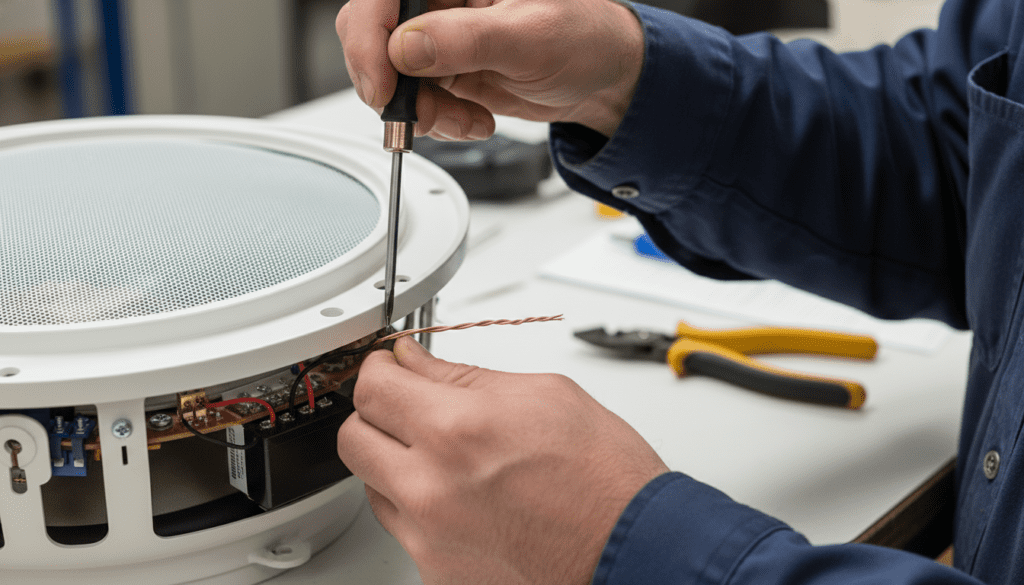
However, almost any standard speaker can be made compatible if you install an external 70V matching transformer between the amplifier and the speaker. This allows you to “tap” the speaker at a specific wattage, making it behave like a native 70V component. In my experience designing commercial audio for retail and warehouse spaces, we often use high-quality bookshelf speakers for specific zones by retrofitting them with Atlas Sound or Bogen transformers.
Key Takeaways: 70V Compatibility Essentials
- Native Compatibility: Only speakers labeled as “70V” or “High Impedance” can be used out of the box.
- The “Workaround”: Standard 8-ohm speakers require an external step-down transformer to function on a 70V line.
- Safety Risk: Connecting an 8-ohm speaker directly to a 70V amp can draw too much current, triggering thermal shutdown in the amplifier.
- Wiring Advantage: 70V systems allow for daisy-chaining dozens of speakers over long distances using thinner 18-gauge wire.
- Wattage Taps: You must manually select the wattage tap on the transformer to determine how loud each speaker will play.
Understanding the Difference: 70V vs. Low-Impedance (8-Ohm)
To understand can any speakers be used with 70v system setups, you have to understand the physics of the “Constant Voltage” system. Standard home audio uses low impedance (usually 4 to 16 ohms). In these systems, the amplifier works hard to push high current through thick wires over short distances.
A 70V system (common in commercial settings) works like a power utility grid. The amplifier steps up the voltage, allowing the signal to travel long distances without significant signal loss. Each speaker then uses a transformer to step that voltage back down to a level the speaker driver can handle.
I’ve seen DIY installers try to save money by using home theater speakers in a restaurant. Without transformers, the first speaker in the chain usually draws all the power and burns out its voice coil within minutes.
How to Use Standard Speakers with a 70V System
If you have a high-quality pair of residential speakers and want to integrate them into a commercial 70V loop, follow these steps. This is the only way can any speakers be used with 70v system logic applies successfully.
Purchase a Matching Transformer
You need a transformer that matches the wattage requirements of your speaker. For example, if you have a 50-watt speaker, look for a transformer with a 30W or 50W primary tap. Popular brands include Quam, JBL Professional, and Crown.
Connect the Speaker to the Secondary Side
The transformer will have two sides. The Secondary side (output) connects directly to the + and – terminals of your 8-ohm speaker. Ensure the polarity is correct to avoid phase cancellation, which makes the bass sound “thin.”
Choose Your Wattage Tap on the Primary Side
The Primary side (input) connects to the 70V line coming from the amplifier. You will see several wires labeled with different wattages (e.g., 5W, 10W, 15W, 30W).
- Select a higher wattage for more volume.
- Select a lower wattage for background music.
- Expert Tip: Always ensure the total sum of all speaker taps does not exceed 80% of the amplifier’s total power rating. This is known as the “Headroom Rule.”
Wire in Parallel (Daisy-Chain)
Unlike 8-ohm systems where you have to worry about series/parallel wiring to maintain impedance, 70V systems are simple. Run one wire from the amp to the first transformer, then from that transformer to the next.
Comparison: Native 70V Speakers vs. Adapted 8-Ohm Speakers
| Feature | Native 70V Speaker | Adapted 8-Ohm Speaker |
|---|---|---|
| Ease of Install | High (Plug and play) | Low (Requires external wiring) |
| Audio Fidelity | Moderate (Commercial Grade) | High (Depends on speaker quality) |
| Cost | Budget-friendly | Can be expensive per unit |
| Weatherproofing | Often built-in | Usually requires extra protection |
| Best Use Case | Offices, Hallways, Retail | High-end Restaurants, Patios |
Why You Shouldn’t “Direct Connect” (The Risks)
We often get asked, “What actually happens if I just hook it up?” If you attempt a direct connection, you are effectively creating a short circuit for the 70V amplifier.
- Impedance Mismatch: A 70V amp expects to see a high impedance (hundreds of ohms). An 8-ohm speaker is a “heavy load.” The amp will try to pour massive amounts of current into that speaker.
- Heat Generation: The amplifier’s output transistors will overheat rapidly. Most modern amps like QSC or Lab Gruppen will go into “Protect Mode,” but older or cheaper units may literally smoke.
- Frequency Distortion: Even if it doesn’t blow immediately, the sound will be muddy. The low frequencies will saturate the output stage, resulting in a “crunchy” sound that ruins the atmosphere of your space.
Calculating Your System Capacity
When determining can any speakers be used with 70v system equipment, you must do some math. We use the “Power Budget” method.
If I am installing a system using a 240W 70V Amplifier, I follow these calculations:
- Apply the 80% Rule: $240W times 0.80 = 192W$. This is my “Safe Ceiling.”
- Tally the Speakers:
* 10 ceiling speakers tapped at 10 Watts each = 100W.
* 4 outdoor speakers tapped at 15 Watts each = 60W.
* 2 “Adapted” 8-ohm bookshelf speakers tapped at 15 Watts = 30W.
- Total Load: $100 + 60 + 30 = 190W$.
- Result: This system is perfectly balanced and will run cool for years.
Practical Advice for DIY Commercial Audio
Through years of troubleshooting failed installs, I’ve developed a few “Golden Rules” for 70V compatibility:
- Check for a Switch: Many modern commercial speakers (like the JBL Control Series) have a physical dial on the back. This dial allows you to switch between 8-Ohm mode and various 70V/100V wattage taps. Always check for this dial before buying external transformers!
- Wire Gauge Matters: For runs under 200 feet, 18/2 oxygen-free copper is fine. For runs over 500 feet, step up to 16-gauge to prevent high-frequency roll-off.
- Use Proper Enclosures: If you are adapting a home speaker for a 70V system in a plenum-rated ceiling (commercial air space), you must house the transformer in a fire-rated junction box to meet building codes.
Frequently Asked Questions
Can I mix 70V and 8-ohm speakers on the same amplifier?
Generally, no. Most amplifiers have dedicated terminals for either 70V or Low-Impedance (4/8 ohm). You cannot use both simultaneously unless the amplifier has independent channels or “Zone” outputs designed for mixed loads.
What happens if I set the wattage tap too high?
If the tap is set to 30W but the speaker is only rated for 15W, the speaker will likely distort and eventually the voice coil will burn out. Always ensure your wattage tap is equal to or lower than the speaker’s continuous power rating.
Is 70V audio “Lower Quality” than 8-ohm audio?
Technically, yes, because the signal passes through two transformers (one at the amp, one at the speaker), which can cause some loss in the very high and very low frequencies. However, for background music and paging in a commercial environment, the difference is negligible.
Do I need special wire for 70V systems?
You don’t need “special” wire, but it is best to use CL2 or CL3 rated 2-conductor wire to stay compliant with fire codes. Since 70V is a high-voltage system, it is subject to different building regulations than standard home theater wiring.
How do I know if my speaker is already 70V compatible?
Look at the back of the speaker for a transformer tap switch or labels like “70V/100V.” If you only see a positive and negative terminal with a rating like “8 $Omega$,” it is a standard low-impedance speaker and requires an external transformer.