Can Audacity Record Speakers? (The Quick Answer)
Yes, Audacity can record speakers directly by capturing the internal audio stream of your computer. On Windows, you use the Windows WASAPI host and a “loopback” input, which allows you to record exactly what you hear without needing an external microphone. For macOS and Linux users, this requires a virtual audio cable like BlackHole or PulseAudio Volume Control since these systems do not provide a native loopback driver.
Key Takeaways for Recording System Audio
- Windows Method: Set the Audio Host to Windows WASAPI and the Recording Device to your primary speakers (Loopback).
- macOS Method: Install a third-party driver like BlackHole to route system audio into Audacity.
- Quality Check: Always record at a 44,100Hz or 48,000Hz sample rate for crystal-clear playback.
- Privacy Warning: Ensure you have permission to record meetings or copyrighted streams to avoid legal issues.
- Zero Latency: Monitoring is usually unnecessary since you are hearing the source through your speakers already.
Why You Might Need to Record Your Speakers
In my years of professional audio editing, I’ve found that recording system audio is one of the most frequent requests from content creators. Whether you are trying to capture a snippet of a webinar, a remote interview via Zoom, or a specific sound effect from a video game, knowing if Audacity can record speakers is a foundational skill.
We often use this method when a direct download of an audio file isn’t available. Instead of using a physical cable to loop your “Line Out” back into your “Line In”—which introduces analog noise—we use digital loopback. This ensures the bit-perfect transfer of data from your sound card directly into the Audacity timeline.
How to Record Speakers on Windows (WASAPI Method)
The most reliable way to answer the question “can audacity record speakers” on a PC is through Windows WASAPI (Windows Audio Session API). This is the most modern protocol provided by Microsoft for high-end audio communication.
Step 1: Configure the Audio Host
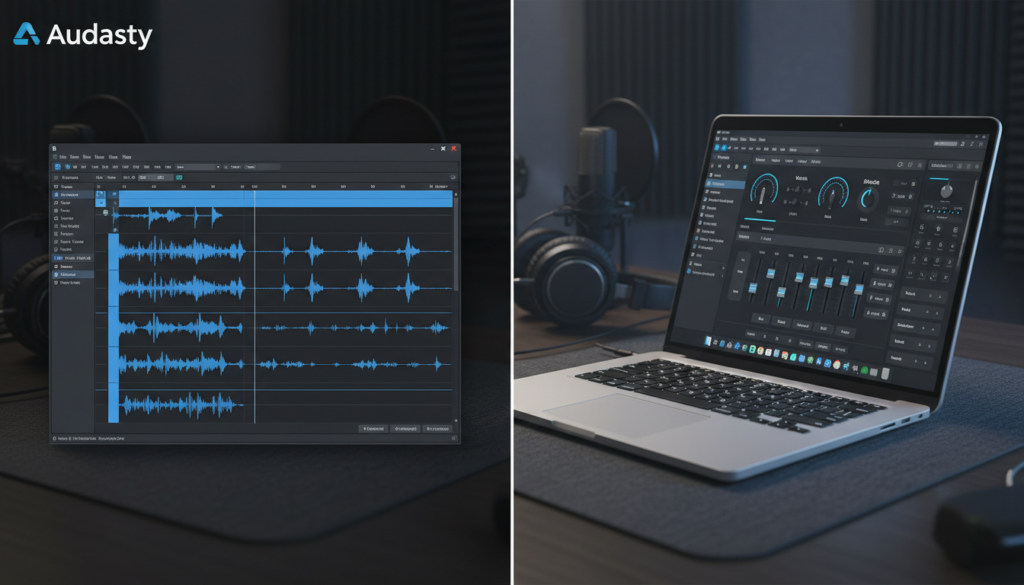
Open Audacity and look at the Audio Setup toolbar (usually located near the top). Click on Host and select Windows WASAPI. This host allows Audacity to “listen” to the data being sent to your output device.
Step 2: Select the Loopback Device
Under the Recording Device dropdown, you must select the device that matches your current speakers or headphones, followed by the word (loopback). For example, if you are using USB headphones, look for Headphones (Realtek Audio) (loopback).
Step 3: Match Your Sample Rates
For a glitch-free recording, ensure your Windows system settings match your Audacity settings.
- Right-click the Speaker Icon in your system tray.
- Select Sound Settings > More Sound Settings.
- Under the Playback tab, right-click your active device and hit Properties.
- In the Advanced tab, check the Default Format (e.g., 24-bit, 48,000Hz).
- Set your Audacity Project Rate to match this number.
Step 4: Execute the Recording
Press the red Record button. Audacity will stay in a “waiting” state until audio actually begins playing from your computer. Start your YouTube video, Spotify track, or Zoom call, and you will see the waveforms appear instantly.
Recording Computer Audio on macOS
Apple prevents apps from recording system audio directly for security and privacy reasons. However, you can bypass this by using a virtual audio bridge. We recommend BlackHole (2ch) as it is open-source and extremely stable on M1, M2, and M3 Silicon chips.
Setting Up the Virtual Bridge
- Download and Install: Install BlackHole from GitHub or their official site.
- Audio MIDI Setup: Open the Audio MIDI Setup app on your Mac (found in Applications > Utilities).
- Create a Multi-Output Device: Click the + icon and select Create Multi-Output Device. Check both your Built-in Output (Speakers) and BlackHole 2ch.
- System Output: Go to your Mac System Settings > Sound and set the output to your new Multi-Output Device. This sends audio to your ears and the virtual driver simultaneously.
Configuring Audacity on Mac
In Audacity, go to Audio Setup and set the Recording Device to BlackHole 2ch. Now, when you play any audio on your Mac, Audacity will catch the stream through the virtual cable.
Audacity Recording Method Comparison
| Feature | Windows WASAPI | macOS BlackHole | Stereo Mix (Legacy) |
|---|---|---|---|
| Setup Difficulty | Very Easy | Moderate | Easy |
| Audio Quality | Digital (Lossless) | Digital (Lossless) | Analog (Noisy) |
| Latency | Extremely Low | Low | Moderate |
| Native Support | Yes (Win 7+) | No (Third-party) | Yes (Hardware Dep.) |
| Primary Use | General Recording | Professional/Mac | Old Hardware |
Troubleshooting: Why Can’t Audacity Record My Speakers?
Even with the right settings, you might encounter the dreaded “Error opening recording device” message. Based on our testing, here are the most common fixes:
The “Silence” Issue
If Audacity records but the waveform is a flat line, you likely selected the wrong loopback device. Ensure you aren’t selecting Microphone (loopback) by mistake. It must be the Output (loopback) device that is currently active.
Software Exclusivity (WASAPI Error)
Some apps (like Tidal or DAWs) use Exclusive Mode, which locks the sound card.
- Go to Sound Settings > Properties > Advanced.
- Uncheck “Allow applications to take exclusive control of this device.”
- Restart Audacity.
Privacy Settings
In Windows 10 and 11, you must grant apps permission to use your “microphone” (which includes loopback streams).
- Go to Privacy & Security > Microphone.
- Ensure “Let desktop apps access your microphone” is toggled ON.
Pro Tips for High-Quality System Audio Capture
To get the most out of your recording, follow these expert-level guidelines we use in our studio:
- Disable System Sounds: Go to your sound control panel and set the sound scheme to “No Sounds.” This prevents annoying “ding” notifications from Windows from ruining your recording.
- Monitor Your Levels: Keep your recording levels between -12dB and -6dB. If the red bars at the top of Audacity hit 0dB, your audio will “clip,” resulting in permanent distortion.
- Use WAV for Export: Always export your initial recording as a WAV (Microsoft) signed 16-bit PCM or 32-bit Float. Avoid exporting directly to MP3 until your final edit is complete to preserve fidelity.
- Check the “Software Playthrough” Setting: Ensure Transport > Transport Options > Software Playthrough is turned OFF. If it’s on, you will hear a delayed echo of what you are recording, which can be incredibly distracting.
Frequently Asked Questions
Can Audacity record speakers and a microphone at the same time?
By default, Audacity can only record from one device at a time. To record both, you need to use a Multi-Device setup (Mac) or a software mixer like Voicemeeter Banana (Windows) to combine your mic and system audio into a single virtual track.
Is it legal to record speakers with Audacity?
Recording for personal use (time-shifting) is generally considered “Fair Use” in many regions, but distributing copyrighted material (like music or movies) is illegal. Always check local laws and the terms of service of the platform you are recording from.
Why is my recording speeded up or slowed down?
This happens due to a Sample Rate Mismatch. If your system is set to 48,000Hz but Audacity is set to 44,100Hz, the audio will play back at the wrong speed. Ensure both numbers match in the Project Rate at the bottom left of the screen.
Does recording speakers reduce audio quality?
Using Windows WASAPI or BlackHole provides a digital-to-digital transfer. This means there is zero quality loss compared to the original audio playing through your system, provided your levels are set correctly.