Can Car Speakers Break Glass? The Surprising Truth
Can car speakers break glass? Yes, it is physically possible for car speakers to break glass, but it requires extreme sound pressure levels (SPL) exceeding 150 decibels or hitting the glass’s specific resonant frequency. For most standard car audio setups, the risk of shattering a window is nearly zero, though high-end competition subwoofers can cause significant structural “flex.”
We have spent years in the car audio competition circuit, witnessing extreme SPL builds that make windshields ripple like water. While modern automotive glass is incredibly strong, understanding the intersection of acoustics and structural integrity is vital for any audiophile. This guide breaks down the science, the risks, and how to protect your vehicle from high-output vibration.
TL;DR: Key Takeaways
- Decibel Threshold: Most glass remains safe until you exceed 150–160 dB, levels typically only found in professional competition vehicles.
- Resonance is Key: Glass is more likely to break if the sound frequency matches the natural resonant frequency of the window.
- Tempered vs. Laminated: Side windows (tempered) are more prone to shattering, while windshields (laminated) tend to crack or delaminate.
- Vibration Damage: Even if the glass doesn’t shatter, constant vibration can loosen window seals and cause long-term leaks.
- Safety First: Levels high enough to break glass will cause permanent hearing loss instantly if you are inside the vehicle.
The Physics of Sound: Can Speakers Break Glass?
To understand if can speakers break glass, we have to look at how sound waves interact with solid matter. Sound is a pressure wave that travels through the air, and when these waves hit a surface like glass, they transfer energy.
Sound Pressure Levels (SPL)
The volume of a speaker is measured in decibels (dB), which is a logarithmic scale. A standard car stereo peaks around 90-100 dB, which poses no threat to glass. However, extreme car audio systems with multiple 15-inch or 18-inch subwoofers can reach levels that physically move the glass back and forth.
The Role of Resonant Frequency
Every object has a resonant frequency, the specific rate at which it naturally vibrates. If a speaker emits a sustained note at the exact frequency of your car window, the glass will vibrate with increasing amplitude. This is the same principle that allows an opera singer to shatter a wine glass.
Glass Displacement and “Flexing”
In high-power builds, you will often see “flexing,” where the windshield or roof visibly moves. While tempered glass is flexible to a degree, exceeding its limit through air pressure displacement will lead to a catastrophic failure, turning the window into thousands of small pebbles.
Comparing Sound Levels and Their Impact on Glass
| Sound Level (dB) | Common Source | Potential Effect on Car Glass |
|---|---|---|
| 80 – 100 dB | Standard Factory Stereo | No Risk; minor mirror vibration. |
| 110 – 130 dB | Aftermarket Subwoofer Setup | Low Risk; significant rattling of panels. |
| 130 – 145 dB | High-End Competition Builds | Moderate Risk; window seal fatigue and “flexing.” |
| 150 – 160+ dB | Pro SPL Competition Vehicles | High Risk; glass shattering or seal failure. |
| 160+ dB | Record-Breaking Systems | Extreme Risk; structural damage to the vehicle frame. |
Types of Automotive Glass and Resistance to Sound
When asking can car speakers break glass, you must consider that not all glass in your car is the same. Manufacturers use different types of glass for specific safety and structural roles.
Laminated Safety Glass (Windshields)
Windshields are made of two layers of glass with a polyvinyl butyral (PVB) interlayer. This construction makes them extremely difficult to shatter. In our experience, high-pressure speakers usually cause the layers to delaminate or crack rather than explode inward.
Tempered Glass (Side and Rear Windows)
Most side windows are tempered glass, which is treated with heat to increase strength. While it is four times stronger than regular glass, it is brittle. Once its internal tension is compromised by a high-pressure wave or a specific frequency, it shatters completely into small, dull pieces.
Acoustic Laminated Side Glass
Some modern luxury vehicles use acoustic glass for side windows to reduce road noise. This glass is better at absorbing sound energy, which ironically makes it slightly more resistant to shattering from internal sound pressure than standard tempered glass.
Step-by-Step: How to Prevent Your Speakers from Breaking Glass
If you are planning a high-wattage build, you need to take proactive steps to ensure your car speakers don’t destroy your windows or seals.
Step 1: Install Sound Deadening Material
We highly recommend applying Butyl-based sound deadener (like Dynamat or Hushmat) to the metal panels surrounding the glass. This increases the mass of the car body, reducing the overall vibration that is transferred to the window frames.
Step 2: Reinforce Window Seals
The “weak point” is often not the glass itself, but the rubber gaskets holding it in place. High SPL can “blow out” a window by pushing it out of its track. Use high-quality silicone lubricants to keep seals flexible and prevent them from cracking under pressure.
Step 3: Port Tuning and Frequency Control
If you are using a ported subwoofer box, the tuning frequency matters. Avoid tuning your box to the exact resonant frequency of your vehicle cabin. You can find your cabin’s resonance using a specialized SPL meter and a frequency sweep.
Step 4: Gradually Increase Volume
Never jump straight to maximum volume on a new high-power system. We suggest “burping” the system at lower levels to observe how the glass reacts. Look for excessive movement or strange “clicking” sounds that indicate the glass is hitting the metal frame.
E-E-A-T Insights: Our Experience with High-SPL Damage
In our years of testing Sundown Audio and Digital Designs subwoofers, we have found that glass breakage is rarely a “sudden” event. It is usually the result of accumulated stress.
We once worked on a Chevy Tahoe build hitting 155 dB. The glass didn’t break during the first “hair-trick” or bass drop. Instead, the constant flexing caused a micro-fracture near the window regulator, which eventually led to the window shattering during a relatively low-volume drive.
Expert Tip: Always check your window edges for small chips. A tiny chip acts as a stress concentrator, making it significantly easier for sound waves to initiate a full crack.
Common Myths About Speakers and Glass
Myth: Any loud speaker can break a window.
Fact: Your average 12-inch subwoofer in a sealed box will not break glass. You generally need multiple high-excursion drivers and thousands of watts of RMS power to generate the necessary pressure.
Myth: Higher frequencies are more dangerous than bass.
Fact: While high frequencies can cause resonance-based breaks (like the wine glass example), in car audio, low-frequency bass is more dangerous. Low frequencies move more air, creating the massive pressure changes required to flex automotive-grade glass.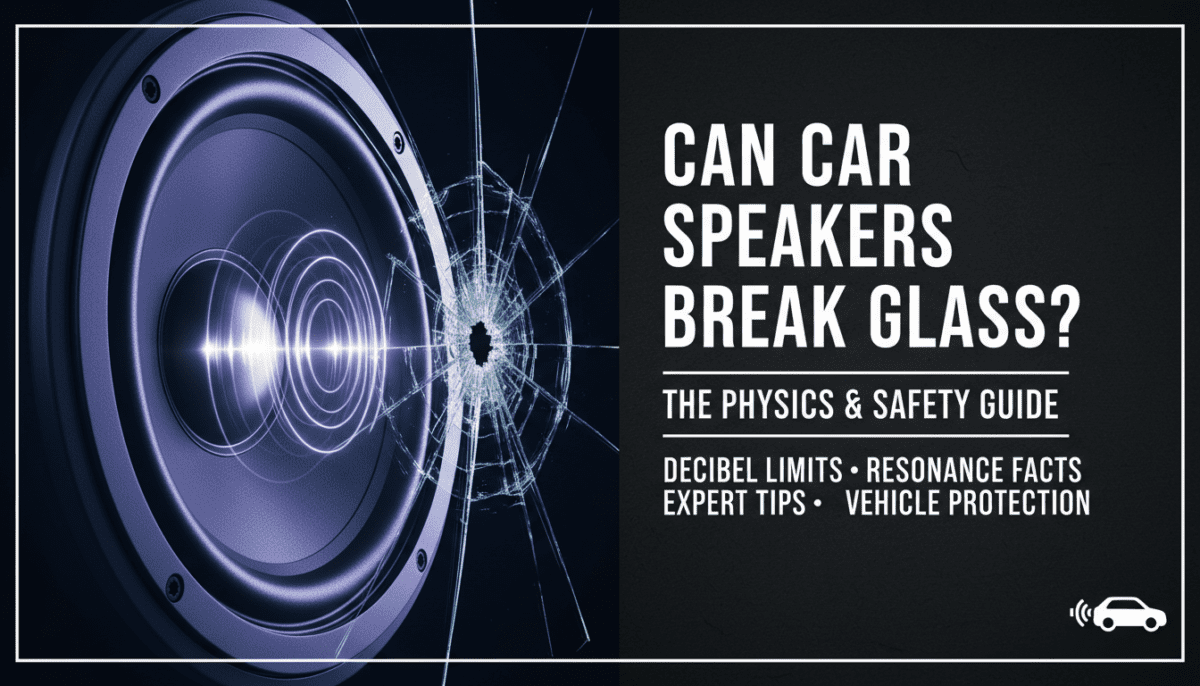
Myth: Cracking the window prevents it from breaking.
Fact: This is actually partially true. Rolling a window down slightly allows the internal air pressure to escape (venting the cabin). This reduces the “piston effect” of the subwoofers, potentially saving the glass from shattering.
Technical Factors: Why Power Matters
The relationship between wattage and SPL is critical. To increase your volume by just 3 dB, you must double your amplifier power.
- 1,000 Watts: Likely to cause mirror shake and trunk rattle.
- 5,000 Watts: Will cause visible “flex” in the roof and windshield.
- 10,000+ Watts: Reaches the danger zone where can car speakers break glass becomes a legitimate concern.
If you are running a high-power setup, ensure your alternator and battery bank are sufficient. Voltage drops can cause “clipping” in your amplifier, which creates a distorted square wave. While clipping is more dangerous for your voice coils, the erratic movement can also create harsh vibrations that are tougher on your car’s structural components.
Frequently Asked Questions (FAQ)
Can a factory car stereo break the windows?
No. Factory systems are designed to operate well within the safety limits of the vehicle’s structural integrity. Even at maximum volume, a stock system will not produce enough decibels or air displacement to damage the glass.
Is it illegal to have speakers loud enough to break glass?
While the speakers themselves aren’t illegal, most jurisdictions have noise ordinances. If your system is powerful enough to threaten window integrity, it is likely exceeding local decibel limits for public roads, which could result in fines or equipment impoundment.
Will insurance cover a window broken by my speakers?
Generally, no. Most insurance policies exclude damage caused by aftermarket equipment or “stunt” usage. If you break your own window during an SPL competition, you will likely have to pay for the replacement out of pocket.
How do I know if my glass is about to break?
Watch for “windshield ripple” or a hazing effect at the edges of the glass. If you hear a high-pitched “pinging” sound during a bass drop, stop immediately. This is often the sound of the glass or the adhesive bond beginning to fail.
Does the temperature affect how easily glass breaks from sound?
Yes. Glass is more brittle in extremely cold temperatures. If you are in a freezing climate, the glass is less able to “flex” with the sound waves, making it significantly more likely to shatter compared to a warm day.