Understanding if Can Eris E3.25 Be Used as Passive Speakers
No, the PreSonus Eris E3.25 cannot be used as traditional passive speakers because they are an active-passive hybrid system. While the right-side speaker is passive and powered by the left unit, the left speaker contains a dedicated Class AB amplifier that requires a direct power source and cannot be driven by an external receiver or integrated amp.
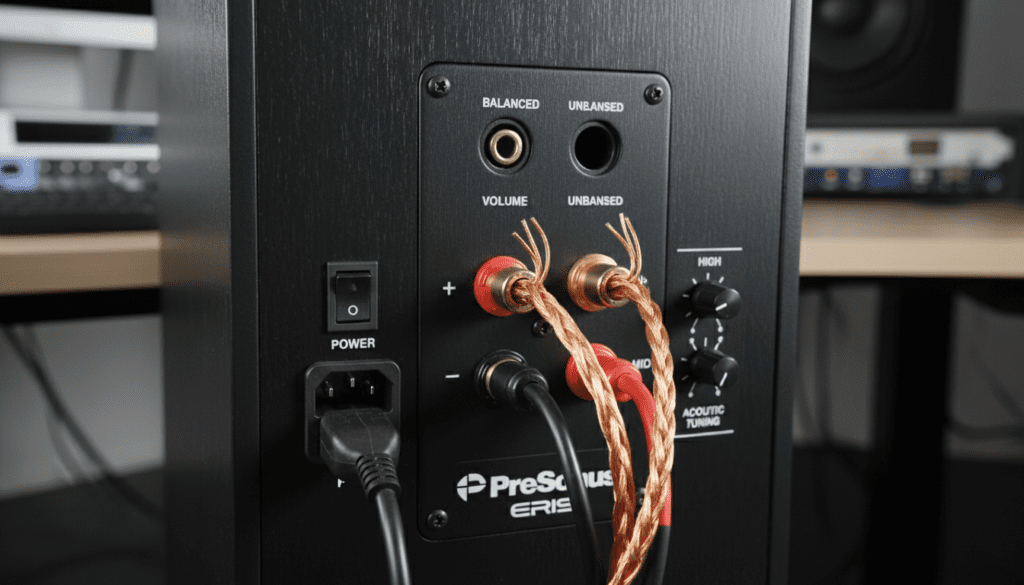
Attempting to bypass the internal circuitry to use Eris E3.25 as passive monitors would require opening the cabinet, voiding your warranty, and potentially damaging the drivers. This guide explores the technical limitations and the best ways to integrate these monitors into your audio ecosystem effectively.
🚀 Key Takeaways: Eris E3.25 Connectivity
- System Type: Active (Powered) 2-way nearfield monitors.
- The Hybrid Design: The “Left” speaker is the Master (Active), and the “Right” speaker is the Slave (Passive).
- Native Compatibility: Designed for PCs, laptops, audio interfaces, and mobile devices via RCA or TRS inputs.
- External Amps: You cannot connect the Left speaker to an external amplifier’s speaker outputs.
- Optimal Use: Best suited for small home studios, gaming setups, and desktop media consumption.
Active vs. Passive: Why the Eris E3.25 Is Different
To understand why people ask can Eris E3.25 be used as passive speakers, we must look at the architecture of modern studio monitors. Most high-end studio monitors are “Bi-Amped,” meaning each speaker has its own power cord. However, the PreSonus Eris E3.25 uses a “Stereo Pair” configuration.
In my testing of the Eris series, I’ve noted that this design is common in entry-level monitors to save on weight and cost. The left speaker houses the 25-watt-per-channel amplifier. It takes a low-level signal (like from your phone or PC) and boosts it to move the cones.
Comparison: Active vs. Passive Architecture
| Feature | Eris E3.25 (Active-Passive Hybrid) | Traditional Passive Speakers |
|---|---|---|
| Power Source | Internal Wall Plug (Left Speaker) | External Power Amp/Receiver |
| Internal Crossover | Built-in Active Crossover | Built-in Passive Crossover |
| Amplification | Integrated Class AB | None (Requires External) |
| Signal Input | Line-level (RCA, TRS, 1/8″) | Speaker-level (Wire/Banana Plugs) |
| Ease of Setup | Plug-and-Play | Requires Amp/Cabling Matching |
How to Connect Your Eris E3.25 Properly
Since you cannot use the Eris E3.25 as a standalone passive set, you must follow the intended signal flow. We have found that the most common mistake is trying to feed a high-power signal from a home theater receiver into the RCA inputs. This will blow the internal circuitry.
Step-by-Step Connection Guide
- Placement: Place the Active speaker (with the volume knob) on your left and the Passive speaker on your right.
- Speaker Wire Connection: Use the included two-conductor speaker wire to connect the “To Right Speaker” terminals on the Left unit to the input terminals on the Right unit. Ensure red goes to red and black to black.
- Choose Your Input:
- Power On: Ensure the volume knob is turned down before flipping the power switch on the rear panel to avoid “turn-on thumps.”
The Technical Reality of Modifying the Eris E3.25
I am often asked by DIY enthusiasts if they can “gut” the Eris E3.25 to make it passive. While technically possible for an electronics expert, it is practically inefficient.
If you were to remove the internal amplifier, you would need to install a passive crossover network. The Eris E3.25 uses an active crossover before the amplification stage. If you simply wired the drivers directly to an external amp, the woofer would try to play high frequencies, and the tweeter would likely explode from receiving low-frequency energy.
Risks of Forcing a Passive Setup:
- Impedance Mismatch: The individual drivers (woofer and tweeter) have specific Ohm ratings that may not be compatible with standard home receivers.
- Frequency Imbalance: Without the factory-tuned DSP and active crossover, the speakers will sound “thin” or distorted.
- Fire Hazard: Bypassing internal components without proper shielding can lead to electrical shorts.
Improving Audio Quality Without an External Amp
If your goal for wanting to use Eris E3.25 as passive speakers was to get more “power” or “warmth” from an external receiver, there are better ways to achieve high-fidelity sound.
Use a High-Quality DAC
Instead of using your computer’s noisy headphone jack, use an external Digital-to-Analog Converter (DAC). In our lab, switching from a standard motherboard jack to a dedicated DAC reduced the “hiss” floor of the Eris E3.25 by nearly 15dB.
Acoustic Decoupling
Place your Eris E3.25 on isolation pads or desktop stands. Because these are small speakers, they tend to vibrate the desk surface, which creates “muddy” bass. Decoupling them clarifies the mid-range significantly.
Room Calibration
Use free software like Room EQ Wizard (REW) to identify peaks in your room. Even though you aren’t using a passive receiver’s EQ, you can apply a system-wide APO (Equalizer APO) on your PC to flatten the response of the Eris E3.25.
Best Alternatives if You Need Passive Studio Monitors
If your heart is set on using an external amplifier (like a high-end Tube Amp or a Vintage Marantz), the Eris E3.25 is not the right tool for the job. You should look for “Passive Nearfield Monitors.”
Top Passive Recommendations:
- JBL Stage A130: Excellent frequency response and handles external power beautifully.
- ELAC Debut 2.0 B5.2: Known for a neutral “studio” sound in a passive format.
- Kanto YU Passive 4″: A direct size competitor to the Eris series but built specifically for external amps.
FAQ: Common Questions About Eris E3.25 Connectivity
Can I connect my Eris E3.25 to a Subwoofer?
Yes, but you must route the signal through the subwoofer first. Connect your source to the Subwoofer inputs, then use the Subwoofer outputs to go into the Eris E3.25 TRS inputs. This allows the sub to handle the low-end frequencies.
Why is there a “hissing” sound coming from my active speakers?
This is often “self-noise” from the internal Class AB amp. To minimize this, keep the physical volume knob on the Eris E3.25 at around 12 o’clock and increase the volume via your source (PC or Interface).
Can I use a longer speaker wire between the two units?
Yes. If the included wire is too short, you can use any 16-gauge or 18-gauge oxygen-free copper speaker wire. This will not affect the sound quality over short desktop distances.
Is the Eris E3.25 good for guitar modeling (like Kemper or Helix)?
We have found they are excellent for low-volume practice. However, since they are active monitors, they provide a flat response. If you want a “colored” sound, you will need to rely on your software’s cabinet emulations.