Can GBA Speakers Catch Fire? The Truth About Handheld Safety
The short answer is: No, GBA speakers cannot catch fire under normal operating conditions. While the speaker itself is a passive component with very low voltage, peripheral issues like leaking electrolytic capacitors, short-circuited audio amplifiers, or faulty lithium-polymer battery mods can generate enough heat to melt plastic or cause smoke. If you smell a “burning” scent or your handheld feels hot to the touch, the danger usually lies in the power delivery system or aging internal components rather than the speaker cone itself.
TL;DR: Quick Safety Summary
- Primary Risk: Aging electrolytic capacitors (C38, CP1) leaking or shorting.
- Modding Danger: Poorly soldered audio amplifiers (like CleanAmp) drawing too much current.
- Speaker Heat: Passive speakers do not generate heat; however, a shorted voice coil can draw excess power if the amp is failing.
- Battery Safety: LiPo battery mods are the only component in a GBA capable of a true “thermal runaway” fire.
- Prevention: Replace 20-year-old capacitors and ensure all solder joints are clean and insulated.
Understanding the Electronics: Can GBA Speakers Catch Fire?
To understand why the question “can gba speakers catch fire” is common among enthusiasts, we have to look at the Game Boy Advance power architecture. The GBA operates on approximately 3 volts (from two AA batteries), which is stepped up or down internally to 3.3V and 5V for different components.
In a standard electrical circuit, fire requires high current and high resistance. The GBA speaker is an 8-ohm or 32-ohm transducer. Even if the audio amplifier (the U4 chip on the motherboard) failed completely and sent 5V directly to the speaker, the resulting current would likely be less than 0.6 amps. This is enough to pop the speaker coil and produce a tiny puff of smoke, but it is physically insufficient to ignite the ABS plastic shell of the console.
The Real Culprit: Component Degradation
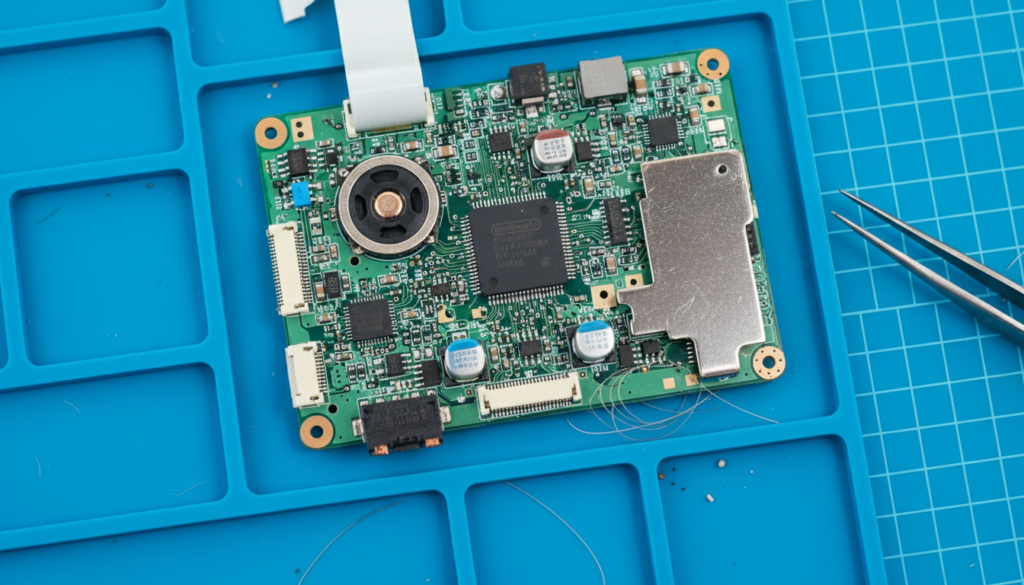
I have refurbished hundreds of AGB-001 and AGS-101 units. In my experience, what users perceive as a “fire risk” is actually component outgassing. When a capacitor fails, it releases a fishy, acrid smell. If you are using an original GBA from 2001, your capacitors are now over two decades old. They can leak electrolyte onto the PCB, causing trace corrosion and minor electrical shorts that generate localized heat.
Comparing GBA Audio Components and Safety Risks
| Component | Heat Risk Level | Common Failure Mode | Safety Advice |
|---|---|---|---|
| OEM Speaker | Very Low | Voice coil burnout (silent) | Replace if sound is crackly or quiet. |
| Aftermarket 1W/2W Speaker | Low | High power draw on stock amp | Ensure amp can handle the lower impedance. |
| Electrolytic Capacitors | Medium | Electrolyte leakage / Shorting | Recap the board every 15–20 years. |
| Audio Amp Mods | High | Improper soldering / Bridge | Use Kapton tape to insulate the mod. |
| LiPo Battery Mods | CRITICAL | Puncture / Overcharging | Only use protected cells with TP4056 chips. |
Step-By-Step Guide: Inspecting Your GBA for Fire Hazards
If you are worried that your GBA speakers might catch fire or if you notice the unit getting unusually warm, follow this professional inspection protocol.
Step 1: Disassemble and Identify the “Smell Test”
Remove the six Tri-wing screws from the back of the shell. Once the PCB is exposed, use your nose. A healthy GBA should smell like neutral plastic. If you smell burnt sugar or dead fish, you have a leaking capacitor or a scorched trace.
Step 2: Inspect the Audio Capacitor (C38)
The C38 capacitor is responsible for filtering the audio signal. Look for:
- Bulging: The top of the metal can should be flat.
- Residue: Crusty green or brown gunk at the base of the component.
- Corrosion: Dull, grey solder joints instead of shiny ones.
Step 3: Check Your Modded Power Rails
If you have installed a FunnyPlaying IPS screen or an audio amplifier, check where you sourced your power. High-draw mods can overheat the inductor (L1) or the power switch. If the area around the power switch feels hot during play, it indicates high resistance due to dirt. Clean the internal contact of the switch with 99% Isopropyl Alcohol (IPA).
Step 4: Verify Speaker Impedance
Using a multimeter, set it to the Ohms (Ω) setting. Touch the probes to the two solder pads on the back of the speaker.
- OEM Speakers should read near 8 ohms.
- If the reading is 0 ohms, the speaker is shorted. While this won’t cause a fire, it will stress the audio amp chip, causing it to heat up significantly.
Why Audio Mods Increase the Risk
Many users ask “can gba speakers catch fire” specifically after installing a “Loud Mode” or CleanAmp module. These mods bypass the original low-power audio circuit to provide 200% or 300% more volume.
- Current Draw: These amps pull more current from the VCC rail. If your wiring is too thin or your solder joints are “cold,” the resistance at the connection point can generate heat.
- Lack of Insulation: Many DIYers leave the amp module floating inside the shell. If the module touches the metal shielding of the cartridge slot, it creates a direct short. Always use Kapton tape (which is heat resistant) to secure these modules.
- Speaker Mismatch: Installing a 4-ohm speaker on a circuit designed for 8-ohm or 32-ohm loads forces the amplifier to work harder, leading to thermal throttling or component failure.
Expert Tips for a Safe Game Boy Experience
In my years of modding, I have found that safety is a byproduct of cleanliness. Here is my “Safety First” checklist for any GBA owner:
- Use High-Quality Batteries: If you aren’t using a LiPo mod, use Eneloop NiMH rechargeables. They have internal venting and are much safer than cheap alkaline batteries that leak acid.
- The “Touch Test”: After playing for 30 minutes, feel the back of the console near the “B” button (where the CPU and Amp are). It should be room temperature. If it’s warm like a modern smartphone, you likely have a short circuit or a failing voltage regulator.
- Fuse Replacement: The GBA has two internal fuses (F1 and F2). If you ever accidentally bridge a connection, these should blow to prevent a fire. Never “bypass” a fuse with a blob of solder. If a fuse blows, find the short, fix it, and replace the fuse with a 0.5A 0603 surface mount fuse.
Frequently Asked Questions
Can a GBA catch fire if left on overnight?
It is extremely unlikely. The GBA draws very little power. However, if you are using an AC adapter mod or a USB-C charging mod, a failure in the charging circuit could cause a fire. Always turn off vintage electronics when not in use.
Why does my GBA speaker smell like it’s burning?
This is usually caused by dust or hair trapped against the speaker’s voice coil or a leaking capacitor (C38) nearby. The “burnt” smell is often the electrolyte fluid being heated by the surrounding circuitry.
Are aftermarket GBA speakers safer than the originals?
Modern replacement speakers from reputable brands like FunnyPlaying or RetroSix are very safe. They often use better materials than the 20-year-old paper cones found in original units. The risk only increases if you add an active amplifier without proper insulation.
Does an IPS screen make the speaker more likely to burn out?
An IPS screen draws significantly more power than the original non-backlit screen. This puts more stress on the entire power management system. While it won’t directly cause the speaker to catch fire, it increases the overall internal temperature of the console, which can accelerate the failure of old capacitors.
What should I do if I see smoke coming from my GBA?
Immediately remove the batteries. Do not use water, as this is an electrical fire (though small). Once the power source is removed, the “fire” will stop instantly because the GBA does not have enough stored energy to maintain a flame without a battery. Inspect the PCB for charred components before attempting to power it on again.