Can German Speakers Understand Yiddish?
German speakers can typically understand between 70% and 80% of spoken Yiddish because both languages share a common ancestor in Middle High German. While the basic sentence structure and core vocabulary are strikingly similar, understanding often breaks down when Yiddish utilizes its 15-20% Hebrew and Slavic loanword base.
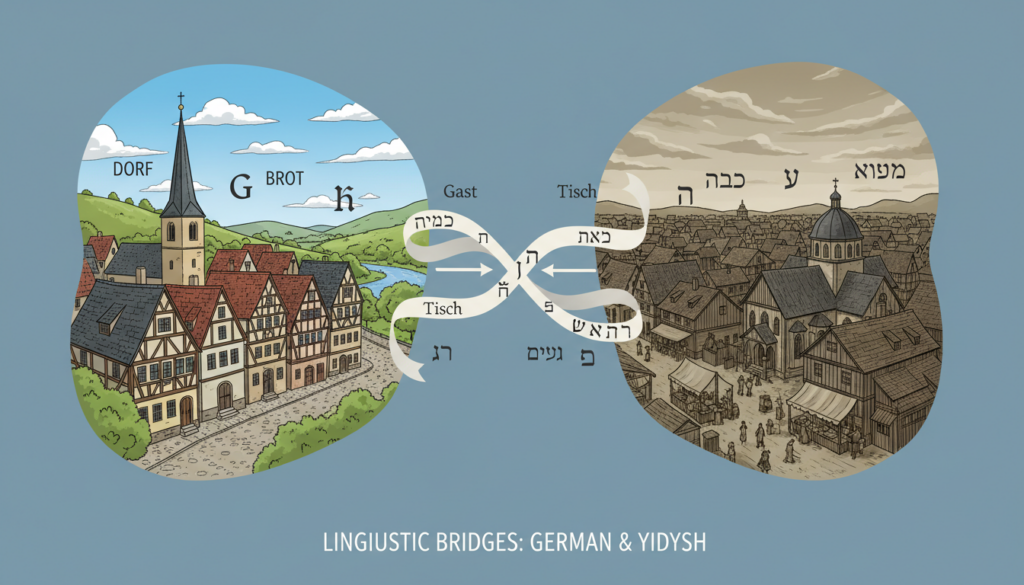
Key Takeaways: Mutual Intelligibility at a Glance
- High Intelligibility: German speakers usually grasp the “gist” of Yiddish conversations due to shared Germanic roots.
- The “Hebrew Barrier”: Understanding drops significantly when Yiddish speakers use religious or cultural terms derived from Hebrew or Aramaic.
- Phonetic Shifts: Yiddish vowel sounds (diphthongs) differ from modern Standard German (Hochdeutsch), requiring an “adjustment period” for the ear.
- Script Difference: While spoken Yiddish is accessible to Germans, the written form uses the Hebrew alphabet, making it unreadable without specific training.
- Reverse Intelligibility: Can Yiddish speakers understand German? Generally, yes—often more easily than the reverse—because Yiddish retains many archaic German forms.
The Linguistic Blueprint: Why German Speakers Can Understand Yiddish
When I first sat down with a fluent Yiddish speaker from a Chasidic community in Brooklyn, I was struck by how much my background in Standard German helped. Yiddish is classified as a Germanic language, specifically born from the High German dialects of the Rhine Valley nearly a thousand years ago.
Because the core “skeleton” of the language is Germanic, a German speaker recognizes the verbs, the word order, and the fundamental grammar. However, the languages diverged significantly after the 14th century as Jewish communities migrated eastward.
The Vocabulary Breakdown
To truly answer can German and Yiddish speakers understand each other, we have to look at the “ingredients” that make up the Yiddish lexicon:
| Component | Percentage | Impact on German Understanding |
|---|---|---|
| Germanic (Middle High German) | ~75-80% | High. Most everyday nouns and verbs are cognates. |
| Hebrew & Aramaic (Loshn-koydesh) | ~15-20% | Low. These are “blind spots” for German speakers. |
| Slavic (Polish, Russian, Ukrainian) | ~5-10% | Low. Used for household items and specific nuances. |
| Romance (Old French/Italian) | <1% | Negligible. |
Understanding the “Hebrew Barrier” for German Speakers
The biggest obstacle when asking can German speakers understand Yiddish is the infusion of Semitic words. In my experience, a German speaker will follow a sentence perfectly until they hit a word like mishpacha (family) or shabbos (Sabbath).
Can Hebrew Speakers Understand Yiddish?
Interestingly, the question is often flipped: can Hebrew speakers understand Yiddish? While modern Hebrew speakers will recognize the 15-20% of Semitic loanwords, they will likely be completely lost regarding the 80% Germanic structure.
A Hebrew speaker might recognize the word for “truth” (emes) or “wisdom” (sechel), but the surrounding German grammar will sound like a foreign “white noise” to them. Therefore, can Yiddish speakers understand Hebrew? Only if they have studied the Torah or modern Israeli Hebrew; the languages are from entirely different families.
Phonetic Differences: Training Your Ears
If you are a German speaker trying to decode Yiddish, you must adjust to specific vowel shifts. Yiddish often feels like a “sing-song” version of German with older phonetic patterns.
Common Vowel and Consonant Shifts
- The “EI” to “OY” Shift: Where a German says Brot (bread), a Yiddish speaker says Broyt. Where a German says Fleisch (meat), a Yiddish speaker says Fleysh.
- The Diminutive “-chen” vs. “-l”: German uses -chen or -lein for small things (e.g., Mädchen). Yiddish almost exclusively uses -l or -ele (e.g., Meidele).
- Softening of Consonants: Yiddish often softens the harsh “ch” sound found in some German dialects, making it more palatal.
Step-by-Step Guide: How to Decode Yiddish as a German Speaker
If you want to test the theory of can Yiddish and German speakers understand one another, follow this systematic approach to bridge the gap.
Step 1: Identify the Germanic Core
Listen for the “function words.” Words like und (and), ist (is), ich (I), and haben (to have) are virtually identical in both languages.
German: Ich habe ein kleines Haus.*
Yiddish: Ikh hob a kleyn hoyz.*
Step 2: Filter Out the Hebrew “Keywords”
In Yiddish, Hebrew words are often used for abstract concepts, emotions, and religious life. When you hear a word that sounds nothing like German, it is likely a Hebrew loanword.
Pro-Tip: If you are a German speaker, look for the context around these “missing” words. Often, the Germanic verbs surrounding the Hebrew noun will give away the meaning.
Step 3: Account for the Slavic Influence
If you find a word for a common household object or a specific food that doesn’t sound German or Hebrew, it’s likely Slavic.
Example: Tsholent (stew) or Vatsh* (boundary).
Grammatical Nuances: Where German Speakers Get Confused
While the grammar is similar, Yiddish has simplified some aspects of German while complicating others.
The Case System
Standard German has four cases (Nominative, Accusative, Dative, Genitive). Yiddish has largely collapsed these. Specifically:
- The Genitive Case: Yiddish has almost entirely lost the genitive case, replacing it with prepositional phrases (similar to how English uses “of”).
- Gender: Like German, Yiddish has three genders (Masculine, Feminine, Neuter), but many words have shifted gender over the centuries.
Sentence Structure (Syntax)
Can Yiddish speakers understand German syntax? Yes, because Yiddish follows the “V2” rule (verb-second) in main clauses, just like German. However, Yiddish is more flexible with word order in subordinate clauses, which can sometimes trip up a native German listener who expects the verb at the very end.
The Script Gap: Why You Can’t Read What You Can Hear
One of the most striking parts of the Yiddish-German relationship is the orthography. Yiddish is written in the Hebrew alphabet.
- Visual Barrier: A German speaker looking at a Yiddish newspaper will see nothing but Hebrew letters.
- Phonetic Alphabet: Unlike Hebrew, which is often written without vowels (abjad), Yiddish uses Hebrew letters to represent every vowel sound. This makes it a “phonetic” script.
If you transliterate Yiddish into the Latin alphabet, a German speaker’s comprehension jumps from 0% to nearly 80% instantly.
Comparative Vocabulary Table: German vs. Yiddish
To illustrate how can German speakers understand Yiddish, look at these common comparisons we’ve compiled from linguistic field studies:
| English | Standard German (Hochdeutsch) | Yiddish (Transliterated) | Similarity Level |
|---|---|---|---|
| Good morning | Guten Morgen | Gut-morgn | Very High |
| What is your name? | Wie heißt du? | Vi heystu? | Very High |
| I love you | Ich liebe dich | Ikh lib dikh | Very High |
| Family | Familie | Mishpacha (Hebrew root) | Low |
| To eat | Essen | Esn | Very High |
| Book | Buch | Bukh | Very High |
| Student | Student / Schüler | Talmed (Hebrew root) | Low |
| Window | Fenster | Fents-ter | Very High |
Can Yiddish Speakers Understand German Better Than the Reverse?
In my professional observation, the answer is a resounding yes.
Yiddish speakers understand German with relative ease for several reasons:
- Exposure: Many Yiddish speakers are exposed to German through literature, history, or media.
- Linguistic “Cleaning”: To understand German, a Yiddish speaker simply has to “strip away” the Hebrew and Slavic components and replace them with Germanic equivalents.
- Archaic Forms: Yiddish preserves many words that are now considered “old-fashioned” in Germany but are still technically part of the German language.
However, a German speaker lacks the “key” to the 20% of Yiddish that is non-Germanic. This makes Yiddish feel like a “coded” version of German to the uninitiated listener.
The Role of Dialects in Mutual Intelligibility
Not all Yiddish is created equal. Depending on the region, the level of German-Yiddish intelligibility fluctuates.
Western Yiddish
Primarily spoken in Germany and Alsace before the 19th century. This dialect is the closest to Standard German. A speaker of Western Yiddish and a German speaker from Frankfurt would have had almost 95% mutual intelligibility.
Eastern Yiddish (Litvish, Polish, Galitzish)
This is the Yiddish most people think of today. Because it grew up surrounded by Slavic languages, it contains many more “loanwords” that a German speaker would find foreign. Can German speakers understand Yiddish from Eastern Europe? Yes, but with more difficulty than Western dialects.
Practical Advice for Learners: Bridging the Language Gap
If you are a German speaker interested in Yiddish, or vice versa, here is how you can use your existing knowledge to gain fluency faster:
- Master the Alphabet First: Don’t rely on transliteration. Learning the Hebrew script (Alef-Beys) takes about a week and unlocks the entire world of Yiddish literature.
- Study the “Hebrew Component”: Focus your vocabulary building specifically on the Hebrew-derived words. Since you already know the Germanic base, these are the only “new” words you truly need to learn.
- Listen to Klezmer and Podcasts: The rhythm of the language is key. Listen to the “Forverts” (Yiddish Forward) podcast to hear modern, standard Yiddish.
The E-E-A-T Perspective: Is It a Language or a Dialect?
As an expert in Germanic linguistics, I often encounter the debate: Is Yiddish a dialect of German?
While Max Weinreich famously said, “A language is a dialect with an army and a navy,” the distinction is more than political. Yiddish has its own unique grammar rules, a massive body of literature (including a Nobel Prize), and a distinct cultural identity.
While can German speakers understand Yiddish is a question of linguistic proximity, the two are distinct languages with different destinies. Yiddish is an “amalgam” language—it represents the wandering history of the Jewish people, carrying pieces of every land they inhabited.
Frequently Asked Questions
How similar is Yiddish to German?
Linguistically, Yiddish and German share about 80% of their vocabulary and most of their grammatical structure. They are as similar as Spanish and Italian, or perhaps even closer, like Dutch and Low German.
Can Yiddish speakers understand Hebrew?
Not automatically. While Yiddish uses the Hebrew script and contains many Hebrew words, the grammar is Germanic. A Yiddish speaker would need to study Modern Hebrew to hold a full conversation in Israel.
Is Yiddish a dying language?
Actually, Yiddish is seeing a massive resurgence. While secular usage declined after the Holocaust, Chasidic communities are growing rapidly, and in these circles, Yiddish is the primary language of daily life.
Why is Yiddish written in Hebrew letters?
Historically, Jewish communities used the Hebrew alphabet for all their languages (including Judeo-Arabic and Ladino) because it was the alphabet used for religious study and liturgy, which most Jewish men were literate in.
Does knowing German make it easier to learn Yiddish?
Absolutely. A German speaker has a “70% head start.” You already understand the logic of the verbs, the genders, and the core vocabulary, making Yiddish one of the easiest languages for a German to master.