Understanding Your Head Unit: Can I Make MOSFET 50×4 Into 2 Speakers?
Yes, you can absolutely use a MOSFET 50×4 head unit to power only 2 speakers by utilizing either the front or rear output channels and safely insulating the unused wires. While the unit is designed for four channels, it functions perfectly well in a two-speaker configuration, provided you do not attempt to “bridge” the channels unless the specific manual explicitly states it is bridge-stable (which most standard head units are not).
In my 15 years of installing car audio systems, I’ve seen thousands of DIYers ask this exact question. Most high-quality aftermarket head units, such as those from Pioneer, Kenwood, or Sony, utilize MOSFET (Metal-Oxide-Semiconductor Field-Effect Transistor) technology because it is significantly more efficient than traditional bipolar transistors. When you only connect two speakers, the internal amplifier simply works less hard, often resulting in cooler operating temperatures for the head unit.
Key Takeaways for MOSFET 50×4 Configuration
- Safety First: Always insulate the unused speaker wires (usually the rear channels) with electrical tape or heat shrink to prevent short circuits.
- No Bridging: Do not combine the positive of one channel with the negative of another to “gain power” unless the manual confirms bridging is supported; doing so will likely fry the internal MOSFET amp.
- Power Reality: A MOSFET 50×4 rating usually refers to “Peak Power.” Expect an RMS (Root Mean Square) output of approximately 14 to 22 watts per channel.
- Impedance Matching: Ensure your two speakers are rated at 4 ohms, which is the standard load for almost all MOSFET-driven car head units.
- Fading Control: Use the “Fader” setting on your head unit to shift 100% of the signal to the active speakers (Front or Rear) for the cleanest sound.
Why Use a MOSFET 50×4 Head Unit for Only 2 Speakers?
You might wonder if you are “wasting” half of your radio’s potential by only using two speakers. In reality, focusing your power on two high-quality speakers often yields better soundstage and clarity than spreading that same power across four cheap speakers.
The Benefits of MOSFET Technology
MOSFETs are preferred in car audio for several technical reasons. Unlike older Bipolar Junction Transistors (BJTs), MOSFETs require very little current to turn on and can switch incredibly fast. This results in:
- Lower Distortion: High-frequency response is much cleaner.
- Thermal Efficiency: They generate less heat, which is vital in the cramped, poorly ventilated space behind a car dashboard.
- Linear Response: They provide a more natural sound across the entire volume range.
Performance Comparison: MOSFET vs. Traditional Amplifiers
| Feature | MOSFET 50×4 Amplifiers | Traditional BJT Amplifiers |
|---|---|---|
| Switching Speed | Extremely Fast | Moderate |
| Heat Generation | Low | High |
| Efficiency | ~60-75% | ~45-50% |
| Signal-to-Noise Ratio | Higher (Cleaner) | Lower (More Hiss) |
| Durability | High (Self-Regulating) | Moderate (Prone to Thermal Runaway) |
Step-by-Step Guide: How to Wire 2 Speakers to a 4-Channel MOSFET Unit
If you are asking, “can i make mosfet 50×4 into 2 speakers,” you are likely looking for the specific wiring steps to ensure you don’t damage your hardware. Follow this professional workflow I use in the shop.
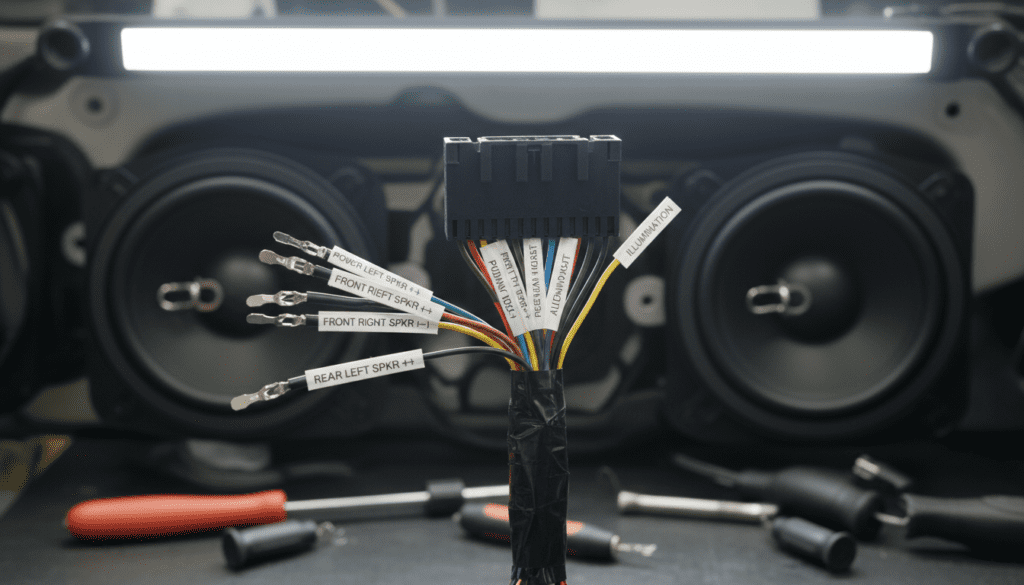
Step 1: Identify Your Wiring Harness
Standard aftermarket wiring harnesses use a universal color code. For a 2-speaker setup, you will primarily use the Front Channels.
- White: Front Left Positive (+)
- White/Black Striped: Front Left Negative (-)
- Gray: Front Right Positive (+)
- Gray/Black Striped: Front Right Negative (-)
Step 2: Insulate the Unused Rear Channels
This is where most DIY mistakes happen. The unused wires (Green and Purple) still carry a live current when the radio is on. If these bare ends touch each other or the metal chassis of the car, the MOSFET internal amp will go into “Protect Mode” or blow entirely.
- Green/Purple Wires: Cut the exposed copper.
- Apply Protection: Use a “butt connector” or electrical tape to cap each wire individually. Do not tape the positive and negative of the same channel together.
Step 3: Connection Methods
For the two speakers you are using, I recommend using crimped connectors or soldering with heat shrink. Avoid simply twisting wires together and using tape, as car vibrations will eventually loosen the connection, causing crackling or intermittent sound.
Step 4: Configuring the Head Unit Settings
Once wired, turn on the unit. Go into the Audio Settings or EQ Menu.
- Find the Fader setting.
- Adjust it entirely to the “Front” (if that is where you wired them).
- This ensures that the internal processor isn’t sending audio data to “empty” channels, which can sometimes reduce the load on the power supply.
Understanding the “50×4” Myth: Peak vs. RMS
When you see MOSFET 50×4 printed on the box, it’s a marketing term. In the world of car audio, Peak Power is the maximum amount of power an amp can produce in a split-second burst (like a drum hit).
The Truth About RMS
RMS Power is the continuous power the unit can output safely. For a 50×4 MOSFET unit:
- Peak Power: 50 Watts per channel.
- RMS Power: Approximately 17-22 Watts per channel.
If you are running 2 speakers, they are still only receiving that 17-22 Watts RMS. You do not “transfer” the 50 Watts from the rear to the front just by leaving them disconnected. To get more power than that, you would need an external 2-channel amplifier.
Common Mistakes When Converting 4 Channels to 2
Through my years of troubleshooting, I’ve identified three critical errors people make when trying to answer “can i make mosfet 50×4 into 2 speakers.”
Attempting to Bridge the Head Unit
In home audio or with external car amps, you can “bridge” channels (combining two channels into one) to increase power. Standard MOSFET head units cannot do this. Their internal circuitry is already bridged internally (BTL – Bridge-Tied Load). Attempting to bridge them again will cause an immediate internal short.
Using the Wrong Impedance
Most MOSFET 50×4 units are stable at 4 ohms. If you try to wire two speakers in parallel to a single channel (creating a 2-ohm load), the MOSFETs will overheat rapidly. Always check that your speakers are 4-ohm rated.
Ignoring Phase Issues
Even with only two speakers, “Phase” is critical. If you swap the positive and negative on just one speaker, the two speakers will work against each other. This results in a “thin” sound with zero bass. Always ensure the striped wire on the harness goes to the negative terminal on the speaker.
When Should You Add an External Amplifier?
While a MOSFET 50×4 unit is a massive upgrade over a stock factory radio, it has limits. If you have high-end component speakers (like Focal, Morel, or JL Audio), a head unit’s internal amp might not provide enough “juice” to make them sing.
Indicators You Need More Power:
- Clipping: The sound becomes crunchy or distorted at high volumes.
- Lack of Mid-Bass: The speakers move, but the sound feels “hollow.”
- Heat: The head unit faceplate becomes hot to the touch after 20 minutes of play.
If you experience these, consider an external 2-channel MOSFET amplifier which can provide a true 50W-100W RMS per channel.
Troubleshooting MOSFET Audio Issues
If you’ve connected your two speakers and something doesn’t sound right, use this checklist:
Problem: No sound at all
- Check the “Mute” or “ATT” setting: It happens to the best of us.
- Inspect the Blue/White wire: This is the Remote Turn-on. If you have a factory-amplified system (like Bose or JBL), this wire must be connected to tell the factory amp to turn on, even if you are using the MOSFET head unit’s power.
Problem: Unit keeps resetting
- Short Circuit: One of your unused rear speaker wires is likely touching the car’s metal frame.
- Voltage Drop: Ensure your Constant (Yellow) and Ignition (Red) wires are getting a full 12V.
Frequently Asked Questions (FAQ)
Can I damage my head unit by only using 2 channels?
No. Using only two channels is perfectly safe. The internal amplifier simply sees no “load” on the other two channels, so no current flows through those specific MOSFET circuits. It is actually easier on the unit’s power supply.
Is MOSFET better than “High Power” standard units?
“High Power” is often a generic term. MOSFET is a specific type of transistor technology. Most modern “High Power” units use MOSFETs, but checking for the MOSFET label ensures better thermal management and lower distortion compared to older IC-based amplifiers.
Will 2 speakers sound louder than 4 on a 50×4 unit?
Not necessarily. Four speakers create more “surface area” of moving air, which typically feels louder and more immersive. However, two high-quality speakers with a proper 2-channel setup will often have better imaging and clarity than four mediocre speakers.
Can I connect a subwoofer to the unused 2 channels?
Generally, no. A subwoofer requires significantly more power than a MOSFET 50×4 head unit can provide. Furthermore, subwoofers usually require a “Low Pass Filter” (LPF) which most rear speaker outputs do not have. You are better off using the Pre-Amp RCA outputs to a dedicated subwoofer amplifier.
What wire gauge should I use for 2 speakers?
For the 15-22W RMS provided by a MOSFET 50×4 unit, 18-gauge or 16-gauge oxygen-free copper (OFC) wire is more than sufficient. Using overly thick wire (like 12-gauge) is unnecessary and difficult to route through door jams.