Can I Put Surround Speakers Behind Me? The Short Answer
Yes, you can put surround speakers behind you, but the “correct” placement depends entirely on whether you are running a 5.1 or a 7.1 surround sound system. In a standard 5.1 setup, speakers should ideally be placed to the sides of your seating position (90° to 110°); however, moving them slightly behind you (up to 120°) is a common and acceptable practice for many living rooms.
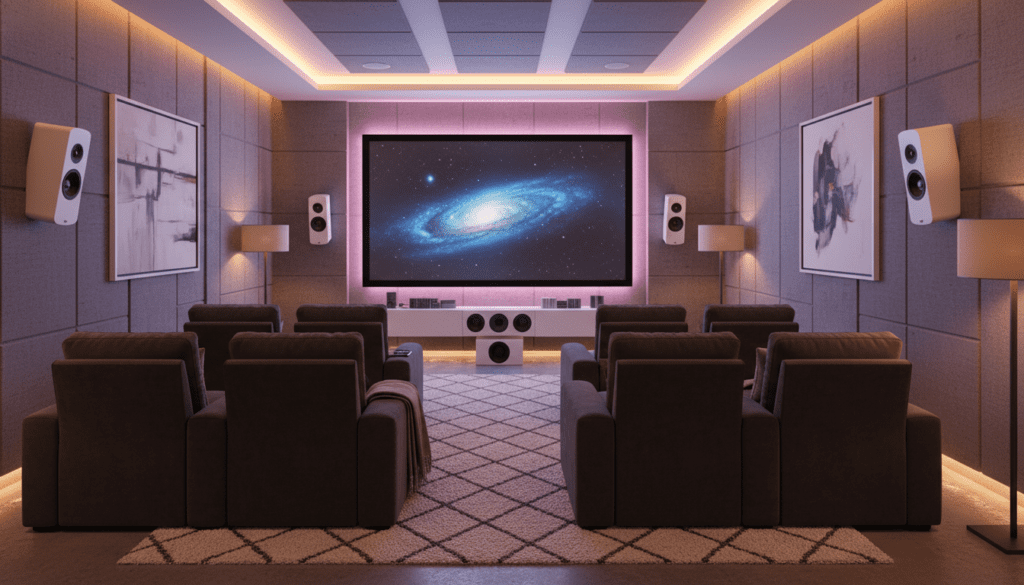
If you are using a 7.1 setup, you actually must put two speakers behind you. These are known as the Rear Surrounds, and they work in tandem with your Side Surrounds to create a fully immersive 360-degree soundstage. During my years of installing custom home theaters, I’ve found that while “purist” layouts are great, the real-world goal is to ensure the tweeters have a clear line of sight to your ears, regardless of whether they are strictly at your sides or tucked slightly behind the couch.
Key Takeaways: Surround Speaker Placement
- 5.1 Systems: Best at 90°–110° (directly to your sides or slightly behind).
- 7.1 Systems: Requires two side speakers (90°–110°) AND two rear speakers (135°–150°).
- Ideal Height: Position speakers about 2 feet above ear level to prevent the sound from being blocked by furniture or other listeners.
- Room Correction: Always run your AV Receiver’s (AVR) auto-calibration (like Audyssey or Dirac Live) after moving speakers to correct for timing and volume.
- The Couch Factor: If your couch is against the wall, bipole speakers are often a better choice than standard monopole speakers.
Understanding the Difference Between Side and Rear Surrounds
Many beginners confuse “surround speakers” with “rear speakers.” In the world of Dolby and DTS audio, these are two different channels. When people ask, “can i put surround speakers behind me,” they are often trying to fit a 5.1 system into a room where the side walls are too far away or non-existent.
In a 5.1 configuration, the “surround” channels are designed to provide ambient noise and directional cues that happen beside you. If you place them directly behind you at a 180-degree angle, you lose the “wrap-around” feeling, and the soundstage can feel “split” between the front and the very back.
In a 7.1 configuration, you have the luxury of both. The side speakers handle the action happening to your left and right, while the back speakers handle sounds that move from the front to the far rear, like a jet flying overhead or a car speeding past.
Comparison: 5.1 vs. 7.1 Placement Logic
| Feature | 5.1 Surround Setup | 7.1 Surround Setup |
|---|---|---|
| Primary Side Speakers | 90° to 110° (Sides) | 90° to 110° (Sides) |
| Rear Speakers Required? | No (Optional/Alternative) | Yes (Mandatory) |
| Ideal Angle Behind Listener | 100°–120° | 135°–150° |
| Best for Small Rooms | Yes | No (Requires depth) |
| Immersive Depth | Good | Excellent |
How to Position Speakers Behind You in a 5.1 Setup
If your room layout forces you to put your only pair of surround speakers behind you, don’t panic. I have set up hundreds of systems in “L-shaped” living rooms where side placement was impossible. The key is to manage the angle and distance.
The 120-Degree Rule
In a 5.1 setup, if you cannot place the speakers at 90 degrees (directly to your left and right), aim for 110 to 120 degrees. This places them slightly behind the listener but still wide enough to provide a sense of width. Avoid placing them directly together at the center of the back wall; this will collapse your soundstage into a single point of sound behind your head.
Dealing with “Couch Against the Wall” Syndromes
This is the most common issue I encounter. If your couch is touching the back wall, you physically cannot put speakers “behind” you. In this case, you have two options:
- Wall Mounts: Mount the speakers on the back wall, but spread them wide and aim them toward the center of the room.
- Bipole Speakers: Use speakers like the SVS Ultra Surround or Klipsch RP-502S. These speakers fire sound in two directions, creating a “diffuse” sound field that masks the fact that the speaker is too close to your head.
The Technical Requirements for 7.1 Rear Speaker Placement
When moving to a 7.1 system, placing speakers behind you is the primary goal. However, there is a specific geometry you need to follow to ensure the Digital Signal Processor (DSP) in your receiver works correctly.
Angle and Distance
The Dolby Labs standard for 7.1 rear surrounds is an angle of 135° to 150° relative to the center of the seating area. We typically recommend keeping the rear speakers at the same distance from the “sweet spot” as the front speakers if possible.
If the rear speakers are much closer to your ears than the front speakers, the sound will be “unbalanced.” Most modern receivers from Denon, Marantz, or Yamaha can fix this by adding a “delay” to the rear channels, but physical distance is always preferable to digital correction.
Separation is Key
I’ve seen many DIY enthusiasts mount their rear surrounds right next to each other. For a true 7.1 experience, you want at least 3 to 6 feet of separation between the two rear speakers. This allows for “stereo imaging” in the back, meaning you can hear a sound move from the back-left to the back-right.
Height Matters: Don’t Put Them on the Floor
One of the biggest mistakes I see in home theater design is placing surround speakers on end tables at the same height as the couch cushions. This is a problem because your body—and the bodies of your guests—will block the high-frequency sounds coming from the tweeters.
The “2-Foot Rule”
For surround and rear speakers, I recommend placing them so the tweeters are 2 feet above ear level when you are seated.
- Why? This prevents the sound from being “localized.” You want the surround sound to feel like an atmosphere, not like someone is whispering directly into your ear.
- Exception: If you are using Dolby Atmos (upward-firing or ceiling speakers), you actually want your surrounds closer to ear level to create a distinct separation between the “ear-level” layer and the “overhead” layer.
Optimizing Your Receiver Settings for Rear Placement
Once your speakers are behind you, your job isn’t done. You must tell your AV Receiver exactly what you did.
- Speaker Configuration: Navigate to your AVR’s “Manual Setup” or “Speaker Setup” menu. Ensure the “Surround” and “Surround Back” (if 7.1) settings are set to “Small” or “Large” based on your speaker size.
- Distance Calibration: Measure the distance from your ears to each speaker with a tape measure. Enter these numbers into the receiver. This ensures that the sound from every speaker reaches your ears at the exact same millisecond.
- Level Matching: Use a Sound Pressure Level (SPL) meter (or a smartphone app) to ensure every speaker is playing at the same volume. If the speakers are behind you, you might find they need to be boosted by 1 or 2 decibels if the room has heavy curtains or carpets that soak up the sound.
Common Obstacles and Expert Solutions
The Open Floor Plan
If your living room opens into a kitchen or hallway on one side, you might not have a wall for your surround speakers.
- The Solution: Use floor stands. Brands like Sanus or Perlesmith make adjustable stands that allow you to place speakers behind or beside your couch without needing walls.
Wiring Difficulties
Running wires to speakers behind you can be a tripping hazard.
- The Solution: I often recommend Flat Adhesive Speaker Wire (like Ghost Wire). You can stick it to the wall, paint over it, and it becomes virtually invisible. Alternatively, consider a wireless kit like the SVS SoundPath Wireless Audio Adapter to send signals to the back of the room without the cable mess.
Expert FAQ: Surround Speaker Placement
Can I use bookshelf speakers as rear surrounds?
Absolutely. In fact, most experts prefer high-quality bookshelf speakers over tiny “satellite” speakers. Just ensure they are securely mounted or placed on stable stands, as rear surround channels can sometimes carry heavy bass and dynamic effects that might vibrate a light stand.
Should I point rear speakers directly at my ears?
In a 5.1 setup where speakers are slightly behind you, “toeing in” (angling) the speakers toward the listener is usually best. However, if you are using a 7.1 setup with dedicated rear speakers, pointing them straight forward toward the screen can sometimes create a more spacious, cinematic feel. Experiment with both!
Can I put my surround speakers in the ceiling behind me?
While “in-ceiling” speakers are great for Dolby Atmos, they are not ideal for primary surround channels. Sound is meant to come from around you, not from 10 feet above you. If you must use ceiling speakers, look for models with aimable tweeters so you can direct the sound toward the seating area.
What happens if I put my 5.1 surrounds at 180 degrees (straight back)?
If you put your only surround speakers directly behind you at 180 degrees, you will experience a “hole” in the soundstage. You will hear sounds in front of you and sounds behind you, but nothing to your left or right. This ruins the “panning” effect where a sound should smoothly travel from the front-left to the back-left.
The Verdict: Finding the Perfect Spot
While the technical answer to “can i put surround speakers behind me” is a resounding yes, the quality of your experience depends on the angle. For a 5.1 system, keep them “behind and wide” (around 110°). For a 7.1 system, embrace the rear placement at 140°.
Always remember that room acoustics vary. I’ve often found that moving a speaker just six inches can completely change the clarity of the dialogue and the impact of the sound effects. Trust your ears, run your room calibration, and don’t be afraid to break the “rules” slightly to fit your specific living space.
**
**
**
**