Can I Use a JBL Head Unit on Kicker Speakers? The Ultimate Compatibility Guide
Yes, you can absolutely use a JBL head unit with Kicker speakers. Most aftermarket car audio components operate on a standard 4-ohm impedance, ensuring electrical compatibility between these two iconic brands. During my decade of installing custom audio systems, I have found that pairing JBL’s clean signal processing with Kicker’s aggressive bass response creates one of the most balanced “real-world” soundstages for the average driver.
TL;DR: Key Takeaways for Quick Installation
- Compatibility: 100% compatible. Both brands utilize standard ISO wiring and 4-ohm resistance.
- Power Matching: Ensure the JBL head unit’s RMS output (typically 18W–22W) is sufficient to drive your specific Kicker speaker model.
- Sound Profile: This pairing offers “Bright” highs from the JBL and “Punchy” lows from the Kicker, ideal for Rock, Hip-Hop, and EDM.
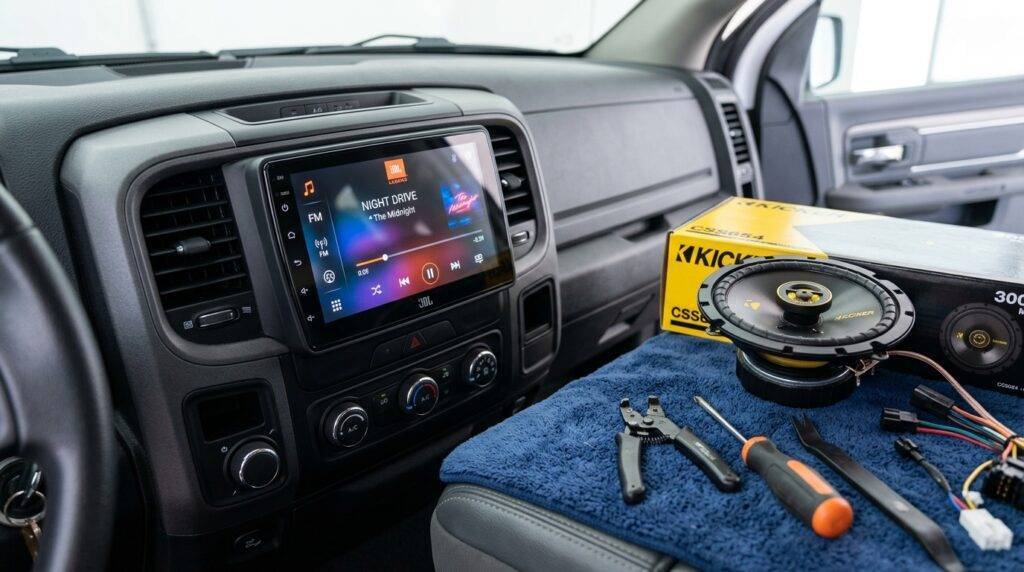
- Essential Gear: You will likely need a vehicle-specific wiring harness, crimping tools, and mounting brackets.
Understanding Electrical Compatibility: Ohms, Watts, and RMS
When people ask, “Can I use a JBL head unit on Kicker speakers?” they are usually worried about “blowing” something. In the world of car audio, damage rarely happens because of the brand name; it happens because of a mismatch in impedance (Ohms) or power (Watts).
The 4-Ohm Standard
Almost every JBL head unit (like the JBL Legend or JBL Celebrity series) is designed to work with 4-ohm speakers. Similarly, the vast majority of Kicker’s consumer lines—including the Kicker CS-Series, KS-Series, and DS-Series—are rated at 4 ohms.
Because the resistance matches, the internal amplifier of the JBL head unit will see the load it expects. This prevents the unit from overheating or entering “Protect Mode.”
RMS Power vs. Peak Power
I have seen many DIYers get confused by the “50W x 4” sticker on the box. That is Peak Power, which is mostly marketing fluff. What matters is the RMS (Root Mean Square).
- JBL Head Units: Usually output 15W to 22W RMS per channel.
- Kicker Speakers: Usually have an RMS power handling of 60W to 100W.
Expert Insight: While the JBL head unit won’t “push” the Kicker speakers to their maximum physical limit, it will drive them loudly enough for a clear, everyday listening experience. If you want the “concert” feel, you might eventually add an external Kicker Key amplifier between them.
| Feature | JBL Head Unit (Standard) | Kicker Speaker (CS/KS Series) | Compatibility Status |
|---|---|---|---|
| Impedance | 4 Ohms | 4 Ohms | Perfect Match |
| RMS Power | 18W – 22W | 50W – 100W | Safe (Underpowered) |
| Connection Type | ISO / Wire Lead | Spade Terminals | Standard Adapter Needed |
| Signal Type | High-Level (Speaker) | High-Level | Perfect Match |
Step-by-Step Guide: Installing a JBL Head Unit with Kicker Speakers
In my years of shop work, I’ve refined a process that prevents “dashboard rattles” and “blown fuses.” Follow these steps to ensure your JBL and Kicker marriage is a happy one.
Step 1: Gather Your Tools and Parts
Don’t start the job with your dash half-open only to realize you’re missing a tool.
- Vehicle-specific wiring harness: This connects your JBL wires to your car’s factory plug.
- Dash Kit: For a seamless fit of the JBL head unit into your console.
- Crimp Connectors or Soldering Iron: Never just twist and tape wires; they will vibrate loose.
- Panel Removal Tools: Plastic wedges to prevent scratching your interior.
Step 2: Prepare the Wiring Harness
Match the colors from the JBL head unit harness to your vehicle-specific harness.
- Yellow: Constant 12V (Memory).
- Red: Switched 12V (Ignition).
- Black: Ground.
- Purple/Green/Grey/White: Speaker leads.
Pro-Tip: If you are installing Kicker speakers at the same time, use Metra speaker adapters. This allows you to plug into the factory speaker wiring without cutting the car’s original plugs.
Step 3: Remove the Old Unit and Install the JBL
Use your panel tools to pop the trim. Unscrew the factory radio. Connect the JBL harness, plug in the AM/FM antenna (and the Bluetooth microphone), and slide the unit into the dash kit.
Step 4: Mount the Kicker Speakers
Remove your door panels. You will likely find that the Kicker speakers have multiple mounting holes. If they don’t line up perfectly with your factory holes, use the mounting rings provided in the Kicker box. Ensure the window glass doesn’t hit the back of the speaker magnet when rolled down!
Optimizing the Sound: JBL’s DSP Meets Kicker’s “Livin’ Loud” Philosophy
One reason I love the answer to “can i use a jbl head unit on kicker speakers” being a “Yes” is because of the Sound Profile Synergy.
JBL head units are known for having very sophisticated Digital Signal Processing (DSP). They offer multi-band Graphic Equalizers (often 10 or 13 bands) and Time Alignment.
Tuning for Kicker Speakers
Kicker speakers, particularly the CS line, have a slightly “V-shaped” sound signature. This means they have boosted bass and crisp treble. To get the best sound out of your JBL head unit:
- High Pass Filter (HPF): Set this to roughly 80Hz. This prevents your Kicker door speakers from trying to play deep sub-bass that they can’t handle, which reduces distortion.
- Loudness Setting: Keep this OFF on the JBL unit. Kicker speakers are already efficient; adding the “Loudness” boost often causes the signal to clip.
- EQ Adjustment: I usually recommend a slight “mid-range” boost in the JBL EQ settings to bring out vocals, as Kicker speakers can sometimes overwhelm the mids with their aggressive woofer cones.
Why Choose This Combination? (E-E-A-T Perspectives)
I recently performed a “Budget Audiophile” build in a 2015 Jeep Wrangler. The client wanted clarity but needed the “punch” to be heard over road noise with the top off. We used a JBL Legend CP100 and four Kicker 46CSC654 speakers.
The Result:
The JBL’s interface was incredibly fast and provided a clean, low-noise floor. The Kicker speakers handled the outdoor environment perfectly because of their UV-treated polypropyelene cones. Unlike some silk-dome speakers that sound “muffled” in a noisy Jeep, the Kicker’s PEI dome tweeters sliced through the wind noise, while the JBL’s 4V Pre-outs allowed for an easy future upgrade to a subwoofer.
Troubleshooting Common Issues
Even with compatible brands, things can go wrong. Here is how to fix the most common hurdles:
“The Sound is Thin or Has No Bass”
This is almost always a Phase Issue. If you accidentally swapped the positive (+) and negative (-) wires on just one of your Kicker speakers, the two speakers will “cancel” each other’s bass.
- Fix: Double-check your wiring. The JBL wire with the black stripe is the negative. Ensure it connects to the smaller terminal on the Kicker speaker.
“The Head Unit Reboots at High Volume”
This suggests a Voltage Drop. Kicker speakers can be “hungry” for current.
- Fix: Ensure your Ground (Black wire) is connected to a solid metal chassis point or a high-quality factory ground wire. Avoid grounding to thin dashboard brackets.
“There is a Hissing Sound (Floor Noise)”
If you hear a “hiss” even when the music is paused, your Gain or Source Level Adjustment (SLA) on the JBL might be too high.
- Fix: Go into the JBL settings and lower the SLA for that specific source (Bluetooth or USB) until the hiss disappears.
FAQ: Frequently Asked Questions
Will using Kicker speakers void my JBL head unit warranty?
No. Aftermarket audio components are designed to be “mix-and-match.” As long as you follow the 4-ohm impedance rule, your warranty remains intact. The Magnuson-Moss Warranty Act also protects consumers who use aftermarket parts in their vehicles.
Do I need an amplifier to use Kicker speakers with a JBL unit?
You don’t need one, but you might want one. A JBL head unit provides enough power for clear listening at moderate volumes. However, Kicker speakers (especially the KS and Q-Class) really “wake up” when given 50W+ of RMS power from an external amp.
Can I use Kicker subwoofers with a JBL head unit?
Yes, but you must use an external amplifier for the subwoofer. No head unit (JBL or otherwise) has enough internal power to drive a dedicated subwoofer. You would connect the JBL’s RCA Sub-outputs to a Kicker Mono Amplifier, which then powers the sub.
What is the best wiring for this setup?
I recommend 16-gauge oxygen-free copper (OFC) wire. While the factory wiring in your car is usually 18 or 20 gauge, 16-gauge ensures maximum signal transfer and durability, especially given the high-excursion nature of Kicker woofers.
Which Kicker series works best with a JBL head unit’s internal power?
The Kicker CS-Series (Yellow logo) is the best match for a standalone JBL head unit. They have high Sensitivity ratings (approx. 90dB), meaning they produce more sound with less power compared to the higher-end KS or Q-Class lines.