Can I Use a Light Switch for Speakers? The Definitive Guide
Yes, you can technically use a standard light switch to turn speakers on and off, but you should not use a standard AC light switch for audio applications. Standard household light switches are designed for high-voltage AC power and can cause audible “pops,” signal degradation, and potential damage to your amplifier or speakers due to impedance issues. For a safe and high-quality setup, you must use a dedicated in-wall speaker volume control or an impedance-matching selector switch designed specifically for low-voltage audio signals.
Quick Summary: Key Takeaways
- Avoid Standard Switches: Standard 120V/240V light switches lack the shielding and contact design needed for audio; they cause “arcing” and loud pops.
- Use Audio-Specific Controls: Dedicated in-wall volume controls (L-pads or transformers) allow you to adjust levels without straining your amplifier.
- Mind Your Impedance: Wiring multiple speakers to one switch can drop impedance (Ohms) too low, which can overheat or fry your receiver.
- Safety First: Always use CL2 or CL3 rated speaker wire for in-wall installations to comply with fire building codes.
- The Best Solution: Use an impedance-matching speaker selector if you are controlling more than two pairs of speakers from a single source.
Why You Shouldn’t Use a Standard Light Switch for Speakers
When I first started installing multi-room audio systems in the early 2000s, I saw many DIY enthusiasts try to save $30 by using a standard Leviton or Lutron toggle switch. While it “works” in the sense that it breaks the circuit, the long-term results are almost always negative.
The “Pop” Phenomenon and Speaker Damage
Standard light switches are “snap-action” switches designed to handle high current. When you toggle a standard switch connected to an active audio signal, the physical contacts create a momentary electrical arc. This manifests as a loud, sharp “pop” in your speakers. This sudden spike can easily tear a speaker cone or blow a delicate tweeter.
Signal Degradation and Resistance
Light switches are built for power delivery, not signal integrity. The internal components aren’t optimized for the wide frequency range of music. Using a standard switch can introduce total harmonic distortion (THD) and add unnecessary resistance, which muffles the high-end frequencies of your favorite tracks.
Impedance Mismanagement
This is the most critical technical reason. Most home theater receivers are rated for 6-ohm or 8-ohm loads. If you use a simple “On/Off” light switch to toggle multiple speakers in parallel, you could accidentally drop the impedance to 2 ohms or lower. I have seen high-end Denon and Onkyo receivers enter “Protection Mode” or literally smoke because the user didn’t use an impedance-matching control.
The Science of Audio Switching: Standard vs. Audio Controls
To understand why a dedicated control is necessary, we need to look at how they handle electricity differently.
| Feature | Standard Light Switch | In-Wall Audio Volume Control |
|---|---|---|
| Voltage Type | 120V/240V AC (High Voltage) | Low-Voltage Audio Signal |
| Switching Style | Instant Break (Causes Arcing) | Make-Before-Break or Transformer-based |
| Impedance Protection | None | Integrated (Prevents Amp Overload) |
| Control Type | On/Off Only | Variable Volume + On/Off |
| Build Materials | Copper/Brass (Heavy Gauge) | High-purity Copper / Silver Plated |
| Safety Rating | Electrical Code (Power) | Fire Code (Signal – CL2/CL3) |
Top Recommended Alternatives to Light Switches
If your goal is to have a physical switch on the wall to control your ceiling speakers or outdoor speakers, you have three professional-grade options.
Impedance-Matching Volume Controls
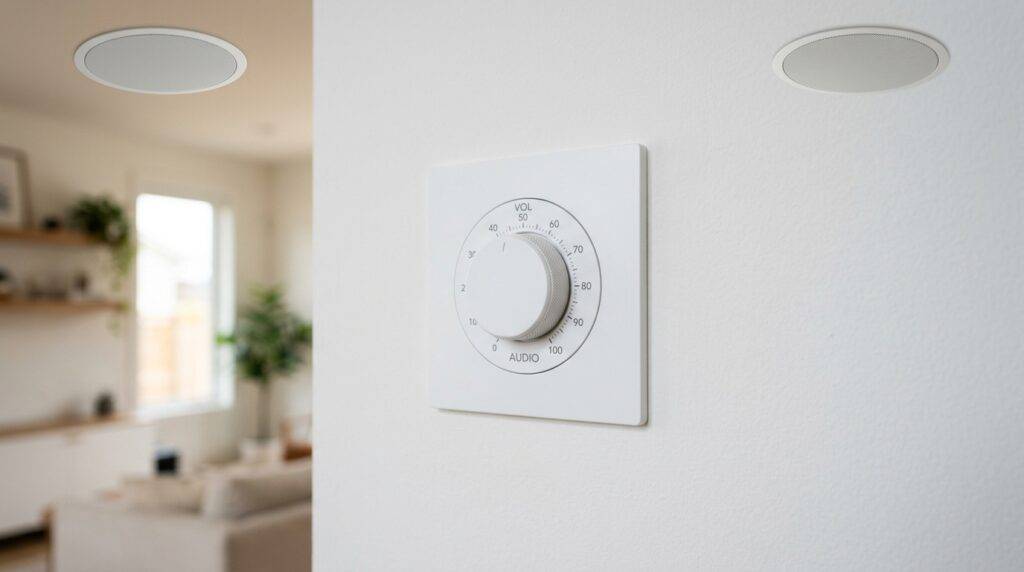
These are the gold standard for in-wall control. They look like a standard light switch (rotary or slider) but contain a transformer. We recommend brands like Niles, Russound, or Monoprice.
- Best for: Controlling the volume in a specific room (e.g., the bathroom or patio) independently from the main receiver.
- Pro Tip: Set the main receiver volume to about 70%, then use the wall dial to adjust locally.
Speaker Selector Switches
If you want to control multiple “zones” from a single location (like a media closet), a speaker selector box is the way to go. These usually feature push-buttons for Zone A, Zone B, etc.
- Best for: Managing a whole-home audio system where you want to toggle the kitchen, dining room, and porch speakers individually.
Smart Audio Controllers
In the modern era, many of our clients are moving toward Sonos or Bluesound systems. You can install a smart “Scene Controller” (like the Lutron Pico for Audio) that looks like a light switch but communicates wirelessly with your smart speakers.
Step-by-Step Guide: How to Properly Install a Speaker Wall Control
Installing a dedicated audio switch is similar to a light switch but requires different wiring techniques. Here is how I perform these installations to ensure longevity and sound quality.
Step 1: Gather Your Tools and Materials
- Dedicated Audio Volume Control (e.g., a 100W Impedance-matching dial).
- CL2 or CL3 Rated 16/2 Speaker Wire (16-gauge, 2-conductor).
- Drywall Saw and Low-Voltage Mounting Bracket (Orange “Old Work” ring).
- Wire Strippers and a Small Flathead Screwdriver.
Step 2: Install the Low-Voltage Bracket
Unlike electrical switches, audio switches do not require a sealed plastic junction box. Use a low-voltage mounting bracket. This allows the wires to breathe and makes it easier to manage the bulky transformer found on the back of volume controls.
Step 3: Run the Wiring (The Home Run)
You must run two sets of wires to the switch location:
- Input: From the Amplifier/Receiver to the Wall Switch.
- Output: From the Wall Switch to the Speakers.
Warning: Do not run speaker wire parallel to high-voltage electrical lines for more than a few feet. This causes 60Hz hum (interference). If you must cross them, do so at a 90-degree angle.
Step 4: Connect the Wires
Most audio controls use “Phoenix” style connectors or screw terminals.
- Strip about 1/4 inch of insulation.
- Connect the Input Left (+/-) and Input Right (+/-) from the amp.
- Connect the Output Left (+/-) and Output Right (+/-) to the speakers.
- Ensure no stray copper strands are touching, as this will cause a short circuit.
Step 5: Set the Impedance Jumpers
On the back of the volume control, you will likely see a small “jumper” or “switch” labeled 1X, 2X, 4X, or 8X.
- If you are only using one pair of speakers, set it to 1X.
- If you are running four pairs of speakers off one amp, set all wall controls to 4X. This protects your amplifier from seeing a load that is too “heavy.”
Understanding Wire Gauges for Speaker Switches
Using the wrong wire thickness can lead to power loss over long distances. In my experience, choosing the right gauge is the most overlooked part of the process.
| Distance (Feet) | Recommended Gauge (AWG) | Reason |
|---|---|---|
| 0 – 50 ft | 16 AWG | Sufficient for most indoor rooms. |
| 50 – 150 ft | 14 AWG | Reduces resistance for longer runs to patios or basements. |
| 150+ ft | 12 AWG | Necessary to prevent audible “voltage drop.” |
Troubleshooting Common Installation Issues
Even with the right gear, things can go wrong. Here is how we troubleshoot the most common “Can I use a light switch for speakers” DIY mishaps:
The “One Speaker is Louder” Issue
If one speaker is significantly quieter, check the impedance jumpers on the back of your wall switches. If one is set to 4X and the other to 1X, the 1X speaker will receive significantly more power.
The Constant Humming Sound
This is almost always Electromagnetic Interference (EMI). If you ran your speaker wire through the same hole in the wall studs as your kitchen’s power lines, you’ll hear a hum. To fix this, you may need to use shielded speaker wire or re-route the cable.
The Receiver Keeps Shutting Off
This is “Thermal Protection.” Your amplifier is getting too hot because the total impedance is too low. If you used a standard light switch to “hard-wire” multiple speakers together, you have likely created a 2-ohm load. Switch to an impedance-matching volume control immediately to save your receiver.
Frequently Asked Questions
Can I use a dimmer switch for my speakers?
Absolutely not. A standard light dimmer works by “tripping” the AC sine wave to reduce power. If you hook this to a speaker, you will feed it distorted electrical noise that will likely destroy the speaker’s voice coil and could potentially cause a fire in the switch itself.
What is the difference between a speaker switch and a volume control?
A speaker switch (or selector) is usually a box that sits by your receiver to turn different rooms on or off. An in-wall volume control is located in the destination room and allows you to fine-tune the decibel level locally.
Is it illegal to use a light switch for speakers?
While not “illegal” in the criminal sense, it often violates local building and electrical codes. Most codes require that high-voltage (lights) and low-voltage (audio) systems be physically separated. Using a light switch for speakers can fail a home inspection during a sale.
Can I use a light switch for a 70V commercial system?
In commercial settings (like a restaurant), they use 70-volt systems. These also require specific 70V attenuators. A standard light switch still carries the same risks of arcing and “popping” and should be avoided in favor of professional commercial grade controls.
Final Expert Verdict
While the question “can i use a light switch for speakers” has a “yes” in the most literal sense, the practical answer for any homeowner or audiophile is a resounding no. For the sake of your equipment’s lifespan and the quality of your audio, invest in proper in-wall volume controls.
Not only do these provide a safer electrical environment for your amplifier, but they also offer a much more professional look and feel. Whether you are rocking out on the patio or setting a mood in the dining room, the right hardware makes all the difference.