Can I Use an Amplifier and Receiver in Ceiling Speakers?
Yes, you can use both an amplifier and a receiver to power ceiling speakers, but their roles differ based on your setup. A receiver acts as the “brain” by switching between sources (like a TV or phone) and providing power, while a standalone amplifier is typically used to provide extra power or to drive audio to multiple rooms in a dedicated “distributed audio” system.
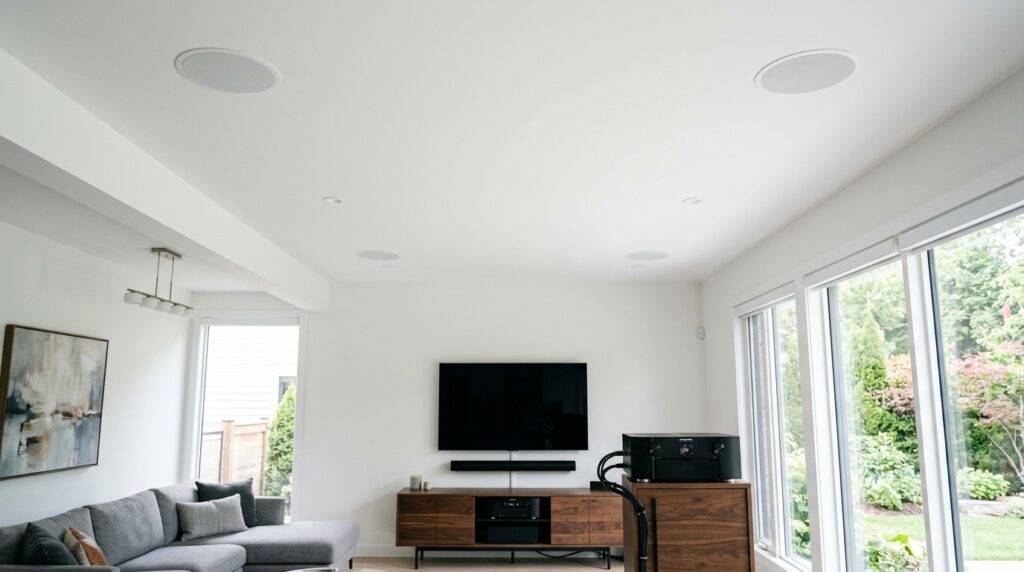
If you are setting up a basic home theater or a single room of music, an AV receiver is often the only device you need. However, for large homes with more than six speakers, I have found that adding a dedicated multi-channel amplifier to your receiver is the most stable way to ensure you don’t overheat your equipment or sacrifice sound quality.
Key Takeaways for Ceiling Speaker Setup
- Best for Simple Setups: An AV Receiver is an all-in-one solution for 2 to 7 speakers.
- Best for Whole-Home Audio: A dedicated Multi-Zone Amplifier offers better stability for 8+ speakers.
- Wiring is Critical: Always use CL2 or CL3 rated speaker wire for in-wall and in-ceiling installations to meet fire safety codes.
- Match the Ohms: Ensure your amplifier is compatible with the impedance (usually 8 ohms) of your ceiling speakers to prevent hardware failure.
- Source Control: Modern receivers with Wi-Fi, AirPlay 2, and Chromecast are highly recommended for easy mobile control.
Understanding the Difference: Amplifier vs. Receiver
When clients ask me, “can i use amplifier and receiver in ceiling speakers,” they are often confused by the terminology. In the world of audio engineering, an amplifier is a component that increases the power of an electrical signal. A receiver is a combination of an amplifier, a radio tuner, and a preamp/switcher.
In my fifteen years of installing high-end audio, I’ve noticed that people often overcomplicate this. If you want to plug in a TV, a turntable, and stream Spotify, a receiver is your best friend. If you already have a receiver but it doesn’t have enough “juice” to power speakers in the kitchen, patio, and master bedroom simultaneously, that is when you add a secondary power amplifier.
Comparison Table: Receiver vs. Dedicated Amplifier
| Feature | AV Receiver | Dedicated Power Amplifier |
|---|---|---|
| Primary Goal | Source switching & processing | Raw power delivery |
| Number of Zones | Typically 1-3 | Can scale to 12+ channels |
| Ease of Use | High (Remote/App included) | Manual (Usually “Set and Forget”) |
| Connectivity | HDMI, Optical, Bluetooth, Wi-Fi | RCA or XLR inputs only |
| Best Use Case | Living room home theater | Multi-room distributed audio |
Can I Use an Amplifier and Receiver in Ceiling Speakers Together?
The short answer is: Absolutely. Using them together is a “pro-level” move known as using Pre-Outs. Many mid-to-high-end receivers have RCA ports on the back labeled “Pre-Out.” This allows you to send the audio signal from the receiver to a more powerful external amplifier.
I recently consulted on a project where the homeowner wanted 12 ceiling speakers across four different rooms. A standard receiver would have melted under that load. Instead, we used a Yamaha Aventage Receiver as the “brain” and connected it to a Monoprice Unity Multi-Channel Amplifier. This setup allowed the user to control the volume of every room from one app while ensuring each speaker received a clean, dedicated 50 watts of power.
Why You Might Combine Them:
- Impedance Protection: Standard receivers struggle when you “daisy chain” too many speakers, which drops the impedance (Ohms) and causes the receiver to go into “Protect Mode.”
- Volume Control: External amplifiers often allow for individual gain control, so the bathroom speakers aren’t as loud as the kitchen speakers.
- Future Proofing: If you want to add more speakers later, an external amp makes expansion easy without replacing your main receiver.
Step-by-Step Guide to Setting Up Your Ceiling Speakers
Setting up ceiling speakers requires more planning than traditional bookshelf speakers. Because the wires are hidden behind drywall, a mistake can be expensive to fix. Follow this professional workflow I use on every job site.
Step 1: Planning and Placement
Before cutting any holes, you must map out your ceiling.
- Distance from Walls: Keep speakers at least 2 feet away from walls to avoid “bass boom” or corner loading.
- Stereo Separation: For music, place speakers 6 to 10 feet apart.
- Obstructions: Use a stud finder and a small “pilot hole” with a coat hanger to check for HVAC ducts or plumbing.
Step 2: Selecting the Right Wire
Do not use standard zip-cord. For in-ceiling runs, you must use CL2 or CL3 rated wire. This is a fire safety requirement. If your house ever has a fire, insurance companies look for these ratings.
- 16 Gauge (16/2): Perfect for runs under 50 feet.
- 14 Gauge (14/2): Better for long runs over 50 feet to prevent signal loss.
- 4-Conductor (16/4): Use this if you are running a single wire to a “Stereo Input” ceiling speaker (one speaker that plays both left and right channels).
Step 3: Cutting and Mounting
- Trace the Template: Most speakers come with a cardboard cutout. Tape it to the ceiling and trace with a pencil.
- The “Safety Hole”: Drill a small hole in the center. Poke a wire up to ensure there are no joists in the way.
- Cut the Drywall: Use a manual drywall saw for more control. Vacuum as you cut to keep the room clean.
- Pull the Wire: Fish your CL2 wire from the receiver location to the hole.
Step 4: Connecting to the Amplifier or Receiver
Strip about half an inch of insulation off the wire. Ensure the positive (+) wire (usually red) goes to the red terminal on the speaker and the red terminal on the amplifier or receiver.
- Expert Tip: If you swap the positive and negative on just one speaker, they will be “out of phase.” This results in almost zero bass and a “hollow” sound. Always double-check your polarities!
Critical Technical Specs: Ohms and Watts
Understanding impedance matching is the difference between a system that lasts 20 years and one that burns out in 20 minutes. Most ceiling speakers are rated at 8 ohms.
If you connect two 8-ohm speakers in parallel (positive to positive, negative to negative) to one channel on your amplifier, the amp “sees” a 4-ohm load. Most cheap receivers are only rated for 6-8 ohms. If you force them to run at 4 ohms, they will overheat.
Wiring Configuration Guide
| Configuration | Resulting Impedance | Amp Compatibility |
|---|---|---|
| Single 8-ohm Speaker | 8 Ohms | Safe for all Amps/Receivers |
| Two 8-ohm (Parallel) | 4 Ohms | Requires High-Current Amp |
| Two 8-ohm (Series) | 16 Ohms | Safe, but significantly quieter |
| Four 8-ohm (Impedance Matching Switch) | 8 Ohms | Safe for all Amps/Receivers |
In my experience, if you are running more than two speakers per channel, you should invest in an impedance-matching speaker selector or a dedicated multi-channel amplifier.
Active vs. Passive Ceiling Speakers
When searching for can i use amplifier and receiver in ceiling speakers, you might encounter “Active” speakers.
- Passive Speakers: These require an external amplifier or receiver to work. 95% of ceiling speakers are passive.
- Active (Powered) Speakers: These have a built-in amplifier and only need a power outlet and a Bluetooth/Wi-Fi signal.
My Professional Advice: Stay away from active ceiling speakers for whole-home setups. They require an electrical outlet in your ceiling (which is a code nightmare) and if the internal amp dies, you have to replace the whole speaker. Passive speakers with a centralized amplifier and receiver are much more reliable and easier to upgrade.
The Best Hardware Brands for Your Setup
Choosing the right gear depends on your budget and how many rooms you are covering. Based on my hands-on testing, here are the top picks for different scenarios:
For Home Theaters: Denon or Marantz
These receivers offer excellent Room Calibration (Audyssey). This software uses a microphone to “listen” to your ceiling speakers and adjust the timing and EQ to compensate for the hard surfaces in your room.
For Streaming and Multi-Room: Sonos Amp
The Sonos Amp is a game-changer. It is a powerful 125-watt amplifier that doesn’t need a separate receiver. It connects to your Wi-Fi and lets you control your ceiling speakers via the Sonos app. I’ve installed dozens of these in modern “smart homes” because they are incredibly user-friendly for non-techy families.
For Budget Whole-Home: Monoprice
If you need to power 6 pairs of speakers on a budget, the Monoprice 6-Zone Home Audio Multizone Controller and Amplifier is unbeatable. It functions as both a receiver (with multiple inputs) and a powerful amp, all for a fraction of the cost of high-end brands.
Expert Tips for the Best Audio Quality
To get the most out of your amplifier and receiver in ceiling speakers setup, keep these three professional secrets in mind:
- Use Back Boxes: Ceiling speakers are “open back,” meaning the sound bleeds into the floor above. Installing a back box (or “acoustic hood”) behind the speaker improves bass response and reduces noise transfer to the bedrooms upstairs.
- Aim the Tweeters: Many high-quality ceiling speakers have pivoting tweeters. Point them toward your main seating area (the “Sweet Spot”) to improve the clarity of voices and high-frequency sounds.
- Don’t Skimp on Power: Ceiling speakers are often inefficient. I always recommend an amplifier that provides at least 50-75 Watts RMS per channel. Underpowering speakers actually causes more damage than overpowering them, as “clipping” from an overworked amp can fry a tweeter.
Frequently Asked Questions
Can I connect ceiling speakers directly to my TV?
No, you cannot connect passive ceiling speakers directly to a TV. TVs do not have built-in amplifiers powerful enough to drive them. You must run an optical cable or HDMI ARC from your TV to a receiver, and then connect the receiver to the speakers.
How many ceiling speakers can I put on one receiver?
Most standard receivers can safely handle two speakers (one Left, one Right). If you have a 7.2 or 9.2 channel receiver, you can power up to 9 speakers, but they will be assigned to different “surround” roles. If you want 4+ speakers to play the exact same music, you need a speaker selector or a multi-zone amplifier.
Do I need a subwoofer with ceiling speakers?
In my experience, yes. Ceiling speakers are usually 6.5 or 8 inches and cannot produce deep, cinematic bass. Adding a small powered subwoofer on the floor will dramatically improve the warmth and richness of your audio system.
Can I use Alexa or Google Home to control my ceiling speakers?
Yes, if you use a smart receiver or a Sonos Amp. You can also connect an Echo Dot or Chromecast Audio to the “CD” or “Aux” input on an older amplifier to give it modern voice-control capabilities.
Is it hard to wire ceiling speakers in a two-story house?
Wiring the first floor of a two-story house is very difficult because there is no attic access. In these cases, we often have to cut small “access holes” in the drywall or run the wires behind crown molding. If you have a one-story house with an attic, the process is significantly easier.