Understanding Fire Alarm Speaker Integration
Yes, public announcements can be made over fire alarm speakers, provided the system is specifically designed as a Voice Evacuation System (VES). In most modern commercial buildings, the fire alarm system is integrated with the Public Address (PA) system or functions as a standalone emergency voice alarm communication system (EVACS). You cannot simply patch a standard microphone into a basic horn-based fire alarm system; doing so violates NFPA 72 standards regarding signal priority and circuit integrity.
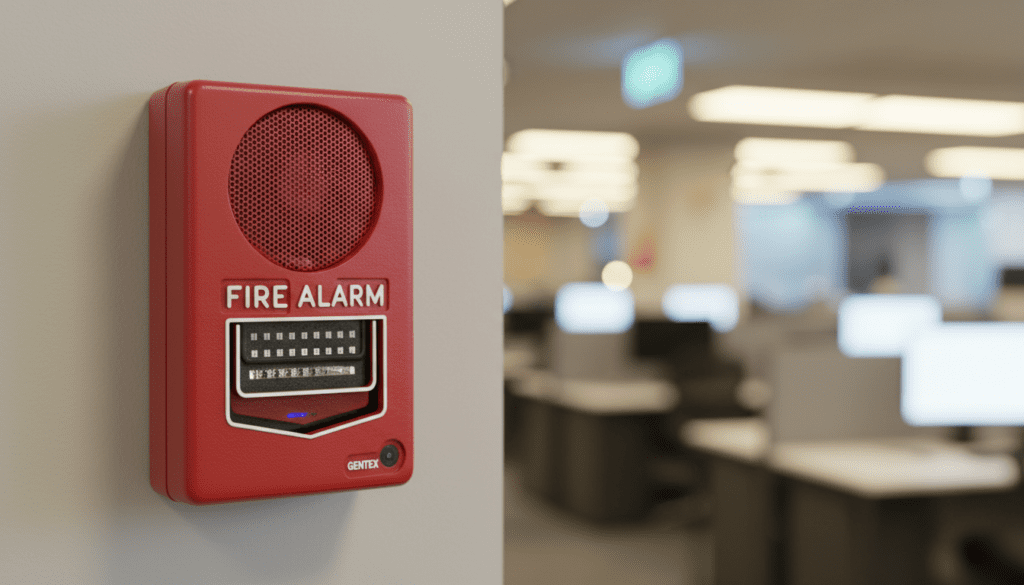
Key Takeaways: Can You Use Fire Alarm Speakers for PA?
- System Type Matters: Only Voice Evacuation Systems are built for audio announcements.
- Priority is Paramount: Fire alarm signals must always override any general page or background music.
- NFPA Compliance: Any integration must follow National Fire Protection Association (NFPA) codes for survivability and intelligibility.
- Equipment Specs: You need specialized amplifiers and emergency voice control equipment to ensure the system doesn’t fail during a fire.
Why Specialized Voice Evacuation Systems Are Required
From my experience working with facility managers, the biggest mistake is assuming all fire alarm speakers are “multi-purpose.” Standard fire alarm systems are designed for Life Safety, not for everyday paging.
If you use a non-compliant system to make general announcements, you risk damaging the emergency notification circuit. Furthermore, if you are mid-announcement when a fire occurs, the system must have a “master override” feature. This feature automatically cuts your speech to deliver the pre-programmed emergency evacuation message.
The Technical Requirements for Integration
- Prioritization: The fire alarm signal must possess the highest priority (P0) over any other input.
- Intelligibility Standards: The system must meet STI (Speech Transmission Index) requirements to ensure instructions are clear, not muffled.
- Circuit Supervision: The wiring must be supervised so that if a PA component fails, it triggers a fault on the Fire Alarm Control Panel (FACP).
- Speaker Compatibility: Fire speakers must be UL 1480 listed for fire protective signaling.
Comparison: Standard PA Systems vs. Voice Evac Systems
| Feature | Standard PA System | Voice Evacuation System |
|---|---|---|
| Primary Goal | General communication | Life safety/Evacuation |
| Priority | Manual | Automatic (Fire Signal) |
| Supervision | Usually not supervised | Fully supervised (NFPA 72) |
| Durability | Standard | High-heat/Fire-rated wiring |
| Intelligibility | Variable | Tested/Certified |
How to Properly Implement Public Announcements
If you are planning to install or upgrade a system to support public announcements through your fire alarm infrastructure, you must follow a strict engineering process. I have seen too many companies get hit with heavy fines from Fire Marshals for “unauthorized modifications” to their fire panels.
Step-by-Step Implementation Guide
- Consult a Licensed Professional: Never attempt to tie a third-party amplifier into a Notifier, Simplex, or EST fire panel without a certified technician.
- Ensure UL-Listed Compatibility: Use an Emergency Interface Module that acts as a bridge between the PA and the fire system.
- Perform Audibility Testing: Use a decibel meter to ensure the volume levels are loud enough to overcome ambient noise but low enough to avoid hearing damage.
- Regular Maintenance: Schedule quarterly checks to ensure the microphone integrity and amplifier health are maintained, as these components see more wear than standard alarm sensors.
Potential Risks of Improper System Integration
Using unauthorized equipment to pipe sound through fire speakers is more than just a code violation; it is a significant liability. If a fire occurs and the system fails to broadcast the evacuation tone because a “background music” setting was active, the legal consequences are severe.
Common Failure Points:
- Ground Faults: Connecting two different power sources often creates ground faults that disable the entire FACP.
- Impedance Mismatch: Standard PA amplifiers can blow out the speaker transformers found in fire alarm speakers.
- Notification Delay: Improper integration can delay the activation of strobes, which are required by the ADA (Americans with Disabilities Act).
Frequently Asked Questions
Can I play background music through my fire alarm speakers?
Generally, no. Most NFPA 72 jurisdictions prohibit playing non-emergency audio through fire speakers unless the system is specifically rated for “dual-use.” Even then, the background music must shut down instantly upon fire detection.
Are fire alarm speakers different from regular ceiling speakers?
Yes. Fire alarm speakers are designed to operate under extreme temperature conditions and are monitored by the fire panel for continuity. Regular ceiling speakers do not have these life-safety protections.
Who is authorized to modify fire alarm speaker settings?
Only a NICET-certified technician or a licensed fire alarm contractor should make changes to the system. Modifying these circuits yourself can void your insurance policy and result in massive code violation fines.
What happens if I make an announcement during a fire drill?
In a properly configured Voice Evacuation System, the moment the fire drill is triggered, your microphone signal will be terminated, and the pre-recorded evacuation message or alarm tone will take over the speakers automatically.