Understanding the Compatibility of RCA Speakers and AV Receivers
Yes, you can use RCA-style speakers on an AV receiver, but you must first determine if the speakers are passive or active. Most vintage speakers using RCA connectors are passive, meaning they lack an internal amplifier and can be connected directly to an AV receiver’s speaker terminals using a simple adapter. However, if your speakers are “active” (powered) and use RCA jacks, you cannot plug them into the receiver’s high-power speaker outputs without risking severe damage to your hardware.
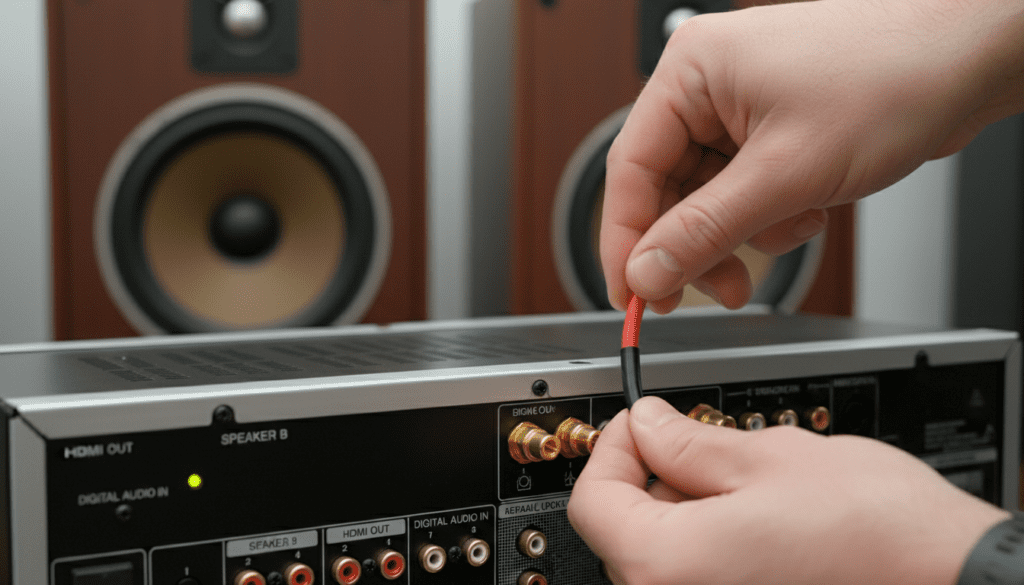
Quick Summary: Key Takeaways
- Passive Speakers: Can connect to receiver Speaker Outputs via a stripped-wire-to-RCA adapter.
- Active/Powered Speakers: Must use the receiver’s Pre-Out jacks; never connect to speaker terminals.
- Impedance Check: Always verify the Ohm rating (usually 6 or 8 Ohms) to ensure it matches your receiver’s requirements.
- Sound Quality: Legacy speakers may offer unique “warm” tones but lack the frequency range of modern Home Theater speakers.
Identifying Your Speaker Type
Before you grab your tools, you must identify what you are working with. I have encountered countless users who assume all speakers with RCA plugs are the same, but the internal electronics differ significantly.
Passive vs. Active Speakers
- Passive Speakers: These have no internal power source. They require an external amplifier (your AV receiver) to move the speaker cones. If you look at the back and see only an RCA jack, it is likely a passive unit from an old “all-in-one” stereo system.
- Active (Powered) Speakers: These have a built-in amplifier. They are common in PC speakers or subwoofers. They require a line-level signal, not a high-power amplified signal.
How to Connect Passive RCA Speakers to an AV Receiver
If you have confirmed your speakers are passive, follow these steps to integrate them into your surround sound system.
- Cut and Strip: Take an RCA cable that you don’t mind sacrificing. Cut off one end to expose the inner copper wire (positive) and the outer shielding or second wire (negative/ground).
- Strip the Ends: Use wire strippers to remove about half an inch of insulation from both the inner and outer strands.
- Check Polarity: Identify which wire is positive. Usually, the center wire is positive, and the outer shielding is negative. Consistency is key to avoiding out-of-phase audio.
- Connect to Receiver: Insert the stripped ends into the Binding Posts or Spring Clips on the back of your AV receiver.
- Test at Low Volume: Start with the volume at zero and slowly increase it to ensure the sound is clear and there is no distortion.
Comparing Connection Methods
Use this table to determine the safest way to connect your legacy hardware.
| Speaker Type | Receiver Port | Safety Level | Requirement |
|---|---|---|---|
| Passive RCA | Speaker Terminals | High (if wired correctly) | RCA-to-Bare-Wire Adapter |
| Active RCA | Pre-Out / RCA Out | High | RCA Male-to-Male Cable |
| Active RCA | Speaker Terminals | DANGEROUS | NEVER DO THIS |
Addressing Impedance and Power Limits
One of the most common mistakes I see involves ignoring impedance (Ohms). Most modern AV receivers are designed for 6 or 8-ohm speakers.
If you connect old 4-ohm speakers to a receiver rated only for 8-ohm loads, the receiver will run hot and could trigger a thermal shutdown or permanent circuit failure. Always check the back of your speaker for an “Impedance” or “Ohms” label. If it isn’t listed, assume it is 4-8 ohms and keep your volume levels moderate to avoid overdrawing current.
Frequently Asked Questions
Will using RCA-to-wire adapters ruin my sound quality?
Generally, no. While the connection is not “audiophile-grade,” the physical connection of a wire is what matters. Ensure the copper strands are tightly twisted and making solid contact with the terminal to prevent signal degradation.
Can I connect an RCA subwoofer to an AV receiver?
Yes, but only via the Subwoofer Pre-Out (RCA) port. Do not connect a powered subwoofer to the main speaker terminals, as the high-voltage signal will blow the subwoofer’s internal amplifier instantly.
My speakers have a proprietary connector. Can I still use them?
Many old “home-in-a-box” systems used proprietary connectors. You can still use these speakers by cutting the proprietary end off and exposing the wire, provided the speakers are passive. Always test with a multimeter if you are unsure which wire is positive.
Is it worth using old RCA speakers in a modern setup?
It depends on the vintage. Some older speakers provide a rich, warm sound that is excellent for stereo music listening. However, for modern Dolby Atmos or 5.1 surround sound, they may lack the detail and frequency response of modern equipment.