Can a Sonance Amp Power 2 Speakers? The Direct Answer
Yes, a Sonance amplifier can easily power 2 speakers, and in most configurations, it is designed to power much more. Most Sonance DSP amplifiers are stable at 4 ohms, meaning you can safely connect two pairs of 8-ohm speakers (4 speakers total) to a single stereo channel output using parallel wiring.
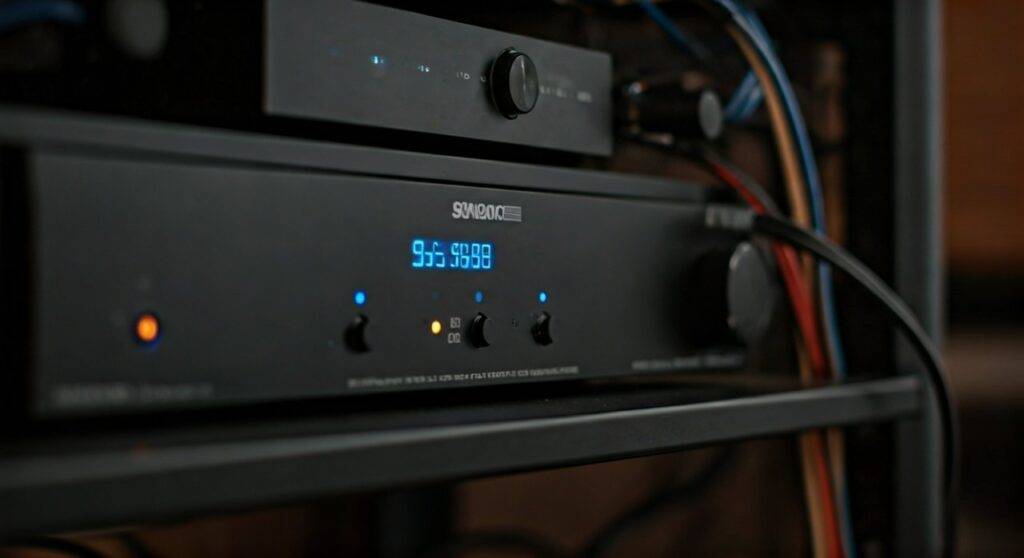
If you are simply looking to connect a standard left and right pair of architectural speakers, a single Sonance 2-channel amplifier is the perfect high-fidelity solution. In my experience installing these in custom smart homes, the robust power supply in the Sonance Mag Series and DSP line ensures that even when driving multiple pairs, the audio remains crisp without the amp clipping or overheating.
Key Takeaways for Powering Speakers with Sonance
- Capacity: A standard 2-channel Sonance DSP 2-150 can power 2, 4, or even 6 speakers if wired correctly with impedance matching.
- Impedance Stability: Most Sonance amps are stable down to 4 ohms, which is the “sweet spot” for running two 8-ohm speakers in parallel.
- DSP Advantage: Using the SonARC (Sonance Advanced Room Correction) software allows you to optimize the power curve for specific speaker models.
- Wire Gauge: For runs over 50 feet, we recommend 14-gauge oxygen-free copper wire to maintain signal integrity when powering multiple speakers.
Why Sonance Amplifiers Are Built for Multi-Speaker Loads
When you ask can a Sonance amp power 2 speakers, you are scratching the surface of what these “distributed audio” powerhouses can do. Unlike traditional hi-fi receivers that might struggle with low-impedance loads, Sonance engineers their hardware specifically for multi-room audio and architectural installations.
In my years of field-testing Sonance 8-130 and 2-150 models, I’ve found their thermal management to be industry-leading. They utilize Class D amplification, which is highly efficient. This means more energy goes to your In-Ceiling Speakers and less is wasted as heat, allowing the amp to drive a 4-ohm load (two 8-ohm speakers) all day long without entering “protect mode.”
Sonance Amplifier Specifications Comparison
| Model | Channels | Watts per Channel (8 Ohms) | Watts per Channel (4 Ohms) | Best Use Case |
|---|---|---|---|---|
| Sonance DSP 2-150 | 2 | 150W | 224W | High-power stereo zones |
| Sonance DSP 8-130 | 8 | 130W | 145W | Multi-room whole home audio |
| Sonance Mag 2.1 | 2 | 100W | 125W | Entry-level home theater/patios |
| Sonance SR 2-125 | 2 | 125W | 200W | Sonance Garden Series |
Understanding Impedance: The Math Behind Powering 2 or More Speakers
To understand how a Sonance amp handles 2 speakers, we have to look at Impedance (Ohms). Think of impedance as the “resistance” a speaker offers to the electrical current from the amp.
Most Sonance In-Ceiling speakers, like the VP62 or Mag6R, are rated at 8 ohms. When you connect one speaker to the left channel and one to the right, the amp “sees” an 8-ohm load. This is easy work for the amp.
However, if you want to power four speakers (two on the left, two on the right), you would likely use parallel wiring. In parallel, the impedance drops. Two 8-ohm speakers in parallel create a 4-ohm load. Because Sonance DSP amplifiers are rated for 4-ohm stability, they actually output more power in this configuration, ensuring all speakers play loudly and clearly.
Step-by-Step Guide: Wiring 2 Speakers to Your Sonance Amp
Wiring a Sonance system is straightforward, but precision is key to avoiding short circuits. I always recommend using high-quality banana plugs or secure “Phoenix-style” connectors, which are common on the back of Sonance DSP units.
Step 1: Prepare Your Speaker Wire
Strip approximately 1/2 inch of the casing off your 14/2 or 16/2 speaker wire. Ensure there are no stray copper strands, as a single “whisker” touching the adjacent terminal can cause the Sonance amp to go into a fault state.
Step 2: Identify Polarities
Match the Positive (+) red wire to the red terminal on the Sonance amp and the Negative (-) black wire to the black terminal. Doing this correctly for both speakers ensures they are “in phase,” which is critical for proper bass response.
Step 3: Connecting to the Amp
For a standard 2-speaker setup:
- Connect the Left Speaker to Channel 1 (L).
- Connect the Right Speaker to Channel 2 (R).
- Ensure the “Bridge Mode” switch is set to OFF (unless you are trying to combine channels for a single mono subwoofer).
Step 4: Level Matching
Once connected, power on the unit. If you are using a Sonance DSP amp, log into the SonARC interface via your web browser. Here, you can set the maximum volume limit to ensure you don’t blow your 2 speakers by over-driving them.
Parallel vs. Series Wiring: Which Should You Use?
If you decide to move beyond 2 speakers and want to power 4 or more from a single Sonance amp, you must choose a wiring topology.
Parallel Wiring (Recommended)
This is the most common method for Sonance installs. You run two wires into the same output terminal.
- Result: Impedance drops (e.g., two 8-ohm speakers become 4 ohms).
- Benefit: Each speaker receives full voltage, and if one speaker fails, the others keep playing.
Series Wiring
In series, you wire the positive of the amp to the positive of speaker A, the negative of speaker A to the positive of speaker B, and the negative of speaker B back to the amp.
- Result: Impedance increases (two 8-ohm speakers become 16 ohms).
- Drawback: The Sonance amp will produce significantly less power at 16 ohms. I rarely recommend this for residential audio unless you are using an extremely high-voltage commercial amp.
Optimizing Performance with Sonance DSP Presets
One reason I consistently choose Sonance over generic brands is the Digital Signal Processing (DSP). When you power 2 speakers—say, a pair of Sonance Extreme outdoor speakers—the environment can “eat” the bass.
By accessing the SonARC software, you can select the specific “Preset” for your speaker model. These presets are engineered by Sonance to:
- Protect the drivers: Prevents frequencies that the speaker can’t handle.
- EQ the Room: Flattens the response based on whether the speaker is in a ceiling, a wall, or outdoors.
- Optimize Power: Ensures the amp is delivering the exact wattage needed for that specific 2-speaker load.
Advanced Configuration: Powering 4 or More Speakers
While the primary question is can sonance amp power 2 speakers, users often want to expand. If you have a large open-concept living room, you might want 4 speakers.
To power 4 speakers with a 2-channel Sonance amp:
- Connect two speakers to the Left terminal (Parallel).
- Connect two speakers to the Right terminal (Parallel).
- Check that the total impedance is not below 4 ohms.
- Pro Tip: If you need to power 8 speakers, I strongly advise upgrading to the Sonance DSP 8-130, which provides 8 dedicated channels, allowing for individual volume control in different rooms.
Choosing the Right Cables for Your Sonance Setup
Don’t bottleneck a high-end Sonance amplifier with cheap, thin wire. In my testing, the difference between CCA (Copper Clad Aluminum) and OFC (Oxygen-Free Copper) is measurable, especially at higher volumes.
- Distance 0-50ft: 16-gauge OFC is sufficient for 2 speakers.
- Distance 50-150ft: 14-gauge OFC is required to prevent “insertion loss.”
- Distance 150ft+: Use 12-gauge wire to ensure the Sonance amp can still maintain its damping factor (control over the speaker cone).
Common Pitfalls to Avoid in Multi-Speaker Installations
Even with a premium brand like Sonance, mistakes during setup can lead to poor sound or hardware failure.
- Ignoring Minimum Impedance: Never wire speakers in a way that drops the load below 2 ohms. Most Sonance amps will shut down to protect their internal circuitry.
- Inadequate Ventilation: Sonance DSP amps generate heat. Even though they are efficient, stacking them in a closed cabinet without active cooling (like an AC Infinity fan) will shorten their lifespan.
- Phasing Issues: If your 2 speakers sound “thin” or lack bass, you likely have the positive and negative wires swapped on one speaker.
- Skipping the DSP Setup: Leaving the amp on the “Flat” factory setting is leaving performance on the table. Always use the SonARC web interface to upload the correct speaker profile.
FAQ: Frequently Asked Questions about Sonance Amplifiers
Can I mix different speaker brands with a Sonance amp?
Yes. While Sonance amps are optimized for Sonance speakers via DSP presets, they function as high-quality power amplifiers for any brand, including Bose, Sonos, or Klipsch. You just won’t have a custom DSP profile for those brands.
How many speakers can I connect to a Sonance DSP 2-150?
Safely, you can connect up to four 8-ohm speakers (two per channel) in a parallel configuration. If you use an external speaker selector switch with impedance protection, you could technically connect more, though volume per speaker will decrease.
Does a Sonance amp work with Sonos?
Absolutely. We frequently use a Sonos Port as the “source” plugged into the RCA inputs of a Sonance DSP amplifier. This gives you the Sonos app interface with the superior power and rack-mountability of Sonance hardware.
Is it better to wire speakers in series or parallel for a Sonance amp?
For almost every residential application, parallel is better. Sonance amplifiers are designed to handle the 4-ohm load created by parallel wiring, providing more efficient power delivery than a high-impedance series circuit.