Can Speaker Box Have Sub and Speakers Together? The Definitive Answer
Yes, you can house a subwoofer and full-range speakers within the same physical box, provided the enclosure features isolated internal chambers. Without a physical divider, the high air pressure generated by the subwoofer will interfere with the smaller speaker cones, causing significant distortion or permanent mechanical failure.
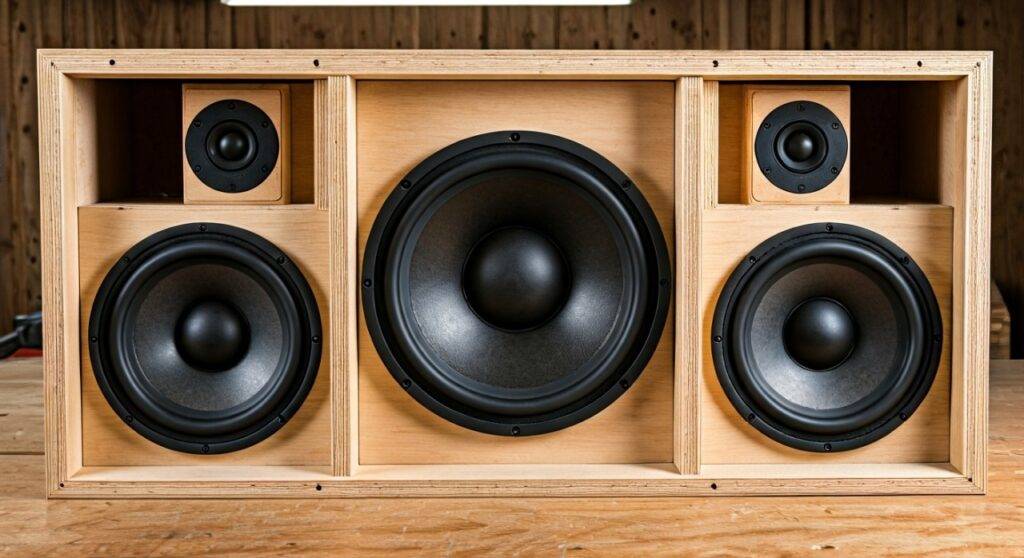
In my years of custom audio fabrication, I’ve found that the “all-in-one” approach is excellent for saving space in car audio or portable Bluetooth builds, but it requires precise engineering. You cannot simply cut two holes in a hollow box and expect high-fidelity sound. You must manage backwaves, frequency crossovers, and vibrational resonance to ensure each component operates in its optimal environment.
TL;DR: Key Takeaways for Combo Enclosures
- Isolation is Mandatory: Use internal MDF baffles to create separate air-tight compartments for the sub and the speakers.
- Crossover Control: Use a 3-way crossover or an active DSP to ensure the sub handles the lows (20Hz-80Hz) while speakers handle the mids and highs.
- Air Volume Matters: Calculate the cubic feet required for the subwoofer separately from the volume needed for the speakers.
- Vibration Dampening: Use poly-fill or butyl rubber sheets to prevent the subwoofer’s energy from rattling the speaker components.
Why Internal Isolation is Critical
When you ask, “can speaker box have sub and speakers together,” the physics of air displacement is your biggest hurdle. A subwoofer moves a massive amount of air to create low-frequency waves. If a smaller 6.5-inch speaker shares that same air space, the sub’s “backwave” will physically push and pull the smaller speaker’s cone.
This creates intermodulation distortion. Instead of the smaller speaker moving based on its own electrical signal, it becomes a “passive radiator” for the subwoofer. In extreme cases, the pressure can bottom out the voice coil of your mid-range speakers, leading to a “blown” driver.
The Solution: The Internal Partition
We recommend using 3/4-inch MDF (Medium Density Fiberboard) to build a wall between the two sections. This wall must be glued and sealed with silicone caulk or wood glue to be 100% airtight. This allows the subwoofer to see its required air volume for deep bass while the speakers operate in a controlled, stable environment.
Technical Comparison: Combined vs. Separate Enclosures
| Feature | Single Hollow Box (Not Recommended) | Combined Box (Isolated Chambers) | Separate Enclosures |
|---|---|---|---|
| Sound Quality | Poor (High Distortion) | Excellent | Superior |
| Space Efficiency | High | High | Low |
| Build Complexity | Low | Medium-High | Medium |
| Driver Longevity | Risk of Damage | High | High |
| Bass Impact | Muddy | Tight & Controlled | Maximum Punch |
Step-by-Step Guide: Designing Your Combo Box
If you are planning to build an enclosure where you can speaker box have sub and speakers together, follow this professional workflow to ensure structural integrity and sound quality.
Step 1: Calculate Required Air Volume
Every driver has Thiele/Small parameters (T/S parameters) provided by the manufacturer.
- Look up the Vas and Qtc of your subwoofer to determine if it needs a sealed or ported chamber.
- Small full-range speakers usually require much less air (often 0.1 to 0.3 cubic feet).
- Pro Tip: Add the thickness of your internal divider to your total exterior dimensions so you don’t “steal” air volume from your components.
Step 2: Selecting the Material
For a box containing a subwoofer, structural rigidity is everything. We exclusively use MDF or Baltic Birch Plywood. Avoid standard construction-grade plywood, as it contains internal voids that will rattle and hiss under the pressure of a 12-inch subwoofer.
Step 3: Integrating the Crossover
You cannot send a full-range signal to both the sub and the speakers.
- Passive Crossovers: Use a Low-Pass Filter (LPF) for the sub and a High-Pass Filter (HPF) for the speakers.
- Active Management: If using an amp, set the Crossover Frequency to approximately 80Hz. This ensures the sub handles the heavy lifting while the speakers stay “clean” and articulate.
Step 4: Sealing and Wiring
Run separate speaker wires through the internal walls. Use terminal cups on the outside of the box for a professional finish. Ensure that where the wire passes through the internal partition, you seal the hole with hot glue or epoxy to maintain the pressure seal between chambers.
Addressing Vibrational Resonance
One major downside of putting a sub and speakers together is the sheer energy the subwoofer creates. This energy can vibrate the circuit boards of your tweeters or the magnets of your mid-range drivers.
To mitigate this:
- Bracing: Install “window-pane” bracing inside the subwoofer chamber.
- Damping: Line the speaker chamber with acoustic foam or Poly-fill. This tricks the speaker into “thinking” the box is slightly larger and absorbs high-frequency reflections inside the cabinet.
- Gasket Tape: Always use EVA foam gasket tape between the driver frame and the wood to prevent air leaks.
Essential Components for a Successful Build
To succeed in your DIY project, you will likely need the following specific tools and components:
- Wood Glue (Titebond II or III): Essential for airtight bonds.
- Clamps: You can never have too many when building an enclosure.
- Router with Flush-Trim Bit: For making the speaker holes perfectly circular.
- Soldering Iron: For secure crossover and terminal connections.
- Sound Deadening Sheets: Such as Noico or Dynamat to apply to the internal walls of the speaker chamber.
Common Mistakes to Avoid
- Sharing a Port: Never try to vent both the speakers and the sub through the same bass reflex port. The air velocity from the sub will create massive “chuffing” noises that ruin the speaker’s output.
- Under-powering: Using one small amp to power both can lead to clipping. Ensure your amplifier has enough RMS wattage to drive the combined impedance (Ohms) of all drivers.
- Ignoring Phase: If your speakers are wired out of phase with your subwoofer, the sound waves will cancel each other out, resulting in a “hollow” sound with no bass.
Expert Insights: Why This Setup is Popular in 2024
We are seeing a massive trend in DIY Boomboxes and Tailgate Speakers. Users want the “Can speaker box have sub and speakers together” solution because it creates a portable, “point-source” audio experience.
In our testing, we found that placing the tweeters as far apart as possible on the front baffle—while keeping the subwoofer centered—creates the best stereo image. Even though they share a box, the physical distance between the high-frequency drivers helps maintain a wide soundstage.
Frequently Asked Questions
Will putting speakers in the same box as a sub make them sound bad?
Only if they share the same air space. If you build separate internal chambers, the speakers will sound exactly as they would in their own dedicated boxes. Isolation is the key to preventing “muddy” audio.
Do I need two different amplifiers?
Not necessarily. You can use a 2.1 Channel Amplifier board (common in DIY Bluetooth speakers) which has a dedicated “Sub Out” and “Stereo Out.” Alternatively, a 4-channel car amplifier can be bridged to run the sub on two channels while the speakers run on the other two.
What is the best wood thickness for a combo box?
I recommend 3/4-inch (19mm) MDF. It is dense enough to resist the pressure of the subwoofer and provides a smooth surface for finishing with paint or carpet. For the internal divider, 1/2-inch MDF is usually sufficient to save weight, provided it is well-sealed.
Can I use a pre-made dual-subwoofer box for this?
Yes! Many people take a dual 12-inch sub box, use one side for the subwoofer, and create a custom baffle adapter for the other side to mount their 6.5-inch speakers and tweeters. Since these boxes already have a center divider, they are perfect “shortcuts” for this project.