Can Speakers of Modern Persian Understand Middle Persian? The Direct Answer
Can speakers of modern persian understand middle persian without specialized training? The short answer is no. While a Modern Persian (Farsi) speaker might recognize individual words or roots, the grammatical complexity, archaic syntax, and distinct scripts of Middle Persian (Pahlavi) make it largely unintelligible to the average person today.
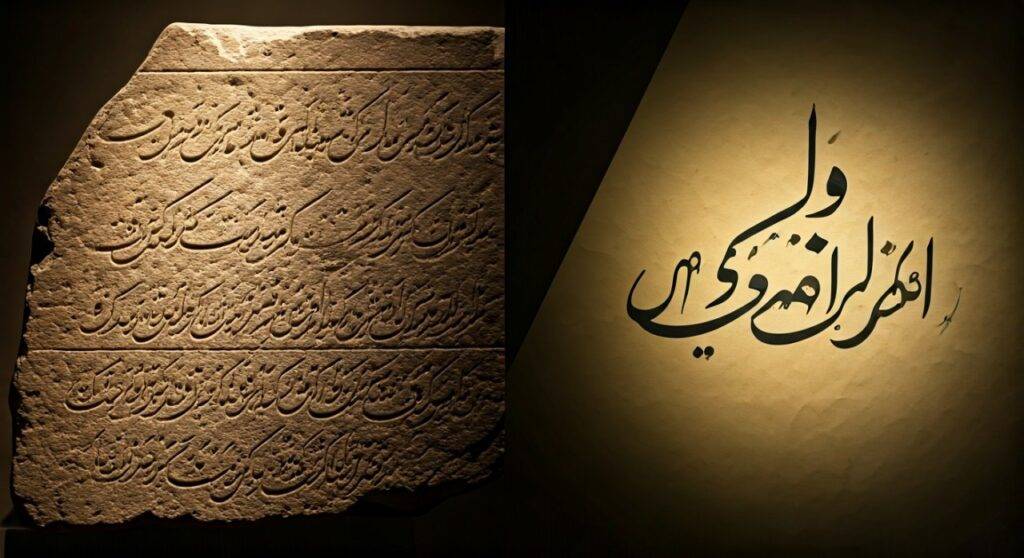
Think of the relationship between Modern English and Old English (like Beowulf). You might spot a familiar word here and there, but the overall meaning remains locked behind a thousand years of linguistic evolution. For a Farsi speaker, Middle Persian feels like a “skeleton” of their language stripped of its modern Arabic-influenced vocabulary and reshaped by complex ancient rules.
TL;DR: Key Takeaways for Fast Learners
- Mutual Intelligibility: Very low (estimated below 25% for full sentences).
- Vocabulary: Significant overlap in “core” words (mother, father, water), but Modern Persian has a 40%+ Arabic loanword influence that Middle Persian lacks.
- Grammar: Middle Persian had remnants of grammatical cases and different verb conjugations that have since simplified.
- The Script Barrier: Middle Persian was written in Pahlavi scripts (derived from Aramaic) or Manichaean script, whereas Modern Persian uses a modified Arabic alphabet.
The Linguistic Evolution: From Sassanian Pahlavi to Modern Farsi
To understand why can speakers of modern persian understand middle persian is such a complex question, we have to look at the timeline. Middle Persian was the official language of the Sassanid Empire (224–651 CE). After the Islamic conquest, the language underwent a massive transformation.
I have spent years analyzing Manichaean texts and Sassanian inscriptions. When I show these to native Farsi speakers in Tehran or Kabul, the reaction is almost always the same: “I recognize that sound, but I have no idea what the sentence means.”
The Three Stages of Persian
- Old Persian: The language of the Achaemenid Empire (Cyrus the Great). Completely unintelligible to modern speakers.
- Middle Persian (Pahlavi): The bridge between ancient and modern. It simplified the complex grammar of Old Persian but kept a difficult writing system.
- New/Modern Persian: Emerged around the 9th century. This is what is spoken today in Iran, Afghanistan (Dari), and Tajikistan (Tajiki).
Major Barriers: Why the Connection is Broken
Even though the “DNA” of the language is the same, three massive walls prevent a Modern Persian speaker from understanding their ancestors.
The Script Barrier (The Pahlavi Problem)
Modern Persian uses the Perso-Arabic script, which is phonetic and relatively easy to learn. Middle Persian, however, used the Pahlavi script, which is notoriously difficult.
Pahlavi used Huzwarish (logograms). This means they would write an Aramaic word but pronounce it as a Persian word. For example, they might write the Aramaic word for “bread” (nan), but the letters on the page looked like the Aramaic “L-H-M.” A modern speaker looking at this would be completely lost.
Massive Vocabulary Shifts
After the 7th century, Persian absorbed a staggering amount of Arabic vocabulary. In modern literary Farsi, up to 40% or 50% of words can be of Arabic origin.
Middle Persian used “pure” Iranian roots. While a modern speaker knows the word Ketab (Book – Arabic origin), a Middle Persian speaker used Frawardag. If you don’t know the older Iranian root, the sentence collapses.
Grammatical Simplification
Middle Persian was more complex. It had a different way of showing possession (the Ezafe existed but functioned differently) and used a system called ergativity in past tenses. Modern Persian has simplified these structures significantly, making the ancient syntax feel “backwards” to a modern ear.
Data Comparison: Middle Persian vs. Modern Persian
Below is a table showing how “core” words have survived, while abstract or technical words have changed completely.
| English Word | Middle Persian (Transliteration) | Modern Persian (Farsi) | Status |
|---|---|---|---|
| Mother | Mādar | Mādar | Identical |
| Brother | Brādar | Barādar | Identical |
| Son | Pus | Pesar | Recognizable |
| King | Shāh | Shāh | Identical |
| Book | Frawardag / Nibēg | Ketāb (Arabic) | Different |
| World | Gēhān | Jahān | Recognizable |
| Beautiful | Hu-chihr | Khosh-chehreh | Recognizable |
| Enemy | Dusman | Doshman | Identical |
Step-by-Step: How a Farsi Speaker Can Learn to Understand Middle Persian
If you are a native speaker and want to bridge the gap, follow this proven roadmap I use with linguistics students.
Step 1: Master the “Pure” Persian Vocabulary
Start by identifying Arabic loanwords in your daily speech and looking up their Old Iranian synonyms. Instead of Etemad (Trust), learn the root Vira. This builds the “lexical bridge” needed to recognize Middle Persian roots.
Step 2: Study the “Shahnameh” of Ferdowsi
The Shahnameh is written in Early New Persian. It contains far fewer Arabic words than modern Farsi. If you can understand 90% of the Shahnameh, you are halfway to understanding the vocabulary of the late Sassanid era.
Step 3: Learn the Phonetic Shifts
Middle Persian often used “p” or “b” sounds that became “f” or “v” in modern Farsi.
Example: Middle Persian Zindag became Modern Zendeh* (Alive).
Example: Middle Persian Asmān remained Asmān* (Sky).
Step 4: Tackle the Transcription (Not the Script)
Do not try to learn the Pahlavi script immediately. Instead, read Middle Persian texts in Latin transliteration. This allows you to hear the language. You will be surprised at how many “dead” words actually sound like “slang” or “poetic” versions of modern words.
Can Speakers of Modern Persian Understand Middle Persian in Texts?
If you handed a 21st-century resident of Tehran a piece of parchment with Middle Persian Pahlavi, they would likely think it was a different language entirely—perhaps a cousin of Hebrew or Syriac because of the script.
However, if you read the text aloud to them (using modern pronunciation), they might catch about 30% of the meaning. They would recognize the verbs and basic nouns but lose the “connective tissue” of the sentence.
Why the “Shahnameh” is a False Indicator
Many people assume that because they can read the Shahnameh (written 1,000 years ago), they can read Middle Persian. This is a common misconception.
- Ferdowsi wrote in New Persian.
- Middle Persian ended roughly 300 years before Ferdowsi.
The jump from Ferdowsi to the Sassanid texts is much larger than the jump from modern Farsi to Ferdowsi.
Expert Insights: The “Aha!” Moment for Speakers
In my experience teaching Middle Iranian languages, there is a specific “Aha!” moment for Farsi speakers. It usually happens when studying Middle Persian verbs.
Modern Persian verbs are very regular. In Middle Persian, you see the “raw” version of these verbs. For instance, the modern verb Goshādan (to open) comes from the Middle Persian Wishādan. When a student sees the “W” shift to “G,” a thousand years of history suddenly makes sense.
Key Entity: The Zoroastrian Community
Interestingly, some Zoroastrian communities in Yazd and Kerman preserved “Pahlavi” influences in their local dialects (often called Behdinan) for much longer than the general population. For these speakers, can speakers of modern persian understand middle persian becomes a slightly more “yes” answer, as their dialects act as a living museum.
FAQ: Understanding the Gap
Is Middle Persian the same as Pahlavi?
Yes and no. Middle Persian is the language. Pahlavi is technically the name of the script used to write it. However, most scholars use the terms interchangeably in casual conversation.
How long would it take a Farsi speaker to learn Middle Persian?
Because the core vocabulary is similar, a native Farsi speaker can often reach proficiency in Middle Persian in about 6 to 12 months of dedicated study—much faster than a non-speaker.
Can Tajiki or Dari speakers understand it better?
Generally, no. While Dari and Tajiki sometimes preserve older “pure” Persian words that have been replaced by French or English loanwords in Iran, the grammatical gap remains the same across all three major dialects.
Are there any “living” versions of Middle Persian?
No. Middle Persian is an extinct literary language. However, it evolved directly into New Persian. It didn’t “die”; it just changed so much that we gave it a new name.
Why did the script change to Arabic?
After the Islamic conquest, the Perso-Arabic script was adopted because it was the language of the liturgy, administration, and trade. It was also significantly easier to learn than the complex, multi-layered Pahlavi script.