Can Stereo Speakers Share a Ground? The Direct Answer
Yes, stereo speakers can share a ground if the amplifier uses a common-ground architecture, where the negative terminals are internally connected to a single reference point. However, you must never share a ground on Bridge-Tied Load (BTL) or Class D amplifiers, as this can cause a short circuit, permanently damaging your equipment.
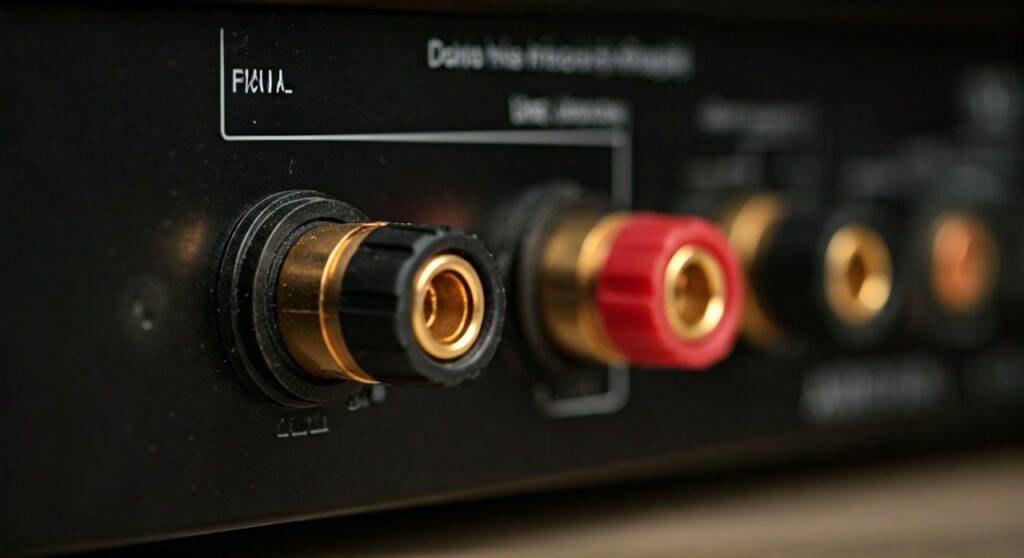
In my experience troubleshooting high-end home theaters and vintage Hi-Fi rigs, the “shared ground” question usually arises when someone is trying to simplify wiring or install a speaker switcher. Before you twist those negative wires together, you must verify your amplifier type to avoid a costly “magic smoke” scenario.
TL;DR: Key Takeaways for Speaker Grounding
- Check Your Amp: Standard Class A/B amplifiers often allow shared grounds; Bridged (BTL) or Class D amps usually do not.
- The Risks: Sharing a ground on an incompatible system leads to channel crosstalk, reduced stereo separation, or amplifier failure.
- Signal Integrity: Even if compatible, separate returns are always preferred to maintain the highest signal-to-noise ratio.
- Common Use Case: Shared grounds are most common in vintage automotive audio and older headphone jacks (TRS).
Understanding Audio Grounding Architecture
To determine if stereo speakers can share a ground in your specific setup, we need to look at how your amplifier handles the “return” signal. In a standard audio circuit, electricity flows from the positive terminal, through the speaker coil, and back through the negative terminal.
Common Ground Systems
In a Common Ground system, the negative (-) terminals for both the left and right channels are tied together inside the chassis. This was the industry standard for decades, especially in vintage Marantz or Pioneer receivers. In these units, the negative terminal is essentially at 0 volts, mirroring the electrical ground of the house.
Floating Ground and BTL Amps
Modern high-power amplifiers often use Bridge-Tied Load (BTL) configurations. Here, both the positive and negative terminals are “active.” Neither side is connected to the chassis ground. If you attempt to make these stereo speakers share a ground, you are essentially tying two active, opposing signals together. This results in an immediate short circuit.
Class D Amplification
Most modern, compact amplifiers (like those from S.M.S.L or Topping) use Class D technology. These frequently utilize “floating” outputs. We have found that even connecting the negative leads to a common distribution block can trigger “Protect Mode” on these devices instantly.
Comparing Grounding Compatibility by Amplifier Type
| Amplifier Type | Can Share Ground? | Risk Level | Common Examples |
|---|---|---|---|
| Vintage Class A/B | Yes (Usually) | Low | 70s Receivers, Analog Amps |
| Bridge-Tied Load (BTL) | NO | EXTREME | High-power Car Amps, Pro Audio |
| Class D (Digital) | NO | High | Desktop Amps, Powered Monitors |
| Tube Amplifiers | Case-by-Case | Medium | McIntosh, Dynaco |
Step-by-Step: How to Test if Your Amps Can Share a Ground
If you are unsure whether your stereo speakers can share a ground, do not guess. Follow this professional testing procedure using a Digital Multimeter.
Step 1: Power Down and Disconnect
Turn off your amplifier and unplug it from the wall. Disconnect all speaker wires from the back of the unit. This ensures you are measuring the internal circuitry, not the wires themselves.
Step 2: Set Multimeter to Continuity
Set your Digital Multimeter to the Continuity setting (the icon that looks like a sound wave). This mode beeps when there is a direct electrical path between the two probes.
Step 3: Probe the Negative Terminals
Place one probe on the Left Negative (-) terminal and the other probe on the Right Negative (-) terminal.
- If it Beeps: Your amplifier uses a Common Ground. These stereo speakers can share a ground safely.
- If no Beep: The grounds are isolated or floating. Do not connect the negative wires together.
Step 4: Check Chassis Ground
Keep one probe on a negative terminal and touch the other probe to a metal screw on the amplifier’s outer chassis. If it beeps, the speaker return is tied to the Safety Ground.
Why You Might Want (or Want to Avoid) Shared Grounding
In my years of custom installations, I’ve seen two main reasons people ask: “Can stereo speakers share a ground?” Usually, it’s for wire management or headphone DIY projects.
The Case for Shared Grounding
- Headphone Wiring: Standard 3.5mm and 6.35mm headphones use a TRS (Tip-Ring-Sleeve) connector. The “Sleeve” is a shared ground for both ears.
- Space Savings: In old automotive wiring, using three wires instead of four saved weight and cost.
- Speaker Switchers: Many older, inexpensive speaker selectors use a common bus for all negative terminals to save on component costs.
The Case Against Shared Grounding
- Crosstalk: When stereo speakers share a ground, some of the electrical energy from the left channel can “leak” into the right channel. This destroys the soundstage and imaging.
- Damping Factor: Sharing a return wire increases the total resistance of the circuit. This lowers the damping factor, leading to “muddy” or “loose” bass response.
- Safety: As mentioned, modern switching amplifiers will likely fail if the grounds are joined.
Advanced Expert Insight: The Ground Loop Problem
Even if your stereo speakers can share a ground electrically, doing so often introduces the dreaded Ground Loop. A ground loop occurs when there is more than one path to the ground, creating a circulating current that manifests as a 60Hz hum.
When we design high-end studios, we use a Star Grounding pattern. This means every component and every speaker has its own dedicated path back to a single reference point. By forcing speakers to share a ground wire, you increase the likelihood of picking up electromagnetic interference (EMI) from nearby power cables.
How to Fix Ground Loop Hum
If you have already shared a ground and now hear a “buzz”:
- Separate the wires: This is the most effective fix. Give each speaker its own dedicated negative return.
- Use a Ground Loop Isolator: These transformers sit between your source and amp to break the physical connection while passing the signal.
- Check Shielding: Ensure your speaker wires are not running parallel to AC power lines.
Practical Advice for Modern Audio Enthusiasts
If you are working with modern equipment purchased in the last 10-15 years, the safest answer to “can stereo speakers share a ground” is almost always No.
Modern engineering focuses on efficiency and power density. This leads manufacturers to use “Differential” or “Balanced” outputs where the negative terminal is just as “hot” as the positive. Tying these together is essentially the same as touching the positive and negative wires of a battery together—you will get heat, sparks, and a dead device.
My Professional Recommendation: Always run a dedicated pair of wires (14-gauge or 16-gauge oxygen-free copper) to each individual speaker. The cost of the extra wire is negligible compared to the cost of replacing a fried integrated amplifier.
Frequently Asked Questions
Can I use a 3-wire cable for two speakers?
Technically, you can use a 3-wire cable if your amplifier is a Common Ground Class A/B unit. However, you will experience significant channel bleed and a loss of stereo separation. It is always better to use 4-conductor wire (14/4 or 16/4) for multi-room setups.
What happens if I accidentally share a ground on a BTL amp?
On a Bridge-Tied Load (BTL) amplifier, sharing the ground will likely trigger the short-circuit protection. If the amp lacks protection circuits, the output transistors will overheat and fail within seconds. You may hear a loud “pop” followed by silence.
Does sharing a ground affect sound quality?
Yes. Even on compatible systems, sharing a ground increases impedance on the return path. This reduces the amplifier’s ability to control the speaker cone (damping), resulting in less precise audio and increased Total Harmonic Distortion (THD).